Interesting, because women’s demand for social insurance was a major driver of the growth of government in the 20th century.
The political party with a worse record on ethnic diversity than UKIP
20 Mar 2015 Leave a comment
in discrimination Tags: Uk Greens, UK politics
Natalie Bennett’s Green party that has the lowest percentage of black and minority ethnic (BME) candidates of the main national parties.

via The political party with a worse record on ethnic diversity than Ukip.
Red Ed has given up on fighting climate change and introducing a carbon tax
11 Mar 2015 Leave a comment
in energy economics, environmental economics, global warming, public economics Tags: carbon tax, climate alarmism, expressive voting, left-wing popularism, rational ignorance, rational irrationality, UK politics
I am starting to warm to Red Ed. His freeze on energy bills rules out any carbon tax was he cannot introduce a carbon tax while freezing energy bills.
A word to left-wing students – Pat Condell
22 Feb 2015 Leave a comment
in liberalism Tags: Pat Condell, political correctness, UK politics
Few UK green party voters are green: Green Party voters look like Lib Dems, think like Labour voters
19 Feb 2015 Leave a comment
in politics - Australia, politics - New Zealand, Public Choice Tags: expressive voting, protest voters, Uk Greens, UK politics, voter demographics
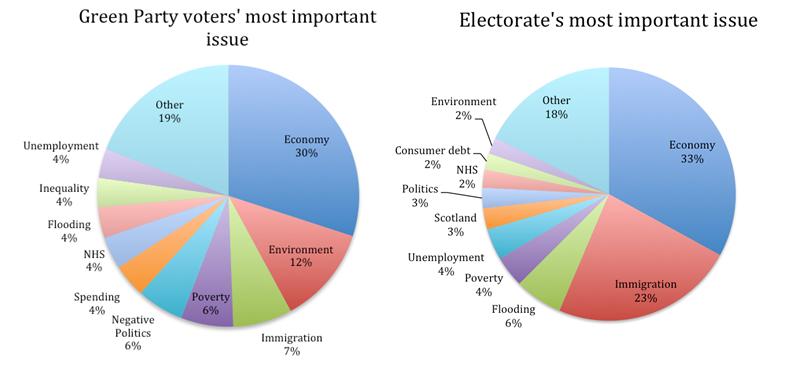
Fewer the mushrooming green party vote in the UK too much at all about the environment. It certainly not the major reason for going green.
Green voters are not radically left-wing on economic issues nor are they primarily driven by environmental concerns. How, therefore, can we explain their decision to vote for a party with a far-left, environmentalist agenda?
One way is to look at who prospective Green voters turned to in previous elections…. Around half voted for the Liberal Democrats in 2010 and around a third voted for the junior coalition partner in both 2005 and 2010. There are a number of ways of interpreting this.
First, Liberal Democrats and Green voters traditionally hold similar socio-demographic profiles. Both are likely to be university educated and to work in professional or managerial jobs.
Second, the Lib Dems were, until the 2010 election, the protest vote of many on the left. Since entering government, they have lost this niche and, subsequently, have seen their poll ratings plummet.
Third, the Greens now have a monopoly on certain policies that they once shared with Nick Clegg’s party – for example, ending university tuition fees.
.
Green and UKIP voters have common key concerns
19 Feb 2015 Leave a comment
Both seriously dislike politicians.

A great hard left critique of the Greens
30 Jan 2015 Leave a comment
in environmentalism, Marxist economics, politics - New Zealand Tags: activists, do gooders, expressive voting, Leftover Left, The Greens, UK politics

A five minute cartoon about the privatisation of the NHS, from the Green Party
26 Jan 2015 Leave a comment
in health economics, managerial economics, organisational economics Tags: green party, Leftover Left, National Health Service, socialised medicine, UK politics
This cartoon video by the Green Party UK claims of their National Health Service is is Britain’s greatest invention. It can be improved by taxes on the rich and companies to increase funding and by everybody getting on a bike or walking to work
- NHS doctors routinely conceal from patients information about innovative new therapies that the NHS doesn’t pay for, so as to not “distress, upset or confuse” them.
- Terminally ill patients are incorrectly classified as “close to death” so as to allow the withdrawal of expensive life support.
- NHS expert guidelines on the management of high cholesterol are intentionally out of date, putting patients at serious risk, in order to save money.
- When the government approved an innovative new treatment for elderly blindness, the NHS initially decided to reimburse for the treatment only after patients were already blind in one eye — using the logic that a person blind in one eye can still see, and is therefore not that badly off.
- While most NHS patients expect to wait five months for a hip operation or knee surgery, leaving them immobile and disabled in the meantime, the actual waiting times are even worse: 11 months for hips and 12 months for knees. (This compares to a wait of 3 to 4 weeks for such procedures in the United States.)
- One in four Britons with cancer is denied treatment with the latest drugs proven to extend life.
- Those who seek to pay for such drugs on their own are expelled from the NHS system, for making the government look bad, and are forced to pay for the entirety of their own care for the rest of their lives.
- Britons diagnosed with cancer or heart attacks are more likely to die, and more quickly, than those of most other developed nations. Britain’s survival rates for these diseases are “little better than [those] of former Communist countries.”

HT: avik-roy
 Utopia, you are standing in it!
Recent Comments