Harvard business School survey discovers that workers want more
12 Feb 2016 Leave a comment
in human capital, labour economics, labour supply, occupational choice, personnel economics, poverty and inequality, unions Tags: compensating differentials, union wage premium, unions

@DavidLeyonhjelm on deregulating the Australian labour market
17 Sep 2015 1 Comment
in applied price theory, economic history, economics of regulation, industrial organisation, job search and matching, labour economics, minimum wage, survivor principle, unions Tags: Australia, employment law, employment protection law, federalism, labour market deregulation, labour market regulation, union power, unions


Minimum wage coverage in Europe
24 Jun 2014 Leave a comment
in economics, labour economics, minimum wage, unions Tags: median voter, minimum wage, unions
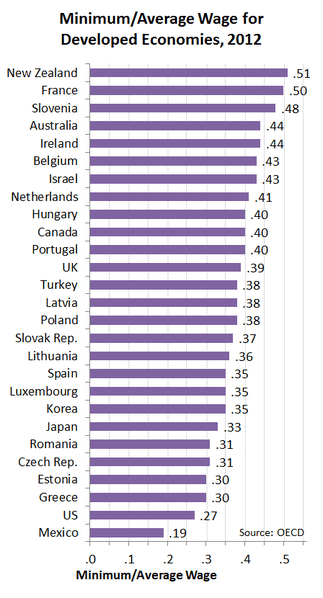
Germany, Denmark, Italy, Austria, Finland, Sweden, Iceland, Norway and Switzerland do not have a statutory minimum wage. Capitalist hell-holes all.
A common feature of this group of countries is the high coverage rate of union agreed minimum wages, generally laid down in sectoral agreements by employers associations with unions.
The percentage of employees covered by union agreed minimum wages ranges from approximately 70% in Germany and Norway to almost 100% in Austria and Italy (though excluding irregular workers, who make up a relatively large share of the Italian labour market). Italy has a huge underground economy.
In Denmark, the percentage of employees covered by union agreed wages is estimated at between 81% and 90%, while in Finland and Sweden, this figure is 90%.
Scandinavia is a capitalist hell-hole that every true blue social democrat must denounce without reservation. Their so called left-wing parties as traitors to the working class and to the least powerful of all workers – the low-paid and unskilled.
The poor should not have to rely on scraps from the tables of the middle-class unions. They have been deserted by their so called social democratic governments.
Whether the low-paid and low-skilled get a fair consideration from unions in collective bargaining given these unions will be driven by majority rule – by the median voter/union member who is older, senior and of high job tenure – is a question worth exploring.
The evidence is not good. In the Finnish depression in the early 1990s, the unions refused to agree to nominal wage cuts despite 20% unemployment – the worst since the 1930s. They protect those that still had a job.
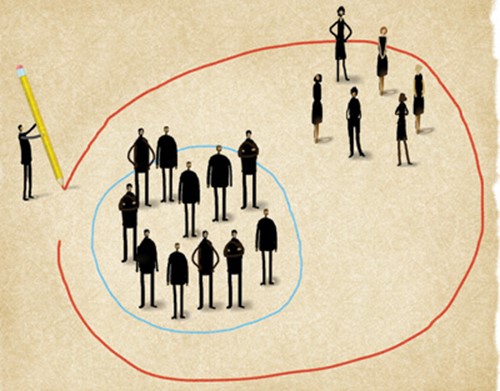
Most European labour markets are dual labour markets. Unions and employment protection laws ensure that they are made up of two-tier systems with ultra-secure permanent jobs with the rest on temporary contracts.
Alchian, Demsetz and the efficiency enhancing roles of unions
31 Mar 2014 Leave a comment
in Armen Alchian, labour economics, theory of the firm Tags: transaction costs, unions
Many look at unions as a cartel that raises wages at the expense of non-members.
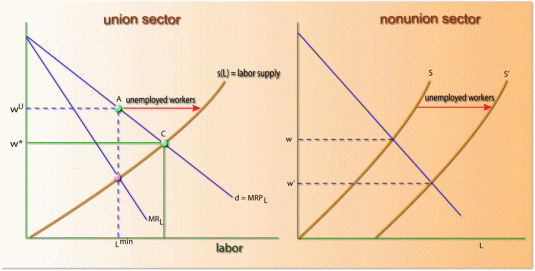
What has been under-sold is the efficiency enhancing role of unions in Alchian and Demsetz (1972) – their modern classic on the theory of the firm.
Employee unions, whatever else they do, act as monitors for employees.
- Are correct wages paid on time? Usually, this is easy to check.
- But some forms of employer performance on the employment contract are less easy to meter and is at risk to employer shirking.
Medical, hospital, and accident insurance and retirement pensions are contingent payments paid in kind by employers to employees. Each employee cannot judge the character of such payments as easily as with money wages.
A specialist monitor – a union hired by the employees – monitors those aspects of employer payments that are more difficult for employees to monitor. As an example, many unions sit on the board of directors of pension funds as an employee watch dog.
Because of economies of scale in monitoring and enforcing contracts, unions may arise as an institution to reduce the costs of contracting for employees with investments in specific human capital and back-loaded pay, including employee pension plans.
In addition to these narrow contract-monitoring economies of scale, a union creates a continuing long-term employment relationship that eliminates the last-period (or transient employee) contract-enforcement problem and creates bargaining power (a credible strike threat) to more cheaply punish a firm that violates the employment contract.
- As a union makes it more costly for a firm to cheat an individual worker in his last period of work, workers are more likely to invest in specific human capital and accept back-loaded pay schemes, both of which raises their career wages and productivity.
- A strike is a cheaper way to enforce a contract than is litigation. Many firms stop dealing with a bad customer/unreliable supplier until a bill or problem is fixed. A quick strike is no different.
Unions are more likely to exist when the opportunistic cheating problem is greater, namely, when there is more firm-specific human capital present in the employment relationship.
Unions perform many of the functions carried out by professional agents in the sports and entertainment industries. These specialists know the going rate for specific talents; act as a credible and informed negotiating agent; warn their clients off working for bad employers; and punish bad employers by not referring future clients to them.
The traditional literature on unions argues that unions act as a productivity shock and give employee voice in workplace affairs, which lowers job turnover. Unions as an institution to reduce contract negotiation and enforcement costs is better nested in the modern theory of the firm. Of course, unions can also act as cartels.
The next blog on unions will be on the withering away of the union wage premium. The final blog will be on how strikes can enhance the profits of employers!
 Utopia, you are standing in it!
Recent Comments