World War I: Every Day
25 Apr 2016 Leave a comment
in defence economics, economics of media and culture Tags: World War I
Map of Europe if the Central Powers won World War I
25 Apr 2016 Leave a comment
in defence economics, economics of media and culture Tags: maps, World War I
The modern European state system in 1919
30 Dec 2015 Leave a comment
in defence economics, economic history, war and peace Tags: Treaty of Versailles, World War I
The Christmas Day truce 1914
25 Dec 2015 Leave a comment
in war and peace Tags: World War I
During the Christmas Truce of 1914, German and British soldiers play football in the “no man’s land” between trenche https://t.co/oKPOw90023—
Historical Pics (@VeryOldPics) October 24, 2015
Do peace talks have a role in wars of annihilation @jeremycorbyn
17 Nov 2015 1 Comment
in defence economics, war and peace Tags: British politics, game theory, ISIS, Middle-East politics, Twitter left, World War I
Peace activists are utterly clueless about what is discussed at peace talks. The ability to negotiate a credible peaceful settlement between sovereign states depends on:
- the divisibility of the outcome of the dispute,
- the effectiveness of the fortifications and counterattacks with which an attacker would expect to have to contend, and
- on the permanence of the outcome of a potential war.
Central to any peace talks is that any peace agreement is credible – it will hold and not will not be quickly broken:
A state would think that another state’s promise not to start a war is credible only if the other state would be better off by keeping its promise not to start a war than by breaking its promise.
Peace talks occur only when there something to bargain about. As James Fearon explained, there must be
a set of negotiated settlements that both sides prefer to fighting
That need for a bargaining range is the fundamental flaw of peace activists. When they call for peace talks, peace activists never explain what will be discussed in a world where everybody is not like them terms of good intentions. What are the possible negotiated settlements that each both side will prefer to continue fighting? Diplomacy is about one side having some control over something the other side wants and this other side have something you want to exchange. In a war, the attacker thinks he can get what it wants to fighting for it.
There were plenty of peace feelers during World War I. World War I came to an end when Germany preferred surrender and disarmament over conquest. Its armies were in full retreat and disarray – revolution was a threat at home
Previous World War I peace feelers failed because each side thought it could gain more by fighting. German peace feelers when they are advancing were premised on keeping what they are taken. When the Germans were retreating, the Germans wanted to go back to the pre-war borders and keep their capability for relaunching the war once they have recouped. The Allies had nothing to gain from allowing Germans simply to withdraw from the fighting intact and regroup, attack again and perhaps win.
When a war is over territory rather than annihilation of the other side, the challenge is to divide the disputed territory in a way that both are happy to keep the peace settlement rather than come back and fight in a few years. Grossman explains:
If the winner of a war would gain control of the entire territory, and if the whole of a contested territory is sufficiently more valuable than the sum of its parts, then, despite the costs and risks of war, promises not to start a war could be not credible, and a peaceful settlement, or at least a peaceful settlement with unfortified borders, would not be possible.
That point about the need for fortified or unfortified borders after a peaceful settlement over contested territory is the ultimate failure of peace activists.
If peace activists truly want peace, rather than victory for the other side, they must prepare for war including fortified borders so that the other side doesn’t dare cross them and start a war. A peace settlement depends upon the ability to divide the contested territory is with or without fortified borders to make a settlement credible:
…despite the costs and risks of war, if a dispute is existential, or, more generally, if the whole of a contested territory is sufficiently more valuable than the sum of its parts, then a peaceful settlement is not possible. A peaceful settlement of a territorial dispute, and especially a settlement that includes an agreement not to fortify the resulting border, also can be impossible if a state thinks, even if over optimistically, that by starting a war it would be able at a small cost to settle the dispute completely in its favour permanently.
Wars of annihilation have a long history. The first two Punic wars were settled by Rome and Carthage. The third was not because the objective of Rome was to destroy Carthage which it did. Rome is decided it simply did not want to have any further wars with Carthage. The only way to ensure that was to destroy that city – level it to the ground. The Arab Israel conflict is another example:
Over the years the Arabs have rejected every proposal for a peaceful settlement that would divide Palestine into a Jewish state and an Arab state, because for the Arabs allowing a Jewish state would be a defeat, not a compromise. The Israelis, however, demand a Jewish state, and they refuse to turn all of Palestine into a single multinational state in which Jews would not make up a large majority of the population. If the dispute between Arabs and Israelis were about the control of tracts of land or sources of water, then a peaceful settlement might have been possible long ago. But, the dispute is about the existence of a Jewish state, and the outcome is indivisible. Is there or is there not to be a Jewish state in Palestine? The answer is either yes or no.
The key guardian of peace and enforcer of peace settlements is the ability of the other side to mount an effective counter-attack if attacked again. If you want peace, you must prepare for war. The loudest champions of a large military budget should be peace activists. Peace activists know, they should know, that a country with a strong military is less likely to be attacked.
If a country is a democracy, it is less likely to start wars and especially with other democracies. If peace activists want more democracies in the world, they should preach capitalism and free trade because countries that are capitalistic become democracies.
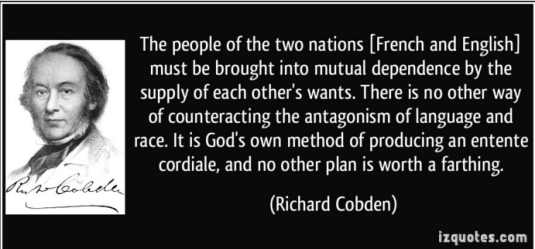
Peace activists think that they can make peace just by talking with people. Peace is made by trading with hostile countries to make them depend on you for their prosperity as well as yours. By growing rich through free trade, training partners have less reasons to go to war or otherwise have poor relations with each other or each other’s friends. Trade increases the opportunity cost of starting a war.
Robert Aumann argued well that the way to peace is like bargaining in a medieval bazaar. Never look too keen, and bargain long and hard. Aumann argues that:
If you are ready for war, you will not need to fight. If you cry ‘peace, peace,’ you will end up fighting… What brings war is that you signal weakness and concessions.
Countries are more likely to cooperate if they have frequent interactions and have a long time horizon. The chances of cooperation increase when it is backed by the threat of punishment.
The ability to threaten to hurt is conducive to peace. Disarmament, Aumann argues, “would do exactly the opposite” and increase the chances of war. He gave the example of the Cold War as an example of how their stockpiles of nuclear weapons and fleets of bombers prevented a hot war from starting:
In the long years of the cold war between the US and the Soviet Union, what prevented “hot” war was that bombers carrying nuclear weapons were in the air 24 hours a day, 365 days a year? Disarming would have led to war.
Aumann has quoted the passage from the biblical Book of Isaiah:
Isaiah is saying that the nations can beat their swords into ploughshares when there is a central government – a Lord, recognized by all. In the absence of that, one can perhaps have peace – no nation lifting up its sword against another. But the swords must continue to be there – they cannot be beaten into ploughshares – and the nations must continue to learn war, in order not to fight!
Civil wars such as those in Syria and Iraq today are grubby affairs in terms of peace talks because of the greater inability to divide what is contested.
Who Does What to Whom in #Syria https://t.co/xO8PJHZwgW—
ian bremmer (@ianbremmer) November 04, 2015
Ending civil wars is even more difficult to make binding commitments because new groups such as ISIS can spring up to replace the signatories to the old peace treaty or introduce new agendas:
…if the constituent groups of a polity are deeply divided and, hence, are unwilling to accept meaningful limitations on the prerogatives of winners of constitutional contests, then civil war can be unavoidable.
Detailed map of Syria and Iraq showing which forces hold what territory. bit.ly/1VlPsH2 http://t.co/up3YGV5SGB—
Kenneth Roth (@KenRoth) August 29, 2015
11 November 1918 was a busy day in Berlin
12 Nov 2015 Leave a comment
in political change, war and peace Tags: Germany, World War I
WWI deaths from the British Empire, day by day
11 Nov 2015 Leave a comment
in war and peace Tags: Armistice Day, British empire, World War I
A stunning and frightening #dataviz of WWI deaths from the British Empire, day by day: theguardian.com/news/datablog/… http://t.co/8Neym8zQBQ—
Randy Olson (@randal_olson) June 05, 2015
Watching people fighting, watching people fighting on Armistice Day
11 Nov 2015 Leave a comment
in defence economics, war and peace Tags: Armistice Day, game theory, Treaty of Versailles, World War I
The Midnight Oil song was true. Generals launched attacks on Armistice Day in full knowledge that the 11 a.m. truce had been agreed unofficially up to two days before. The Germans finally signed the armistice at 5:10 a.m. on the morning of the 11th November.
- The records of Commonwealth War Graves Commission shows that 863 Commonwealth soldiers died on 11 November 1918 – this figure includes those who died of wounds received prior to November 11.
- The Americans took 3,300 casualties on the last day of the war.
The last American soldier killed was Private Henry Gunter who was killed at 10.59 a.m. – the last man to die in World War One. His divisional record stated:
Almost as he fell, the gunfire died away and an appalling silence prevailed.

General Pershing supported commanders who wanted to be pro-active in attacking German positions on the last day of the war. Pershing stated at 1919 Congressional hearings that although he knew about the timing of the Armistice, he simply did not trust the Germans to carry out their obligations. Pershing also pointed out that his orders of the Allies Supreme Commander, Marshal Ferdinand Foch, to
pursue the field greys (Germans) until the last minute
Pershing found the idea of an armistice repugnant. He maintained:
Germany’s desire is only to regain time to restore order among her forces, but she must be given no opportunity to recuperate and we must strike harder than ever.
As for terms, Pershing had one response:
There can be no conclusion to this war until Germany is brought to her knees.
Pershing said that conciliation now would lead only to a future war. He wanted Germany’s unconditional surrender. He insisted that Germany must know that it was fully defeated in the field of battle rather than betrayed from within.
When presented with the terms of the 1919 Treaty of Versailles, several German governments resigned. France started to remobilise before Germany finally accepted the Treaty. The Treaty was somewhat harsher than the German Foreign Office anticipated.
A blow by blow account of the six-months of treaty negotiations is in Margaret MacMillan Paris 1919: Six Months That Changed the World 2002 who showed that:
- real defeat was not brought home to the German people,
- the power of the peacemakers was limited,
- they were not responsible for the fragmentation of Europe which was already happening,
- the blockade did not starve Germany,
- neither the Versailles treaty nor France was vindictive,
- reparations were not crushing,
- the treaty was not enforced with any consistency, and it did not seriously restrict German power, and
- The Versailles treaty was not primarily responsible for either the next twenty years or for World War II.
The high-minded efforts of the Paris negotiators were doomed as some of them realised. Lloyd George wrote:
It fills me with despair the way in which I have seen small nations, before they have hardly leapt into the light of freedom, beginning to oppress other races than their own.
Casualties in the First World War
11 Nov 2015 1 Comment
in war and peace Tags: World War I
The casualties of the First World War econ.st/1B1Riq6 http://t.co/fUrmVKy6M2—
The Economist (@ECONdailycharts) November 11, 2014
European alliances in 1914 set the stage for the first world war
11 Nov 2015 Leave a comment
in defence economics, war and peace Tags: economics of alliances, game theory, World War I
European alliances in 1914 set the stage for the first world war. bit.ly/VoxMapsWWI (via @WestPoint_USMA) http://t.co/NVTZ5dtymJ—
Vox Maps (@VoxMaps) October 03, 2015
How the first world war changed the world
04 Nov 2015 Leave a comment
in politics - Australia, politics - New Zealand, politics - USA, war and peace Tags: Armistice Day, World War I
#Dailychart: How the first world war changed the world econ.st/1rvj6tW http://t.co/OldeGaiJEe—
The Economist (@ECONdailycharts) July 28, 2014
@jeremycorbyn @BernieSanders oppose the one path to peace
04 Nov 2015 Leave a comment
in international economics, liberalism, politics - USA, war and peace Tags: British politics, capitalism and freedom, China, expressive voting, free trade, game theory, populists, rational ignorance, rational irrationality, Richard Cobden, World War I

Jeremy Corbyn is in trouble again, this time for describing World War I as pointless.
Corbyn has, for all his life, opposed the only means of securing peace either in Europe or anywhere else. He is against trade agreements, the European Union and NATO. Bernie Sanders is equally as misguided.
Corbyn and Sanders thinks you can make peace just by talking with people. Peace is made by trading with hostile countries to make them depend on you for their prosperity as well as yours. By growing rich through free trade, it’s in no ones interest to go to war or have poor relations with each other or each other’s friends.
German and French war planners both believed WWI was going to be an offensive one
11 Oct 2015 Leave a comment
in war and peace Tags: Armistice Day, World War I
The territorial evolution of #Germany from 1867
21 Sep 2015 Leave a comment
in economic history, war and peace Tags: economics of borders, Germany, World War I, World War II
The Middle East and North Africa looked very different in 1914
14 Aug 2015 Leave a comment
in economic history, war and peace Tags: Africa, age of empires, British empire, colonialism, Middle Eastern history, Middle Eastern politics, World War I
The Middle East and North Africa looked very different in 1914. vox.com/a/maps-explain… (map via @LMDiplo) http://t.co/j056KtFUDN—
Vox Maps (@VoxMaps) June 10, 2015
 Utopia, you are standing in it!
Recent Comments