
The Jonathan Gruber revelations, Obamacare and the honesty of politics
13 Nov 2014 Leave a comment
in politics - USA, Public Choice Tags: Jonathan Gruber, Machiavelli, Obamacare, public choice, Yes Minister, Yes Prime Minister


Paul Krugman, Tom Sargent and Me
22 Apr 2014 Leave a comment
in macroeconomics, politics - USA Tags: Karl Popper, Paul Krugman, Thomas Sargent, vast right-wing conspiracy, Yes Minister
Paul Krugman seems to be implying that I am the double-secret ring-leader of a vast right-wing conspiracy.
Today in his blog at the New York Times, Krugman said:
…why the sudden attention to Sargent’s 2007 speech?
I think it’s fairly obvious: it’s essentially stealth anti-Keynesian propaganda, cloaked in the form of a widely respected and liked economist uttering what sound like eternal truths.
But they aren’t, and the real goal here is to undermine the case for fighting unemployment in the here and now. There are virtues to that 2007 talk, but right now is no time for 2007 Sargent.
In my reply at his blog, I said that I originally posted the link to Sargent’s speech to make a point that most economic analysis is free of politics because the average economist is a moderate Democrat. Tom Sargent is a life-long Democrat.
To add to my reply at Krugman’s blog, Krugman said earlier in his blog that:
It’s not so much that what Sargent said is wrong, although some of his principles are by no means universally agreed upon, even in normal times.
What’s so striking about Sargent’s points is that it’s hard to think of a worse time to cite them.
And the people citing that old speech clearly have ulterior motives.
I live in New Zealand. Not everything is about U.S. domestic politics.
I rather prophetical said on Marginal Revolution on the 20th that “Too many on social media such as Reddit responded by smearing Sargent as a right-winger and neo-liberal. He is a life-long Democrat.”
My conspiratorial minions span the globe to include initially Newmark’s Door and then Marginal Revolution, Stephen Williamson, Vox.com, the American Enterprise Institute, Catallaxyfiles and the Business Insider to name but a few. There are other unindicted co-conspirators.
Karl Popper argued that conspiracy theories overlook the pervasive unintended consequences of political and social action; conspiracy theorists assume that all consequences must have been intended by someone.
Krugman agrees that Sargent’s 12-points are not that controversial in themselves. Krugman then plays the man rather than the ball:
“How to discredit an unwelcome report:
… Stage Four: Discredit the person who produced the report. Explain (off the record) that
1. He is harbouring a grudge against the Department.
2. He is a publicity seeker.
3. He is trying to get a Knighthood/Chair/Vice Chancellorship.
4. He used to be a consultant to a multinational.
5. He wants to be a consultant to a multinational.Sir Humphrey, The Greasy Pole
Obama’s opportunistic record on fighting global warming
18 Apr 2014 Leave a comment
in environmentalism, global warming, politics - USA, Public Choice Tags: global warming, Matthew Kahn, McCain, obama, Yes Minister
Even in the US, where nothing can be done through legislation thanks to Republican delusionists.
The 2008 Republican Party presidential nominee supported cap-and-trade. McCain had a strong legislative record; he introduced a bill with Joe Lieberman to introduce carbon trading in 2003.
McCain has been one of the most outspoken members of Congress on the issue of climate change’ and he “managed to force the first real Senate vote on actually doing something about the largest environmental peril our species has yet faced.
McCain used a Senate parliamentary manoeuvre that forced a floor vote on the climate legislation. The McCain-Lieberman bill lost 43-55.
In 2007 he reintroduced his bill, with bipartisan co-sponsorship. Obama missed the June 2008 vote on McCain’s Climate Security Bill.
In a March 2008 speech, McCain called for a “successor to the Kyoto Treaty” and a cap-and-trade system “that delivers the necessary environmental impact in an economically responsible manner.”
McCain’s climate policy includes several target dates. By 2012, McCain said U.S. emissions should return to 2005 levels. By 2050, he says, the U.S. emissions should be 60 per cent below 1990 levels.
In January 2010, the Pew Research Center asked Americans to rank the importance of twenty-one issues. Climate change came in last.
After winning the fight over health care, another issue for which polling showed weak support, Obama moved on to the safer issue of financial regulatory reform.
There were 5 Republican senators who would have voted for cap and trade in April 2010: Lindsey Graham, Susan Collins, Olympia Snowe, Scott Brown, and George LeMieux. There were 57 Democrat Senators. It takes 60 votes to break a filibuster.
President Obama could have fought harder to get the Bill the House passed through the Senate but he did not.
Blame Obama, no one else. He is supposed to make change happen. He lacked the political skills to build coalitions even within his own party to deliver.
Many others, including McCain softened or reversed positions as voter support waned as the great recession deepened.
In Copenhagen’s final private negotiations, Obama, Brown, Sarko and Merkel sat down with He Yafei, the Chinese vice-minister of foreign affairs. There is a tape of this meeting at Der Spiegel. HT: The Guardian.
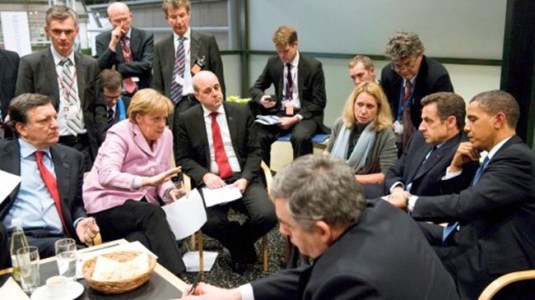
He Yafei was the smartest guy in the room – listen to the tape. Wen Jiabao refused to attend most of the negotiating sessions.
Given the choice of walking out and sitting down with a vice-minister, they chose humiliation. One response of Obama was:
It would be nice to negotiate with somebody who can make political decisions.
Rather than blaming vast right-wing conspiracies, using Google searches for “unemployment” and “global warming”, Kahn and Kotchen found that:
- Recessions increase concerns about unemployment at the expense of public interest in climate change;
- The decline in global-warming searches is larger in more Democratic leaning states; and
- An increase in a state’s unemployment rate decreases in the probability that Americans think global warming is happening, and reduces the certainty of those who think it is.
The middle-of-the-road voters changed their priorities and their political leaders followed them.
It’s the peoples’ will, I am their leader, I must follow them. – Jim Hacker, The Greasy Pole
As Geoff Brennan has argued, CO2 reduction actions will be limited to modest unilateral reductions of a largely token character. There are many expressive voting concerns that politicians must balance to stay in office and the environment is but one of these. Once climate change policies start to actually become costly, expressive voting support for these policies will fall away, and it has.
 Utopia, you are standing in it!
Recent Comments