From paper to plastic!

judithfabian's avatarStories from the Museum Floor

Today’s post is by Judith from the Visitor Team at Manchester Museum. We are each sharing our passion and  interest in the museum and its objects.

For more about the Money Gallery at Manchester Museum, have a look at the Curator’s blog, Ancient Worlds.

From Paper to Plastic – The History of the Five Pound Note

The Bank of England has cooked them in ovens, drowned them in red wine, stuck them in the microwave and run them through a 90°C washing machine cycle with a well-known brand of washing powder! It reckons that the new £5 plastic notes – which go into circulation on 13th September 2016 – are fairly indestructible!  They’re expected to be more environmentally friendly, last longer, stay cleaner and be more difficult to counterfeit than the notes we use now.  Just don’t iron them – but more of that later …

5-coffe-cupThe new polymer £5 note being put…

View original post 829 more words

Gallery

Votes for Women 2018: Part I – Background to the Women’s Movement

St Andrews Special Collections's avatarEchoes from the Vault

2018 is an important year for the commemoration of the struggle for women’s suffrage. A number of anniversaries of key events in the history of votes for women are celebrated over the course of this year.

6 February 2018 is the 100th anniversary of the Representation of the People Act, 1918 which extended the vote to some women over the age of 30 for the first time.

2 July 2018 is the 90th anniversary of the Equal Franchise Act, 1928 which gave the vote to women aged 21 and over.

21 November 2018 is the 100th anniversary of the Parliament (Qualification of Women) Act, 1918 which allowed women to stand for election to the House of Commons.

14 December 2018 is the 100th anniversary of some women voting for the first time in the election of December 1918.

Tomorrow, the 6th of February, is the 100th anniversary of the parliamentary…

View original post 998 more words

Gallery

The Representation of the People Act, 1918: A radical reform measure bill

specifically denied the franchise for five years to Conscientious Objectors who had refused to undertake war work.

Emma Peplow's avatarThe History of Parliament

This is the second in our blog series, women and parliament in this, the centenary year of the Representation of the People Act 1918. Here at the History of Parliament we are closely involved in celebrations, commemorations and projects relating to this anniversary. So today, on the actual anniversary that this Act became law it seemed pertinent to honour its passage. to that end, our assistant director, Dr Emma Peplow explains not only what this Act meant for women, but for men and the whole electoral system…

One hundred years ago today George V gave his assent to the Representation of the People Act. Throughout the country we are celebrating this centenary, particularly because it gave the parliamentary vote to some women for the first time as well as to millions of previously excluded working men. The number of registered voters franchise rose dramatically, from 7.9 million to 21.4…

View original post 978 more words

Gallery

The making and dissemination of Milton Friedman’s 1967 AEA Presidential Address

Beatrice's avatarThe Undercover Historian

Joint with Aurélien Goutsmedt

In a few weeks, the famous presidential address in which Milton Friedman is remembered to have introduced the notion of an equilibrium rate of unemployment and opposed the use of the Phillips curve in macroeconomic policy will turn 50. It has earned more that 8,000 citations, more than Arrow, Debreu and McKenzie’s proofs of the existence of a general equilibrium combined, more than Lucas’s 1976 critique. In one of the papers to be presented at the AEA anniversary session in January, Greg Mankiw and Ricardo Reis ask “what explains the huge influence of his work,” one they interpret as “a starting point for Dynamic Stochastic General Equilibrium Models.” Neither their paper nor Olivier Blanchard’s contribution, however, unpack how Friedman’s address captured macroeconomists’ minds. This is a task historians of economics – who are altogether absent from the anniversary session – are better equipped to…

View original post 3,200 more words

Gallery

Nicholas Falls: A British Ambassador Recalls the Russian Revolution

cabinetroom's avatarcabinetroom

This is the first in a series of posts about Anglo-Russian relations in the 1910s and 1920s, exploring themes and stories connected to my book, The Secret Twenties: British Intelligence, the Russians and the Jazz Age (published by Granta, September 2017).

Young Nicholas Nicholas II, pictured in 1895, still young and perhaps hopeful early in his reign.

A century ago this week, Russia found herself in a state of turmoil with all her society, everyone from princes to peasants, frantically struggling to work out what the Tsar’s sensational abdication meant for them. Tsar Nicholas II, Emperor of All the Russias, had clung doggedly to his throne for more than twenty-two years, offering only a minimum of concessions to those of his subjects who wanted a fairer society while punishing many who dared to campaign for basic freedoms and a less autocratic regime. Revolution had long been prophesied but, when it came, it was nonetheless a great shock. Hundreds of years of unbroken one-person rule suddenly ended and the future was riven with insecurity.

This sense of uncertainty…

View original post 2,964 more words

Gallery

Two Sided Tango

Gallery

Islamist Gehad Haddad Versus Muslim Reformer Maajid Nawaz

nervana111's avatarNervana

The New York Times (NYT) recently published a column by Gehad el-Haddad — the [previous] spokesman for the global Islamist group The Muslim Brotherhood — penned from the confines of his Egyptian jail cell, in Tora prison. Haddad wrote about his movement’s “peaceful reformist approach,” and he concluded his letter by a shy admission that his group’s political maneuvering created distance between the Brotherhood and the Egyptian people. Haddad, however, failed to address the problematic approach of the ideology of political Islam that was the core problem that forced many Egyptians, including millions of Muslims to turn against the Muslim Brotherhood.

In a column in the Daily Beast, British activist and columnist Maajid Nawaz wrote an open letter to Gehad Haddad, addressing the points Haddad in his NYT’s column and how Haddad only presented half the story, and how it is “disingenuous to argue that your Islamist ideology does not…

View original post 93 more words

Gallery

How not to screw up your economic expertise: lessons from the Kennedy tax cut grandmaster, Walter Heller

Beatrice's avatarThe Undercover Historian

What is the “crisis in economic expertise” about?

Trump’s decision to demote whoever might be nominated chairman of the Council of Economic Advisers (CEA) from his cabinet has been interpreted as a final blow to a though year – in which economists’ advice has been systematically ignored by voters- within a though post-financial crisis decade. Economists are under the impression that since 2008, their expertise has been increasingly challenged, and theyhaveofferedseveral analyses and remedies: more micro, more data, more attention to distribution and less to efficiency, more humility, more awareness to the moral and political element in economic expertise, more diversity and more interdisciplinarity –economic education included- Few of these however rely on the whopping literature on the history and sociology of scientific expertise.

A systematic review would take a book, so let’s jump to how it helps elucidate what the problem with economic…

View original post 4,103 more words

Gallery

The problem with “economists-failed-to-predict-the-2008-crisis” macrodeath articles

Beatrice's avatarThe Undercover Historian

macrodeathThis week has delivered one more interesting batch of economics soul-searching posts. On Monday,  the Bloomberg View editorial board has outlined its plans to make economics more of a science (by “tossing out” models that are “refuted by the observable world” and relying “on experiments, data and replication to test theories and understand how people and companies really behave.” You know, things  economists have probably never tried…). John Lanchester then reflected on recent macro smackdown by Bank of England’s Andy Haldane and World Bank’s Paul Romer. And INET has launched a timely “Experts on Trial” series. In the first of these essays, Sheila Dows outlined how economists could forecast better (by emulating physics less and relying on a greater variety of approaches) and why economists should make peace with the  inescapable moral dimension of their discipline. In the second piece, Alessandro Roncaglia argued that considering economists as princes or…

View original post 1,774 more words

Gallery

ACTION: How Britain’s most brutal comic laid the real ’70s bare

bigmouthmag's avatarBigmouth.

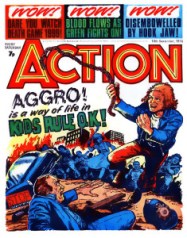
AGGRO! In the long, hot summer of 1976, ACTION comic’s blood-crazed sharks, spy thugs and football yobs warped young minds across Britain. Creator Pat Mills tells JOHN NAUGHTON about the comic The Sun called the Sevenpenny Nightmare.

In the recent trend for publishing books based around specific years, no-one has yet laid claim to 1976. Like visitors strolling past a boss-eyed mongrel at Battersea Dogs’ Home, prospective authors have failed to see the appeal of a year that began with 15 people murdered in Northern Ireland before the Christmas decorations came down and continued in grindingly grim fashion with front pages dominated by endless tales of industrial aggro or Cod and Cold War stand-offs. Civil war raged in Angola and bombs exploded throughout London. Is this the MPLA, is this the IRA? Yes, on both counts, Johnny.

01 copy 2 Action’s most infamous cover, as seen in High-Rise.

Listen closely and you can hear the tectonic plates…

View original post 4,199 more words

Gallery

How the EU budget is spent: Common Agricultural Policy

Members' Research Service's avatarEpthinktank

Written by Gianluca Sgueo, Francesco Tropea and Marie-Laure Augere-Granier,

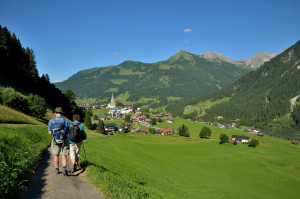
Rural area view © Andreas P / Fotolia

With 52% of the European Union (EU) territory classified as predominantly rural, more than 170 million hectares of agricultural land, and 113 million people (nearly one quarter of the EU population) living in rural areas, the Common Agricultural Policy (CAP) represents one of the largest shares of expenditure from the EU budget. The CAP pools European Union resources spent on agriculture to protect the viable production of food, the sustainable management of natural resources, and to support rural vitality.

The CAP consists of two ‘pillars’, the first includes direct payments (i.e. annual payments to farmers to help stabilise farm revenues in the face of volatile market prices and weather conditions) and market measures (to tackle specific market situations and to support trade promotion). The second pillar concerns rural development policy and it is aimed at achieving balanced territorial development…

View original post 371 more words

Gallery

Phillips, Laffer and Gatsby: on economists obsessing about curves

Beatrice's avatarThe Undercover Historian

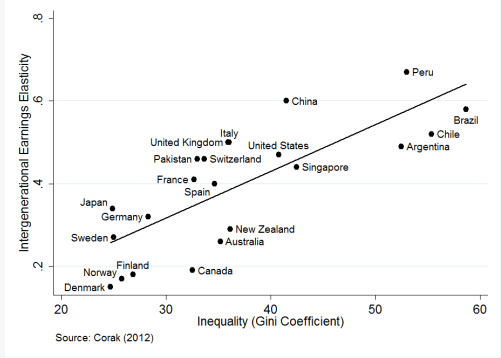
On Monday, if I can navigate through strikes, river floods, and tear gaz, I’ll be taking a course on the Great Gatsby curve in Rennes. And as I scroll through articles on the topic, I’m struck by an air of déjà-vu. Thought similar curves had been circulated by Miles Corak since 2006, the name was introduced by Alan Krueger, then chairman of the Council of Economic Advisers in a January 2012 address on inequality. Statistics, Krueger argued, show a negative relationship between inequality in the mid-1980s and intergenerational mobility across countries, one he called the “Great Gatsby Curve.”

GatsbyCorak’s Great Gatsby Curve

Both the empirical existence and the theoretical foundations of the Gatsby curve have since been hotly debated within academia. It has been argued that no correlation, even less causation, existed across countries, nor across US local labor markets, that the relation disappears when other measures…

View original post 816 more words

Gallery

The computerization of economics: a chronology (in progress)

Beatrice's avatarThe Undercover Historian

On Hardware, there’s a great illustrated history of computers here (and timeline). For econometrics software, I relied on Charles Renfro’s massive history. I have tried to classify the various ways in which computerization affected the development of economics here and I list further research questions here. Comments welcome. 

1930s

Leontief tries to solve 44 simultaneous equations on a mechanical computer developed by John Wilbur at MIT and fails. The computing capacities at that time, Dorfman recalls, enabled econs to solve 9 simultaneous equations in 3/4 hours.

Late 1940s

ENIAC02 The ENIAC

While the first general-purpose computer, the Electronic Numerical Integrator and Computer (ENIAC) becomes operational in 1946, economists’ fascination with machine is then still related to the utilization of physics metaphors and tools to build economic models. In 1949, for instance, engineers Walter Newlyn and Bill Phillips (of the Phillips curve) built an hydromechanical analogue computer to simulate monetary and…

View original post 2,513 more words

Gallery

9 ways computers have affected the development of economics

Beatrice's avatarThe Undercover Historian

“The rise of applied economics from the 1970s onward is a consequence of computerization and better data.” This increasingly canonical narrative has the allure of truthiness, and it is therefore surprising that the computerization of economics has never been historicized. Gathering a few important occurrences of economists’ engagement with computers has made me aware of the unclear interplay of hardware, software, econometric theory, modeling, coding, data gathering and policy making. My tentative chronology hints at the many ways in which the development of computers have affected economics, from speeding up econometrics calculations to challenging entrenched conceptions of economic “proof,” from providing new objects of studies to forging new relationship between theory and empirical work, even eliminating the distinction between the two spheres. More specifically, here are the 9 tentative layers of influence I read in it (comments much  welcome)

1) Improving calculations: as they were brought by academic and research institutions…

View original post 1,013 more words

Gallery

Four pictures of two tribes of academia

brianmlucey's avatarBrian M. Lucey

14kgdhHow do academics work? How do they communicate? How do they analyse data? Does it differ between Arts, Humanities, and Social Sciences (AHSS)  avs Science, Technology and MedMath (STEM) . Lets see

View original post 338 more words

Gallery

Previous Older Entries Next Newer Entries

Bassett, Brash & Hide

Celebrating humanity's flourishing through the spread of capitalism and the rule of law

Truth on the Market

Scholarly commentary on law, economics, and more

The Undercover Historian

Beatrice Cherrier's blog

Matua Kahurangi

Celebrating humanity's flourishing through the spread of capitalism and the rule of law

Temple of Sociology

Celebrating humanity's flourishing through the spread of capitalism and the rule of law

Velvet Glove, Iron Fist

Celebrating humanity's flourishing through the spread of capitalism and the rule of law

Why Evolution Is True

Why Evolution is True is a blog written by Jerry Coyne, centered on evolution and biology but also dealing with diverse topics like politics, culture, and cats.

Down to Earth Kiwi

Celebrating humanity's flourishing through the spread of capitalism and the rule of law

NoTricksZone

Celebrating humanity's flourishing through the spread of capitalism and the rule of law

Homepaddock

A rural perspective with a blue tint by Ele Ludemann

Kiwiblog

DPF's Kiwiblog - Fomenting Happy Mischief since 2003

The Dangerous Economist

Celebrating humanity's flourishing through the spread of capitalism and the rule of law

Watts Up With That?

The world's most viewed site on global warming and climate change

The Logical Place

Tim Harding's writings on rationality, informal logic and skepticism

Doc's Books

A window into Doc Freiberger's library

The Risk-Monger

Let's examine hard decisions!

Uneasy Money

Commentary on monetary policy in the spirit of R. G. Hawtrey

Barrie Saunders

Thoughts on public policy and the media

Liberty Scott

Celebrating humanity's flourishing through the spread of capitalism and the rule of law

Point of Order

Politics and the economy

James Bowden's Blog

A blog (primarily) on Canadian and Commonwealth political history and institutions

Science Matters

Reading between the lines, and underneath the hype.

Peter Winsley

Economics, and such stuff as dreams are made on

A Venerable Puzzle

"The British constitution has always been puzzling, and always will be." --Queen Elizabeth II

The Antiplanner

Celebrating humanity's flourishing through the spread of capitalism and the rule of law

Bet On It

Celebrating humanity's flourishing through the spread of capitalism and the rule of law

History of Sorts

WORLD WAR II, MUSIC, HISTORY, HOLOCAUST

Roger Pielke Jr.

Undisciplined scholar, recovering academic

Offsetting Behaviour

Celebrating humanity's flourishing through the spread of capitalism and the rule of law

JONATHAN TURLEY

Res ipsa loquitur - The thing itself speaks

Conversable Economist

Celebrating humanity's flourishing through the spread of capitalism and the rule of law

The Victorian Commons

Researching the House of Commons, 1832-1868

The History of Parliament

Articles and research from the History of Parliament Trust

Books & Boots

Reflections on books and art

Legal History Miscellany

Posts on the History of Law, Crime, and Justice

Sex, Drugs and Economics

Celebrating humanity's flourishing through the spread of capitalism and the rule of law

European Royal History

Exploring the Monarchs of Europe

Tallbloke's Talkshop

Cutting edge science you can dice with

Marginal REVOLUTION

Small Steps Toward A Much Better World

NOT A LOT OF PEOPLE KNOW THAT

“We do not believe any group of men adequate enough or wise enough to operate without scrutiny or without criticism. We know that the only way to avoid error is to detect it, that the only way to detect it is to be free to inquire. We know that in secrecy error undetected will flourish and subvert”. - J Robert Oppenheimer.

STOP THESE THINGS

The truth about the great wind power fraud - we're not here to debate the wind industry, we're here to destroy it.

Lindsay Mitchell

Celebrating humanity's flourishing through the spread of capitalism and the rule of law

Alt-M

Celebrating humanity's flourishing through the spread of capitalism and the rule of law

croaking cassandra

Economics, public policy, monetary policy, financial regulation, with a New Zealand perspective

The Grumpy Economist

Celebrating humanity's flourishing through the spread of capitalism and the rule of law

International Liberty

Restraining Government in America and Around the World