
The Most Heroic Cat Ever Saves A Little Boy From Vicious Dog Attack (Video)
15 May 2014 Leave a comment
in cats Tags: man's best friend
The next time you make an allegation of price fixing
15 May 2014 Leave a comment
in entrepreneurship, industrial organisation, law and economics, Richard Posner Tags: cartels
Remember this, firms are only likely to collude in certain market environments.
Brozen and Posner suggest the following pre-conditions to collusion
- market concentration on the supply side;
- no fringe of small sellers;
- high transport costs from neighbouring markets;
- small variations in production costs between firms;
- readily available information on prices;
- inelastic demand at the competitive price;
- low pre-collusion industry profits;
- long lags on new entry;
- many buyers (otherwise selective discounting to big buyers will be too tempting while monitoring adherence to the agreement will be difficult);
- no significant product differentiation;
- large suppliers selling at the same level in the distribution chain;
- a simple price, credit and distribution structure;
- price competition is more important than other forms of competition;
- demand is static or declining over time; and
- stagnant technological innovation and product redesign.
Stable collusive arrangements are thus likely to be rare; the absence of any of the conditions will tend to undermine the potential for successful collusion.
Supply-Side Economics in Iceland
15 May 2014 Leave a comment
in economic growth, labour economics Tags: Iceland, tax reform
The move to a pay-as-you-earn income tax system in Iceland in 1988 made income earned in 1987 tax-free.
- Icelandic GDP increased by 4.16% in 1987.
- Total labour supply rose by 6.7% in 1987 over the average of 1986 and 1988.
- This included an 8.6% increase in weeks of work supplied by those already in the labour market in 1986.
Notice in the graph the big kink in employment in 1987. A spike just for the year of no taxes. Labour supply then fell away.
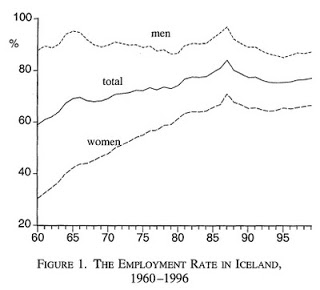
Iceland in 1987 was a unique opportunity to study the labour supply response of individuals who were temporarily faced with a zero marginal-and average-income tax rate.
Ain’t no Mountain High Enough – Marvin Gaye and Tammi Terrell
14 May 2014 Leave a comment
My favourite song.
I must admit that The Sister Act 2 version is pretty good too.
Super-Economy “pre-reviewed ” Piketty in 2010
14 May 2014 Leave a comment
in applied welfare economics, entrepreneurship, labour economics, liberalism, politics - USA, technological progress Tags: Piketty, poverty versus inequality
The French are poorer that the 3rd poorest American state: Arkansas. The EU-15 as a whole would qualify to be the 49th poorest American state.
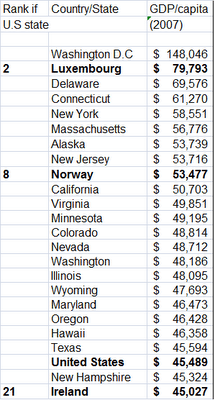
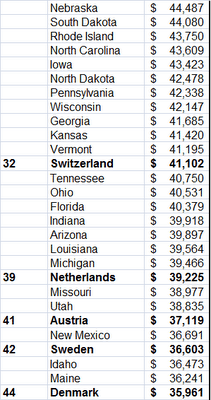

The rich in Europe are poor by American standards. The poor in the USA are middle class by European standards. The European middle class has smaller houses, few cars and few consumers durables that the average poor in the USA.

via Super-Economy: Dynamic America, Poor Europe and Tino Sanandaji

Media conspiracies versus cartel theory
14 May 2014 Leave a comment
in entrepreneurship, industrial organisation Tags: cartels, conspiracy theories, media bias
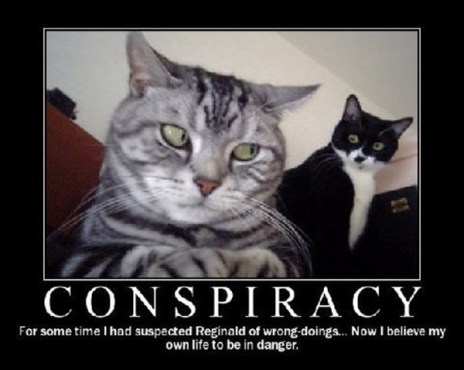
Media conspiracy theories suggest someone is in control; that dark, all-powerful cabals of men in cultish robes control the world. The truth is no one is in control. What about 57 channels, nothing on!
Newspapers, TV and cable, are not a monopoly. A monopoly is a single seller of as product with a legal right to bar new entry. It is an exclusive right to sell something.
At best, newspapers, TV and cable, are a large and unwieldy cartel under pressure from costs and new entry. The Internet makes electronic news competition global.
There are many different Australian news outlets and media types, three national networks, plus many cable news networks and 9 media owners. That is more than enough to destabilise any cartel.
Why is the mass media special? A supply-side model of media ownership suggesting that media outlets weigh the rewards of bias—political influence or personal pleasure—against the cost of bias—lost circulation from providing faulty news.
The mass media is a big business, and they increase readership and revenue by presenting factual and informative news.

The most likely to turn-off are women, and women vote to the Left more often than do men. The media is perhaps pandering to this centre-left marginal buyer.
A news cartel is like any other cartel. All cartels break-down and only some get back together.

Cartels contain seeds of their own destruction. Cartel members are reducing their output below their existing potential production capacity, and once the market price increases, each member of the cartel has the capacity to raise output relatively easily.

All cartels must decide how to allocate the reduction of output that follows the price increases across members with different costs structures and spare capacity.:
- The tendency is for cartel members to cheat on their production quotas, increasing supply to meet market demand and lowering their price.
- Most cartel agreements are unstable and at the slightest incentive they will quickly disband, and returning the market to competitive conditions.
One sign of a cartel that was developed by Aaron Director is periods of stable prices, despite cost fluctuations, followed by sudden price changes when the cartel collapses or decide to increase prices.
For a news cartel, this means toeing the line and then periods of truth, and then a sudden return to the party line when the cartel starts-up again.
The exercise of collective market power will not be stable unless sellers agree on prices and production shares; on how to divide the profits; on how to enforce the agreement; on how to deal with cheating; and on how to prevent new entry.

A cartel is in the unenviable position of having to satisfy everyone, for one dissatisfied producer can bring about the feared price competition and the disintegration of the cartel.
Thus a successful cartel must follow a policy of continual compromise. Little wonder that John. S McGee wrote that:
The history of cartels is the history of double crossing
Peter Drucker hated meetings too
13 May 2014 Leave a comment
in entrepreneurship, managerial economics Tags: meetings, Peter Drucker
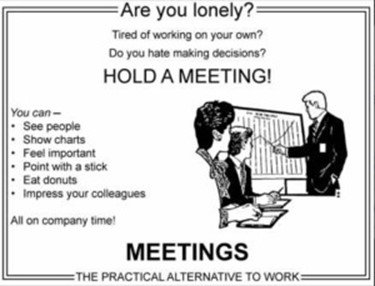
Meetings are by definition a concession to a deficient organization.
For one either meets or one works. One can not do both at the same time…
There will always be more than enough meetings…Every meeting generates a host of little follow-up meetings—some formal, some informal, but both stretching out for hours.
Meetings, therefore, need to be purposefully directed.
An undirected meeting is not just a nuisance; it is a danger.
But above all, meetings have to be the exception rather than the rule.
An organization where everybody meets all the time is an organization in which no one gets anything done.
Wherever a time log shows the fatty degeneration of meetings—whenever, for instance people in an organization find themselves in meetings a quarter of their time or more—there is time-wasting malorganization.
Drucker also said:
The senior financial executive of a large organization knew perfectly well that the meetings in his office wasted a lot of time.
This man asked all of his direct subordinates to every meeting, whatever the topic.
As a result, the meetings were far too large.
And because every participant felt that he had to show interest, everybody asked at least one question—most of them irrelevant. As a result, the meetings stretched on endlessly.
But the senior executive had not known, until he asked, that his subordinates too considered the meetings a waste of their time.
Aware of the great importance everyone in the organization placed on status and on being "in the know", he feared that the uninvited men would feel slighted and left out.
Now, however, he satisfies the status needs of his subordinates in a different manner.
He sends out a printed form which reads:
"I have asked [Messrs Smith, Jones and Robinson] to meet with me [Wednesday at 3] in [the fourth floor conference room] to discuss [next year’s capital appropriations budget].
Please come if you think that you need the information or want to take part in the discussion.
But you will in any event receive right away a full summary of the discussion and of any decisions reached, together with a request for your comments".
Where formerly a dozen people came and stayed all afternoon, three men and a secretary to take the notes now get the matter over within an hour or so. And no one feels left out.
Gary Becker on crony capitalism in Latin America
13 May 2014 Leave a comment
in development economics, Gary Becker, politics, Public Choice Tags: crony capitalism, Latin America
One legitimate reason for the opposition to capitalism in Latin America is that it frequently has been "crony capitalism" as opposed to the competitive capitalism that produces desirable social outcomes.
Crony capitalism is a system where companies with close connections to the government gain economic power not by competing better, but by using the government to get favoured and protected positions.
These favours include monopolies over telecommunications, exclusive licenses to import different goods, and other sizeable economic advantages. Some cronyism is found in all countries, but Mexico and other Latin countries have often taken the influence of political connections to extremes.
…The excesses of cronyism have provided ammunition to parties of the left that are openly hostile to capitalism and neo-liberal policies. Yet when these parties come to power they usually do not reduce the importance of political influence but shift power to groups that support them.
…Leftist ideologies take advantage of the discontent this causes among intellectuals and the poor, and promise a redistribution of assets and better education opportunities for the poor.
Promises of redistribution have figured prominently in the speeches of Chavez, Lula, Morales, Peronists in Argentina, and Andres Manuel Lopez Obrador, former mayor of Mexico City and a leading candidate to be Mexico’s next president.
When it is discovered that left wing governments usually do not end up helping the poor very much, they tend to be voted out of office.
… The overall trend during the past several decades in practically all countries of this region has been toward more open economies with greater competition within industries, with much more reliance on private enterprise, and with a reduced role for government mandates, government-run enterprises, and cronyism.
Since these policies have provided greater benefits to all classes than the socialist policies of a Fidel Castro or a Hugo Chavez, the vast majority of people that live under such leaders will be, or in Cuba have been, disappointed by the unfulfilled promises. They are likely to come back to parties that support more market policies as long as free elections are preserved.
Gary Becker 2006

What were Truman’s other options before Hiroshima-updated?
12 May 2014 Leave a comment
in war and peace Tags: struggle for peace
A demonstration explosion would have signalled to the Japanese oligarchy that the new president is weak and reluctant to spill blood.
The Japanese leadership had already interpreted the terms of the Potsdam declaration was a sign of weakness. They hoped that by making the invasion of Japan as bloody as possible, they could extract even better terms in light of this sign of weakness at Potsdam.
The willingness of the Japanese oligarchy to waste the blood of their own people and spill the blood of others without limit was central to their strategy of avoiding occupation and the dismantling of the old order.
Japan was governed largely by a consensus among an oligarchy of military and civilian factions. No major decisions of national policy could be reached until such a consensus had been obtained:
Japan’s governmental structure was such that in practice the Emperor merely approved the decisions of his advisers.
A consensus among the oligarchy of ruling factions at the top was required before any major question of national policy could be decided.
These factions, each of which had a different point of view, included the group around the Emperor of whom Marquis Kido, the Lord Keeper of the Privy Seal, was the most important, the ex-premiers constituting the Jushin or body of senior statesmen, and the cabinet.
The Army and Navy named their own cabinet ministers, who, together with the two chiefs of staff, had direct access to the Emperor.
The cabinet could perpetuate itself only so long as it was able to absorb or modify the views of the Army and Navy ministers, who, until the end, were strongly influenced by the fanaticism of the Army officers and many of the younger Navy officers.
The ruling oligarchy considered the opinions of the Japanese people as only one among the many factors to be taken into consideration in determining national policy and in no sense as controlling.
This process inevitably took time and involved complicated struggles of will among those of differing opinions. Assassinations and the threat of the same often greased the wheels.
The Japanese oligarchy felt in the spring of 1944 that Japan was facing certain defeat or at least that the time had come for positive steps to end the war. Prime Minister Tojo was forced to resign to make way for those more skilled at extracting the best possible terms to end the war.
Japan always anticipated a negotiated end of the war in the Pacific.
- The Japanese elite considered that the weakness of the U.S. as a democracy would make it impossible for her to continue all-out offensive action in the face of the losses imposed by a fanatically resisting Japanese military;
- The U.S. would compromise and allow Japan to retain a substantial portion of her initial territorial gains; and
- Civilian and naval groups were familiar with American industrial and technological potential, and its fighting determination when aroused, expressed their doubts about a strategy which promised no conclusion to the war other than negotiation.
While Japan no longer had a realistic prospect of winning the war by the end of 1944 and they knew it, Japan’s leaders believed they could make the cost of conquering Japan too high for the Allies to accept, leading to some sort of armistice rather than total defeat.
The Japanese army fought to the death with 99% plus casualty rates as the Americans moved from island to island to show that any attempt to invade Japan would be too high a price to pay.
This was the Japanese ruling elite’s ace in the hole. The War Department staff in Washington estimated there would be 250,000 to 500,000 American casualties in an invasion of Japan.
500,000 Purple Heart medals were manufactured in anticipation of the casualties resulting from the invasion of Japan.
- To the present date, all the American military casualties of the sixty years have not exceeded that number.
- In 2003, there were still 120,000 of these Purple Heart medals in stock!
After the bombings, a public admission of defeat by the responsible Japanese leaders was secured prior to an invasion and while Japan was still possessed of some 2,000,000 troops and over 9,000 planes in the home islands.
There was no need for the Allies to either invade Japan or deal with the million Japanese troops in China who could have held out as a government-in-exile.
What were the chances of a military coup and assassinations and of army mutinies in China if the Japanese leaders capitulated? There were coup and assassination attempts after the figure-head emperor was used to resolve the dead-lock in a face saving way.
The 12-15 August coup plotters failed to persuade the Eastern District Army and the high command of the Imperial Japanese Army to move against the surrender. Importantly, the junior officers leading the coup felt secure enough to approach the Army minister and senior army officers as potential co-conspirators.
The army leadership knew of the coup plans but neither joined the plotters nor arrested them.
The key point is any Japanese government would automatically fall if the navel or army minister resigned. The Army and Navy name their own cabinet ministers. The resignation of Shigetaro Shimada, the Navy Minister, forced out Tojo in 1944.
The Oligarchy had decided in late 1944 that Japan was facing ultimate defeat and unseated the Tojo government in favour of a new cabinet which would bring the war to an end on terms that preserved old military dominated oligarchic order. The army and navy ministers did not resign after the post-atomic bombing peace terms were accepted. They knew the game was up.
A hypothetical:
-
You are Truman’s chief defence counsel at his 1946 impeachment hearings where he is charged with not using the atomic bomb as soon as possible to force the Japanese to accept terms of surrender.
-
Truman could have chosen to abjure from using the 2 bombs at his disposal and let the fire bombings burn down most Japanese cities and towns from new air bases for B26s from Okinawa, let 100,000 Chinese be slaughtered on average every month at the hands of the occupying Japanese army, and invade in December and call forth a slaughter of a million or two more.
- The second bombing discredited the important faction within the Japanese ruling oligarchy that argued that the USA had only one bomb to use.
Truman’s secretary of state put this hypothetical to Truman when he was wavering on using the bomb.
I always wonder when people engage in handwringing over the horrors of war, will any of their suggestions about the good guys staying their hands ever shorten these wars.
Would World War 2 have finished even one day earlier if the handwringers had their way on how wars should be fought by the good guys? Who would have won?
Death and bank accounts
12 May 2014 Leave a comment
in applied price theory Tags: thieving relatives
My first job was with a Bank.

Surprisingly many relatives overcame their grief to be in the bank first thing the next morning at opening time to claim the bank account.
We would say thank you for the notification of a deceased depositor, the bank account would be frozen and we waited for correspondence from the executor of the will.
An eye-opener as was my first encounter with illiteracy. Customers asked for their deposit slips to be written out for them because they could not write the word twenty.
How much would an IPhone cost in 1991? | Techpolicy Daily
12 May 2014 Leave a comment
in entrepreneurship, technological progress Tags: mobile phones, standards of living, The Great Fact
In the beginning, mobile phones were just a walkie-talkie. iPhones have the same capabilities of 13 distinct electronics gadgets worth more than $3,000 in a 1991.

An iPhone incorporates a computer, CD player, phone, and video camera, among other items.
In 1991, a gigabyte of hard disk storage cost around $10,000. Today, it costs around four cents.
Back in 1991, a gigabyte of flash memory, which is what the iPhone uses, would have cost something like $45,000, or more. (Today, it’s around 55 cents ($0.55).)
The mid-level iPhone 5S has 32 GB of flash memory. Thirty-two GB, multiplied by $45,000, equals $1.44 million.
The iPhone used 20,500 millions of instructions per second which in 1991 would have cost around $620,000.
In 1991, a mobile phone used the AMPS analog wireless network to deliver kilobit voice connections.
A 1.44 megabit T1 line from the telephone company cost around $1,000 per month.
Today’s LTE mobile network is delivering speeds in the 15 Mbps range.
Safe to say, the iPhone’s communication capacity is at least 10,000 times that of a 1991 mobile phone.
The 1991 cost of mobile communication was something like $100 per kilobit per second.
Fifteen thousand Kbps (15 Mbps), multiplied by $100, is $1.5 million.
Considering only memory, processing, and broadband communications power, duplicating the iPhone back in 1991 would have (very roughly) cost: $1.44 million + $620,000 + $1.5 million = $3.56 million.
This doesn’t even account for the MEMS motion detectors, the camera, the iOS operating system, the brilliant display, or the endless worlds of the Internet and apps to which the iPhone connects us.
via Techpolicy Daily and Cafe Hayek
The path to higher U.S. prosperity
12 May 2014 Leave a comment
in applied welfare economics, economic growth, Edward Prescott, great recession, labour economics, macroeconomics Tags: capital taxation, Edward Prescott, retirement savings, tax reform
Suppose the USA:
- Had mandatory savings for retirement
- Eliminated capital income taxes
- Broadened tax base and lowered the marginal tax rate
- Phased in reforms so all birth-year cohorts are made better off
- Left welfare programs and local public good shares the same
- Savings not part of taxable income, saving withdrawals part of taxable income – with these changes U.S. income tax would be a consumption tax
US Detrended GDP per Capita
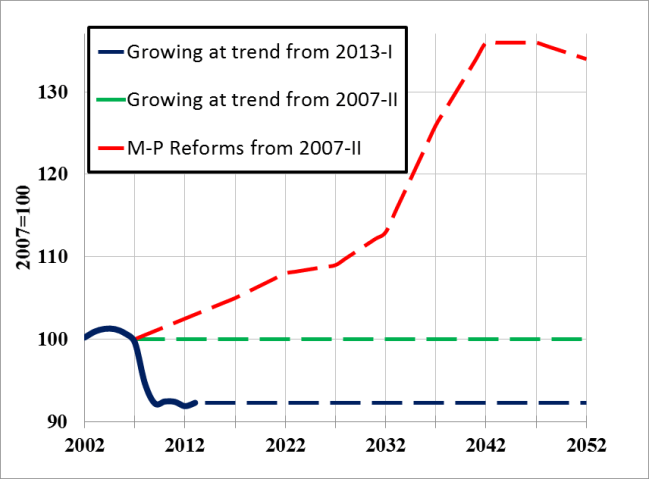
Source: Edward Prescott and Ellen McGrattan 2013.
Joe Jackson – Is She Really Going Out With Him? (Live acappela)
11 May 2014 1 Comment
One of my favourite songs and favourite singers since high school.
 Utopia, you are standing in it!
Recent Comments