- Skim until Offended
- Disqualify that Opinion
- Attack, Attack, Attack
- Disregard Inconvenient facts
- Make Shit Up
- Resort to Moral Equivalency
- Concern Trolling
- When all else fails, Racism!

Celebrating humanity's flourishing through the spread of capitalism and the rule of law
06 May 2014 Leave a comment
in politics - Australia, politics - New Zealand, politics - USA Tags: infotopia, open society
06 May 2014 Leave a comment
in economics of regulation, environmental economics, environmentalism, health economics, law and economics Tags: Cass Sunstein, GMOs, killer green technologies, Paul Nurse, precautionary principle
Previously the precautionary principle was used to introduce doubt when there was no doubt. But when climate science turned in their favour, environmentalists wanted public policy to be based on the latest science.
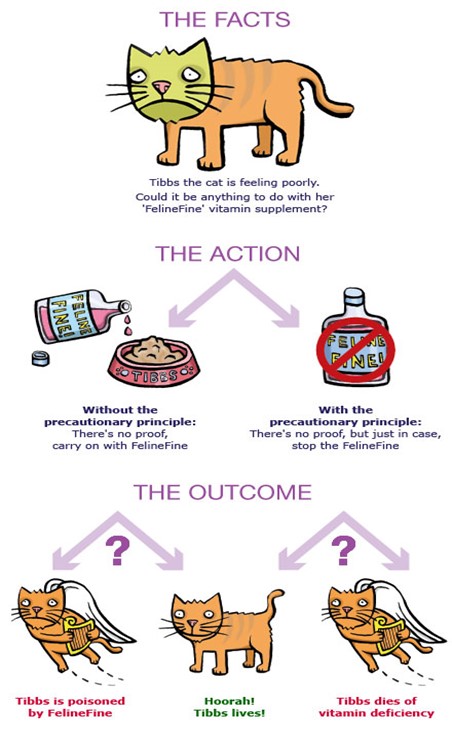
The precautionary principle is deeply incoherent. We should take precautions but there are always risks on both sides of a decision; inaction can bring danger, but so can action. Precautions themselves create risks so the precautionary principle bans what it simultaneously requires.

There is never perfect certainty about the nature and causes of health and environmental threats, so environmental and health regulations are almost always adopted despite some residual uncertainty.
We live in a Schumpeterian world where new risks replace old risks.
The obvious question is it safer or more precautionary to focus on the potential harms of new activities or technologies without reference to the activities or technologies they might displace? Jonathan Alder explains
In any policy decision, policy makers can make two potential errors regarding risk.
On the one hand, policy makers may err by failing to adopt measures to address a health or environmental risk that exists.
On the other hand, policy makers may adopt regulatory measures to control a health or environmental risk that does not exist.
Both types of error can increase risks to public health.
Consider the overwhelming consensus among researchers that biotech crops are safe for humans and the environment
This is a conclusion that is rejected by the very environmentalist organisations that loudly insist on the policy relevance of the scientific consensus on global warming.
In his 2012 Dimbleby lecture, Sir Paul Nurse calls for a re-opening the debate about GM crops based on scientific facts and analysis:
We need to consider what the science has to say about risks and benefits, uncoloured by commercial interests and ideological opinion. It is not acceptable if we deny the world’s poorest access to ways that could help their food security, if that denial is based on fashion and ill-informed opinion rather than good science.
Cass Sunstein wrote that in its strongest and most distinctive forms, the precautionary principle imposes a burden of proof on those who create potential risks, and requires regulation of activities even if it cannot be shown that those activities are likely to produce significant harms:
…apparently sensible questions have culminated in an influential doctrine, known as the precautionary principle.
The central idea is simple: Avoid steps that will create a risk of harm.
Until safety is established, be cautious; do not require unambiguous evidence.
Yet the precautionary principle, for all its rhetorical appeal, is deeply incoherent.
It is of course true that we should take precautions against some speculative dangers.
But there are always risks on both sides of a decision; inaction can bring danger, but so can action.
Precautions, in other words, themselves create risks – and hence the principle bans what it simultaneously requires.
Sunstein is a Democrat whose White House appointment to the head the White House Office of Information and Regulatory Affairs under Obama was opposed by the Left of the Democrat Party because of his views on the precautionary principle and his support of cost-benefit analysis as a primary tool for assessing regulations. Sunstein again:
The simplest problem with the precautionary principle is that regulation might well deprive society of significant benefits, and even produce a large number of deaths that would otherwise not occur.
Genetic modification holds out the promise of producing food that is both cheaper and healthier – resulting, for example, in products that might have large benefits in developing countries.
The point is not that genetic modification will definitely have those benefits, or that the benefits of genetic modification outweigh the risks.
The point is that the precautionary principle provides no guidance
The epitome of anti-science is support for the precautionary principle and opposition to cost-benefit analysis in assessing regulations. Which side of politics is guilty of this?
Environmentalists accept the views of scientists when its suits their anti-progress agenda. In other cases, the precautionary principle is used to delay judgment, reject science such as on GMOs and demand ever more evidence.
Environmentalists are all for the precautionary principle except when applied to natural medicines, organic food and marijuana.
05 May 2014 Leave a comment
in public economics Tags: amazon, substitution effects, tax incidence
When several US states passed laws to require the collection of sales tax on online purchases, households living in these states reduced their Amazon expenditures by 9.5%. In practice, only Amazon was affected by the tax.

The decline in Amazon purchases is offset by a 2% increase in purchases at local brick-and-mortar retailers and a 19.8% increase in purchases through the online operations of competing retailers. The decline in sales is sharpest (23%) for purchases above $300.
Online consumers are very sensitive to total prices, taxes and options to avoid taxes.
05 May 2014 1 Comment
in applied welfare economics, constitutional political economy, law and economics, transport economics Tags: crime and deterrence, James Buchanan, punishment dilemma
Due to budget cuts, 35% of Oregon State Highway Police were laid off. These mass layoffs dramatically reduced citations and resulted in a 10-20% increase in injuries and fatalities.

The strongest effects were under fair weather conditions outside of city-limits where state police employment levels were most relevant.
These results in DeAngelo and Hansen’s “Life and Death in the Fast Lane: Police Enforcement and Traffic Fatalities” American Economic Journal: Economic Policy 2014 suggest that a highway fatality can be prevented with $309,000 of additional expenditures on traffic police.
A standard measure of the “value of a statistical life” is it is worth taking regulatory or law enforcement actions that reduce the risks of death when the costs of these actions are less than about $9 million per life saved.
Road safety is an area where James Buchanan’s punishment dilemma is strong:
For some laws or behavioural rules, the individual’s self-interest may override adherence [to the law], at least in certain circumstances.
Traffic violations offer a good example here.
Recognizing that he may himself violate traffic regulations on occasion, the individual may be reluctant to accept institutions that impose severe penalties, despite his preferences that all “others” than himself should be led to obey the general rules by sufficiently severe sanctions.
Just as the individual prefers that all others abide voluntarily by law while he remains free to violate it, so, too, he prefers that differentially severe punishment for law violation be meted out to others than himself.
Voters are less than keen to support strong penalties and convict when sitting on juries because of the fear that there but for the grace of god go I: that they would be in the dock at the receiving end of the heavy punishments.
If we commit to punish offenders and those who might commit offenses are deterred by this commitment to punish them, there would be fewer offenses. This also means doing the unpleasant things of meeting out these punishment when there are offenses by the undeterred:
The initially low penalties for causing death by dangerous driving is an example of the punishment dilemma. These penalties only slowly increased over several decades as societal attitudes hardened.
04 May 2014 Leave a comment
in constitutional political economy, development economics, entrepreneurship, liberalism, market efficiency, technological progress Tags: Deirdre McCloskey, industrial revolution, Rise of the Western World, rule of law, The Bourgeois Virtues, The Great Fact
Throughout the history of the world, the average person on earth has been extremely poor: subsisting on the modern equivalent of $3 per day.
This was true until 1800, at which point average wages—and standards of living—began to rise dramatically.
Prof. Deirdre McCloskey explains how this tremendous increase in wealth came about.
In the past 30 years alone, the number of people in the world living on less than $3 per day has been halved.
The cause of the economic growth we have witnessed in the past 200 years may surprise you.
It’s not exploitation, or investment. Innovation—new ideas, new inventions, materials, machinery, organizational structures—has fueled this economic boom.
Prof. McCloskey explains how changes in Holland and England in the 1600s and 1700s opened the door for innovation to take off—starting the growth that continues to benefit us today.
via Why Does 1% of History Have 99% of the Wealth? | Learn Liberty – YouTube.
04 May 2014 Leave a comment
in applied welfare economics, technological progress Tags: Cafe Hayek, Howard Hughes
Back in the day, with two flatmates, we bought a VCR for about $1000.

It was a remote control albeit this was connected by a cord to the machine – luxury
These days, DVD players go for $50.
Cafe Hayek makes these wonderful elaborations about how ordinary people live their lives as well as the billionaire Howard Hughes did in 1965:
Hughes could afford to talk on the phone for hours to someone hundreds or thousands of miles away. Even the poorest pays no long-distance charges even when making an overseas telephone call. There is Viber and Skype.
Hughes could afford to equip his house with a large screen, a state-of-the-art projector, an impressive sound system, and a film library filled with thousands of movies, documentaries, and television shows, so that he had a virtual movie theatre in his home. Today, nearly everyone can buy a large-screen hi-definition television, a surround-sound speaker system, and download movies.
Hughes could afford to staff his kitchen with chefs from Thailand, Korea, Japan, Vietnam, Ethiopia, Afghanistan, Morocco, Lebanon, and India. Today, such restaurants are common-place.
Hughes could easily afford to equip each member of his family with an automobile of his or her own. Today it’s not unusual for a middle-class household to have one car each for every person in that household who is at least 17 years old.
Hughes could easily afford to holiday in a foreign country. In New Zealand, overseas travel is included in living wage calculations.
Hughes could afford to fly to whatever distant locations he visited. Air travel is now emphatically routine even for high school students.
Hughes hired servants to wash his dishes. Today, automatic dishwashers are the norm.
Hughes could afford to equip his residence with an always-at-the-ready dark room so that he could take high-quality photographs and view them minutes later. People upload their photos and videos to Facebook and Instagram moments after they take them.
04 May 2014 Leave a comment
in applied welfare economics, economic growth, entrepreneurship, industrial organisation, market efficiency, Rawls and Nozick, technological progress Tags: envy, John Rawls, super-rich, SuperEntrepreneurs, top 1%, top talent
The report SuperEntrepreneurs shows that:
SuperEntrepreneurs examined about 1,000 self-made men and women who have earned at least $1 billion dollars and who appeared in Forbes magazine list of the world’s richest people between 1996 and 2010.

Hong Kong has the most, with around three SuperEntrepreneurs per million inhabitants, followed by Israel, the US, Switzerland and Singapore.
The US is roughly four times more super-entrepreneurial than Western Europe and three times more super-entrepreneurial than Japan.
Super-entrepreneurs tend to be well-educated – 84% have a university degree.
Many started their own company but there is no clear relationship between self-employment and successful entrepreneurship
Steven Kaplan and Joshua Rauh’s “It’s the Market: The Broad-Based Rise in the Return to Top Talent” Journal of Economic Perspectives 2013 found that those in the Forbes 400 richest are less likely to have inherited their wealth or grown-up wealthy.
Today’s super-rich are self-made rich because they produce new and better products and services that people wanted and are willing to pay for.
John Rawls was alive to the importance of incentives in a just and prosperous society.
With his emphasis on fair distributions of income, Rawls’ initial appeal was to the Left. Left-wing thinkers then started to dislike his acceptance of capitalism and his tolerance of large discrepancies in income and wealth.
Rawls excluded envy when we are behind his veil of ignorance designed the social contract about how the society will be organised. He believed that principles of justice should not be affected by individual inclinations, which are mere accidents.
Rawls also argued that the liberties and political status of equal citizens encourage self-respect even when one is less well off than others; and background institutions (including a competitive economy) make it likely that excessive inequalities will not be the rule. He supposes that
the main psychological root of our liability to envy is a lack of self-confidence in our own worth combined with a sense of impotence
Then there is the old Russian joke that tells the story of a peasant with one cow who hates his neighbour because he has two. A sorcerer offers to grant the envious farmer a single wish any thing he wants: “Shoot my neighbour’s cow!” he demands.
03 May 2014 Leave a comment
in great recession, macroeconomics Tags: Edward Prescott, great recession, Robert Lucas
Ed Prescott and Robert Lucas are several of many who use variations of the chart below to show that the USA has moved to a lower long-term growth path.
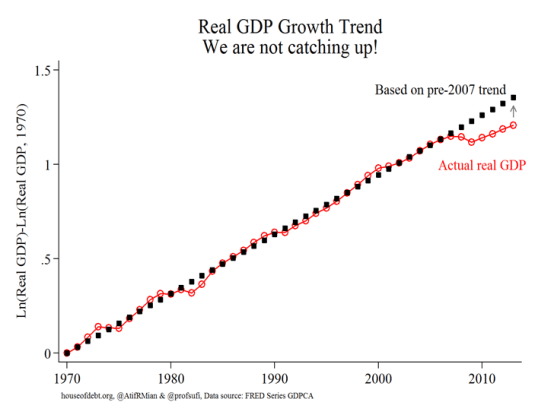
Source: House of Debt
The chart below for output per working age American (ages 15 to 64) is just as depressing.
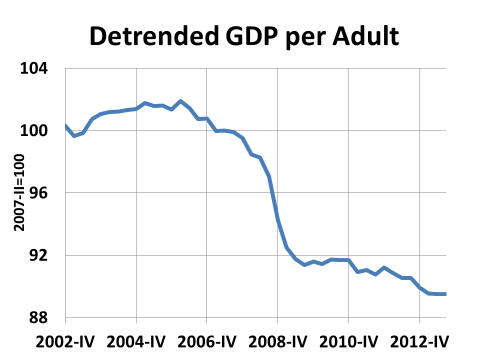
Source: Edward Prescott
At least Spain with its 25% unemployment rate is doing a little worse.
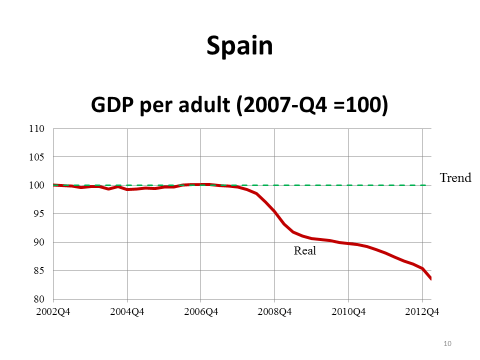
Source: Edward Prescott
03 May 2014 Leave a comment
in politics, war and peace Tags: cowardice of intellectuals

03 May 2014 Leave a comment
in human capital, industrial organisation, labour economics, technological progress Tags: Ben Jones, innovation, polymaths, renaissance man
Ben Jones in ‘The Burden of Knowledge and the Death of the Renaissance Man: Is Innovation Getting Harder? found that as knowledge accumulates as technology advances, successive generations of innovators may face an increasing educational burden.

Innovators can compensate through lengthening their time in education and narrowing expertise, but these responses come at the cost of reducing individual innovative capacities.
This has implications for the organization of innovative activity – a greater reliance on teamwork – and has negative implications for economic growth.
Jones found that the age at first invention, specialisation, and teamwork increased over time in a large micro-data set of inventors. Upward trends in academic collaboration and lengthening doctorates can also be explained in his framework.
Using data on Nobel Prize winners, Jones found that the mean age at which the innovations are produced to win the Prize has increased by 6 years over the 20th Century.
It’s now taking longer for scientists to get their basic training and start their careers. There is simply more to learn because knowledge in all fields has grown by quantum leaps in the past century.
Nobels are being handed out for different types of work than a century ago.
Jones’ theory provides an explanation for why productivity growth rates did not accelerate through the 20th century despite an enormous expansion in collective research effort and levels of education and many more graduates.
The more experienced readers of this blog might remember that the better of their professors seemed to be masters of the entire field of economics and could teach almost any subject.
These days, too many professors rely on textbooks with annual editions that come with the lecture notes, assignments and test-banks written for them by the publishing company.
Are there any polymaths left? Posner? Tullock?
02 May 2014 Leave a comment
in applied welfare economics, law and economics, liberalism
02 May 2014 Leave a comment
in entrepreneurship, human capital, labour economics Tags: Bill Gates, Piketty, top 1%, top talent
Bill Gates once said:
You take away the top 20 employees of Microsoft, we’ll just be an ordinary company. Top employees are what makes us.

via Gary Becker on Human Capital | Atanu Dey On India’s Development.
02 May 2014 Leave a comment
in law and economics, Richard Posner, Ronald Coase Tags: University of Chicago
Chicago Unbound contains 60+ years of scholarship, most of it ungated online, of the members of University of Chicago Law School
via Chicago Unbound | University of Chicago Law School Research.
02 May 2014 Leave a comment
in macroeconomics, Milton Friedman, politics - Australia Tags: current account deficits, inflation, monetary policy
No one under 40 has an adult memory of inflation in Australia. They have forgotten what high inflation was like.

Those older than 40 have forgotten how inflation was tamed.
Edward Nelson’s paper ‘Monetary policy neglect and the Great Inflation in Canada, Australia, and New Zealand‘ is good on this. His paper trawls through the press reports of the 1970s onwards to document exactly what the views of the day were of the causes of inflation:
The Governments and Reserve Bank of the 1970s and 1980s attributed the double-digit inflation of that time to a range of causes other than loose monetary policy.
1988 witnessed a major monetary policy tightening in Australia.
The tightening itself was motivated by balance-of-payments rather than inflation considerations. It was that old bogey, the current account deficit. The current account is the most pernicious statistic published.
The fall in inflation to 3% in 1991 transformed the views of policymakers and observers about the role of monetary policy in inflation control.
As late as 1990, the Governor of the Reserve Bank rejected central-bank inflation targeting as infeasible in Australia, and cited the need to use other tools such as wages policy.
When inflation fell below 3% in early 1991—clearly a response to the period of monetary restraint – I can assure you that none of the briefings to ministers at that time forecasted inflation to fall so rapidly.
Policy attitudes changed all through brute experience; no neo-liberal conspiracies here. Milton Friedman was still a swear word back then and the idea that inflation was a monetary phenomenon was still career limiting.
Gruen and Stevens (2000) record that in the 1990s, “the main insight of two centuries of monetary economics… that monetary policy ultimately determined inflation” convinced the authorities that non-monetary approaches to inflation control should be abandoned in favour of central-bank inflation targeting.
The current account did not change much as a result of the deep recession designed to bring it under control. The current account deficit as a major policy problem was quietly forgotten.
Celebrating humanity's flourishing through the spread of capitalism and the rule of law
Scholarly commentary on law, economics, and more
Beatrice Cherrier's blog
Celebrating humanity's flourishing through the spread of capitalism and the rule of law
Celebrating humanity's flourishing through the spread of capitalism and the rule of law
Celebrating humanity's flourishing through the spread of capitalism and the rule of law
Why Evolution is True is a blog written by Jerry Coyne, centered on evolution and biology but also dealing with diverse topics like politics, culture, and cats.
Celebrating humanity's flourishing through the spread of capitalism and the rule of law
Celebrating humanity's flourishing through the spread of capitalism and the rule of law
A rural perspective with a blue tint by Ele Ludemann
DPF's Kiwiblog - Fomenting Happy Mischief since 2003
Celebrating humanity's flourishing through the spread of capitalism and the rule of law
The world's most viewed site on global warming and climate change
Tim Harding's writings on rationality, informal logic and skepticism
A window into Doc Freiberger's library
Let's examine hard decisions!
Commentary on monetary policy in the spirit of R. G. Hawtrey
Thoughts on public policy and the media
Celebrating humanity's flourishing through the spread of capitalism and the rule of law
Politics and the economy
A blog (primarily) on Canadian and Commonwealth political history and institutions
Reading between the lines, and underneath the hype.
Economics, and such stuff as dreams are made on
"The British constitution has always been puzzling, and always will be." --Queen Elizabeth II
Celebrating humanity's flourishing through the spread of capitalism and the rule of law
Celebrating humanity's flourishing through the spread of capitalism and the rule of law
WORLD WAR II, MUSIC, HISTORY, HOLOCAUST
Undisciplined scholar, recovering academic
Celebrating humanity's flourishing through the spread of capitalism and the rule of law
Res ipsa loquitur - The thing itself speaks
Celebrating humanity's flourishing through the spread of capitalism and the rule of law
Researching the House of Commons, 1832-1868
Articles and research from the History of Parliament Trust
Reflections on books and art
Posts on the History of Law, Crime, and Justice
Celebrating humanity's flourishing through the spread of capitalism and the rule of law
Exploring the Monarchs of Europe
Cutting edge science you can dice with
Small Steps Toward A Much Better World
“We do not believe any group of men adequate enough or wise enough to operate without scrutiny or without criticism. We know that the only way to avoid error is to detect it, that the only way to detect it is to be free to inquire. We know that in secrecy error undetected will flourish and subvert”. - J Robert Oppenheimer.
The truth about the great wind power fraud - we're not here to debate the wind industry, we're here to destroy it.
Celebrating humanity's flourishing through the spread of capitalism and the rule of law
Celebrating humanity's flourishing through the spread of capitalism and the rule of law
Economics, public policy, monetary policy, financial regulation, with a New Zealand perspective
Celebrating humanity's flourishing through the spread of capitalism and the rule of law
Restraining Government in America and Around the World
 Utopia, you are standing in it!
Recent Comments