The World Bank wrote South Korea off in the 1960s

The World Bank (2002) mentions South Korea and Botswana as long term success stories. The first World Bank mission to Korea in the early 1960s described Korea’s development program as ludicrously optimistic:

There can be no doubt that this development program GDP growth of 7.1 per cent exceeds the potential of the Korean economy. . .

It is inconceivable that exports will rise as much as projected.

Korean economic growth turned out to be 7.3 per cent in the forecasted period. In 1960, South Korea was one of the poorest countries in the world, with an income per head on a par with the poorest parts of Africa.
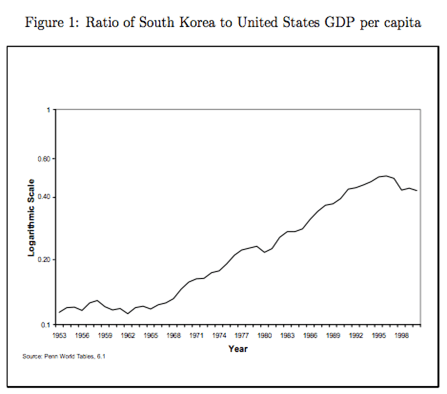
Unfortunately, a study for the World Bank’s Operations Evaluation Department found that Korea’s growth accelerated only after the decline in US aid, and did so by following policies contrary to the advice of US aid officials; hence, the consensus of most studies of Korea is that aid contributed little to Korea’s take-off (Fox 2000).
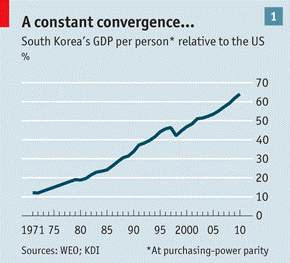
Chenery and Strout forecast in the early 1960s that growth in India and Pakistan over 1962-76 would exceed that of Korea. Rosenstein-Rodan at the same time predicted that Sri Lanka would have a higher per capita income than Taiwan or Korea by 1976. Hong Kong and Singapore, according to the same predictions, were to be left in the dust by Argentina and Colombia.
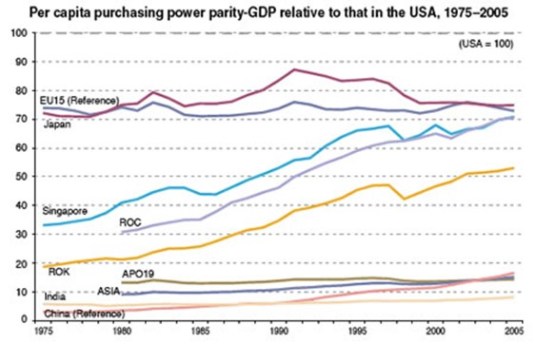
A key feature of this development miracle was an enormous increase in Korea’s international trade. In the early 1960s, Korea eliminated tariffs on imported production inputs and capital goods as long as these imports were used to produce goods for export. Beginning in the 1970s, Korea engaged in a broader, gradual reduction of tariff from about 40 per cent to 13 per cent.

Gordon Tullock is an interesting writer on South Korea saying that:

• Syngman Rhee was a socialist who knew nothing of capitalism.
• To make his country look capitalist to please the Americans, Rhee gave previously Japanese owned industries to his friends as monopolies.
• When General Park overthrew Syngman Rhee, he knew no economics, but he knew the bureaucracy was filled with Rhee’s cronies so he fired them all.

Tullock considers that South Korea became an open economy as a by-product of this political purge.

3 Comments (+add yours?)

  1. Akin's avatar Akin
    Jun 23, 2014 @ 06:50:06

    I discussed this same topic with a friend about how South Korea was able to drag itself out of poverty and became a wealthy society.

    Liked by 1 person

    Reply

  2. Jim Rose's avatar Jim Rose
    Jun 25, 2014 @ 16:14:24

    My Korean friends at Graduate School in Japan were very proud of the successes of their country in recent decades.

    Like

    Reply

  3. John Scott's avatar John Scott
    Jan 24, 2017 @ 16:28:25

    I am an economics professor in the US. A student asked a question today and I have been trying to run down the data to answer it. In my text, he read about the natural experiment with NK and SK. The student wanted to credit US aid for all the difference between the two states.

    I have searched high and low for some data to answer his comment. I think a sufficient measurement would be aid/GDP for the relevant years, except that I can’t find the data. I found one figure for aid of $12.96 B. All the places I go for SK GDP only start in 1960. Your data in this post implies that someone has the data on NK GDP.

    Ideas?

    Like

    Reply

Leave a comment

This site uses Akismet to reduce spam. Learn how your comment data is processed.

Bassett, Brash & Hide

Celebrating humanity's flourishing through the spread of capitalism and the rule of law

Truth on the Market

Scholarly commentary on law, economics, and more

The Undercover Historian

Beatrice Cherrier's blog

Matua Kahurangi

Celebrating humanity's flourishing through the spread of capitalism and the rule of law

Temple of Sociology

Celebrating humanity's flourishing through the spread of capitalism and the rule of law

Velvet Glove, Iron Fist

Celebrating humanity's flourishing through the spread of capitalism and the rule of law

Why Evolution Is True

Why Evolution is True is a blog written by Jerry Coyne, centered on evolution and biology but also dealing with diverse topics like politics, culture, and cats.

Down to Earth Kiwi

Celebrating humanity's flourishing through the spread of capitalism and the rule of law

NoTricksZone

Celebrating humanity's flourishing through the spread of capitalism and the rule of law

Homepaddock

A rural perspective with a blue tint by Ele Ludemann

Kiwiblog

DPF's Kiwiblog - Fomenting Happy Mischief since 2003

The Dangerous Economist

Celebrating humanity's flourishing through the spread of capitalism and the rule of law

Watts Up With That?

The world's most viewed site on global warming and climate change

The Logical Place

Tim Harding's writings on rationality, informal logic and skepticism

Doc's Books

A window into Doc Freiberger's library

The Risk-Monger

Let's examine hard decisions!

Uneasy Money

Commentary on monetary policy in the spirit of R. G. Hawtrey

Barrie Saunders

Thoughts on public policy and the media

Liberty Scott

Celebrating humanity's flourishing through the spread of capitalism and the rule of law

Point of Order

Politics and the economy

James Bowden's Blog

A blog (primarily) on Canadian and Commonwealth political history and institutions

Science Matters

Reading between the lines, and underneath the hype.

Peter Winsley

Economics, and such stuff as dreams are made on

A Venerable Puzzle

"The British constitution has always been puzzling, and always will be." --Queen Elizabeth II

The Antiplanner

Celebrating humanity's flourishing through the spread of capitalism and the rule of law

Bet On It

Celebrating humanity's flourishing through the spread of capitalism and the rule of law

History of Sorts

WORLD WAR II, MUSIC, HISTORY, HOLOCAUST

Roger Pielke Jr.

Undisciplined scholar, recovering academic

Offsetting Behaviour

Celebrating humanity's flourishing through the spread of capitalism and the rule of law

JONATHAN TURLEY

Res ipsa loquitur - The thing itself speaks

Conversable Economist

Celebrating humanity's flourishing through the spread of capitalism and the rule of law

The Victorian Commons

Researching the House of Commons, 1832-1868

The History of Parliament

Articles and research from the History of Parliament Trust

Books & Boots

Reflections on books and art

Legal History Miscellany

Posts on the History of Law, Crime, and Justice

Sex, Drugs and Economics

Celebrating humanity's flourishing through the spread of capitalism and the rule of law

European Royal History

Exploring the Monarchs of Europe

Tallbloke's Talkshop

Cutting edge science you can dice with

Marginal REVOLUTION

Small Steps Toward A Much Better World

NOT A LOT OF PEOPLE KNOW THAT

“We do not believe any group of men adequate enough or wise enough to operate without scrutiny or without criticism. We know that the only way to avoid error is to detect it, that the only way to detect it is to be free to inquire. We know that in secrecy error undetected will flourish and subvert”. - J Robert Oppenheimer.

STOP THESE THINGS

The truth about the great wind power fraud - we're not here to debate the wind industry, we're here to destroy it.

Lindsay Mitchell

Celebrating humanity's flourishing through the spread of capitalism and the rule of law

Alt-M

Celebrating humanity's flourishing through the spread of capitalism and the rule of law

croaking cassandra

Economics, public policy, monetary policy, financial regulation, with a New Zealand perspective

The Grumpy Economist

Celebrating humanity's flourishing through the spread of capitalism and the rule of law

International Liberty

Restraining Government in America and Around the World