The World Bank (2002) mentions South Korea and Botswana as long term success stories. The first World Bank mission to Korea in the early 1960s described Korea’s development program as ludicrously optimistic:
There can be no doubt that this development program GDP growth of 7.1 per cent exceeds the potential of the Korean economy. . .
It is inconceivable that exports will rise as much as projected.
Korean economic growth turned out to be 7.3 per cent in the forecasted period. In 1960, South Korea was one of the poorest countries in the world, with an income per head on a par with the poorest parts of Africa.
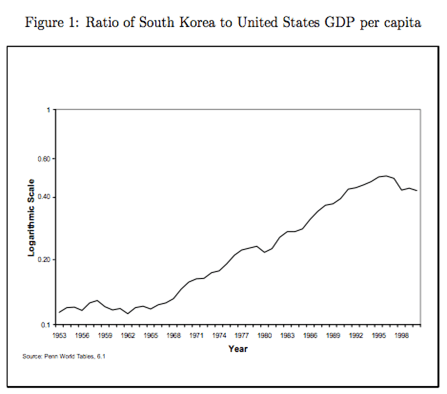
Unfortunately, a study for the World Bank’s Operations Evaluation Department found that Korea’s growth accelerated only after the decline in US aid, and did so by following policies contrary to the advice of US aid officials; hence, the consensus of most studies of Korea is that aid contributed little to Korea’s take-off (Fox 2000).
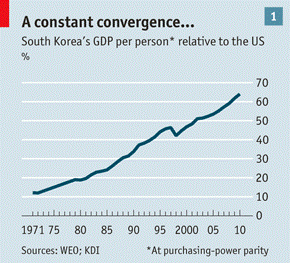
Chenery and Strout forecast in the early 1960s that growth in India and Pakistan over 1962-76 would exceed that of Korea. Rosenstein-Rodan at the same time predicted that Sri Lanka would have a higher per capita income than Taiwan or Korea by 1976. Hong Kong and Singapore, according to the same predictions, were to be left in the dust by Argentina and Colombia.
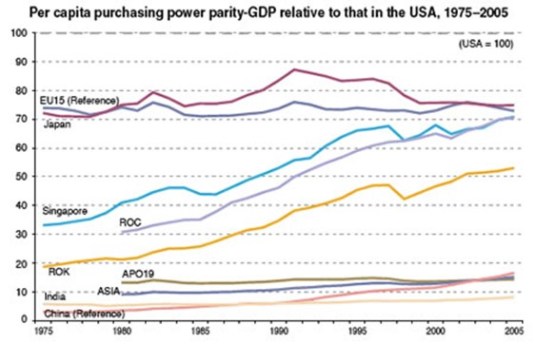
A key feature of this development miracle was an enormous increase in Korea’s international trade. In the early 1960s, Korea eliminated tariffs on imported production inputs and capital goods as long as these imports were used to produce goods for export. Beginning in the 1970s, Korea engaged in a broader, gradual reduction of tariff from about 40 per cent to 13 per cent.
Gordon Tullock is an interesting writer on South Korea saying that:
• Syngman Rhee was a socialist who knew nothing of capitalism.
• To make his country look capitalist to please the Americans, Rhee gave previously Japanese owned industries to his friends as monopolies.
• When General Park overthrew Syngman Rhee, he knew no economics, but he knew the bureaucracy was filled with Rhee’s cronies so he fired them all.
Tullock considers that South Korea became an open economy as a by-product of this political purge.
 Utopia, you are standing in it!
Jun 23, 2014 @ 06:50:06
I discussed this same topic with a friend about how South Korea was able to drag itself out of poverty and became a wealthy society.
LikeLiked by 1 person
Jun 25, 2014 @ 16:14:24
My Korean friends at Graduate School in Japan were very proud of the successes of their country in recent decades.
LikeLike
Jan 24, 2017 @ 16:28:25
I am an economics professor in the US. A student asked a question today and I have been trying to run down the data to answer it. In my text, he read about the natural experiment with NK and SK. The student wanted to credit US aid for all the difference between the two states.
I have searched high and low for some data to answer his comment. I think a sufficient measurement would be aid/GDP for the relevant years, except that I can’t find the data. I found one figure for aid of $12.96 B. All the places I go for SK GDP only start in 1960. Your data in this post implies that someone has the data on NK GDP.
Ideas?
LikeLike