
A New Measure of Political Risk: The DOG Factor
29 Jul 2014 Leave a comment
in economics

Governments behaving badly… We’ve all seen it. Get a bunch of libertarians from around the world together, and each seems to take perverse pride in proving that her own government is the worst of all. How can we quantify governments’ badness?
On the economic side, we might look to the Economic Freedom of the World index. The Economist has come up with a clever new one: the DOG factor (“discount for obnoxious governments”). It’s the deviation of the price-to-earnings ratio in the domestic market from global standard valuations. Some governments score very high indeed on the DOG factor:
Iran, like Russia a target of Western sanctions, trades on a p/e of just 5.6 and has a total stockmarket value of $131 billion; were it to be rated on a par with the average emerging market, its market value would be $292 billion, so its DOG factor is $161 billion…
View original post 115 more words
George Stigler on do business owners maximise profits?
29 Jul 2014 Leave a comment
in applied price theory, Armen Alchian, entrepreneurship, George Stigler, survivor principle, theory of the firm Tags: george stigler, market selection, profit-maximisation

Entrepreneurs often do not know why they survived in competition. George Stigler in his autobiography told this wonderful story about how you could not get businessmen to admit in a survey that they maximise profits.
You go to their office and asked them: Do they maximise profits?
Their answer would be, of course, not. I am here to provide employment to my workers and put a small amount aside for the education of my children.
The surveyor would then ask them: if you do were to raise your prices, do you expect to increase your profits?
The businessman answers no.
The surveyor how would then ask them: if you were to cut your prices, do you expect to increase your profits?
The businessman answers no.
The survey would then ask: can you point to a time in the last 12-months where you substituted profit for some other objective?
At this point of time, you would be thrown out of their office as some sort of lunatic.


Some principles of job design
29 Jul 2014 Leave a comment
in managerial economics, organisational economics, personnel economics Tags: Edward Lazear, job design

A job is a grouping of tasks (Lazear 1998). Job design objectives include technological efficiency, flexibility to temporary and permanent changes, explicit incentives, intrinsic motivation and commitment, and social aspects such as peer pressure, social comparisons and social interactions (Baron and Kreps 1999; Lazear 1998).
Job design parameters include the level and the breath of job content, the variability over time of task assignment and extent of rotations, the specific mix of tasks of worker or group at any time, individual effort or team membership, and the level of autonomy (Baron and Kreps 1999).
Multi-task working environments are common. Most jobs group together a variety of tasks with each requiring different degrees of employee effort and attention. The design of jobs and rewards to employees affects the level and allocation of employee effort and initiative (Holmstrom and Milgrom 1991; Lazear 1998).
The complexity of tasks that are grouped into many jobs allows workers to work harder on measured and rewarded tasks at the expense of unmeasured and unrewarded outputs and quality, and workers can take excessive risks or be too cautious (Baron and Kreps 1999; Prendergast 1999; Lazear 1998).
Employee effort can be strategically shifted between measurement periods, or too much time is spent influencing supervisors’ evaluations. In addition, workplaces require co-operation but giving strong rewards for individual efforts can undermine team performance (Lazear 1998; Baron and Kreps 1999).
Employers bundle tasks into specific jobs. There are competing merits in specialised and broad task assignment (Brickley, Smith and Zimmerman 2004). Specialised task assignments exploits comparative advantage of employees in specific task and lowers cross-training expenses, but foregoes complementarities across tasks, increases coordination costs, and reduces flexibilities (Brickley, Smith and Zimmerman 2004). Phased retirement affects the nature and specialisation of task assignments because fewer tasks can be bundled into a part-time job.
Every firm must provide incentives embedded into job and team designs so that employees act in the way the employer wishes, giving the agreed level of effort and correctly allocating their efforts across different tasks as the employer would want them to do in the presence of uncertainty, incomplete and dispersed information and costly observation and measurement (Alchian and Demsetz 1972; McKenzie and Lee 1998; Holmstrom and Milgrom 1991).
Employers do not always know what instructions to give to their employees. This is because employers lack access to all of the local and tacit information dispersed across the firm and individual employees about what can be done, what needs to be done and what has changed. Incentives are important to ensuring that workers have the freedom of action to best use the information particular and local to their particular jobs, equipment and customer interactions and are correctly rewarded for taking the initiative (McKenzie and Lee 1998).
Entrepreneurs reap profits from discovering the job designs and wage policies that elicit the agreed level of employee effort and the desired levels of initiative, self-management and expeditious use of local knowledge across the multiple tasks that each employee must perform across time in their jobs and teams.
Will work-for-the-dole work in Australia?
29 Jul 2014 12 Comments
in labour economics, labour supply, macroeconomics, unemployment, welfare reform Tags: benefit exhaustion spike, search and matching, unemployment insurance, US welfare reforms, welfare reform

One of the strongest empirical findings of modern labour economics is the benefit exhaustion spike. This is the large increase, shown in the diagram, in the probability of finding a job on the eve of exhausting unemployment benefits or unemployment insurance eligibility.
This benefit exhaustion spike is mobile: when unemployment insurance eligibility is lengthened, the benefit exhaustion spike moves out to the new benefit exhaustion date. For example, from 26 weeks, then to 39 weeks, then 52 weeks and then to 99 weeks. There is also a benefit exhaustion spike where the generosity of unemployment or other insurance decreases after a certain time. The alleged decay in the human capital of the long-term unemployed does not seem to affect this benefit exhaustion spike.
In addition, in the EU, the job finding probability of unemployment insurance recipients eligible for other welfare schemes are less sensitive to changes in the level and duration of their unemployment benefits benefits.
The benefit exhaustion spike shows that job seekers have much more control over their re-employment prospects than is commonly granted even in the worst of economic conditions such as in Pittsburgh in the early 1980s in a major recession and when US manufacturing industry industry was in a long-term decline.
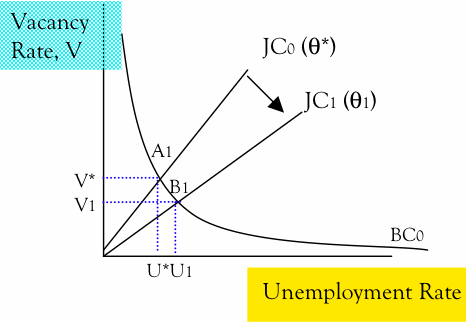
The individual’s reservation wage (i.e. the lowest wage wage at which individuals will accept a job offer) decreases whilst search intensity increases as they approach unemployment benefit eligibility exhaustion.

This reduction in reservation wages or the asking wages of job seekers increases the incentives for employers to post new vacancies because they can fill them at a lower cost. Both more intensive job search and more vacancies will see jobs filled faster, and more jobs created and filled.
A mechanism for reducing welfare programme entry rate while increasing welfare benefit exits is mandatory minimum job search and mandatory work requirements such as those proposed this week for Australia. These minimum hours can be spent working part time, in study and training, work preparation and job search assistance or volunteering. A work requirement is a screening device that removes any advantage of moving on to welfare in terms of more leisure time.
The proposals announced this week in Australia are most job seekers will be required to look for up to 40 jobs per month and work for the dole will be mandatory for all jobseekers younger than 50. Job seekers younger than 30 would have to work 25 hours a week under the expanded programme, while those between 30 and 49 will be asked to do 15 hours work a week, and those aged 50-60, 15 hours a week.
At least 13 OECD member countries require at least monthly visits to a local employment office by unemployment beneficiaries to present job-search evidence and also perhaps to receive advice and even referrals to specific job openings.
Reforms in a range of overseas countries that introduced more intensive monitoring of job search and stronger sanctions on benefits for non-compliance significantly reduced unemployment spells.
One of the surprising results of more intensive monitoring of job search and a requirement to sign on regularly at the local employment office or Social Security office is the sheer horror of having to sign-on and talk to caseworker for five minutes encourages 5 to 10% of unemployed beneficiaries to find a job. When unemployment and sickness beneficiaries are required to undergo a full reassessment of their eligibility, it is common for up to 30% of them simply to not reapply.
The stronger monitoring of job search and the real prospect of stiffer sanctions for non-compliance encourages all benefit claimants, current and future, and not just those actually sanctioned to search harder for jobs. This anticipation of stricter monitoring and more frequent eligibility reviews has a much larger effect of welfare dependency than the actual sanctioning of the non-complaint. People review their options and marshalled their resources to find or stay in work.
The welfare exit effect and welfare entry deterrence arises from mandatory work requirements from the relative non-financial rewards of working and not working having changed in favour of staying in full-time and semi-work for persistent workers temporarily on a welfare benefit.
Persistent workers gain from anticipating the onerous nature of work requirements and searching more intensively for jobs which are more stable and enduring. These job seekers may reduce their asking wage to win a lower paid but steadier job.
Seasonal and temporary jobs will be less attractive if there are work requirements. The incentive to cycle between the benefit and part-time and full-time work including seasonal and temporary jobs are reduce because work requirements make welfare receipt more onerous. Those job seekers with fewer outside of the workforce obligations such as young children are the most likely to move to (stable) full-time work because of work requirements.
A work requirement as a condition for a welfare benefit receive unambiguously increases net labour supply and reduces the number of people relying on the welfare system now and into the future.
The number of people working increase and some leave welfare rather than comply with the mandatory work programmes. Work requirements make welfare receipt unambiguously less attractive and will close the gap between earning full-time wages and the net rewards of not working or part-time work and partial benefit receipt.
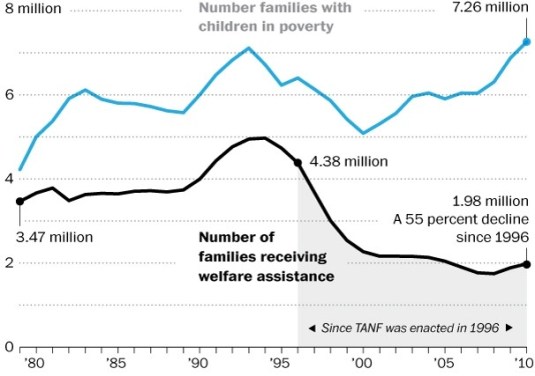
There was a more than 60% reduction in welfare caseloads after the 1996 federal welfare reform in the USA that introduced work requirement and five year lifetime federal welfare eligibility time limits on a national basis. In the four decades preceding the 1996 welfare reform, the number of Americans on welfare had never significantly decreased.
The gains in U.S. employment after the 1996 Federal welfare reform were largest among the single mothers previously thought to be most disadvantaged: young (ages 18-29), mothers with children aged under seven, high school drop-outs, and black and Hispanic mothers. These low-skilled single mothers in the USA were thought to face the greatest barriers to employment.

The U.S. literature has many competing estimates of the relative effects of work requirements, lifetime time limits and a far more generous earned income tax credit (EITC). It is agreed that work requirements and time limits reduced entry into welfare caseloads. The relative importance of time limits, work mandates and greater EITC generosity for exits is more disputed.

The Minnesota Family Investment Program (MFIP) had a more complex experimental design that allowed separate evaluation of the mandatory welfare-to-work program and the lower benefit reduction rate. The results indicated that the lower benefit abatement rates appear to have had little labour supply effect. The increase in labour supply seems to have come almost entirely from the mandatory welfare-to-work program and its associated sanctions.
Much was initially made in the US empirical literature of the strong state of the American economy in the 1990s as an explanation for part of the drop in welfare caseloads. The relevance of this faded when welfare caseloads did not increase again when the economy deteriorated after 2007 in the USA.
More Compelling Evidence that America’s Corporate Tax System Is Pointlessly Destructive
29 Jul 2014 Leave a comment
in economics

It’s probably not an exaggeration to say that the United States has the world’s worst corporate tax system.
 We definitely have the highest corporate tax rate in the developed world, and we may have the highest corporate tax rate in the entire world depending on how one chooses to classify the tax regime in an obscure oil Sheikdom.
But America’s bad policy goes far beyond the rate structure. We also have a very punitive policy of “worldwide taxation” that forces American firms to pay an extra layer of tax when competing for market share in other nations.
And then we have rampant double taxation of both dividends and capital gains, which discourages business investment.
 No wonder a couple of German economists ranked America 94 out of 100 nations when measuring the overall treatment of business income.
So if you’re an American company, how do you deal with all…
View original post 771 more words

Reasonable and unreasonable wariness of intellectuals
29 Jul 2014 Leave a comment
in applied price theory, economics, economics of education, personnel economics Tags: intellectuals, Richard Posner, Thomas Sowell


The shape of recoveries from recessions
28 Jul 2014 Leave a comment
in business cycles, macroeconomics, Milton Friedman, monetarism Tags: boom and bust, Milton Friedman, plucking model, recoveries from recessions
Milton Friedman (1993) proposed a model of the depth of recessions and steepness of recoveries built on two empirical regularities:
- output is on average below a ceiling defined by supply capacity and tends back to this ceiling; and
- large contractions are followed by large expansions and mild contractions are followed by mild expansions.
The strength of a recovery should be positively correlated with depth of the recession but there should be no correlation between expansions and recessions (Friedman 1993; Alchian 1969).
The figure below illustrates Friedman’s model, which likens the time path of output to a string on the underside of an upward sloping board that is plucked downward at random intervals to various extents into busts that are followed by booms.

Source: Garrison (1996).
The upward sloping board plotted as a thick line in the figure represents a ceiling on feasible output and employment in a given year that is set by resource and technology availabilities. The upward slope of this board accounts for trend real GDP growth over time due to technological progress and other factors.
The business cycle starts with a bust caused by an adverse policy or other shock and is then followed by a boom as the market self-adjusts and the policy errors are reversed. Without the initial adverse policy or other shock, there would neither be a bust nor a boom.
The correlation between busts and booms arises from the monetary contraction that caused the bust eventually inducing an offsetting correction in monetary policy.
The monetary contraction that pushed or plucked output below the upward sloping ceiling is later followed by a monetary expansion that offset the earlier contraction. With the amplitude of monetary expansions correlated to offset the prior contractions, GDP growth will have similar plucks or falls and rebounds to the upward sloping output ceiling because of the link albeit with a lag between monetary growth and output fluctuations. The increases and decreases in monetary growth are independent policy choices with unique causes.
The associated upward and downward movements in GDP growth are not correlated with each other but should be correlated with the prior fluctuations in monetary growth. There would not be a bust and later boom if there is no monetary contraction to start the cycle. This is why Friedman (1993) proposed that the depths of busts are unrelated to the duration and strength of prior economic booms.

Paul Samuelson (1989) on the bright future of the Soviet Union
28 Jul 2014 Leave a comment
in comparative institutional analysis, Marxist economics Tags: fall of communism, forecasting, Paul Samuelson

What Austrian Economics IS and What Austrian Economics Is NOT with Steve Horwitz
28 Jul 2014 Leave a comment
in Austrian economics Tags: Pete Boetkke, Steve Horwitz
Pete Boettke’s entry on “Austrian Economics” at the Concise Encyclopedia of Economics, also offered 10 propositions that define Austrian economics:
- Only individuals choose.
- The study of the market order is fundamentally about exchange behaviour and the institutions within which exchanges take place.
- The “facts” of the social sciences are what people believe and think.
- Utility and costs are subjective.
- The price system economizes on the information that people need to process in making their decisions.
- Private property in the means of production is a necessary condition for rational economic calculation.
- The competitive market is a process of entrepreneurial discovery.
- Money is non-natural.
- The capital structure consists of heterogeneous goods that have multispecific uses that must be aligned.
- Social institutions often are the result of human action, but not of human design.
Where did the anti-war movement go after Obama was elected?
28 Jul 2014 Leave a comment
in war and peace Tags: anti-war movement, peace movement, voter demographics

Michael T. Heaney and Fabio Rojas found that half of democratic party voters previously involved in anti-war protests under President Bush withdrew from the anti-war movement upon the election of President Obama:
The withdrawal of Democratic activists changed the character of the anti-war movement by undermining broad coalitions in the movement and encouraging the formation of smaller, more radical coalitions
Not even the loud, raucous and disruptive Code Pink stayed to its principle, and show themselves to be bunch of Democratic party hacks – Heaney and Rojas explain:
Code Pink: Women for Peace continues to speak out against war, but it has devoted a greater proportion of its energy to other issues, such as health care reform and the Israeli-Palestinian crisis.
After Obama’s election as president, their surveys of 5,400 demonstrators at 27 protests from January 2007 to December 2009 showed that Democratic party voter participation in anti-war activities plunged 37 per cent of anti-war protest this in January 2009 to 19 per cent in November 2009.
 Utopia, you are standing in it!
Recent Comments