Another welfare reform is a modest income threshold below which benefits are not abated. This is low for unemployment and sickness beneficiaries and higher for domestic purposes and invalid beneficiaries.
The idea behind abatement-free income thresholds is to not penalise part-time work among sole mothers and encourage the unemployed and sick to return to full-time work.
The Figure 1 shows that an increase in the benefit abatement threshold has similar ambiguous net labour supply effects to a lowering of welfare benefit abatement rates.
Figure 1: Impact of abatement thresholds on labour supply
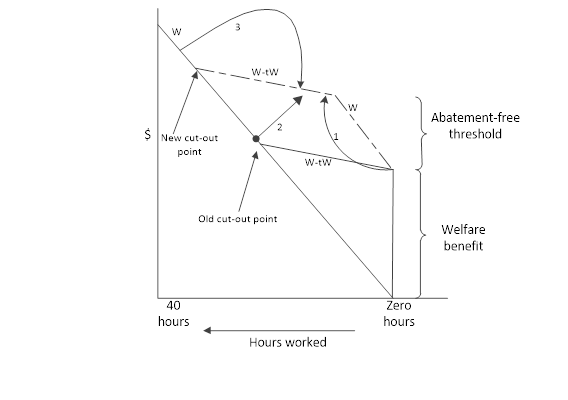
- Arrow 1 in figure 1 shows that some who were not currently working will now find working part-time a more attractive option because of the introduction of a benefit abatement-free threshold. Their take-home pay is higher although they enjoy less leisure time.
- Arrow 2 in figure 1 shows that some part-time workers will reduce their working hours because working less and claiming the benefit clearly increases both their take-home pay and allow for more leisure time.
- Arrow 3 in figure 1 shows that workers who work a relative high number of hours per week for a relative low wage will reduce from full-time to part-time working hours because of a revised leisure-labour trade off now makes a somewhat lower take-home pay worthwhile because of increased leisure time.
- No welfare recipients leave the welfare system but some join it because of the introduction or increase in the abatement-free income threshold.
The net labour supply effects of a higher benefit abatement-free threshold are ambiguous because the reduced hours of those already in work offsets the labour force participation of those previously not in work.
Whether net labour supply increases or decreases depends on the relative numbers of individuals at different points on the budget constraint working full-time, not working and working part-time and on the magnitudes of their responses. Some will stay as they were either working full-time, not working or working part-time.
The objective of reducing welfare dependency by encouraging part-time work by those not working has important unintended adverse consequences for the labour supply and welfare dependency of those currently working part-time and full-time on low wages.
A common result of welfare reforms that increase abatement thresholds or reduce abatement rates is that no welfare recipients leave the welfare system but some join it. Welfare dependency is not reduced by financial incentives that increase the generosity and the availability of welfare benefits.
The labour supply effects of welfare reforms that increase benefit abatement thresholds or reduce benefit abatement rates are ambiguous because the reduced working hours of existing workers offsets the hours worked by those not employed prior to the reform. A further complexity is that encouraging part-time work channels beneficiaries into low paid jobs that offer little training and other human capital benefits.
In summary, an increase in the benefit abatement-free income thresholds for welfare recipients has the following effects:
- not all welfare recipients will respond to a higher abatement-free income threshold by supplying more labour;
- those welfare recipients who do respond to a higher abatement-free income are better-off and supply more labour and take-home more pay;
- the increase in labour supply is in part-time work by beneficiaries earning income up to the higher abatement-free income threshold;
- No welfare recipient leaves the welfare system – those welfare recipients who respond to this welfare reform continue to collect their full welfare benefit and work a few more hours each week.
While reforming the welfare system is intended to change the labour market behaviour of welfare recipients, it also has unintended consequences on individuals who are not collecting welfare benefits.
An increase in the exemption level for earned income affects the labour market behaviour of someone who is not receiving welfare benefits has the following effects:
- prior to the increase in the abatement-free threshold, the individual is best off by working part-time or full-time and not collecting welfare or even being eligible to collect welfare benefits; and
- after an increase in the benefit abatement-free income threshold, a worker is better-off by supplying less labour and collecting a full welfare benefit, which raises their total income.
Permitting welfare recipients to keep larger amounts of income without losing any of their welfare benefits will attract more workers into the welfare system. Some workers will find that they are better-off by joining the welfare system and switch from full-time work to being a welfare recipient who works part-time (up to the new higher exemption level). The cost of the welfare programme increases, there are more welfare recipients, and no welfare recipient loses any benefits.
All welfare recipients who increase their labour supply up to the new higher exemption level (and lower abatement rates) and all workers who switch to the welfare system will be better-off.
The effect of the quantity of labour supplied is ambiguous: some old welfare recipients will increase their labour supply up to the new higher abatement-free threshold (probably by a relatively small amount) but new welfare recipients will decrease their labour supply (probably by a relatively large amount) as they move from full-time work to part-time work on welfare.
The overall effect of changes in benefit abatement regimes depends on the number of old and new welfare recipients and the size of the labour supply change for each.
- The quality of labour supplied will deteriorate as some full-time workers switch to welfare and work part-time; part-time workers generally have less attachment to the labour force and tend to invest less in human capital to up-grade their labour market skills.
- High-productivity workers are working fewer hours while lower-productivity workers work more hours.
If the objective is to reduce the number of people on welfare by moving some welfare recipients (those who are able to work) into work, increasing abatement free income thresholds or lowering abatement rates are not the solution. Both options increase the number of people on welfare.
A reduction in the amount of welfare benefits will reduce the number of people on welfare, reduce the cost of the welfare programme, increase the supply of labour, increase the number of full-time workers relative to part-time workers but make all current welfare recipients worse-off and risks providing inadequate income support to those who are unemployable.
The blogs so far
part-one-the-labour-leisure-trade-off-and-the-rewards-for-working
part-two-the-labour-supply-effects-of-welfare-benefit-abatement-rate-changes
part-3-abatement-free-income-thresholds-and-labour-supply
part-4-in-work-tax-credits-and-labour-supply
part-5-higher-abatement-rates-and-labour-supply
 Utopia, you are standing in it!
Recent Comments