Trade diversion occurs when preferential trading agreements cause imports to shift from low cost countries to higher cost countries. Rather than gaining tariff revenue from inexpensive imports from world markets, a country may import expensive products from member countries but not gain any tariff revenue. An example of trade diversion is when Britain closed its doors to New Zealand agricultural exports after joining the common market.
Preferential trading agreements are trade agreements between countries in which they lower tariffs for each other but not for the rest of the world. The mass media mislabel them free trade agreements.
Under trade diversion, the partner country benefits from this change as an exporter, but the importing country loses due to this higher cost, as does the third country whose exports fall.
The loss to the importing country is not visible to consumers, who find the higher-cost product cheaper due to the absence of tariff. The country as a whole loses, with that loss being lost tariff revenue – lost to cover the cost of the higher cost imports from a member of the new preferential trading agreement.

It does not take much trade diversion to make a preferential trading agreement welfare reducing because of this switch to high cost producers.
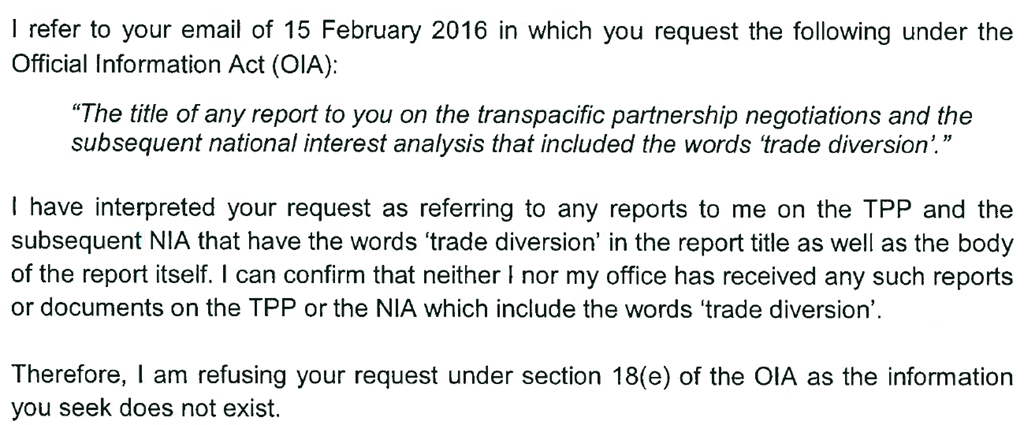
The New Zealand Minister of Trade and the Ministry of Foreign Affairs and Trade did not discuss this major risk even from the simplest preferential trading agreement in recent policy analysis of the TPPA as my Official Information Act request has revealed. The term trade version does not appear in any of their analysis.
Adherents of the natural trading partner hypothesis argue that preferential trade agreements are more likely to improve welfare if participating countries already trade disproportionately with each other. Opponents of the hypothesis claim that the opposite is true: welfare gains are likely to be greater if participating countries trade less with each other. The powerful critique by Bhagwati and Panagariya (1996) is now widely accepted and one hears little justification of on preferential trading agreements on the grounds of the natural trading partners hypothesis
 Utopia, you are standing in it!
Recent Comments