Yesterday was simply a fascinating day in British politics. On the Tory side, the race for party leader provided several twists and turns. Michael Gove surprised many by announcing his candidacy, and then Boris Johnson unexpectedly bowed out.
In the Labour Party, amid continued calls by an overwhelming majority of his own MPs to stand down, an event to roll out Shami Chakrabarti’santisemitism report devolved into chaos when a Jewish MP stormed out of the room after being accused by of colluding with the media to undermine Corbyn. An even bigger Labour own-goal was achieved when Corbyn gave a speech interpreted by some as suggesting a comparison between ISIS and Israel.
Here’s the video.
Whilst following tweets by journalists on the ongoing British political drama, I noticed this by former Guardian journalist Glenn Greenwald
There has been a lot of speculation as to the meaning of the ‘constitutional requirements’ to trigger Article 50. Nature abhors a vacuum and sometimes, it seems, so do constitutions. This vacuum arises because, unlike other legislation providing for a referendum, the European Union Referendum Act 2015 makes no mention of any legal obligation triggered by the referendum result. Most, if not all, British constitutional lawyers would accept the proposition that referenda do not generate legally binding obligations upon government to implement their results, and the lack of provisions in the 2015 Act contrasts starkly with the Northern Ireland Act 1998 and the Parliamentary Voting and Constituencies Act 2011. Given the relative silence of the European Union Referendum Act 2015, one can only infer that the result of the referendum is advisory only, and does not trigger Article 50 in and of itself. If any legal obligations follow from…
My two cents on the sharp rise of partisanship and congressional polarisation is they are driven by the great restraint in the growth of government spending in the 1980s.
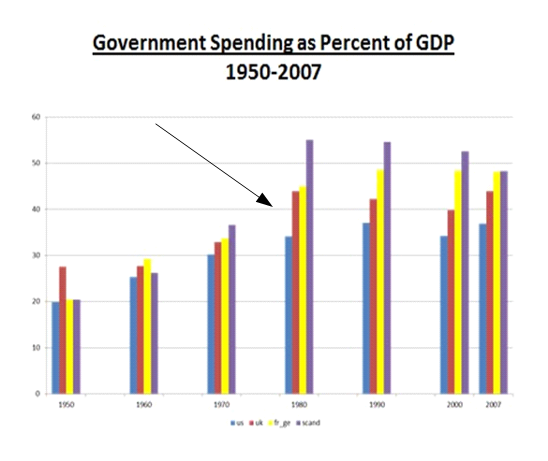
From 1950 to 1980 the size of government doubled but then stopped dead in the 1980s. This great restraint on the growth of government happened everywhere. It was not just Thatcher’s Britain or Reagan’s America. It was everywhere, France and Germany, and even Scandinavia.
Peltzman’s data which I have charted has government spending in the USA, Britain, France and Scandinavia doubling between 1950 and 1980, and then nothing much happened between 1980 and 2007 – the size of government was pretty flat as a share of GDP for 27 years.
Governments everywhere hit a brick wall in terms of their ability to raise further tax revenues. Political parties of the Left and Right recognised this new reality.
Government spending grew in many countries in the m-d-20th century because of demographic shifts, more efficient taxes, more efficient spending, a shift in the political power from those taxed to those subsidised, shifts in political power among taxed groups, and shifts in political power among subsidised groups Importantly for explaining later political polarisation, that growth of government was concentrated in four programs – defence, health, education and income security
The median voter in all countries was alive to the power of incentives and to not killing the goose that laid the golden egg which underwrote the initial growth in the size of government. The rising deadweight losses of taxes, transfers and regulation limit inefficient policies and the sustainability of redistribution.
After 1980, the taxed, regulated and subsidised groups had an increased incentive to converge on new lower cost modes of redistribution to protect what they had. More efficient taxes, more efficient spending, more efficient regulation and a more efficient state sector reduced the burden of taxes on the taxed groups. Reforms ensued after 1980 led by parties on the Left and Right, with some members of existing political groupings benefiting from joining new coalitions.
A lot more is at stake when the main political battleground is dividing a relatively fixed revenue pie post-1980 than a growing pie Between 1950 and 1980. Fiscally conservative voters will elect parties strongly committed to no new taxes. Their opponents will look for equally ideologically committed parties. Peltzman makes the very interesting point that:
There is no new program in the political horizon that seems capable of attaining anything like the size of any of these four. For the time being the future government rest on the extent of existing mega programs.
Health and income security account for 55% of total government spending in the OECD. It is in these two programs where the future of the growth of government lie.
The pressure for that growth in government will come from the elderly. Governments will have to choose between high taxes on the young to fund the current generosity of social insurance, healthcare and old-age pensions or find other options. Peltzman explains this political tension for programs benefiting the elderly in his essay The Socialist Revival:
Deficit financing of future growth in these programs becomes increasingly problematic. So we now have the seeds of political conflict rather than consensus.
These very large programs confer substantial benefits on some. These beneficiaries resist any change in the status quo. But the benefits have to be financed at substantial cost to today’s workers. Many of them will not benefit on balance from these programs over their lifetimes. It is by no means clear whether the number of winners exceeds the number of losers today.
Policies that were once unthinkable now can be discussed and even implemented here and there. These include increased retirement ages, less generous public health care programs, more reliance on private saving for retirement and so forth.
Given that intergenerational and other struggles over who is taxed and who faces benefit cuts, middle-of-the-road politicians lose their appeal to the electorate.
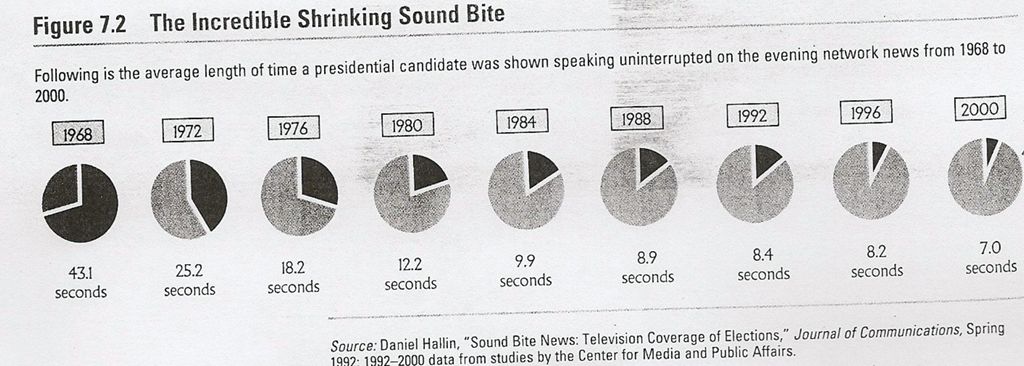
Another reason for greater political polarisation is the rising cost of time. Sound-bites news programs and current affairs are now a couple of seconds long when they used to be 15 seconds long maybe 30 years ago.
People have less time to pay attention to politics so they want to work out quickly from short sound-bites whether the politicians they are contemplating supporting are made of the right stuff. For voters in a hurry, conviction politicians are more appealing be they of the left or of the right. Voters want someone who will hold fast against new taxes or for new taxes as the case may be. Much is at stake as Sam Peltzman explained in his 2012 essay The Socialist Revival:
The steady growth of the old age population share is on the verge of a substantial acceleration… This means that government health care and public pension spending growth will also have to accelerate merely to keep the promises implicit in present programs.
The political economy will have to choose between higher taxes on the young to keep these promises, an accelerated shrinkage of the rest of the budget or less generous public health and pension programs. It is not clear yet which way the decision will go.
What is clear is that for the first time since the invention of the welfare state the magnitude and generosity of its signature programs is at political risk.
In this stand-off between those who might have to pay more in taxes and those who might receive less in old age pensions, welfare benefits and services including healthcare, neither side wants a politician naturally inclined to blink and compromise. They will elect politicians who hang tough for their side of the argument and their share of the budget.
Ed Miliband managed to do what 30 years of militant tendency entryism failed to do. He delivered the British Labour Party to the far left.
By allowing anyone to join the Labour Party for £3 to vote for its leader, far left activists were able to join online and vote in a leader and certainly re-elect him in the forthcoming challenge.
Far left control of the National Executive and National Conference means the Left will never have to agree to a less favourable form of electing the leadership. Corbyn plans to remove the parliamentary party from approving developing policy and nominating leadership candidates.
A Labour Party led by Jeremy Corbyn and then John McDonnell and other grumpy old socialists will never win a British general election. They will be massacred in 2020.
John McDonnell is good at saying there is much agreement on domestic policy but some want to go faster. That agreement is to be a more radical government than the Attlee government.
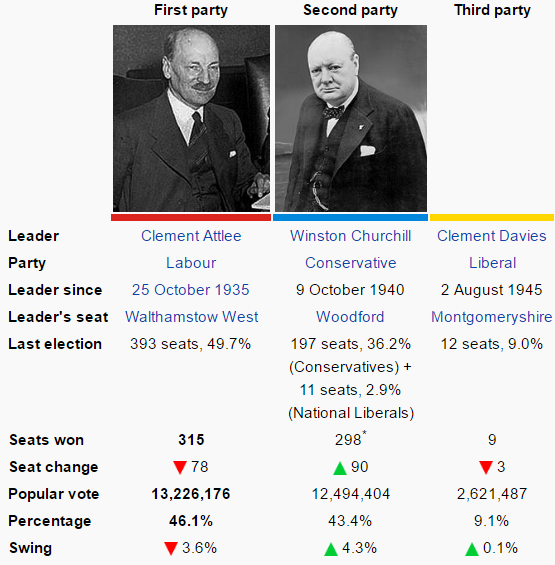
Labour was elected in a landslide in 1945 in the hope of a Better Britain. It was re-elected by 5 seats in 1950 in a time far more forgiving of socialism and the growth of government. Labour lost the 1951 general election and stayed out of office for the next 13 years.
If Labour wants to win a 2020 election in the United Kingdom of England, Wales and Northern Ireland, it must win 6% more of the vote and win England for one of the few times in its history. There will be no Scottish MPs to join in coalition in 2020.
If Labour is ever to be an effective opposition, an opposition that might actually win the next election by winning England outside of London, the party must split, discard the far left and become a social democratic party under a firm control of its MPs.
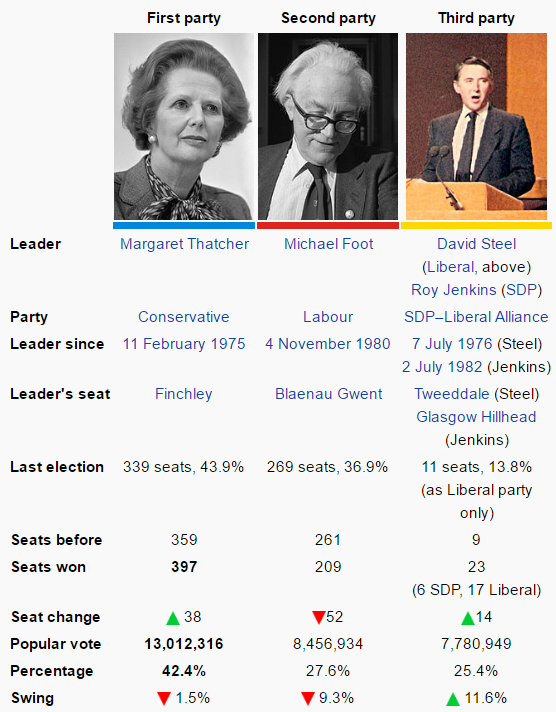
When four leading MPs left in 1981, they were able to cobble together 25% of the popular vote in the 1982 British general election in an alliance with the Liberal Party.
Imagine if 100-150 MPs left to form a new party big enough to be the official opposition now. They would have a real chance of killing off the left-wing rump in 2020 and winning in 2025.
That is better chances that they have now assuming there is no mandatory reselections and mass de-selections of MPs who do not support Corbyn. If Corbyn carries out his plan for mandatory re-selections, they have nothing to lose from forming another party and everything to gain.
Why Evolution is True is a blog written by Jerry Coyne, centered on evolution and biology but also dealing with diverse topics like politics, culture, and cats.
“We do not believe any group of men adequate enough or wise enough to operate without scrutiny or without criticism. We know that the only way to avoid error is to detect it, that the only way to detect it is to be free to inquire. We know that in secrecy error undetected will flourish and subvert”. - J Robert Oppenheimer.



 Utopia, you are standing in it!
Recent Comments