Simon & Garfunkel – The Sound Of Silence
31 May 2017 Leave a comment
in economics, Music Tags: Simon and Garfunkel
The Sanders-Boxer carbon tax will be 15 times costlier than letting warming happen
31 May 2017 Leave a comment
in economics
More on The Great Escape
31 May 2017 Leave a comment
in development economics, economic history, entrepreneurship, health economics Tags: The Great Escape

Claim: Four TRILLION Dollar Per Annum Carbon Tax Required to Save the World
31 May 2017 Leave a comment
in economics
About that Low Carbon Economy….
31 May 2017 Leave a comment
in economics

Recently the media has been full of stories about how Canada must jump on the ‘low-carbon’ economy bandwagon or be left behind. Eco-activists are claiming 100% renewables is possible.
Robert Lyman, energy economist of 37 years experience, has reviewed a recent EXXON report on future demand and summarizes it as follow. “Love ’em or hate ’em” this corporation is well-positioned to provide clear and accurate assessments of market realities. To make thoughtful policy decisions, it is important that we understand the reality of market demands and global growth.
EXXON’S VIEW OF GLOBAL ENERGY SUPPLY AND DEMAND TO 2040
Contributed by Robert Lyman @ March 2016
EXXON Corporation, one of the world’s largest energy enterprises, recently published its updated projection of energy supply and demand to 2040. The International Energy Agency, the United States Energy Information Administration, and British Petroleum have recently issued similar projections.
Projections of these kinds are interesting…
View original post 693 more words
The Sky is Falling!
31 May 2017 Leave a comment
in economics
Contributed by Robert Lyman © May 2017
In a story published two days ago in the Independent, a U.K. newsmagazine, Seth Berenstein reported on the claims of a group of scientists, including Michael Oppenheimer of Princeton University, about the possible effects of the United States withdrawing from the December 2015 Paris agreement on global warming. Oppenheimer is quoted as saying that “one expert group” (unidentified) ran a worst case computer simulation of what would happen if the U.S. does not curb greenhouse gas emissions but all other countries meet their targets. It found that “America would add as much as half a degree of warming (0.3 degrees Celsius) to the globe by the end of the century.”
“Another computer simulation team put the effect of the U.S. pulling out somewhere between 0.1 and 0.2 degrees Celsius.”
Wow! As a matter of fact, the Paris Agreement contains no targets. It is a…
View original post 224 more words
Average Income of Top 10% in 2010
31 May 2017 Leave a comment
in financial economics, human capital, labour economics, labour supply, occupational choice Tags: superstars, top 1%
Is Single Payer Right For America?
31 May 2017 Leave a comment
in applied price theory, applied welfare economics, health economics, politics - USA Tags: health insurance
Can the 41st Legislature of British Columbia Elect a Speaker?
31 May 2017 Leave a comment
in economics

 Legislative Assembly of British Columbia
A Hung Parliament and Revival of 19th-Century Norms
British Columbians went to the polls on 9 May 2017 and appeared to elect a hung parliament. Elections British Columbia had to conduct some mandatory recounts and count absentee and other ballots before certifying the results in some constituencies. On 24 May, Elections British Columbia certified that the Liberals had won a plurality of 43 seats (one short of a majority), and that the New Democrats had won 41 seats. The Greens hold the balance of power, with 3 seats.
On 29 May 2017, the leaders of the New Democratic and Green parties announced that they had come to a formal supply arrangement, whereby the Greens agreed to support a New Democratic ministry on confidence matters for the full four-year parliamentary term. The Liberals have governed British Columbia since 2001; the Greens want leverage in a…
View original post 1,169 more words
Have you biked down this trail before?
31 May 2017 Leave a comment
in economics of media and culture Tags: Darwin awards
An efficiency wage is a theory of persistent mass unemployment
31 May 2017 Leave a comment
in business cycles, labour economics, macroeconomics, personnel economics, unemployment Tags: efficiency wage, involuntary unemployment, living wage, moral hazard
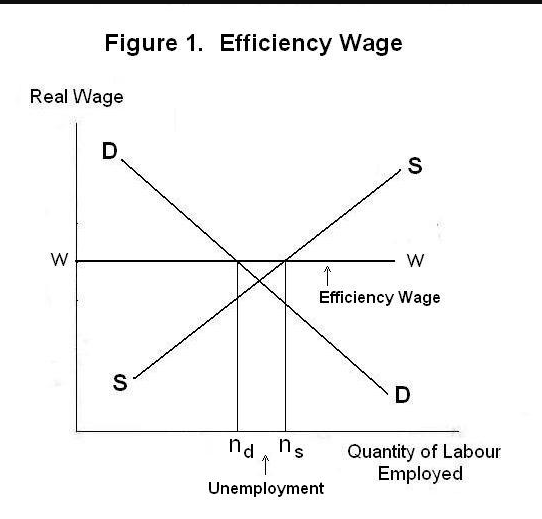
Shapiro and Stiglitz (1984) first put forward their theory of an efficiency wage to explain large-scale involuntary unemployment. It was the very real threat of a prolonged spell of unemployment (rather than a morale boosting pay rise) that motivated employees to put in more effort to keep their jobs:
To induce the worker not too shirk, the firm attempts to pay more the “going rate”; then, if the worker is caught shirking and is fired, he will pay a penalty. If it pays one firm to raise its wage, it pays all firms to raise their wages. When they all raise their wages, the incentive to shirk again disappears. But as all firms raise their wages, the demand for labour decreases, and unemployment results. With unemployment, even if all firms pay the same wage, a worker has an incentive not to shirk. For, if he is fired, an individual will not immediately obtain another job. The equilibrium unemployment rate must be sufficiently large that it pays the workers to work rather than take the risk of being caught shirking (Shapiro and Stiglitz 1984, p. 435).
The unemployed offer to work for less pay than existing employees but they are not hired because their labour productivity is not assured at this lower pay (Akerlof 1982, 1984; Katz 1986, 1988; Yellen 1984). There is involuntary mass unemployment because of the prevalence of efficiency wages:
If there is involuntary unemployment in an equilibrium situation, it must be that firms, for some reason or other, wish to pay more than the market-clearing wage. And that is the heart of any efficiency-wage theory (Akerlof 1984, p. 79).
Direct parallels were quickly drawn between the efficiency wage hypothesis as a worker discipline device eliciting greater effort and the old Marxist concept of the reserve army of the unemployed:
… it pays each firm to increase its wage to eliminate shirking. When all firms do this, the average wage rises and employment is reduced. In equilibrium, all firms pay a wage above the market clearing level, creating unemployment. Since jobs are scarce and rationed, the loss of a job can involve a lengthy spell of unemployment. The reserve army of the unemployed acts as a discipline device making shirking costly (Katz 1986, pp. 240-41).
It is misconceived for living wage activists to use a theory of lengthy unemployment to justify a large living wage rise but argue that there will be little unemployment because of the efficiency wage effects. This is the exact opposite of what the efficiency wage hypothesis is about. The leading Keynesian macroeconomists of their generation were striving to explain mass unemployment:
… the economists who developed the theory of efficiency wages (including Shapiro and Stiglitz, Akerlof and Yellen and Yellen) had no illusions that they were helping business firms to discover a new way to increase profits. The economists who developed efficiency wage theory were trying to explain persistent unemployment. Hence the title of Janet Yellen’s famous survey, Efficiency Wage Models of Unemployment.
The question that motivated efficiency wage theory was not why firms should raise wages but why firms don’t cut wages when they should. The answer they gave was that firms don’t cut wages despite unemployment because they fear that workers will respond to lower wages with reduced productivity …
In the original efficiency wage literature, there is no wishful thinking–no idea that we can have more of everything that we want without trade-offs. Instead of being desirable, the efficiency wage is a problem because lower wages would reduce unemployment and be better for the economy … the efficiency wage theorists took it for granted that to the extent that firms can increase profits by raising wages they have already done so (hence the persistent unemployment) (Tabarrok 2015).
Gordon was blunt about why efficiency wage arguments were popular and with whom
If any development in the microeconomics of labor markets could be called the “rage of the 80s,” it is efficiency wage theory, based on the hypothesis that worker productivity depends on the level of the real wage. When there is such a link between the wage rate and worker efficiency, firms may rationally pay a real wage rate that exceeds the market-clearing level. Firms may refuse to reduce the wage to hire members of a pool of unemployed workers who may be available at a lower wage, fearful that a reduction in real wages for existing workers may reduce productivity by more than the gain in lower wages (Gordon 1990, p. 1157).
Living wage activists have it the wrong way around about the social benefits of paying an efficiency wage. The efficiency wage hypothesis is a theory of why wages are too high and employment is too low (Akerlof 1982, 1984, 2002; Yellen 1984; Katz 1986, 1988; Stiglitz 2002). Living wage activists are using a well-respected theory of why wages are too high to argue that wages are too low.
Christopher Hitchens – Dispels two widespread illusions about islamic terror [2006]
31 May 2017 Leave a comment
in defence economics, economics of religion, war and peace Tags: war against terror
The Godfather – Deleted Scene – Not So Tough
31 May 2017 Leave a comment
in movies Tags: The Godfather
Please Please Me – Bee Gees on Bandstand (1963)
31 May 2017 Leave a comment
in economics, Music Tags: Bee Gees
 Utopia, you are standing in it!
Recent Comments