1933 German Federal Elections
David Seymour – Quote Of The Year – Update.
24 Jan 2025 Leave a comment
in liberalism, politics - New Zealand
I have just finished watching ACT Leader David Seymour’s State Of The Nation Speech and in it he produced this absolute gem: Yes we joined the Government But we did not join in the group think. I think it will stand the test of time and still be quote of the year on 31 December […]
David Seymour – Quote Of The Year – Update.
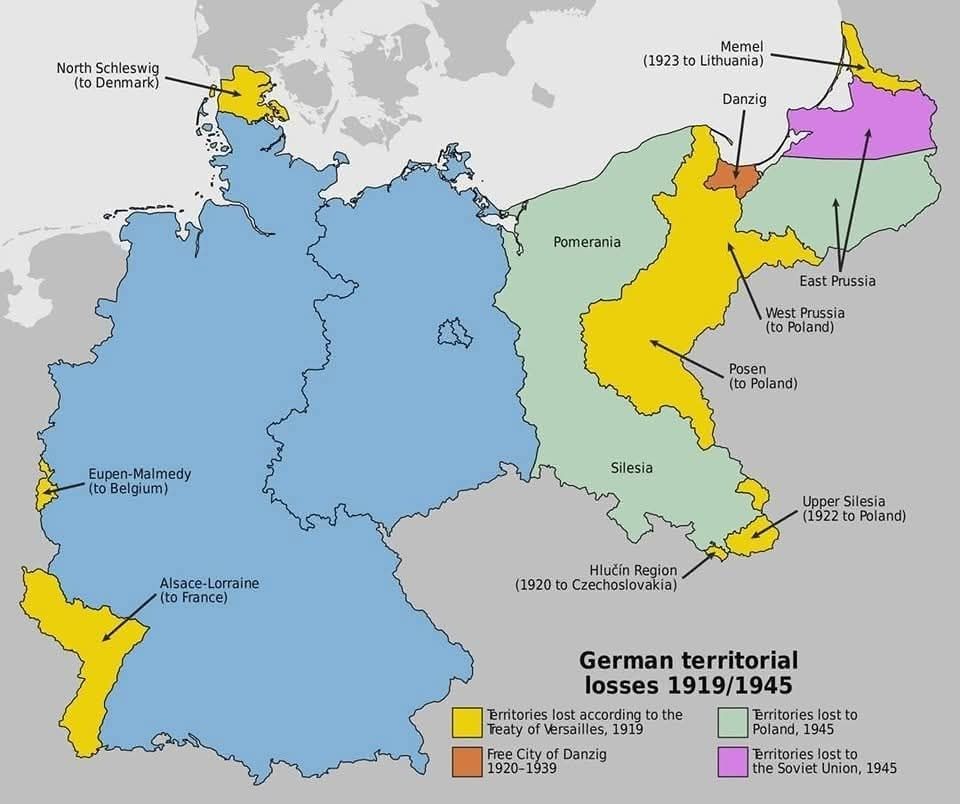
I like maps
24 Jan 2025 Leave a comment
in defence economics, economic history, international economics, International law, war and peace Tags: Nazi Germany, World War I, World War II
Britain’s Turn to be Dunkelfucked
24 Jan 2025 Leave a comment
in economics of climate change, energy economics, environmental economics, environmentalism, global warming Tags: British politics, wind power
First it was Germany discovering the expensive failure that is wind power, now Britain: Wind power has collapsed to less than 1pc of Britain’s electricity supply as some of the stillest weather in years hits the UK and Europe.***Near-zero wind speeds and low temperatures have left the UK dependent on France, Norway, Belgium and Denmark to […]
Britain’s Turn to be Dunkelfucked
The Tennessee-BlackRock Settlement: A Win for Transparency and Investor Interests
24 Jan 2025 Leave a comment
in economics of climate change, economics of regulation, energy economics, environmental economics, environmentalism, financial economics, global warming, law and economics, politics - USA, property rights Tags: active investing, climate activists, climate alarmism, efficient markets hypothesis
While no settlement is perfect, this agreement represents a significant victory for transparency, accountability, and the integrity of financial markets. For Tennessee investors—and indeed, all investors across the country—it’s a step in the right direction.
The Tennessee-BlackRock Settlement: A Win for Transparency and Investor Interests
Inflation (but not that sort)
24 Jan 2025 Leave a comment

The CPI will be out later this morning and I’m sure all eyes will be on that. But the Prime Minister’s reshuffle on Sunday prompted thoughts about inflation of another sort – the number of ministerial portfolios/titles in our executive government. When the reshuffle comes into effect on Friday there will (still) be 30 members […]
Inflation (but not that sort)
Nazispolozza: The Left’s Third Reich Mania Collapses into Comedy
24 Jan 2025 Leave a comment
in politics - USA Tags: 2024 presidential election

Below is my column in the New York Post on the latest attack on Elon Musk from the left. There is a mania on the left in calling people with opposing views “Nazis” and referencing the Third Reich. The left has jumped the Nazi shark in this rhetoric as the public tunes out these increasingly […]
Nazispolozza: The Left’s Third Reich Mania Collapses into Comedy
Trump Pardons and Commutations Included Violent Offenders Who Assaulted Police Officers
24 Jan 2025 Leave a comment
in economics of crime, law and economics, politics - USA Tags: 2020 presidential election, 2024 presidential election, crime and punishment, law and order

On Tuesday, President Donald Trump stated that the roughly 1500 pardons and commutations for J6 defendants issued Monday night are not the final resolution of cases. The President indicated that some commutations may be converted into full pardons. What is now clear is that the executive action includes violent offenders. That is wrong regardless of […]
Trump Pardons and Commutations Included Violent Offenders Who Assaulted Police Officers
The Little Book of Common Sense Investing
24 Jan 2025 Leave a comment
in applied price theory, financial economics Tags: active investing, efficient markets hypothesis, passive investing

John Bogle, the founder of Vanguard, wrote a short book in 2006 that explains his investment philosophy. I can sum it up at much less than book length: the best investment advice for almost everyone is to buy and hold a diversified, low-fee fund that tracks an index like the S&P 500. Of course, a […]
The Little Book of Common Sense Investing
Milei Implements Peer Approval for Food
24 Jan 2025 Leave a comment
in applied price theory, development economics, economics of regulation, health economics, politics - Australia, politics - New Zealand, politics - USA Tags: drug lags, food safety
Reason: In a sweeping move to overhaul Argentina’s food trade policies, Javier Milei’s administration officially deregulated food imports and exports on Monday. The reform, outlined in Decree 35/2025, seeks to boost foreign trade, cut bureaucratic red tape, and lower consumer prices. Federico Sturzenegger, head of the Ministry of Deregulation and State Transformation, explained in a post on […]
Milei Implements Peer Approval for Food
Sorry, Steve Paikin, but Mackenzie King Is Not The Longest-Serving Prime Minister in the Commonwealth
23 Jan 2025 Leave a comment

The myth which holds that Mackenzie King holds the record of “Canada’s longest-serving Prime Minister” persists. Steve Paikin has outdone himself now by going so far as to claim Mackenzie King holds the record of not merely Canada’s longest-serving Prime Minister but also as “the longest-serving Prime Minister in the history of the British Empire […]
Sorry, Steve Paikin, but Mackenzie King Is Not The Longest-Serving Prime Minister in the Commonwealth
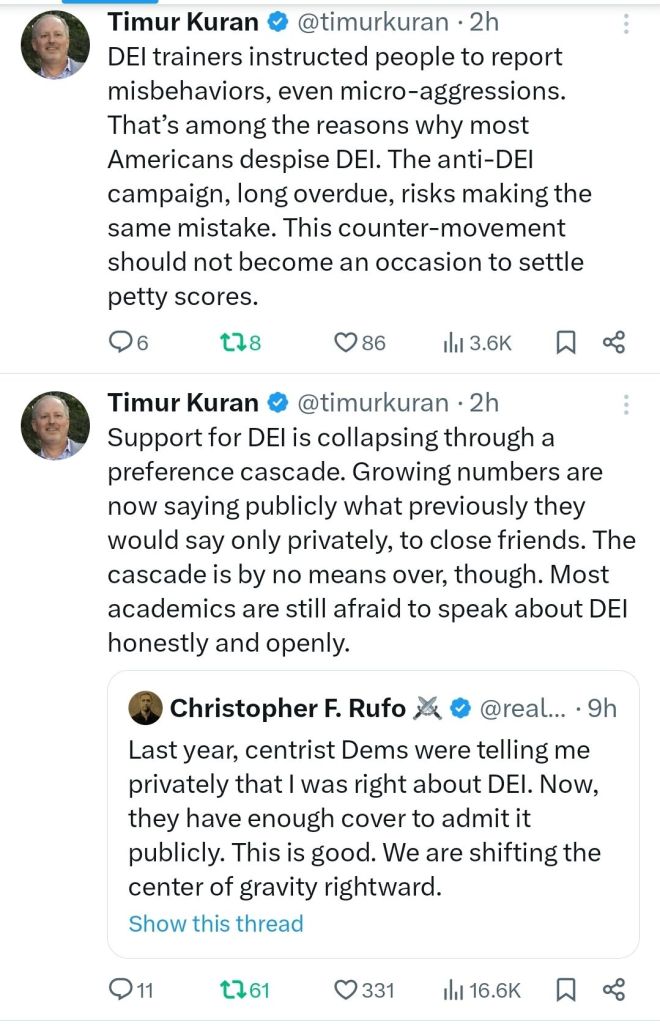
The DEI preference cascade
23 Jan 2025 Leave a comment
in applied price theory, behavioural economics, discrimination, economics of bureaucracy, economics of education, economics of information, economics of media and culture, economics of regulation, gender, labour economics, law and economics, liberalism, Marxist economics, politics - USA, property rights, Public Choice Tags: affirmative action, Age of Enlightenment, free speech, political correctness, racial discrimination, regressive left, sex discrimination
The Final Corruption of Joe Biden
23 Jan 2025 Leave a comment
in economics of crime, law and economics, politics - USA Tags: 2024 presidential election, crime and punishment, law and order

Below is my column in the Hill on the decision of Joe Biden to end his presidency with a final act of ignominy. The use of his pardon authority to protect his own family members was the final corruption of Joe Biden. Here is the column:
The Final Corruption of Joe Biden
Forbes and Frist Are Wrong About Climate Change Harming Human Well-Being
23 Jan 2025 Leave a comment
in economics of climate change, environmental economics, environmentalism, global warming Tags: climate alarmism
Frist and Forbes are perpetuating the baseless claims that weather has become more unpredictable and extreme when long-term data demonstrates that it has not, and that climate change presents an existential threat to human life and health, when it does not. They are misinforming their readers in order to spur environmental action, but instead are generating hopelessness and fear. This is shameful behavior.
Forbes and Frist Are Wrong About Climate Change Harming Human Well-Being
The Sting: Joe Biden Delivers the Final Blow to Mainstream Media
23 Jan 2025 Leave a comment
in economics of crime, law and economics, politics - USA Tags: 2024 presidential election

Below is my column on the Biden family pardons in Fox.com. President Joe Biden merely confirmed the worst expectations of his critics. The true condemnation rests with those in the media who enabled the Biden influence-peddling operation. Here is the column:
The Sting: Joe Biden Delivers the Final Blow to Mainstream Media


Recent Comments