
Part 1 of 2 on a damning new paper that takes on the top-down climate-economics literature — “The empirically inscrutable climate-economy relationship”
The Paper That Breaks Climate Economics
Celebrating humanity's flourishing through the spread of capitalism and the rule of law
22 Apr 2026 Leave a comment
in applied price theory, applied welfare economics, development economics, econometerics, economic history, economics of climate change, economics of natural disasters, energy economics, environmental economics, environmentalism, global warming, growth miracles
Part 1 of 2 on a damning new paper that takes on the top-down climate-economics literature — “The empirically inscrutable climate-economy relationship”
The Paper That Breaks Climate Economics
21 Apr 2026 Leave a comment
in applied price theory, development economics, econometerics, economic history, economics of love and marriage, financial economics, growth miracles, labour economics, labour supply, population economics Tags: China
The subtitle of the paper is Puzzles, Patterns, and Possible Causes. Here is the abstract: China’s large current account surplus has been an irritant to its trading partners. While industrial and trade policies often lead to sector-level imbalances, they play a relatively limited role in the economy-wide surplus. Structural factors such as an unbalanced sex…
The Chinese Current Account Imbalances
21 Apr 2026 Leave a comment
in applied price theory, development economics, international economics, politics - USA Tags: tarrifs
By Inti Pacheco of The WSJ. Excerpts:”Behind the jump: Extreme weather, including droughts in Brazil and Vietnam, had hit coffee crops. And even before any tariff increases, hedge-fund bets anticipating the levies were pushing commodity prices higher.” (droughts cause supply to shift to the left which raises price)”Then in July, President Trump slapped an additional 40%…
Why the Cost of Your Coffee Has Soared—and Isn’t Going Down Soon
19 Apr 2026 Leave a comment
in applied price theory, econometerics, entrepreneurship, fiscal policy, human capital, income redistribution, labour economics, labour supply, macroeconomics, poverty and inequality, Public Choice, public economics Tags: taxation and entrepreneurship, taxation and investment, taxation and labour supply
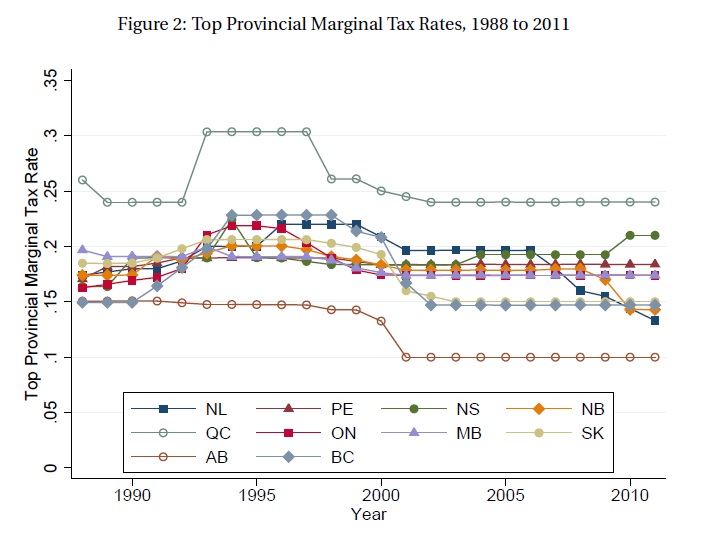
In Part I of this series back in 2014, we looked at some academic research from Canada showing that the revenue-maximizing tax rate on the richest taxpayers was 27.5 percent. A key insight from that research is that high-income taxpayers have considerable control over the timing, level, and composition of their income (just like in […]
The Laffer Curve and Limits to Class Warfare Tax Policy, Part II
18 Apr 2026 Leave a comment
in applied price theory, economic history, history of economic thought, income redistribution, industrial organisation, international economics, labour economics, labour supply, politics - USA, poverty and inequality, Public Choice, rentseeking, survivor principle Tags: creative destruction, free trade, tarrifs
In our textbook, Modern Principles, Tyler and I emphasize that Congress and the President are subject to a higher law, the law of supply and demand. In an excellent column, Jason Furman gives a clear example of how difficult it is to fight the law of inelastic demand: …Today a given number of autoworkers can…
The President(s) Fought the Law and the Law Won
17 Apr 2026 Leave a comment
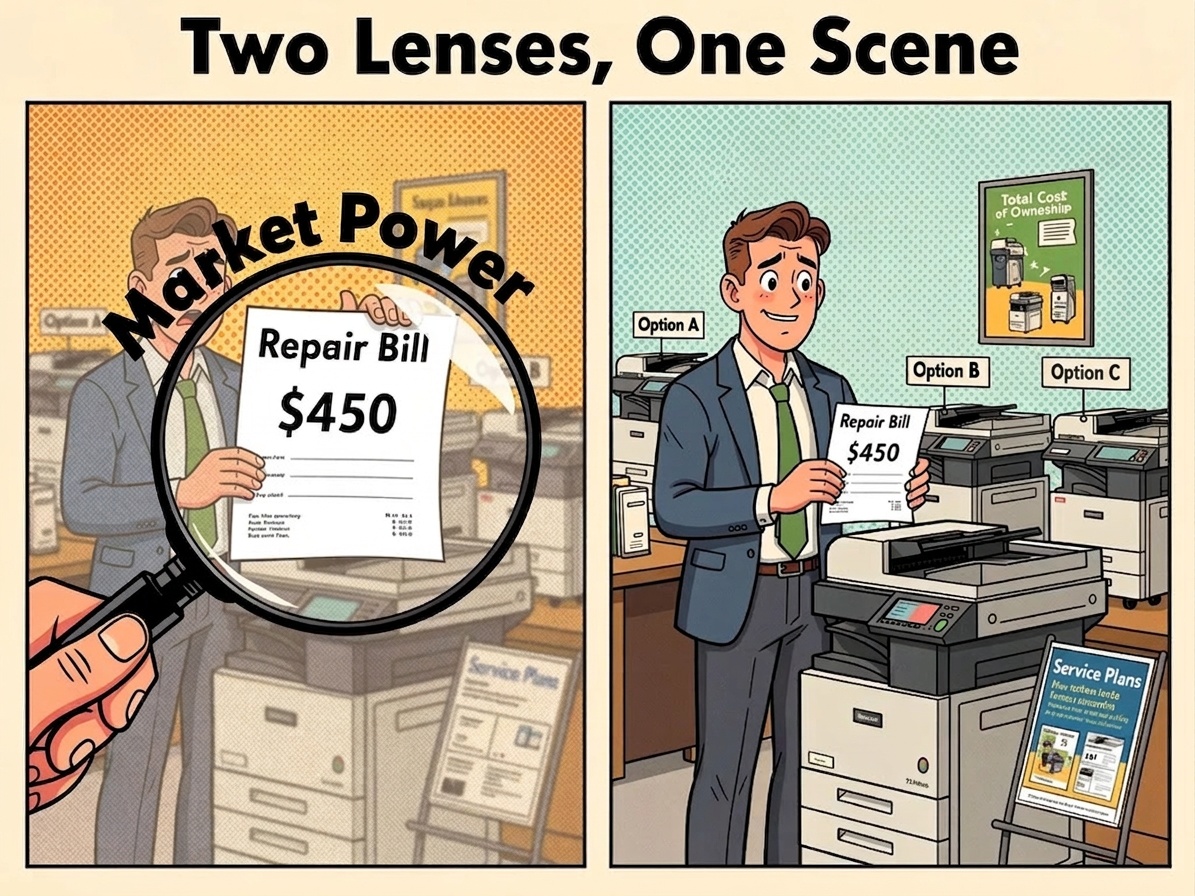
In 1992, the U.S. Supreme Court held in Eastman Kodak Co. v. Image Technical Services that a firm without market power in photocopiers might still possess market power in photocopier parts and service. The Court’s logic turned on opportunistic hold-up: Kodak could profit by trading short-run exploitation of locked-in customers for long-run losses in equipment…
‘Market Power in Antitrust: Economic Analysis after Kodak,’ by Benjamin Klein
17 Apr 2026 Leave a comment
in applied price theory, economics of regulation, history of economic thought, industrial organisation, law and economics, politics - USA Tags: competition law
In 1992, the U.S. Supreme Court held in Eastman Kodak Co. v. Image Technical Services that a firm without market power in photocopiers might still possess market power in photocopier parts and service. The Court’s logic turned on opportunistic hold-up: Kodak could profit by trading short-run exploitation of locked-in customers for long-run losses in equipment…
‘Market Power in Antitrust: Economic Analysis after Kodak,’ by Benjamin Klein
17 Apr 2026 Leave a comment
in applied price theory, history of economic thought, industrial organisation, international economics
TweetIdeally, every government would implement a policy of unilateral free trade. But governments, of course, by their nature testify that reality is very far from ideal. Here’s a letter to a long-time correspondent. Mr. B__: Thanks for your email in response to this blog post of mine in which I express support for the World…
Harnessing Mercantilist Idiocy for the Public Good
17 Apr 2026 Leave a comment
in applied price theory, economics of media and culture, economics of regulation, entrepreneurship, industrial organisation, law and economics, managerial economics, market efficiency, movies, organisational economics, politics - USA, television Tags: competition law, creative destruction, merger law enforcement

Big mergers make headlines. They don’t always make antitrust problems. In a previous commentary, I explored the antitrust implications of a potential acquisition of Warner Bros. Discovery (WBD). That uncertainty is now resolved. On Feb. 27, Paramount Skydance Corp. agreed to acquire WBD for roughly $110 billion in enterprise value—$31 per share, all cash. The…
The Paramount Question Isn’t Paramount
16 Apr 2026 Leave a comment
in applied price theory, development economics, economics of crime, economics of regulation, law and economics, transport economics, urban economics Tags: Mexico
But the cartel’s interests may prove just as important to security as government efforts, according to a dozen local and state officials and security experts. The CJNG has much to gain from the regional economic boost of a successful tournament in Guadalajara — akin to its administrative headquarters — and much to lose from drawing…
Incentives matter, Mexican cartel edition
15 Apr 2026 Leave a comment
in applied price theory, comparative institutional analysis, economics of regulation, health economics, liberalism, Marxist economics Tags: nanny state, regressive left
I spoke to my friends at the Sloavkian think tank INESS (the Institute of Economic and Social Studies) recently. We talked about my 2025 paper Anti-Capitalism and Public Health and you can watch the video below.
A discussion about Anti-Capitalism and “Public Health”
14 Apr 2026 Leave a comment
in applied price theory, applied welfare economics, econometerics, economic history, health economics Tags: life expectancies
This paper estimates the economic value to the United States of eliminating cancer mortality over a 35-year horizon beginning in 2030, which would eliminate 30.7 million cancer deaths with a total mortality burden of 380 million life-years. We quantify the economic value of this substantial reduction in cancer mortality by incorporating the monetized value of…
The economic value of eliminating cancer
13 Apr 2026 Leave a comment
in applied price theory, econometerics, economic history, technological progress
From the still-active Sam Peltzman: I document a sudden, sharp and historically unprecedented decline in self-reported happiness in the US population. It occurred during 2020, the year of the Covid pandemic, and mainly persists through 2024. This happiness crash spread across nearly all typical demographics and geographies. The happiest groups pre-Covid (e.g., whites, high income,…
The Happiness Crash of 2020
10 Apr 2026 Leave a comment
in applied price theory, defence economics, economic history, economics of bureaucracy, energy economics, financial economics, history of economic thought, labour economics, macroeconomics, monetary economics, politics - New Zealand, Public Choice, unemployment, war and peace Tags: 1973 oil crisis, monetary policy, oil shocks

I didn’t have too much problem with either the Reserve Bank Governor’s speech a couple of weeks ago on a framework for how monetary policy might deal with the oil shock, or with this week’s OCR review release from the Monetary Policy Committee. It was really all very orthodox stuff, much as any of the […]
Oil and monetary policy
07 Apr 2026 1 Comment
in applied price theory, Austrian economics, economics of information, economics of regulation, health economics, law and economics, politics - USA, property rights Tags: copyrights and patents, intellectual property

The U.S. Supreme Court agreed to hear Hikma v. Amarin to answer a narrow question. It may end up saying far more about how policymakers misunderstand pharmaceutical markets. On its face, the case is narrow. It asks whether a generic drug manufacturer can face liability for inducing patent infringement based on how it markets a…
The Fatal Conceit of Cheap Drugs
Celebrating humanity's flourishing through the spread of capitalism and the rule of law
Celebrating humanity's flourishing through the spread of capitalism and the rule of law
Celebrating humanity's flourishing through the spread of capitalism and the rule of law
Celebrating humanity's flourishing through the spread of capitalism and the rule of law
Celebrating humanity's flourishing through the spread of capitalism and the rule of law
A History of the Alt-Right
Econ Prof at George Mason University, Economic Historian, Québécois
Celebrating humanity's flourishing through the spread of capitalism and the rule of law
Scholarly commentary on law, economics, and more
Beatrice Cherrier's blog
Celebrating humanity's flourishing through the spread of capitalism and the rule of law
Celebrating humanity's flourishing through the spread of capitalism and the rule of law
Celebrating humanity's flourishing through the spread of capitalism and the rule of law
Why Evolution is True is a blog written by Jerry Coyne, centered on evolution and biology but also dealing with diverse topics like politics, culture, and cats.
Celebrating humanity's flourishing through the spread of capitalism and the rule of law
A rural perspective with a blue tint by Ele Ludemann
DPF's Kiwiblog - Fomenting Happy Mischief since 2003
Celebrating humanity's flourishing through the spread of capitalism and the rule of law
The world's most viewed site on global warming and climate change
Tim Harding's writings on rationality, informal logic and skepticism
A window into Doc Freiberger's library
Let's examine hard decisions!
Commentary on monetary policy in the spirit of R. G. Hawtrey
Thoughts on public policy and the media
Celebrating humanity's flourishing through the spread of capitalism and the rule of law
Politics and the economy
A blog (primarily) on Canadian and Commonwealth political history and institutions
Reading between the lines, and underneath the hype.
Economics, and such stuff as dreams are made on
"The British constitution has always been puzzling, and always will be." --Queen Elizabeth II
Celebrating humanity's flourishing through the spread of capitalism and the rule of law
Celebrating humanity's flourishing through the spread of capitalism and the rule of law
WORLD WAR II, MUSIC, HISTORY, HOLOCAUST
Undisciplined scholar, recovering academic
Celebrating humanity's flourishing through the spread of capitalism and the rule of law
Res ipsa loquitur - The thing itself speaks
In Hume’s spirit, I will attempt to serve as an ambassador from my world of economics, and help in “finding topics of conversation fit for the entertainment of rational creatures.”
Researching the House of Commons, 1832-1868
Articles and research from the History of Parliament Trust
Reflections on books and art
Posts on the History of Law, Crime, and Justice
Celebrating humanity's flourishing through the spread of capitalism and the rule of law
Exploring the Monarchs of Europe
Cutting edge science you can dice with
Small Steps Toward A Much Better World
“We do not believe any group of men adequate enough or wise enough to operate without scrutiny or without criticism. We know that the only way to avoid error is to detect it, that the only way to detect it is to be free to inquire. We know that in secrecy error undetected will flourish and subvert”. - J Robert Oppenheimer.
 Utopia, you are standing in it!
Recent Comments