How parliament approved the Anglo-Irish Treaty

The Constitution Unit's avatarThe Constitution Unit Blog

The Anglo-Irish Treaty, which resulted in independence for what was initially known as the Irish Free State, was signed 100 years ago today. David Torrance outlines how MPs and peers reacted when asked to approve the treaty at a specially convened parliament later that month.

Despite its significance to the history of the United Kingdom, the Anglo-Irish Treaty – signed a century ago on 6 December 1921 – has had remarkably little attention from historians and constitutional scholars.

Especially neglected has been the UK Parliament’s consideration of that treaty, in marked contrast to considerable analysis of the Dáil debates during December 1921 and January 1922. In accordance with Article 18 of the treaty, its provisions required approval by both the UK Parliament and ‘a meeting’ of those elected to the (devolved) Parliament of Southern Ireland in May 1921.

Parliament was convened on 14 December 1921 for the sole purpose…

View original post 1,666 more words

We already have congestion pricing

Did the New Deal End the Great Depression? (with George Selgin)

Why Intermittent Wind & Solar Are The World’s Most Expensive (Occasional) Power Sources

stopthesethings's avatarSTOP THESE THINGS

The Sun and wind might be free, but wind and solar power are by far the most expensive power sources, of them all.

Diffuse and dilute – entirely dependent on the weather (wind – in the case of wind power, and cloud cover in the case of solar) and, in solar’s case, where the Sun sits in the sky – every MW of wind or solar capacity has to be backed up by a MW of reliable, dispatchable capacity, from either coal, gas or nuclear power (and hydro where that might be available).

Over the years, renewable energy rent seekers have attempted to paint a very different picture; viz, by claiming that wind and solar are ‘free’ and getting cheaper all the time. The accounting tricks employed are fairly obvious for those with the faintest idea about how electricity is generated and distributed.

Donn Dears is one such character. Here…

View original post 1,783 more words

Rumpole BBC Complete – Rumpole and the Gentle Art of Blackmail – John Mortimer

adamsmith1922's avatarThe Inquiring Mind

Good casts

Rumpole BBC Complete

Rumpole of the Bailey is a radio series created and written by the British writer and barrister John Mortimer based on the television series Rumpole of the Bailey. Five different actors portrayed Horace Rumpole in these episodes: Leo McKern, Maurice Denham, Timothy West, Benedict Cumberbatch, and Julian Rhind-Tutt.

His skill at defending his clients is legendary among the criminal classes. The Timson clan of “minor villains” (primarily thieves) regularly rely on Rumpole to get them out of their latest bit of trouble with the law. Rumpole is proud of his successful handling of the Penge Bungalow Murders “alone and without a leader” (that is, as a “junior” barrister without a QC) early in his career and of his extensive knowledge of bloodstains and typewriters. Cross-examination is one of his favourite activities, and he disdains barristers who lack either the skill or courage to ask the right questions. His…

View original post 610 more words

Who funds Extinction Rebellion? American & UK millionaires – ‘Some of America’s most famous families, including the Kennedys & the Gettys’

Luxon and the media

Submission on central bank digital currencies

Michael Reddell's avatarcroaking cassandra

The Reserve Bank has a consultation document out inviting public feedback on the idea – to which they express themselves sympathetic – of the Bank possibly, at some stage in the future, issuing a new central bank digital currency, to which members of the general public would have access (unlike their existing wholesale digital currency – exchange settlement accounts – that only (some) banks currently have).

I wrote a post last week on Barry Eichengreen’s recent seminar for the University of Auckland and some of my own ideas, notably the idea that there is little reason to suppose there would be much demand for such a product (unless subsidised or underpinned by other distorting regulation).

Submissions close on Monday – at the curious hour of 10am. I spent a few hours this afternoon jotting down some thoughts as a submission. No doubt various bankers will make longer, more detailed, and…

View original post 1,090 more words

How Markets Work | Russ Roberts (2021)

Remote People by Evelyn Waugh (1931)

Simon's avatarBooks & Boots

How wrong I was, as it turned out, in all my preconceived notions about this journey.
(Remote People, page 97)

After weeks of reading heavy factual and often horrifying history about Africa, it was like getting into a warm bubble bath to read some Evelyn Waugh. He is a wonderful writer, clear and smooth – admittedly with occasional old-fashioned locutions and sometimes antiquated word order which makes you realise he was closer to the Victorians than to us – but he is nonetheless a deep pleasure to read because of his calm, clear, quietly cynical, drily humorous attitude. For his sophistication and style. For his combination of super-civilised manners and bright heartlessness. For his permanent alertness to the absurdity of life.

We sat in the open under an orange-tree and drank chianti and gossiped about the coronation, while many hundreds of small red ants overran the table and…

View original post 6,953 more words

George Selgin on the Fed 12/06/2010

The Biggest Megaprojects Never Finished

Energy Matters: Why Wind & Solar Make Trivial Contribution to World’s Energy Needs

stopthesethings's avatarSTOP THESE THINGS

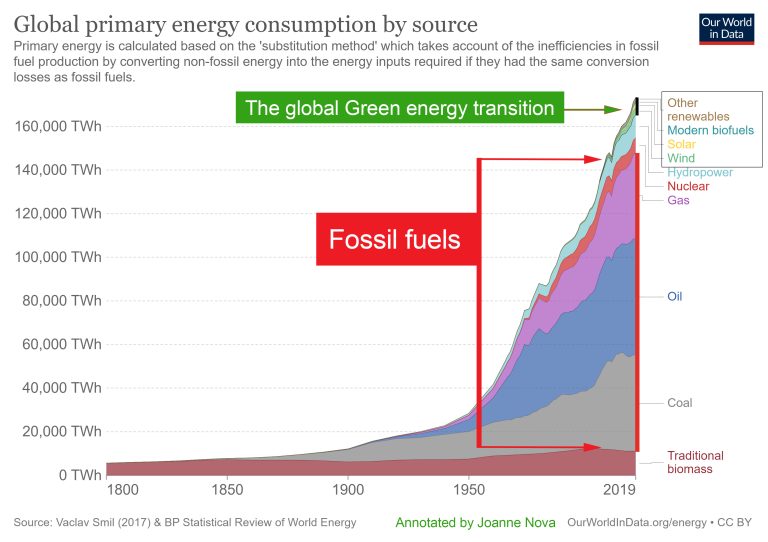
Notwithstanding the $billions in subsidies directed to wind and solar, their joint contribution to energy demand amounts to little more than a rounding error.

Oil and gas still account for more than 80% of world energy demand and talk about an ‘inevitable transition’ to an all wind and sun powered future, remains just that.

Energy matters, and what truly matters is that it’s available all day, every day, irrespective of the weather. Which is precisely why wind and solar will never amount to meaningful power sources.

Here’s a few numbers from the team at Jo Nova explaining why.

After 26 COP meetings we are a Fossil Fueled World: Coal, oil gas give us 80% of the energy on Earth
Jo Nova Blog
Jo Nova
5 November 2021

This is what Decarbonization Failure looks like:

After three decades of effort, twenty-six glorious international COP meetings, six IPCC reports, and the installation…

View original post 125 more words

The Economic History of the 20th Century

Dan Mitchell's avatarInternational Liberty

It’s not often (actually, only once) that I share a video lasting nearly two hours. But this video – revolving around the intellectualrivalry between pro-market Hayek and pro-intervention Keynes – is an excellent summary of 20th-century economic policy.

We learn about the growth of socialism and communism during and after World War I.

This then led economists from the Austrian school – including Hayek – to explain why that approach (genuine socialism, meaning government ownership, central planning, and price controls) was doomed to failure.

But other forms of intervention and redistribution gained new adherents, especially when Keynes argued that the Great Depression was the fault of capitalism (for what it’s worth, I think the video fails to include analysis on how the New Deal actually lengthened and deepened the downturn).

Unfortunately, the Keynesian narrative dominated and the video informs us that the people of the…

View original post 362 more words

Who (or What) Deserves Credit for Germany’s Post-War Economic Miracle?

Dan Mitchell's avatarInternational Liberty

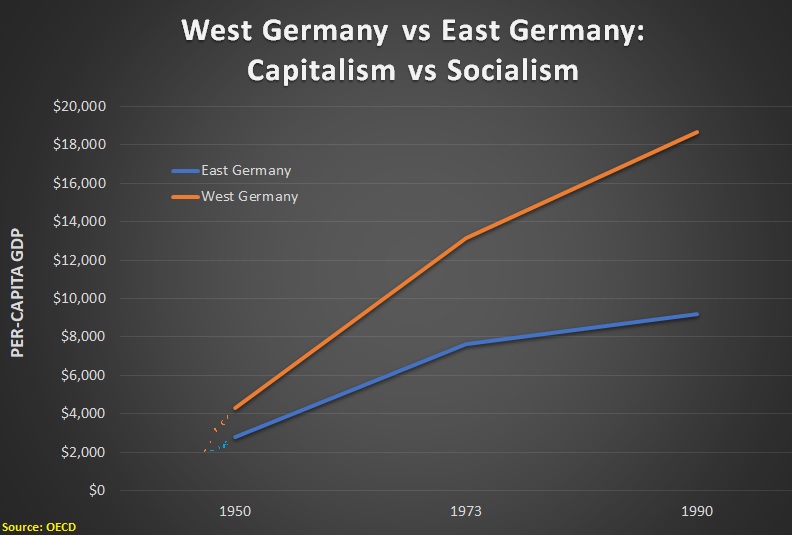
A couple of years ago, to help build the case against socialism, I showed how West Germany enjoyed much faster growth and much more prosperity than East Germany.

The obvious lesson to be learned from this example of “anti-convergence” is that market-oriented economies out-perform state-controlled economies.

I want to revisit this topic because I recently dealt with someone who claimed that government spending via the Marshall Plan deserves the credit for West Germany’s post-war economic renaissance.

What does the evidence say? Was foreign aid from the United States after World War II a key driver (for Keynesian or socialist reasons) of the West German economy.

The answer is no.

Professor David Henderson explained the role of the Marshall Plan for Econlib.

After World War II the German economy lay in shambles. …less than ten years after the war people already were talking about the German economic miracle…

View original post 752 more words

Previous Older Entries Next Newer Entries

Arin’s Substack

Celebrating humanity's flourishing through the spread of capitalism and the rule of law

David Andolfatto

Celebrating humanity's flourishing through the spread of capitalism and the rule of law

Monetary Non-Neutrality

Celebrating humanity's flourishing through the spread of capitalism and the rule of law

Reason Magazine

Celebrating humanity's flourishing through the spread of capitalism and the rule of law

Coyote Blog

Celebrating humanity's flourishing through the spread of capitalism and the rule of law

Thoughts from the North

Celebrating humanity's flourishing through the spread of capitalism and the rule of law

Fardels Bear

A History of the Alt-Right

Vincent Geloso

Econ Prof at George Mason University, Economic Historian, Québécois

Bassett, Brash & Hide

Celebrating humanity's flourishing through the spread of capitalism and the rule of law

Truth on the Market

Scholarly commentary on law, economics, and more

The Undercover Historian

Beatrice Cherrier's blog

Matua Kahurangi

Celebrating humanity's flourishing through the spread of capitalism and the rule of law

Temple of Sociology

Celebrating humanity's flourishing through the spread of capitalism and the rule of law

Velvet Glove, Iron Fist

Celebrating humanity's flourishing through the spread of capitalism and the rule of law

Why Evolution Is True

Why Evolution is True is a blog written by Jerry Coyne, centered on evolution and biology but also dealing with diverse topics like politics, culture, and cats.

NoTricksZone

Celebrating humanity's flourishing through the spread of capitalism and the rule of law

Homepaddock

A rural perspective with a blue tint by Ele Ludemann

Kiwiblog

DPF's Kiwiblog - Fomenting Happy Mischief since 2003

The Dangerous Economist

Celebrating humanity's flourishing through the spread of capitalism and the rule of law

Watts Up With That?

The world's most viewed site on global warming and climate change

The Logical Place

Tim Harding's writings on rationality, informal logic and skepticism

Doc's Books

A window into Doc Freiberger's library

The Risk-Monger

Let's examine hard decisions!

Uneasy Money

Commentary on monetary policy in the spirit of R. G. Hawtrey

Barrie Saunders

Thoughts on public policy and the media

Liberty Scott

Celebrating humanity's flourishing through the spread of capitalism and the rule of law

Point of Order

Politics and the economy

James Bowden's Blog

A blog (primarily) on Canadian and Commonwealth political history and institutions

Science Matters

Reading between the lines, and underneath the hype.

Peter Winsley

Economics, and such stuff as dreams are made on

A Venerable Puzzle

"The British constitution has always been puzzling, and always will be." --Queen Elizabeth II

The Antiplanner

Celebrating humanity's flourishing through the spread of capitalism and the rule of law

Bet On It

Celebrating humanity's flourishing through the spread of capitalism and the rule of law

History of Sorts

WORLD WAR II, MUSIC, HISTORY, HOLOCAUST

Roger Pielke Jr.

Undisciplined scholar, recovering academic

Offsetting Behaviour

Celebrating humanity's flourishing through the spread of capitalism and the rule of law

JONATHAN TURLEY

Res ipsa loquitur - The thing itself speaks

Conversable Economist

In Hume’s spirit, I will attempt to serve as an ambassador from my world of economics, and help in “finding topics of conversation fit for the entertainment of rational creatures.”

The Victorian Commons

Researching the House of Commons, 1832-1868

The History of Parliament

Articles and research from the History of Parliament Trust

Books & Boots

Reflections on books and art

Legal History Miscellany

Posts on the History of Law, Crime, and Justice

Sex, Drugs and Economics

Celebrating humanity's flourishing through the spread of capitalism and the rule of law

European Royal History

Exploring the Monarchs of Europe

Tallbloke's Talkshop

Cutting edge science you can dice with

Marginal REVOLUTION

Small Steps Toward A Much Better World