Still No Global Warming June 2021
11 Jul 2021 Leave a comment

The post below updates the UAH record of air temperatures over land and ocean. But as an overview consider how recent rapid cooling has now completely overcome the warming from the last 3 El Ninos (1998, 2010 and 2016). The UAH record shows that the effects of the last one are now gone as of April 2021. (UAH baseline is now 1991-2020).
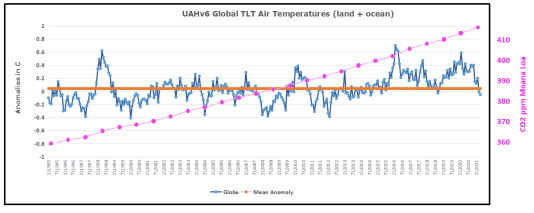 For reference I added an overlay of CO2 annual concentrations as measured at Moana Loa. While temperatures fluctuated up and down ending flat, CO2 went up steadily by ~55 ppm, a 15% increase.
Furthermore, going back to previous warmings prior to the satellite record shows that the entire rise of 0.8C since 1947 is due to oceanic, not human activity.
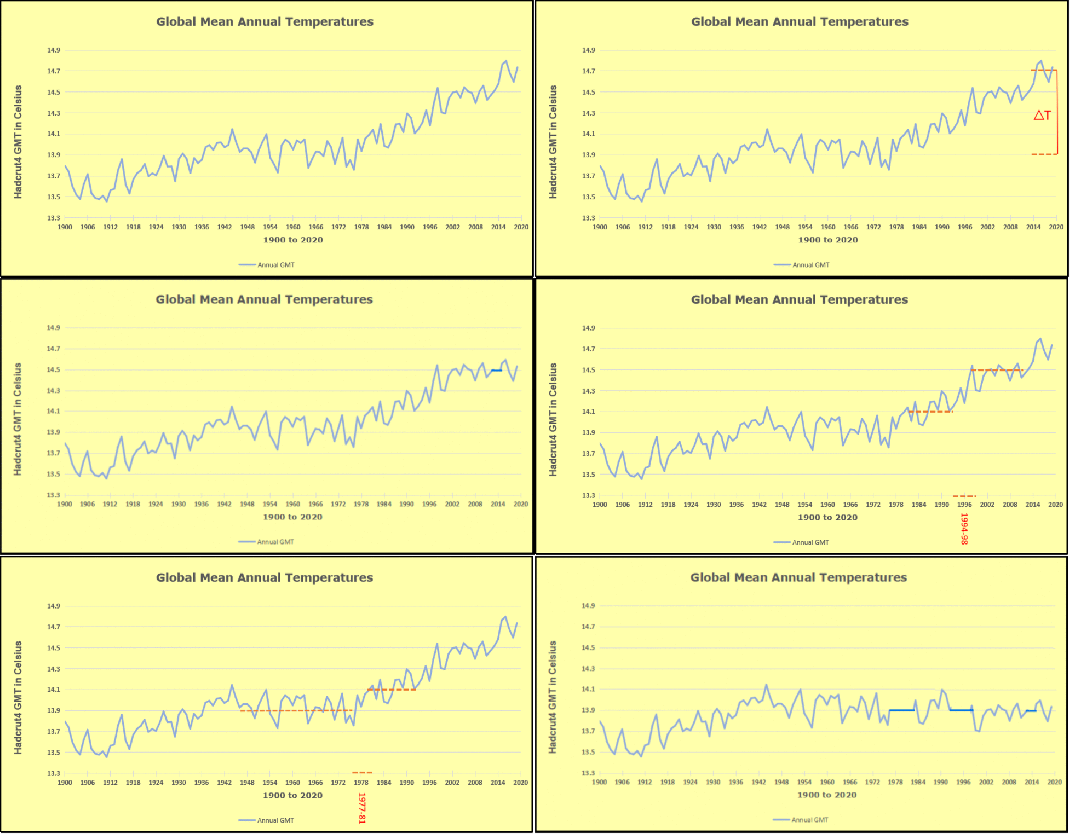
The animation is an update of a previous analysis from Dr. Murry Salby. These graphs use Hadcrut4 and include the 2016 El Nino warming event. The exhibit…
View original post 1,144 more words
Wind energy in crisis as expansion stalls in Germany
10 Jul 2021 Leave a comment

 Feldheim village near Berlin, Germany.
Subsidies drying up. Public resistance to wind turbines in the neighbourhood. Is the climate steamroller running out of puff in Germany?
– – –
The German wind power industry is suffering setback after setback, says The GWPF.
Hardly any new turbines are being built, and more and more old wind turbines are being phased out. Now wind industry lobbyists are calling for new subsidies and construction rules to be relaxed.
In the Free State of Bavaria there is almost nothing going on when it comes to wind power.
View original post 154 more words
Reviewing The Pink Panther Series
10 Jul 2021 Leave a comment


The Pink Panther (1963)
Release Date: December 18, 1963
Director: Blake Edwards
Studio: United Artists
The Pink Panther is the first film in the “Pink Panther” series featuring Peter Sellers as the bumbling but lovable French inspector, Jacques Clouseau. This first film focuses on the story of Sir Charles Lytton (played by David Niven) who moonlights as the jewel thief, the “Phantom.” It was an amusing film however later films are superior because they focus mainly on the foibles of Inspector Clouseau.

A Shot in the Dark (1964)
Release Date: June 23, 1964
Director: Blake Edwards
Studio: United Artists
In many ways A Shot In The Dark is the first true “Pink Panther” film, despite technically being the second “Pink Panther” movie following the prior year’s The Pink Panther (1963). With Peter Sellers accidentally tearing up pool tables, walking into walls, stumbling into fountains, getting arrested numerous times, and accidentally…
View original post 556 more words
July 9, 1762: Catherine II becomes Empress of Russia via a coup d’état. Part I
10 Jul 2021 Leave a comment

Catherine II (born Sophie of Anhalt-Zerbst: May 2, 1729 – November 17, 1796), most commonly known as Catherine the Great, was Empress of All Russia from 1762 until 1796 – the country’s longest-ruling female leader. She came to power following a coup d’état that overthrew her husband and second cousin, Peter III. Under her reign, Russia grew larger, its culture was revitalised, and it was recognised as one of the great powers of Europe.
Catherine was born in Stettin, Pomerania, Kingdom of Prussia (now Szczecin, Poland) as Princess Sophie Friederike Auguste von Anhalt-Zerbst-Dornburg. Her father, Christian August, Prince of Anhalt-Zerbst, belonged to the ruling German family of Anhalt. He tried to become the duke of the Duchy of Courland and Semigallia but in vain. At the time of his daughter’s birth Christian August held the rank of a Prussian general in his capacity as governor of the city of Stettin.
View original post 752 more words
Henderson versus Wolfers on Lockdowns
08 Jul 2021 Leave a comment
in applied price theory, applied welfare economics, comparative institutional analysis, economics of regulation, health economics Tags: economics of pandemics
The Return of the Pink Panther
08 Jul 2021 Leave a comment
The Return of the Pink Panther (1975) Director: Blake Edwards
“Now he’s off to Gstaad. Today… a paradise in the Swiss Alps; tomorrow… a wasteland! Compared to Clouseau, Attila the Hun was a Red Cross volunteer!”

★★★★★
After a failed Pink Panther film which was absent Peter Sellers (Inspector Clouseau), Blake Edwards and Peter Sellers were persuaded to put their differences aside and try to make another Pink Panther movie in order to reboot the series. Both had incentives to do so as their careers had gone somewhat downhill, and Peter Sellers was struggling with heart problems. What followed was the best Pink Panther film in the series and one of the funniest movies of all-time (apparently it was the highest grossing Hollywood comedy up to that time, as well). After its release and subsequent success Blake Edwards attempted to turn the concept into a television show but…
View original post 496 more words
Question of the Week: Who Is Your Favorite Political Cartoonist?
08 Jul 2021 Leave a comment

If you asked me that question 30 years ago, I would have said Jeff MacNelly without hesitation.
 Not that I was exposed to many options in the pre-Internet dark ages, so my choice may have been driven by lack of knowledge. Nonetheless, MacNelly was a genius with the details, as you can see from these cartoons about IRS complexity and government shutdowns.
But what about today’s cartoonists?
Based on the number of cartoons I’ve shared, the easy answer would be either Michael Ramirez or Chuck Asay, but there are cartoons from other artists that are absolutely superb.
So I’m going to turn this question around.
Here are my favorite cartoons from various artists and you can answer the poll about which one you would rank highest.
In no particular order, the options are:
 Michael Ramirez – This gem about Obamanomics is the most-viewed professional cartoon in the history of…
View original post 936 more words
The Adverse Economic Consequences of “Basic Income”
08 Jul 2021 Leave a comment
When I first looked at the issue of “basic income,” back in 2013, my gut reaction was deep skepticism.
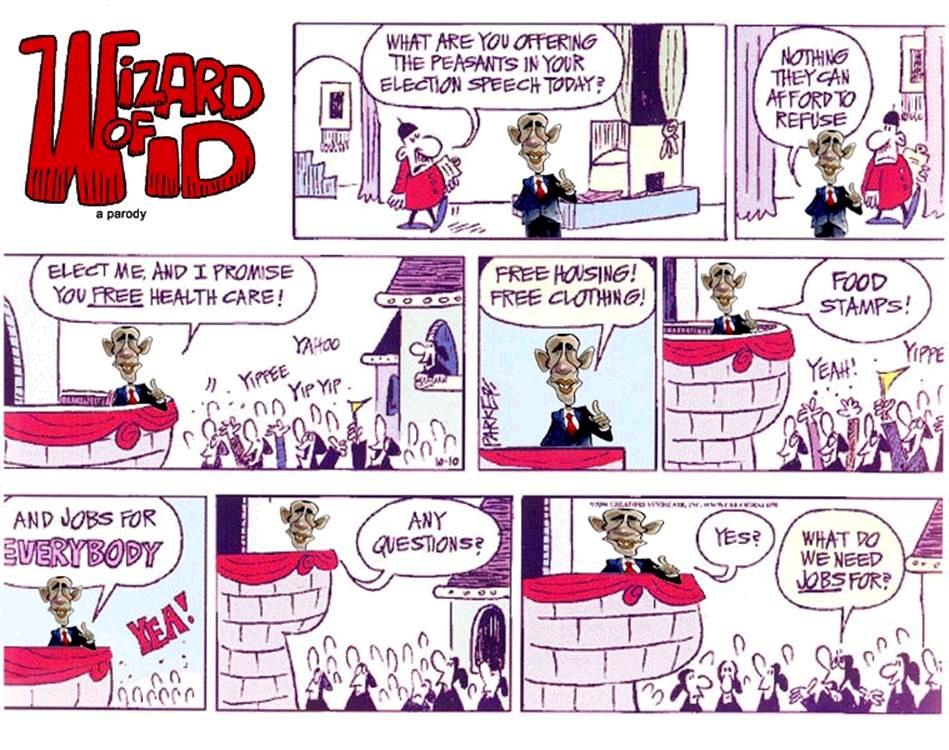 That’s because I feared many people would drop out of the labor force if they could live off government handouts (as illustrated by this Wizard-of-Id parody).
It’s true that the current amalgamation of welfare programs also discourages work and creates dependency, but a government-provided basic income could make a bad situation worse.
Especially if politicians didn’t get rid of other redistribution programs (a very realistic concern).
That being said, what’s the evidence, either pro or con?
There was an experiment in Finland, which poured cold water on the concept.
And now we have some U.S.-focused research. Four economists from the University of Chicago (Mikhail Golosov, Michael Graber, Magne Mogstad, and David Novgorodsky) investigated this topic in a new study from the National Bureau of Economic…
View original post 327 more words
Matthew E. Kahn “Unlocking the Potential of Post Industrial Cities”
08 Jul 2021 Leave a comment
in applied price theory, applied welfare economics, development economics, economic history, energy economics, entrepreneurship, environmental economics, global warming, human capital, industrial organisation, labour economics, labour supply, property rights, public economics, survivor principle, transport economics, urban economics
America is not a racist country.
07 Jul 2021 Leave a comment

That’s a direct quote from a speech given a few days ago by a Republican Senator doing the usual reply to the President’s Congressional address (which was decidedly not a State Of The Union address).
It’s something that tens of millions of American voters, Democrat and Republican alike, agree on about their nation in 2021.
Here’s the context around the statement.
“Today, kids again are being taught that the color of their skin defines them — and if they look a certain way, they’re an oppressor. From colleges to corporations to our culture, people are making money and gaining power by pretending we haven’t made any progress.
By doubling down on the divisions we’ve worked so hard to heal. You know this stuff is wrong. Hear me clearly: America is not a racist country. It’s backwards to fight discrimination with different discrimination. And it’s wrong to try to use our…
View original post 937 more words
“That wasn’t Anarcho-Communism” – in just two days
07 Jul 2021 1 Comment
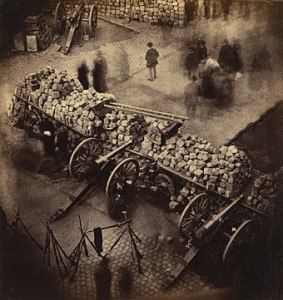 |
| Commune Barricade |
I don’t know if the news has penetrated all the way down to New Zealand but it seems that the Antifa and BLM groups in Seattle have finally decided to go beyond starting riots and instead try to build something.
Specifically – and very much in the spirit of the 1871 Paris Commune – they’ve decided to create an Anarcho-Communist “state” in the middle of Seattle.
They even took over a Police Station in the area, violently attacking the cops there for several days before the Mayor ordered the Police to abandon the station and effectively yield a six block area to Antifa.

This capitulation didn’t go down too well with the Seattle Police Chief, Carmen Best, who made the following address to her people to make it clear that it was not her decision. She also talks about the incredible physical assault Antifa and other groups made…
View original post 823 more words
The simple, but unpleasant, arithmetic of a simple UBI
07 Jul 2021 Leave a comment
A nice straightforward explanation of the unaffordability of a universal basic income is even when pitch at the low annual rate. Few advocates of a universal basic income even make these basic calculations. The Morgan Foundation in New Zealand went to the length of calculating whether people currently receiving each type of welfare benefit were worse or better off. They were a notable exception.

In discussions about Universal Basic Income, lots of people are attracted by the idea of making things as simple as possible. Sadly, that doesn’t work well once you take a closer look.
The simplest UBI would pay every Australian an amount equal to the single age pension, which is just above the poverty line. That’s $20000/yr per person or $500 billion for a population of 25 million, about equal to total Federal government expenditure. That would replace about $180 billion in existing social welfare spending. That leaves $320 billion, approximately equal to total revenue from personal and income taxes.
To fill the gap, we would need either to double income tax revenue, scrap all other public spending, or some mixture of the two. Assuming that’s not feasible, we need to start complicating things. The most obvious step is to treat children differently, for example by giving them half the benefits…
View original post 69 more words
Insidious: Off-hand references signal deep embedding of prominent media myths
07 Jul 2021 Leave a comment

The insidious nature of prominent media myths is evident in how casually they are invoked, as if their veracity is beyond question.
These blithe, passing references in news articles and commentary seldom are accompanied by much context or explanation. And their appearance signals how deeply embedded some media myths have become.
Two recent cases serve to illustrate this tendency.
 Musings in the New York Times
One example appeared last week in an entertaining if overlong New York Timesarticle that mused about the identity of an elusive and anonymous Instagram user whose handle is rg_bunny1. Over the recent months, user rg_bunny1 has unleashed what the Times called “a daily torrent of quirky, particular images that, taken together, speak to an aesthetic that delights, confounds, fixates and infuriates in equal measures.”
What most interests Media Myth Alertwas the article’s passing reference to Carl Bernstein, one of the Washington…
View original post 1,318 more words


Recent Comments