Power Politics: Want to Win Elections? Then Don’t Ignore Spiralling Electricity Prices

stopthesethings's avatarSTOP THESE THINGS

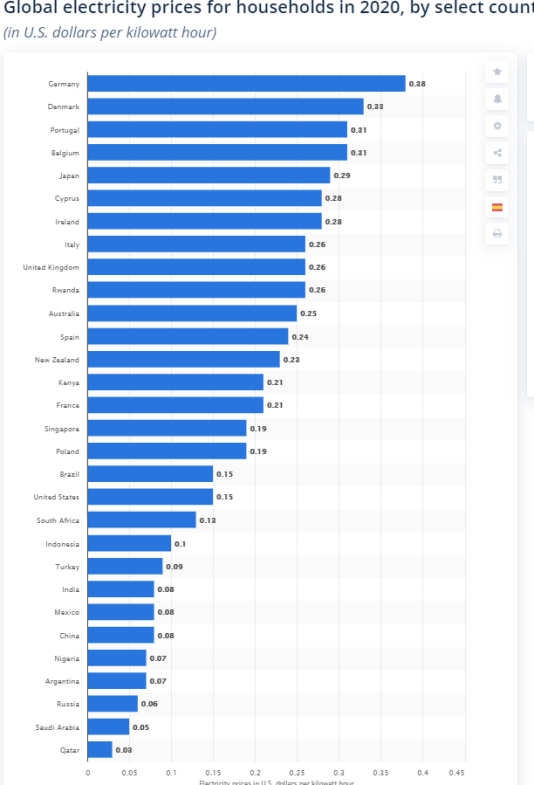
With Biden and the Squad in the White House, the Californian experience of spiralling power prices will soon be delivered to all Americans, thanks to a raft of suicidal renewable energy policies that are about to be landed across the USA.

The energy hungry businesses and industries that Trump brought home, will soon start packing up and vanish in search of cheaper electricity.

In Australia, the damage has largely been done on that score.

Ludicrous subsidies to wind and solar have left reliable conventional power generators on the ropes, as those subsidies were designed to do. Power is delivered according to the weather, not the demands of businesses; big users, such as aluminium smelters, are forced to shut down when the wind stops blowing and the sun sets. And the power prices they suffer have doubled in a decade.

What appears in the paragraph above would have been inconceivable to…

View original post 1,142 more words

The Tudors: Henry VIII & The English Reformation (1509-1547)

Great Books Guy's avatarGreat Books Guy

Was he “Bluff King Hal,” the famous Renaissance Prince, or was he a bloated, arrogant tyrant who put his own interests above those of the kingdom? Do we remember him fondly as an intellectual purveyor of freedom, or rather as a self-seeking opportunist who opened the door to radical change? Who is the true Henry VIII? His persona is at once captivating and elusive. Henry VIII wore many hats throughout his lifetime, but surely his kingship is the most famous and also the most infamous of all English monarchs. Today, we see him proudly standing forth, clad in bright and exuberant colors, dressed as a peacock, donning extravagant Turkish costumes, bombastically shunning clerical Orthodoxy, founding his own church, marrying six different women, executing friends and foes alike. Henry VIII’s legacy remains bold, his stature towering, his life the stuff of legend, his reign consequential beyond a doubt. As a young…

View original post 5,239 more words

Surviving an Execution in Medieval England and Modern Ohio: Miracle, or Incompetence?

Sara M. Butler's avatarLegal History Miscellany

Posted by Sara M. Butler; 5 February 2021.

In Ohio, Governor DeWine’s landmark 8 December 2020 press conference has left the future of felony execution in the state up in the air. The indefinite delay in capital punishment announced back in 2018 has turned into what DeWine is referring to as a “de facto moratorium,” as he instructs lawmakers to find some method of execution other than lethal injection. Since 2015, Ohio, like twenty-eight other American states where the death penalty remains on the books, has been struggling to find an American pharmaceutical company willing to supply sodium thiopental. A nation-wide shortage of the drug springs from the reluctance of drug companies to be openly associated with the death penalty. Past boycotts of their products across Europe have demonstrated that it is bad for business.

Those of us who are residents of Ohio, and not supporters of the death penalty…

View original post 2,073 more words

Douglass North and the Hard Problem of Institutions – Noel Johnson

The Corn Law debates

Inconvenient Truths: Spanish Solar Firm Slaughters 500 Native Deer to Make Way for Panels

stopthesethings's avatarSTOP THESE THINGS

The modern ‘green’ worships wind turbines and solar panels in the belief that they’re literally saving the planet, merrily ignoring the wave of environmental destruction wrought by their beloveds.

Solar panels are pitched as the paragon of ‘green’ energy, silently caressing the sun’s rays to give off an occasional burst of power that someone, somewhere just might need at that particular time. Although it’s always tough luck after sunset.

The idea that thousands of 260 m, 300 tonne wind turbines and millions of solar panels are – because of the virtuous energy they occasionally produce – a benign force in the environment is all part of the grand, collective delusion attached to our purportedly ‘inevitable’ transition to renewable energy.

This site, however, is dedicated to always letting the facts stand in the way of a good story. Especially when the facts in question are of the troublesome kind. Such as…

View original post 625 more words

Randomized Control Trials in the Field of Development: A Critical Perspective (Webinar)

Reforming the Reserve Bank, continued

Michael Reddell's avatarcroaking cassandra

Submissions to Parliament’s Finance and Expenditure Committee on the Reserve Bank of New Zealand bill close today. This is the next stage in the ongoing overhaul of the Reserve Bank legislation, and this particular bill focuses on a new governance structure for the Bank, largely importing for monetary policy the provisions of the amending legislation passed a couple of years ago. In the process, the substantive regulatory powers that were part of the Act are being spun out, unchanged for now, into a separate piece of legislation.

There is a fair amount of sensible stuff in the bill. The single decisionmaker model, flawed and unusual for monetary policy, deeply unsuited to the regulatory functions, will finally be no more. The MPC now makes monetary policy – well at least on paper at does, perhaps it more true that MPC is the venue at which monetary policy is made – and…

View original post 1,933 more words

A Case Study of How Venezuelan Socialism Killed the Goose with the Golden Eggs

Dan Mitchell's avatarInternational Liberty

The economic disintegration of Venezuela is a powerful example how socialism fails. Even in a nation with massive oil wealth.

This video from Reason tells the tragic story.

I think long-run data is especially valuable when assessing a nation’s economic performance.

And Venezuela definitely looks terrible when looking at decades of data on per-capita economic output.

Especially when compared to a pro-market nations such as Chile.

Not that we should be surprised. This is what we find anytime capitalist-oriented counties are compared with statism-oriented countries.

And there are many other case studies.

But let’s re-focus on the problems of Venezuela. In one of her Wall Street Journal columns, Mary Anastasia O’Grady analyzes the government-caused crisis. She starts by describing what happened.

Efforts to guarantee outcomes are at odds with what it…

View original post 373 more words

France found guilty of climate inaction in ‘historic victory’ 

oldbrew's avatarTallbloke's Talkshop


‘Hoist by their own petard’ springs to mind. French courts are now willing to hear from ‘direct victims of climate change’. How they might define climate change remains to be seen, as the insanity gets further embedded into the system.
– – –
A court in Paris has ruled that France’s government is guilty of climate inaction in a ground-breaking legal case, reports Euronews.

The decision comes after a group of NGOs, with the support of two million citizens, filed a lawsuit against the French government for failing to meet the country’s commitments to limit greenhouse gas emissions.

The legal claim was hailed as the “L’Affaire du siècle” or “the case of the century” by activists, who first started the dispute in March 2019.

View original post 160 more words

Importing is ‘GREAT’, too

The Real-Bills Doctrine, the Lender of Last Resort, and the Scope of Banking

David Glasner's avatarUneasy Money

Here is another section from my work in progress on the Smithian and Humean traditions in monetary economics. The discussion starts with a comparison of the negative view David Hume took toward banks and the positive view taken by Adam Smith which was also discussed in the previous post on the price-specie-flow mechanism. This section discusses how Smith, despite viewing banks positively, also understood that banks can be a source of disturbances as well as of efficiencies, and how he addressed that problem and how his followers who shared a positive view toward banks addressed the problem. Comments and feedback are welcome and greatly appreciated.

Hume and Smith had very different views about fractional-reserve banking and its capacity to provide the public with the desired quantity of money (banknotes and deposits) and promote international adjustment. The cash created by banks consists of liabilities on themselves that they exchange for liabilities…

View original post 3,306 more words

Israeli Armor Pre-1973

MSW's avatarWeapons and Warfare

Following World War II the opposing Arab and Israeli armies were among the primary practitioners of armored warfare, largely because the terrain and conditions were so suitable. Long before the partition of Palestine, Israeli agents began the covert purchase of heavy weapons including ten old French R39 light tanks. The newly created Arab states were arming themselves with whatever surplus weapons could be procured on the black market or were abandoned in place by the colonial powers. Egypt had a mixed bag of American M4s and M22 Locust light tanks, British Crusaders and Matildas, and even 1930s vintage British Mark VI light tanks. The Syrians had French H35 and H39 tanks. The Lebanese were stuck with venerable French FTs. Tanks played little role in the 1948–49 War of Independence.

Eager to gain a foothold in the Mediterranean, the Soviet Union cultivated relations with Egypt, and supplied about 230 T-34/85 and…

View original post 1,509 more words

Origins of the British Light Infantry

MSW's avatarWeapons and Warfare

‘Light troops are, as it were, a light or beacon for the general, which should constantly inform him of the situation, the movements and nature of the enemy’s designs; it is upon the exactness and intelligence of what they report that he is enabled to regulate the time and manner of executing his own enterprises.’ (Colonel Coote Manningham)

There was nothing particularly new about light infantry at the turn of the nineteenth century. Most armies had light troops in some form, including the British who had theoretically deployed light companies of just forty-four men since the middle of the eighteenth century. Captain Cooper wrote in his 1806 compendium of works on light infantry that

In the American wars they were particularly useful; and the mode of fighting, which the American nations pursued, evidently showed the necessity of such a corps. For, until Light Infantry were established, a regular army was…

View original post 794 more words

European Emergency: Chaotic Wind & Solar Collapses Threaten Entire Europe-Wide Blackout

stopthesethings's avatarSTOP THESE THINGS

This winter is delivering wind and solar obsessed Europeans a banquet of consequences. Massive power price spikes in ‘wind powered’ Britain followed a period of dead calm, as the owners of Britain’s remaining dispatchable power plants cashed in: the wholesale price went from £40 to £4,000 per MWh.

Across the ditch, a complete collapse in wind and solar output on 8 January forced Europe’s grid managers to cut power to big users in France, Germany and Austria in order to avoid a complete ‘system black’. It was, like Napoleon’s Waterloo, “a close-run thing”.

The number of similar “emergency operations” has increased from a dozen or so each year to over 240, thanks to chaotically intermittent wind and solar.

None of this was on the radar when Germany was content to rely upon its ever-reliable nuclear and coal-fired power plants. As they say, you reap what you sow.

Here’s Henrik Paulitz…

View original post 917 more words

Previous Older Entries Next Newer Entries

Vincent Geloso

Econ Prof at George Mason University, Economic Historian, Québécois

Bassett, Brash & Hide

Celebrating humanity's flourishing through the spread of capitalism and the rule of law

Truth on the Market

Scholarly commentary on law, economics, and more

The Undercover Historian

Beatrice Cherrier's blog

Matua Kahurangi

Celebrating humanity's flourishing through the spread of capitalism and the rule of law

Temple of Sociology

Celebrating humanity's flourishing through the spread of capitalism and the rule of law

Velvet Glove, Iron Fist

Celebrating humanity's flourishing through the spread of capitalism and the rule of law

Why Evolution Is True

Why Evolution is True is a blog written by Jerry Coyne, centered on evolution and biology but also dealing with diverse topics like politics, culture, and cats.

Down to Earth Kiwi

Celebrating humanity's flourishing through the spread of capitalism and the rule of law

NoTricksZone

Celebrating humanity's flourishing through the spread of capitalism and the rule of law

Homepaddock

A rural perspective with a blue tint by Ele Ludemann

Kiwiblog

DPF's Kiwiblog - Fomenting Happy Mischief since 2003

The Dangerous Economist

Celebrating humanity's flourishing through the spread of capitalism and the rule of law

Watts Up With That?

The world's most viewed site on global warming and climate change

The Logical Place

Tim Harding's writings on rationality, informal logic and skepticism

Doc's Books

A window into Doc Freiberger's library

The Risk-Monger

Let's examine hard decisions!

Uneasy Money

Commentary on monetary policy in the spirit of R. G. Hawtrey

Barrie Saunders

Thoughts on public policy and the media

Liberty Scott

Celebrating humanity's flourishing through the spread of capitalism and the rule of law

Point of Order

Politics and the economy

James Bowden's Blog

A blog (primarily) on Canadian and Commonwealth political history and institutions

Science Matters

Reading between the lines, and underneath the hype.

Peter Winsley

Economics, and such stuff as dreams are made on

A Venerable Puzzle

"The British constitution has always been puzzling, and always will be." --Queen Elizabeth II

The Antiplanner

Celebrating humanity's flourishing through the spread of capitalism and the rule of law

Bet On It

Celebrating humanity's flourishing through the spread of capitalism and the rule of law

History of Sorts

WORLD WAR II, MUSIC, HISTORY, HOLOCAUST

Roger Pielke Jr.

Undisciplined scholar, recovering academic

Offsetting Behaviour

Celebrating humanity's flourishing through the spread of capitalism and the rule of law

JONATHAN TURLEY

Res ipsa loquitur - The thing itself speaks

Conversable Economist

In Hume’s spirit, I will attempt to serve as an ambassador from my world of economics, and help in “finding topics of conversation fit for the entertainment of rational creatures.”

The Victorian Commons

Researching the House of Commons, 1832-1868

The History of Parliament

Articles and research from the History of Parliament Trust

Books & Boots

Reflections on books and art

Legal History Miscellany

Posts on the History of Law, Crime, and Justice

Sex, Drugs and Economics

Celebrating humanity's flourishing through the spread of capitalism and the rule of law

European Royal History

Exploring the Monarchs of Europe

Tallbloke's Talkshop

Cutting edge science you can dice with

Marginal REVOLUTION

Small Steps Toward A Much Better World

NOT A LOT OF PEOPLE KNOW THAT

“We do not believe any group of men adequate enough or wise enough to operate without scrutiny or without criticism. We know that the only way to avoid error is to detect it, that the only way to detect it is to be free to inquire. We know that in secrecy error undetected will flourish and subvert”. - J Robert Oppenheimer.

STOP THESE THINGS

The truth about the great wind power fraud - we're not here to debate the wind industry, we're here to destroy it.

Lindsay Mitchell

Celebrating humanity's flourishing through the spread of capitalism and the rule of law

Alt-M

Celebrating humanity's flourishing through the spread of capitalism and the rule of law

croaking cassandra

Economics, public policy, monetary policy, financial regulation, with a New Zealand perspective

The Grumpy Economist

Celebrating humanity's flourishing through the spread of capitalism and the rule of law