
.@AOC @BernieSanders @SenWarren @Greens @NZGreens @oxfamnz
31 May 2020 Leave a comment
in applied price theory, comparative institutional analysis, constitutional political economy, development economics, economic history, economics of bureaucracy, economics of crime, economics of regulation, growth disasters, human capital, income redistribution, industrial organisation, labour economics, labour supply, law and economics, Marxist economics, poverty and inequality, property rights, Public Choice, rentseeking, survivor principle, Thomas Sowell Tags: fall of communism, offsetting behaviour, rational irrationality, regressive left, The fatal conceit, unintended consequences

The Audit of War by Correlli Barnett (1986)
30 May 2020 Leave a comment
‘The time and energy and thought which we are all giving to the Brave New World is wildly disproportionate to what is being given to the Cruel New World.’ (British economist J.M. Keynes, quoted page 40)
The full title of this book is The Audit of War: The Illusion and Reality of Britain as a Great Nation, which very accurately states its aim and its Manichaean structure. It is not your average leisurely, rather reassuring history book but a fierce and forcefully argued polemic which, if you’re British, is intellectually and emotionally devastating.
The basic premise is this: When Barnett wrote the book, received opinion tended to think that Britain fell behind its industrial competitors (America, Germany and Japan) and prey to the so-called ‘British disease’ of abysmal industrial performance, in the decades after the end of the Second World War. During the war itself, the nation had pulled together…
View original post 4,132 more words
May 29, 1630: Birth and Restoration of King Charles II of England, Scotland and Ireland.
30 May 2020 Leave a comment
During the exclusion crisis Charles sided with the Tories, and, following the discovery of the Rye House Plot to murder Charles and James in 1683, some Whig leaders were executed or forced into exile. Charles dissolved the English Parliament in 1681, and for the remainder of his reign, Charles ruled without Parliament.
Charles II (May 29, 1630 – February 6, 1685) was king of England, Scotland, and Ireland. He was king of Scotland from 1649 until his deposition in 1651, and king of England, Scotland and Ireland from the 1660 Restoration of the monarchy until his death in 1685.

Charles II was the eldest surviving child of Charles I of England, Scotland and Ireland and Henrietta-Maria de Bourbon of France, daughter of King Henri IV of France and Navarre and his second wife, Marie de Medici. After Charles I’s execution at Whitehall on January 30, 1649, at the climax of the English Civil War, the Parliament of Scotland proclaimed Charles II king of Scotland on February 5, 1649.
However, England entered the period known as the English Interregnum or the English Commonwealth, and the country was a de facto republic led by Oliver Cromwell. Cromwell defeated Charles II at the Battle of Worcester…
View original post 929 more words
Not in narrow seas
30 May 2020 Leave a comment
That’s the title of a new book, published this month, by veteran economist and commentator Brian Easton. The title is borrowed from a collection of poems, published in 1939, by New Zealand poet Allen Curnow, but presumably also keys off the author’s previous book published in 1997, In Stormy Seas: The Post-War New Zealand Economy.
The full title of the new book, published by Victoria University Press, is Not in Narrow Seas: The Economic History of Aotearoa New Zealand. It is a curious title in a number of respects. First, there is that reference to the place – so beloved of public servants and the Wellington liberals – that is no place: New Zealand is the name of the modern country, and there was – so far as we know – no collective name for what went before. Then there is the definite article…
View original post 2,380 more words
LOGISTICS IN ROMAN WARFARE
30 May 2020 Leave a comment


The Romans’ success in conquering and maintaining their enormous empire lay partly in their military culture, their weapons and their training. Rome’s ability to provision large armies at long distances was, however, equally as, or more important to its success. The military history of Rome is not one of continuous victory: indeed the Romans often won wars because, after losing battles—and sometimes entire armies and fleets—they could keep replacing them until the enemy was defeated. Polybius, a keen observer of the Roman military at its height, remarked that “the advantages of the Romans lay in inexhaustible supplies of provisions and men.”
A sophisticated logistical system allowed the Romans to exploit their military resources effectively. The Romans recognized the importance of supply and used it both as a strategic and a tactical weapon and the necessities of military supply influenced and often determined the decisions of the Roman commanders at war…
View original post 2,056 more words
The 2019 Witch Hunts.
30 May 2020 Leave a comment
The Witch Hunts, which began in the 1500’s, swept across Europe in the 17th Century. Estimates of the deaths vary wildly with the most conservative estimates, of casualties, ranging around 60,000. Feminist theories of the trials focussed on the sex of the victims. In England a staggering 90% were women. Coincidentally (not) this was inversely proportionate to the sex composition of the saintly class. Theories which contradict the feminist interpretation can’t dismiss the sex of the victims. Some theorists point to the role of the rising printing press in the spread of Witchcraft Trials. This modern re-enactment owes much to Twitter. Twitter Shaming has replaced the burning. Just when this will tip over into more serious violence, against a woman, is anyone’s guess. The violent incidents we have already seen have been denied, dismissed and minimised. This is a dangerous climate we are creating for women.

The focus was on…
View original post 1,274 more words
Revisiting the Brook case
30 May 2020 Leave a comment
There is very little case law about single and separate sex services and gender identity. Only one case has been litigated since the Equality Act 2010 was enacted.
In 2014 Halifax County Court awarded £1,500 in damages to S Brook, who was refused access to the women’s toilets of a pub and then barred after complaining.
The case is what is known as a “first instance”, which means it wasn’t appealed and did not create a legal precedent (legal precedents mean that court must follow decisions of previous decisions of the same or higher court in cases that are similar in relation to the facts and the legal issues).
No transcript of the judgment by Judge Miller is available. Nevertheless it has been reported as a “landmark case”and has been influential. It is leaned on heavily by those who argue that self-declared “gender identity” gives someone the right…
View original post 2,150 more words
Pure Unbridled Chaos: Why Unreliable and Intermittent Wind & Solar Destabilise Power Grids
29 May 2020 Leave a comment
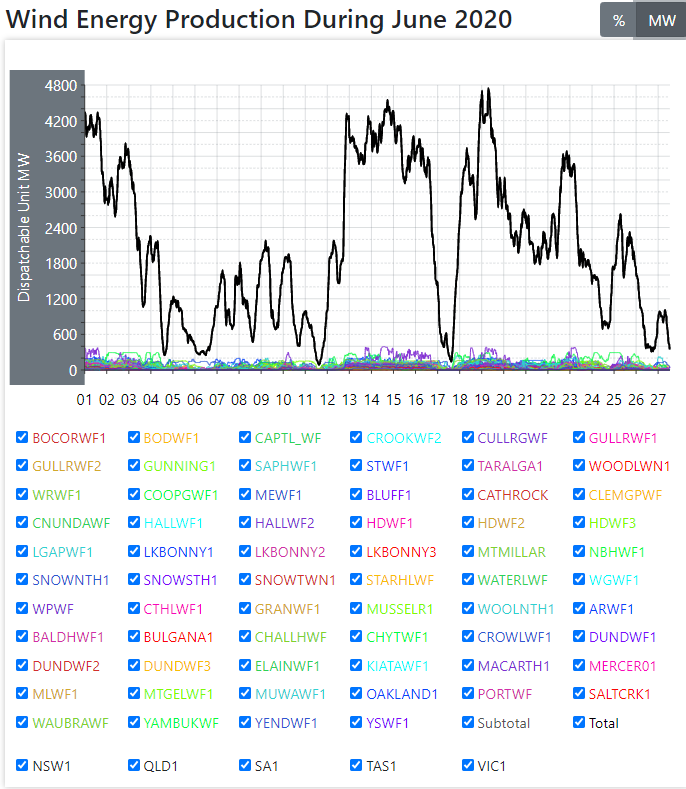
The more intermittent wind and solar get added to the grid, the greater the risk that their chaotic delivery of power will wreck it. By which we mean the delivery of an entire ‘system black’ – of the kind that Australia’s wind and solar capital, South Australia became world-renowned for.
Depicted above – courtesy of Aneroid Energy – is the output delivered by Australian wind power outfits to the Eastern Grid so far this month.
Spread from Far North Queensland, across the ranges of NSW, all over Victoria, Northern Tasmania and across South Australia its entire capacity routinely delivers just a trickle of its combined notional capacity of 7,295MW.
Collapses of over 3,000 MW or more that occur over the space of a couple of hours are routine, as are rapid surges of equal magnitude, which make the grid manager’s life a living hell, and provide the perfect set up…
View original post 1,172 more words
COVID19 update, May 28, 2020: ACE inhibitors beneficial; asymptomatic infection rate as high as 80%; NYT on California economy in freefall
29 May 2020 Leave a comment
(1) The lead story of Chemical and Engineering News, the house organ of the American Chemical Society, is about rethinking the role of ACE inhibitors (angiotensin converting enzyme inhibitors, a commonly used family of blood pressure drugs).
“Once thought to boost levels of ACE2 , the novel coronavirus’s doorway into human cells, these widely used medicines are now contenders to treat the respiratory disease”
(2) Meanwhile, the Daily Telegraph has a popular write-up of an intriguing paper that just appeared in Thorax, a daughter journal of the British Medical Journal. It suggests the asymptomatic infection rate may be much higher than the 35% in the revised CDC figures
http://doi.org/10.1136/thoraxjnl-2020-215091
ABSTRACT: We describe what we believe is the first instance of complete COVID-19 testing of all passengers and crew on an isolated cruise ship during the current COVID-19 pandemic. Of the 217 passengers and crew on board, 128 tested…
View original post 630 more words
RESTORATION
29 May 2020 Leave a comment
Louis XVIII Of France
Since both the republican and imperial models were discredited and unacceptable to the victorious Allies, a royal restoration was inevitable; the victor of Waterloo, the Duke of Wellington, warned that there would be no peace in Europe unless the Bourbons mounted the throne again. The Congress of Vienna, held to define European frontiers after two decades of war, reversed Napoleon’s conquests but was otherwise generous to France after Talleyrand inserted himself into the deliberations; in a sign of flexibility among recent adversaries, Britain and Austria allied with France to block a Prussian attempt to absorb Saxony.
However, the new monarch who called himself Louis XVIII in deference to his nephew who had died in prison two decades earlier, made a poor fist of it on his return from exile in Britain in May 1814. The corpulent 59-year-old king surrounded himself with appointees who had been out…
View original post 2,556 more words
FOREIGN OBJECTIVITY
29 May 2020 Leave a comment
Below an article in the top Aussie newspaper, The Australian, published a few days ago.
View original post 1,014 more words
The Return of Charles II, 29 May 1660
29 May 2020 Leave a comment
In today’s blog Dr Andrew Barclay, senior research fellow in our Commons 1640-1660 project, returns to his exploration of the days leading up to the restoration of Charles II. In this final instalment, we turn to 29 May 1660, as Charles entered London as King for the first time...
Charles II entered London in triumph on 29 May 1660, his 30th birthday. Three weeks earlier Parliament had proclaimed him as King. He had landed at Dover on 25 May and had made stops at Canterbury and Rochester en route to the capital. On 29 May he was greeted at St George’s Fields in Southwark by the lord mayor of London. The huge procession, mostly formed of the army, the London trained bands and the City worthies, crossed London Bridge and then proceeded through London to Whitehall. The parade took seven hours to pass through the City…
View original post 799 more words
The Schweinfurt Raid – Americas Worst Day
29 May 2020 Leave a comment
14 OCTOBER 1943
“The mission of October 14th had demonstrated that the cost of such deep penetrations by daylight without fighter escort was too high … the Eighth Air Force was in no position to make further penetrations either to Schweinfurt or to any other objectives deep in German territory.” US Official Report on the Schweinfurt Raid.
It is a great tragedy of war that commanders can blindly persist with plans which have been repeatedly proven to be dangerously misguided. After World War I, visionary young officers in a number of countries argued that in the future wars would be won not by armies or navies but by fleets of aircraft bombing enemy cities, in what became known as `strategic’ bombing. World War II saw the creation of such strategic bombing fleets, chiefly by the British and Americans, of which perhaps the strongest and the most famous was `The Mighty…
View original post 3,150 more words


Recent Comments