By Nick Whitaker and J. Zachary Mazlish, this is the best piece on this question so far. Excerpt, noting I will not double indent: “Rather than regulation, our explanation for the absence of widespread prediction markets is a straightforward demand-side story: there is little natural demand for prediction market contracts, as we observe in practice. […]
Why prediction markets are not popular
Why prediction markets are not popular
20 May 2024 Leave a comment
in applied price theory, comparative institutional analysis, economics of information, entrepreneurship, financial economics
OneNews blames immigration to NZ for emigration (of young Kiwis out of NZ). Maybe they’re leaving because our Media has depressed them?
20 May 2024 Leave a comment
in applied price theory, human capital, labour economics, labour supply, politics - New Zealand, population economics Tags: economics of immigration
If a Blogger accused immigrants of nicking houses & jobs off young native NZ’ers, causing them to leave the country, then we’d likely be prosecuted under anti-freedom of speech legislation. But seems our State-owned broadcaster, OneNews, can get away with it. After all, like the Reserve Bank, TVNZ can do what it wants. Its above…
OneNews blames immigration to NZ for emigration (of young Kiwis out of NZ). Maybe they’re leaving because our Media has depressed them?
Debunking Bad Class Warfare and Debunking Nonsensical Class Warfare
19 May 2024 Leave a comment
in applied price theory, economic history, economics of education, entrepreneurship, human capital, income redistribution, industrial organisation, labour economics, labour supply, occupational choice, politics - USA, poverty and inequality, Public Choice Tags: taxation and entrepreneurship, taxation and investment

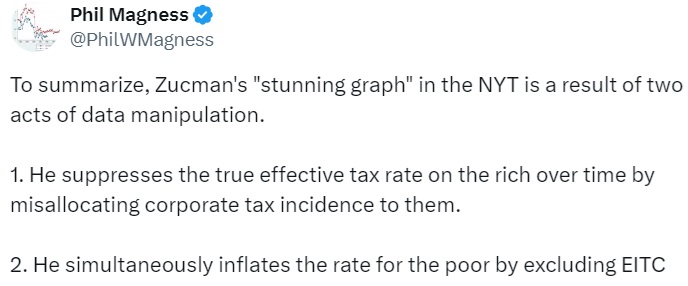
Like Thomas Piketty, Gabriel Zucman is a French economist who promotes economically destructive class-warfare tax policy. He’s also infamous for dodgy data manipulation, as Phil Magness explains in this Reason discussion. The interview lasts for 64 minutes, and I recommend the entire discussion. Yes, that’s a lot of time, but Phil has encyclopedic knowledge and […]
Debunking Bad Class Warfare and Debunking Nonsensical Class Warfare
Is it time to take the Interislander away from Kiwirail?
17 May 2024 Leave a comment
in applied price theory, economics of bureaucracy, industrial organisation, law and economics, managerial economics, politics - New Zealand, privatisation, property rights, Public Choice, survivor principle, theory of the firm, transport economics
The Herald reports: KiwiRail’s seemingly endless requests for more money is damning. At one point, KiwiRail assured Robertson when he was the Finance Minister that the worst-case scenario would be an extra $300 million before requesting $1.2 billion a few months later. Not what most people regard as worst case. It’s no wonder Ministry of Transport officials […]
Is it time to take the Interislander away from Kiwirail?
New York restaurants find a new way to respond to the minimum wage
17 May 2024 Leave a comment
in applied price theory, development economics, entrepreneurship, labour economics, labour supply, minimum wage
The New York Times (paywalled, but also available here) reported last month:At Sansan Chicken in Long Island City, Queens, the cashier beamed a wide smile and recommended the fried chicken sandwich.Or maybe she suggested the tonkatsu — it was hard to tell, because the internet connection from her home in the Philippines was spotty.Romy, who…
New York restaurants find a new way to respond to the minimum wage
The Treasury and productivity
10 May 2024 Leave a comment
in applied price theory, economic growth, economic history, human capital, labour economics, labour supply, macroeconomics, politics - New Zealand

Late last week The Treasury released a new 40 page report on “The productivity slowdown: implications for the Treasury’s forecasts and projections” (productivity forecasts and projections that is, rather than any possible fiscal implications – the latter will, I guess, be articulated in the Budget documents). In short, if (as it has) productivity growth has slowed down […]
The Treasury and productivity
The work culture that is German, something about France too
10 May 2024 Leave a comment
in applied price theory, economics of regulation
In Germany, robots must obey the sabbath pic.twitter.com/vphLpXAA0e — Matthew Yglesias (@mattyglesias) April 25, 2024 As for Canada, “Justice Minister defends house arrest power for people feared to commit a hate crime in future.“
The work culture that is German, something about France too
The Rise and Decline and Rise Again of Mancur Olson
09 May 2024 Leave a comment
in applied price theory, comparative institutional analysis, constitutional political economy, development economics, economic history, growth disasters, growth miracles, history of economic thought, income redistribution, industrial organisation, law and economics, property rights, Public Choice, public economics, rentseeking

Mancur Olson’s The Rise and Decline of Nations is one of my favorite books and a classic of public choice. Olson may well have won the Nobel prize had he not died young. He summarized his book in nine implications of which I will present four: 2. Stable societies with unchanged boundaries tend to accumulate […]
The Rise and Decline and Rise Again of Mancur Olson
Dishonest Pimping for a Global Wealth-Tax Cartel
07 May 2024 Leave a comment
in applied price theory, economic growth, economic history, entrepreneurship, human capital, income redistribution, industrial organisation, labour economics, labour supply, macroeconomics, Marxist economics, politics - USA, Public Choice, public economics Tags: taxation and entrepreneurship, taxation and investment, wealth tax
Everything you need to know about wealth taxation can be summarized in two sentences. The biggest problem with most tax systems is the pervasive tax bias against income that is saved and invested, which discourages the accumulation of capital that helps to finance future growth. Wealth taxes would dramatically increase the tax bias against saving […]
Dishonest Pimping for a Global Wealth-Tax Cartel
The Peltzman Effect at Sea
04 May 2024 Leave a comment
in applied price theory, economics of bureaucracy, Economics of international refugee law, labour economics, labour supply, law and economics, Public Choice, public economics Tags: economics of migration, offsetting behavior, unintended consequences
Deiana, Maheshr,and Mastrobuoniand have recently published an analysis of the effects of Search and Rescue operations on migration from Africa to Europe.Nearly half a century ago, Sam Peltzman showed that, because mandatory seat-belts made driving safer, drivers tended to drive more recklessly, partially offsetting the increased safety. Similar effects occurred in the search and rescue…
The Peltzman Effect at Sea
Some Economics of Tipping
01 May 2024 Leave a comment
in applied price theory, economic history, industrial organisation, labour economics, labour supply Tags: asymmetric information, moral hazard, tipping
Why leave a tip? You have already received whatever food or service you are going to receive. Maybe if you are a very regular customer, tipping could lead to better service in the future. But most people who leave tips do so even if they are stopping off at, say, a restaurant in a city…
Some Economics of Tipping
Conversations that Matter: Is 2050 a Realistic Net-Zero Goal?
29 Apr 2024 Leave a comment
in applied price theory, applied welfare economics, development economics, energy economics, environmental economics, global warming, growth miracles Tags: climate alarmism
Quotation of the Day…
28 Apr 2024 Leave a comment
in applied price theory, Austrian economics, history of economic thought, industrial organisation, law and economics Tags: competition law
Tweet… is from page 422 of Robert Bork’s masterful 1978 book, The Antitrust Paradox: Competition in open markets reflects the ideal of equality of opportunity, while antitrust’s longstanding and growing concern for the small and less efficient reflects a preference for equality of outcome. Outcomes are not equal in open competition, hence the pressure for…
Quotation of the Day…
Why Socialism Won’t Die
26 Apr 2024 Leave a comment
in applied price theory, comparative institutional analysis, constitutional political economy, development economics, economic history, economics of bureaucracy, entrepreneurship, growth disasters, history of economic thought, income redistribution, industrial organisation, law and economics, liberalism, Marxist economics, property rights, Public Choice Tags: economics of socialism

“to employ a hundred people is… exploitation, but to command the same number [is] honorable.” That’s an actual book by the way, explaining that although communism has failed in the past across different nations, races and cultures, it might work in the future where machines can create anything we want. Think Star Trek’s replicator technology. […]
Why Socialism Won’t Die
US v. Google: do complaints have to be internally consistent?
26 Apr 2024 Leave a comment
in applied price theory, entrepreneurship, industrial organisation, law and economics, managerial economics, organisational economics, politics - USA Tags: competition law, creative destruction
From former DOJ Economist Greg Werden: The governments case suggests that its exclusive deals with Apple and Mozilla to be the default search engine on their browsers “allowed Google to maintain its monopoly power [in “general search”] in violation of Section 2 of the Sherman Act.” However, the government’s brief also suggests that Google’s scale is very important,…
US v. Google: do complaints have to be internally consistent?
 Utopia, you are standing in it!
Recent Comments