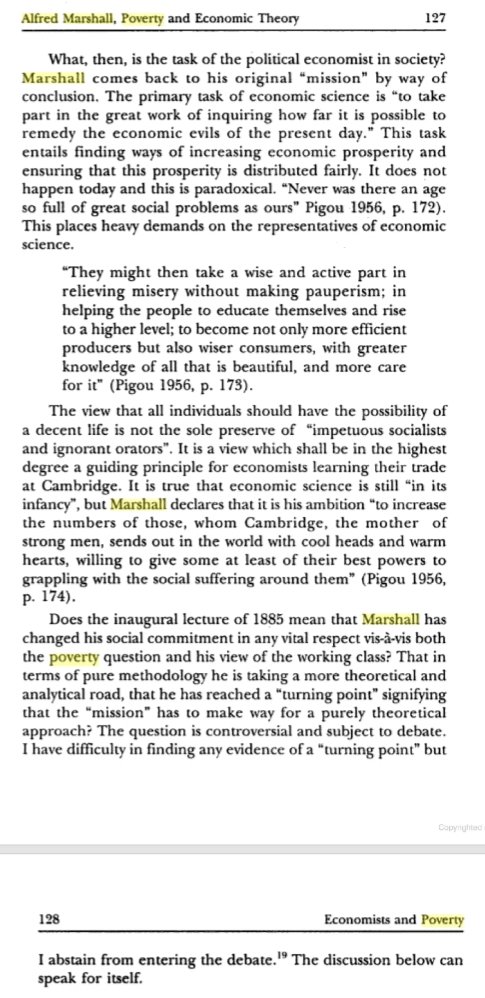
Alfred Marshall was an astute observer of the labour market using asset specificity and hold-ups
25 Sep 2019 Leave a comment
in applied price theory, labour economics, labour supply, unions
Surprise! Cats are just as attached to their staff as are dogs and babies
25 Sep 2019 Leave a comment
There’s a new paper in Current Biology (click screenshot below, pdf here, and reference at bottom), which shows that, using standard methodology for measuring attachment to staff (“owners” in the vulgate), both kittens and adult cats are as attached to their staff as are human babies and d*gs. The paper is very short—two pages if you don’t read the supplementary material—and you can peruse it below. There’s also a good summary of the results in Ars Technica by Jennifer Oullette.
Initially, 70 kittens between 3 and 8 months old were tested for their degree of “security” using the Secure Base Effect test (SBT). As Jennifer notes, it’s done this way:
The felines spent two minutes in an unfamiliar room with their owner, who sat on an X in the middle of a circle marked on the floor and could only interact with their cat when the animal entered the…
View original post 723 more words
In Indy op-ed, Omar Barghouti blames Israel for his UK visa delay
24 Sep 2019 Leave a comment
In a Sept. 23rd Independent op-ed, BDS leader Omar Barghouti, who rejects Israel’s right to exist, responded to the fact that he was unable to speak at the Labour Party conference in Brighton (due to his visa request being delayed) by peddling a conspiracy theory.
I was set to take part in a Labour Party conference fringe event this weekend talking about my work advocating for Palestinian rights – but was unable to travel to Brighton because of a peculiar delay in the processing of my UK visa application. I suspect that Israel’s far-right government has once again outsourced its desperate war of repression against those supporting Palestinian rights to another western government.
Barghouti’s suggestion is clear: that his visa application delay was not the fault of the UK Home Office, or even Prime Minister Boris Johnson, but, rather, the government in Jerusalem – an allegation…
View original post 544 more words
The IDI and government data linking
24 Sep 2019 Leave a comment
Browsing on The Treasury’s website the other day, it was the title that caught my eye: “Talkin’ about a revolution”. I’m rather wary of revolutions. Even when – not always, or perhaps even often – good and noble ideas help inspire them, the outcomes all too often leave a great deal to be desired. There are various, quite different, reasons for that, but one is about the failure to think through, or care about, things – themselves initially small or seemingly unimportant – that the revolution opens the way to.
This particular “revolution” – billed as “a quiet and sedate revolution, but a revolution nonetheless” – was sparked by Statistics New Zealand’s Integrated Data Infrastructure (IDI). Here is the Treasury author
The creation of Stats NZ’s IDI (or Integrated Data Infrastructure), a treasure trove of linked data, sparked the revolution, and its ongoing development drives it…
View original post 2,017 more words
Book Review
24 Sep 2019 3 Comments
Faith in appeasement, the central tenet of British foreign policy throughout the 1930s, remained strong among the most devout long after it had been exposed as entirely bankrupt. Even as it lay in tatters with the German military massing on the Polish frontier for the invasion of Poland in the late summer of 1939, the virtually disloyal British ambassador to Berlin Sir Nevile Henderson recommended the Polish government concede to Hitler’s demands, while in London R.A.B. Butler, member of parliament, despaired that the British Foreign Office was displaying an unwarranted “absolute inhibition” to pressure the Poles to negotiate. After the German invasion of Poland, Prime Minister Neville Chamberlain and his government prevaricated one last time before finally declaring war on Germany.
Appeasement was “the attempt by Britain and France to avoid war by making ‘reasonable’ concessions to German and Italian grievances.” The long list of “reasonable concessions” when finally catalogued included…
View original post 719 more words
THE MAINZEAL OUTRAGE
24 Sep 2019 Leave a comment
There’s a lot of silliness currently being talked about building industry sub-contractors being left unpaid following the failure of building companies. Calls for builders to maintain trust funds ignore practicalities.
But let’s get one thing straight. Being left out of pocket through commercial failure goes with the territory of running any business. My company here and abroad would lose on average over a decade, 5 to 10 million dollars through lessee failure. So too suppliers to retailers, and retailers themselves through hire purchase failures, theft, unsold stock and so on. Publishers produce books which bomb, retailers buy a line of goods customers reject, and so it goes. No‑one is immune, even professionals when their clients go belly‑up.
View original post 327 more words
My @DomPost op-ed on viewpoint discrimination in the abortion bill restrictions on clinic protests @familyfirstnz @NZFreeSpeech
24 Sep 2019 Leave a comment
in applied price theory, law and economics, politics - New Zealand, politics - USA, Public Choice Tags: abortion law reform, free speech
Policy costings office: a perspective from Australia
24 Sep 2019 Leave a comment
45 staff to run spreadsheets with no dynamic scoring!
Over the years I’ve written a fair bit here about the idea of some sort of independent fiscal analysis body (most recent post here, with links to earlier ones). There are ever-increasing numbers of such agencies around the world, partly because the EU says each of its member countries has to have one. As I’ve argued here, I think there is a reasonable case for some sort of such body here – small and focused on all macro policy rather than just fiscal policy – but I’ve become increasingly sceptical of the sort of direction the current government has chosen to take. They seem to be looking at something that serves mostly as free research for MPs costing policies, perhaps most closely resembling the Australian Parliamentary Budget Office set up a couple of election cycles ago.
The Treasury yesterday held an excellent guest lecture on the issue…
View original post 1,783 more words
Malcolm Gladwell and other authors who make big errors in their books
24 Sep 2019 Leave a comment
When I started writing books for the general public (“trade books”, as they call them), I was surprised to find out that I alone was responsible for the accuracy of their content. While publishers do have their legal departments vet books that may violate laws against libel, or cause other legal troubles, publishers have neither the time nor the money to have books thoroughly fact-checked. This is one reason why authors put references for many factual statements at the end of the book, as I did with my two.
Even so, errors slip in, and sometimes those errors are numerous. A new piece in the New York Times cites some serious or numerous mistakes in popular books. Here are four that are highlighted:
Accusations of sloppiness and journalistic malpractice now quickly explode on social media. Ms. [Jill] Abramson was pilloried on Twitter by sources and other journalists this year for…
View original post 1,184 more words
EVERYTHING YOU EVER WANTED TO KNOW ABOUT THE TREATY, BUT WERE TOO TERRIFIED OF BEING LABELLED A RACIST TO ASK — Part 1: Maori Ask British for Protection From Maori
23 Sep 2019 Leave a comment

This is the first of a series of posts designed to bust the myths created by the Treaty of Waitangi grievance industry — myths shamelessly presented as truths by your government.
If you think it rude of me to expose these facts, tough. If conmen are going to tell lies about my forefathers, I’m going to tell the truth about theirs.
Much of what you see below is distilled from New Zealand in Crisis by Ross Baker of the One New Zealand Foundation.
In the plainest English I could muster, here is the boiled-down background to the drafting and signing of the Treaty:
c.1350 — Maori meet the tangata whenua
Maori history tells of seven canoes arriving from Hawaiki in around 1350AD.
They find New Zealand already inhabited by people they call the tangata whenua.
Maori historian Dr Ranginui Walker confirms: “The traditions are quite clear: wherever crew disembarked there were already tangata whenua (prior inhabitants).”
These first…
View original post 1,278 more words
Did @greenpeace @oxfam celebrate this massive, rapid reduction in energy poverty?
23 Sep 2019 Leave a comment
in applied price theory, development economics, economic history, energy economics, growth miracles Tags: The Great Escape

What are we reading?
23 Sep 2019 Leave a comment
Well, I don’t know what you’re reading, and whether you like it, but that’s what this post is for. In fact, a lot of the books I’ve read, and a few I’m reading now, have come from readers’ comments on posts like this.
I usually read only one book at a time, and have been reading only nonfiction, but now I’m reading multiple books at once. The one I’m concentrating on—as it’s big and I need to finish it before I go to Antarctica—is this biography of Churchill (click on all books for the Amazon link). It was published in November of last year and was highly rated.
I’m reading it because I finally grew tired of not knowing all about Churchill’s life. I’d read the first two volumes of William Manchester’s The Last Lion: Winston Spencer Churchill, which was fabulous—along with Robert Caro’s biographies of Lyndon Johnson and…
View original post 805 more words
George H. Smith Debates David D. Friedman: Ethics vs. Economics (1981)
23 Sep 2019 Leave a comment
in applied price theory, applied welfare economics, Austrian economics, comparative institutional analysis, constitutional political economy, David Friedman, defence economics, economic history, economics of crime, economics of education, economics of regulation, environmental economics, labour economics, law and economics, property rights, Public Choice Tags: anarchocapitalism
1831 Maori petition to King for protection
23 Sep 2019 Leave a comment
This is T.L. Buick’s account of the petition from 13 Ngapuhi chiefs that the King responded to in my earlier post.
For ease of reading, I’ll spread out the words below.
Then I’ll show you some blow-ups of relevant parts of the original English and Maori documents.
You will notice some words which have a bearing on what Maori are claiming today.
First, the words:
TO KING WILLIAM, THE GRACIOUS CHIEF OF ENGLAND
KING WILLIAM — We, the chiefs of New Zealand assembled at this place, called the Kerikeri, write to thee, for we hear that thou art the great chief of the other side of the water, since the many ships which come to our land are from thee.
We are a people without possessions.
We have nothing but timber, flax, pork and potatoes, we sell these things, however, to your people, and then we see property of the Europeans.
It is…
View original post 748 more words
To Help the Poor, Focus on Poverty Reduction Rather than Inequality
22 Sep 2019 Leave a comment
Here’s a simple quiz to determine whether you should support a candidate like Bernie Sanders or Elizabeth Warren: Would you embrace a policy that increased income for poor Americans by 10 percent if it also happened to increase income for rich Americans by 15 percent?
Normal people automatically say yes. After all, they don’t resent rich people and they want lower-income people to enjoy better living standards.
Some of our left-leaning friends (including at the IMF!), however, are so fixated on inequality that they are willing to deprive the poor so long as higher-income people have even larger losses (Margaret Thatcher nailed them on this issue).
Let’s look at some analysis of this issue.
The Wall Street Journal has an editorial that starts by highlighting some good economic news.
…low- and middle-income folks are reaping more economic benefits than during the Obama years. …Worker earnings increased…
View original post 512 more words


Recent Comments