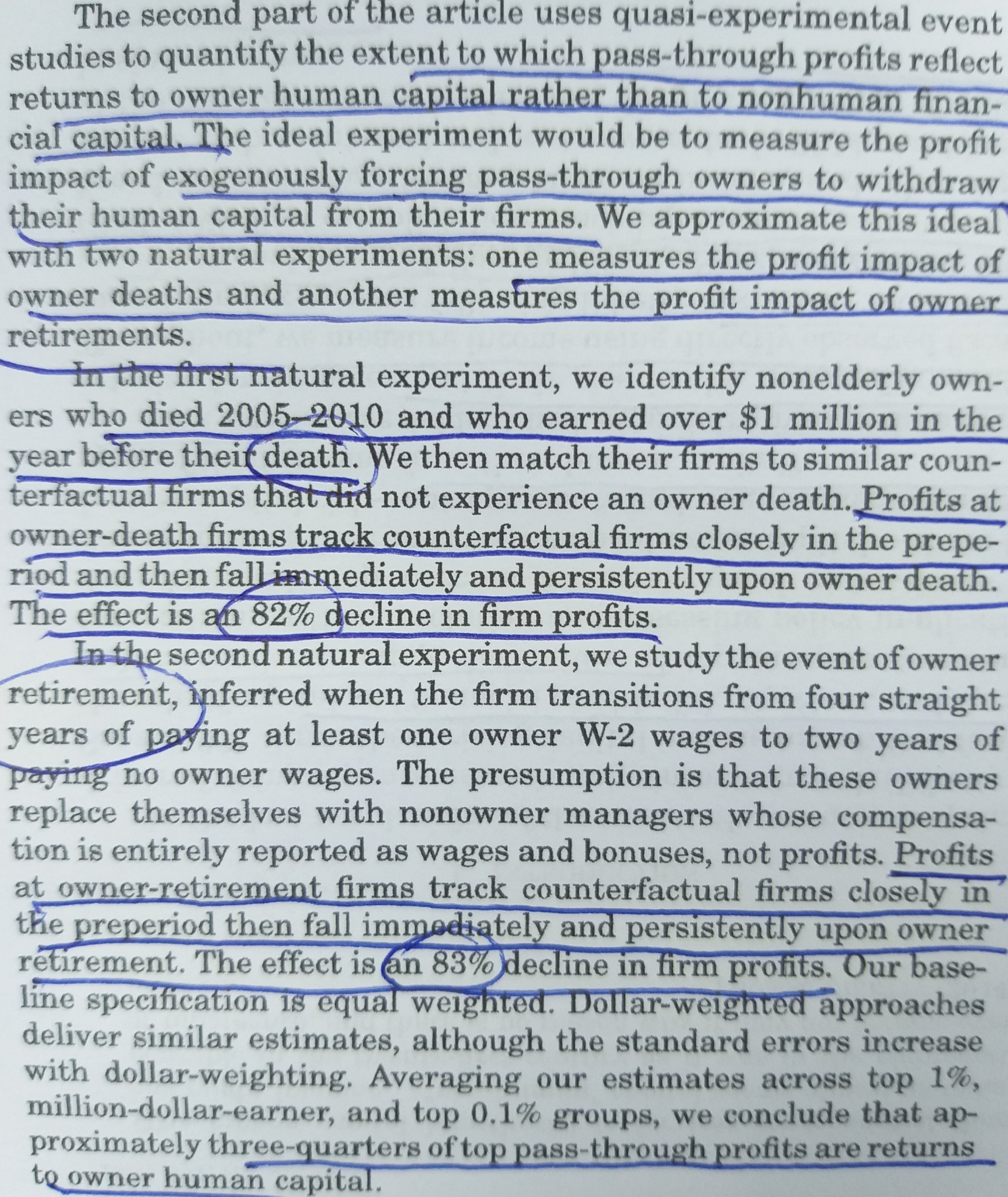
from http://www.ericzwick.com/capitalists/capitalists.pdf
Matthew Smith, Danny Yagan, Owen Zidar, Eric Zwick, Capitalists in the Twenty-First Century, The Quarterly Journal of Economics, Volume 134, Issue 4, November 2019, Pages 1675–1745,
Celebrating humanity's flourishing through the spread of capitalism and the rule of law
19 Oct 2019 Leave a comment
in applied price theory, entrepreneurship, financial economics, human capital, income redistribution, industrial organisation, labour economics, labour supply, law and economics, Marxist economics, occupational choice, poverty and inequality, property rights, Public Choice, survivor principle Tags: labour theory of value, top 1%
from http://www.ericzwick.com/capitalists/capitalists.pdf
Matthew Smith, Danny Yagan, Owen Zidar, Eric Zwick, Capitalists in the Twenty-First Century, The Quarterly Journal of Economics, Volume 134, Issue 4, November 2019, Pages 1675–1745,
19 Oct 2019 Leave a comment
in applied price theory, applied welfare economics, comparative institutional analysis, development economics, economics of bureaucracy, economics of crime, economics of information, growth disasters, law and economics, Public Choice Tags: bribery and corruption, The fatal conceit
19 Oct 2019 Leave a comment
The Anglo-Saxon kings of England used numerous different titles, including “King of the Anglo-Saxons” and “King of the English. Around the mid 880s Is period in which almost all chroniclers agree that the Saxon people of pre-unification England submitted to Alfred. This was not, however, the point at which Alfred came to be known as King of England; in fact, he would never adopt the title for himself.
Initially Alfred was titled King of Wessex until 886 when in London Alfred received the formal submission of “all the English people that were not under subjection to the Danes”, and thereafter he adopted the title Anglorum Saxonum rex (King of the Anglo-Saxons). While Alfred was not the first king to claim to rule all of the English, his rule represents the start of the first unbroken line of kings to rule the whole of England, the House of Wessex.
Alfred’s son…
View original post 774 more words
19 Oct 2019 Leave a comment
It is the final Friday before Shemini Atzeret, also known as Election Day in Canada this year, And what an interesting campaign it has been! The polls have moved quite a lot, especially recently. The New Democrats (NDP) seem to be enjoying a surge. Not on anything like the scale of 2011, but still something notable, as it was not long ago that there was talk about the Greens possibly passing them for third place. The Greens have slipped somewhat, as has been the case in past campaigns. No longer do they look likely to win as many as four seats; two (which is their current number) looks most likely.
The striking thing is that the poll aggregate at CBC (compiled by Éric Grenier) shows both major parties–incumbent seat-majority Liberal and opposition Conservative) barely above 30% of the vote (31.7-30.8 at my latest check). From 1949 to present, the largest party…
View original post 877 more words
18 Oct 2019 Leave a comment
 Wind industry victim: the endangered Tasmanian wedge-tailed eagle.
Cars, cats and skyscrapers don’t kill Eagles – like the critically endangered Tasmanian wedge-tailed eagle, but 60m wind turbine blades with their tips travelling at 350Kph routinely smash them out of existence.
The current crop of well-fed and poorly educated teens raging against the evil patriarchy and its grand conspiracy to cook the planet and demanding immediate ‘climate action’ – code for carpeting the planet in windmills and solar panels – either have no idea about the carnage caused by these things, or they couldn’t care less.

Millions of tonnes of beneficial bugs get splattered annually, along with millions of birds and bats, some of them being among the last of their kind.
All, as we’re constantly berated, in the name of ‘saving’ Mother Earth. [Note to Ed: with friends like that, who needs enemies?]
Denial, obfuscation and outright lies…
View original post 4,633 more words
18 Oct 2019 Leave a comment
Expect the old campaigner Winston Peters to be at his belligerent best as he gears up for another election. He’s kept his party alive for 27 years and he shows no sign of quitting.
The omens may be bleak—polls this week showed his party below the 5% threshold– but Peters insists NZ First’s own polling puts the party “comfortably in the zone” to do well. He told Radio NZ the party is getting “enormous support” in the provinces and he’ll use the conference to outline a winning strategy.
As for those political commentators who say NZ First won’t make it back into Parliament, they are “moronic”.
Yet even when Peters fires up, as he did in that interview, the odds are stacking up against NZ First. He can brush off the polls, dismiss leaks of sensitive party documents pointing to questionable internal administrative issues, and assert his party …
View original post 569 more words
18 Oct 2019 Leave a comment
in applied price theory, applied welfare economics, econometerics, economics of bureaucracy, economics of information, Public Choice Tags: The fatal conceit
18 Oct 2019 Leave a comment
This is one of those issues where I can sort of see a point, but in general think it’s also overblown. In fact, it was the subject of an NBC Today show post and tv segment. It turns out that a nine year old Utah girl named Rhythm Pacheco was asked to answer a math question in which the weights of various students (females) were compared. In particular, as you see below, it was a simple subtraction question, one that Rhythm answered but then expressed anger, saying she “wont right this its rood” (committing four errors in five words). Here’s her answer.
In the NBC video on the site, the hosts get all upset and see the question as sexist (or otherwise offensive).
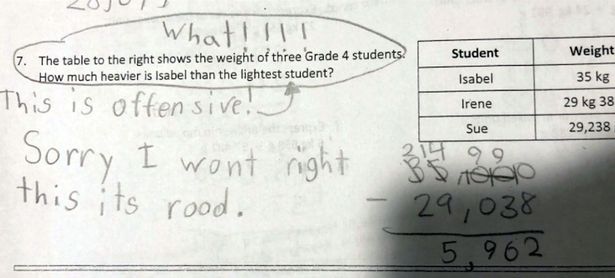
Now Rhythm wrote a nice note to her teacher, and the teacher responded nicely (and corrected Rhythm’s writing in brown ink!:

Here’s a television report from…
View original post 148 more words
18 Oct 2019 Leave a comment
It’s NBER Summer Institute season, when every bar and restaurant in East Cambridge, from Helmand to Lord Hobo, is filled with our tribe. The air hums with discussions of Lagrangians and HANKs and robust estimators. And the number of great papers presented, discussed, or otherwise floating around inspires.
The paper we’re discussing today, by Wyatt Brooks at Notre Dame and Kevin Donovan at Yale SOM, uses a great combination of dynamic general equilibrium theory and a totally insane quasi-randomized experiment to help answer an old question: how beneficial is it for villages to be connected to the broader economy? The fundamental insight requires two ideas that are second nature for economists, but are incredibly controversial outside our profession.
First, going back to Nobel winner Arthur Lewis if not much earlier, economists have argued that “structural transformation”, the shift out of low-productivity agriculture to urban areas and non-ag sectors, is fundamental…
View original post 1,491 more words
18 Oct 2019 Leave a comment
in applied price theory, applied welfare economics, comparative institutional analysis, constitutional political economy, development economics, economics of bureaucracy, economics of crime, economics of education, economics of information, economics of regulation, growth disasters, growth miracles, history of economic thought, industrial organisation, labour economics, law and economics, property rights, Public Choice
18 Oct 2019 Leave a comment
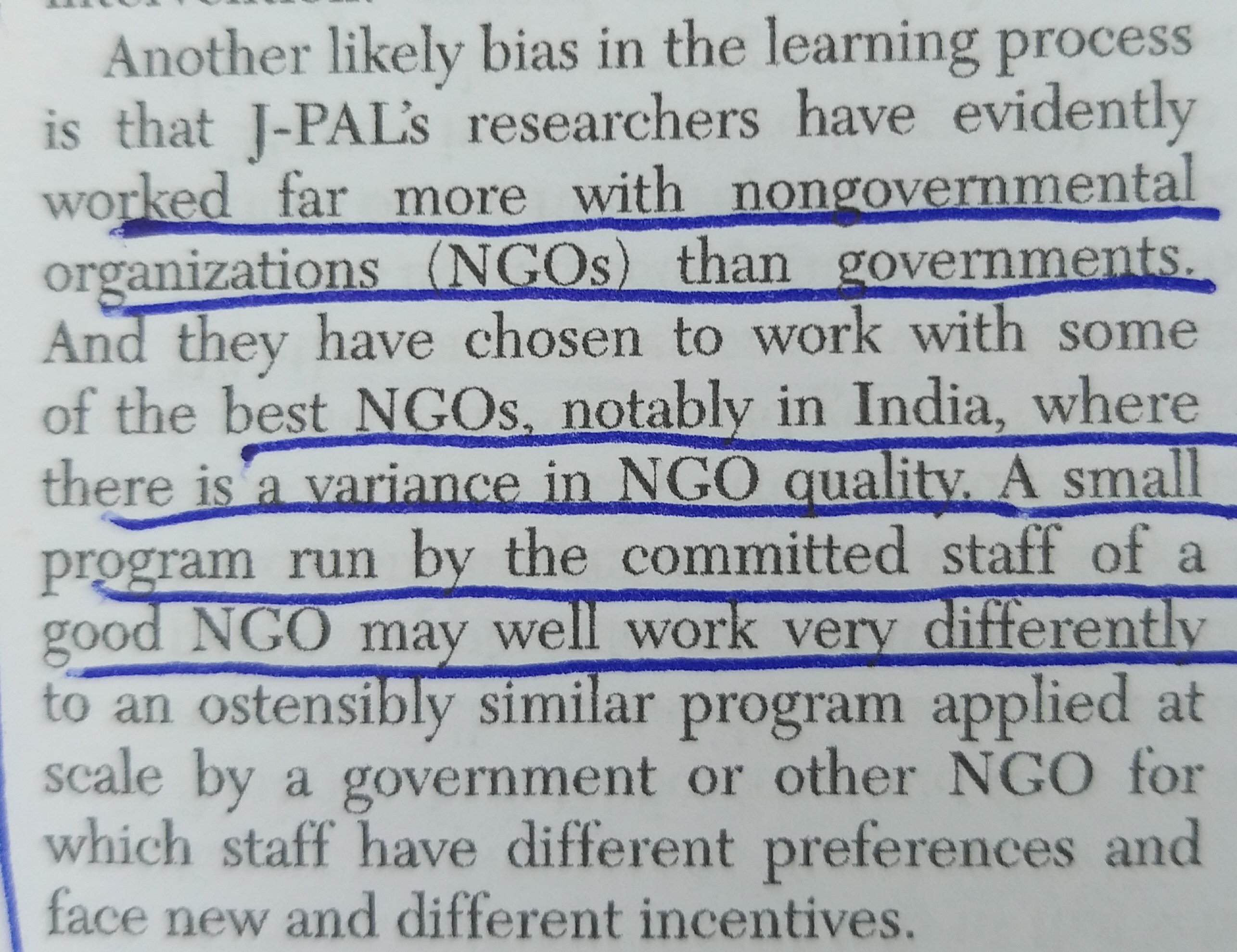
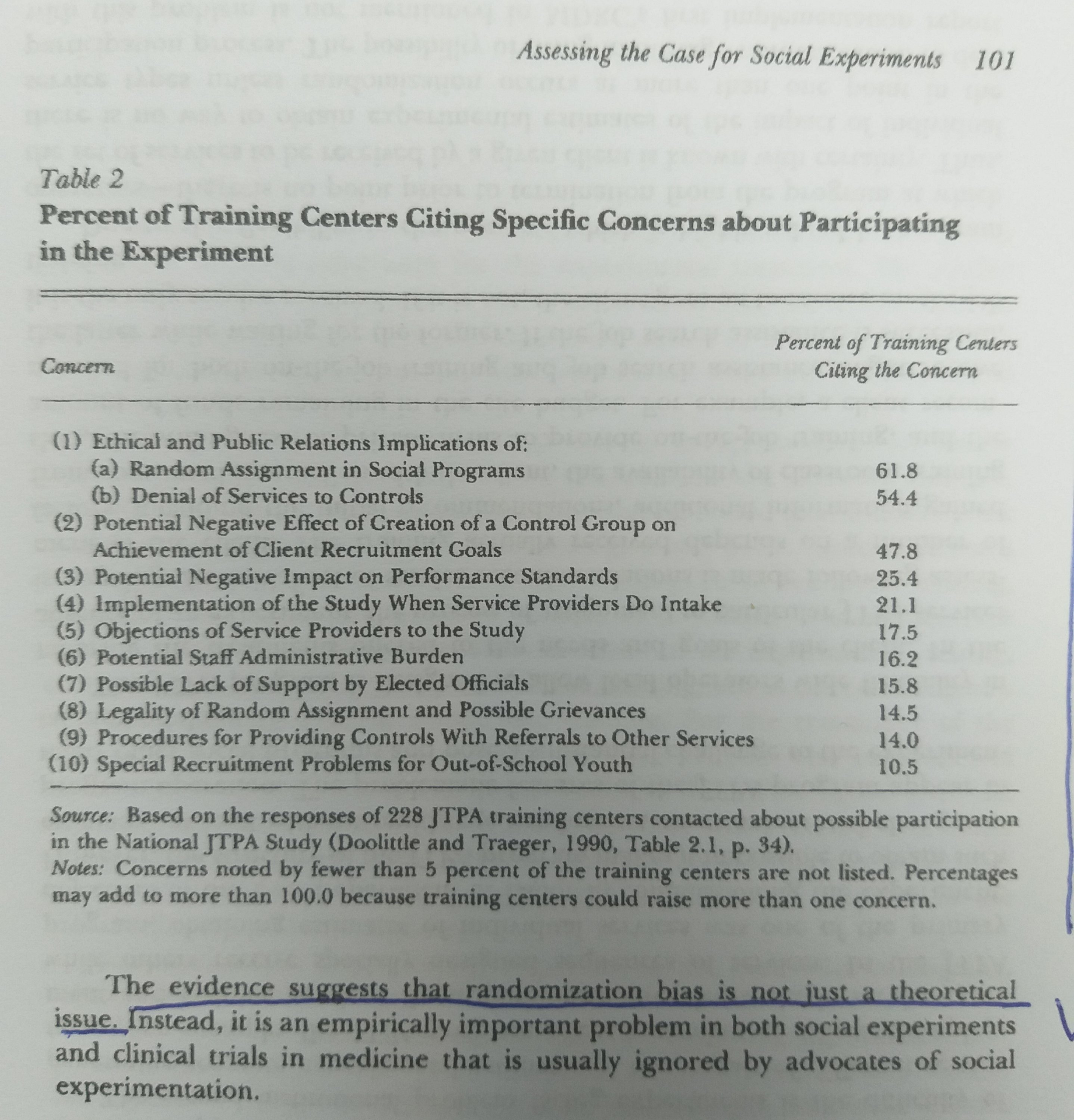
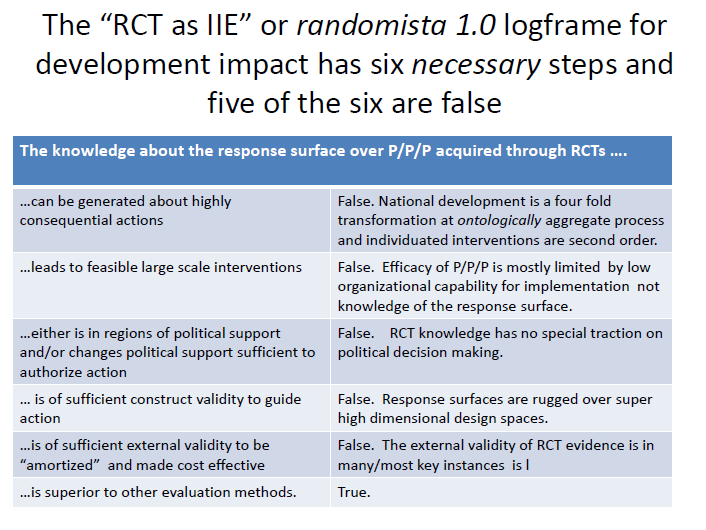
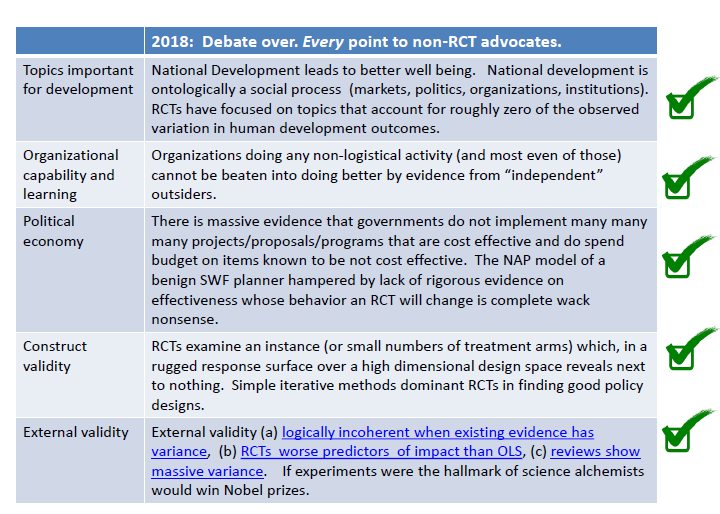
“A PhD student of ours on the market this year, Carlos Inoue, examined the effect of random allocation of a new coronary intervention in Brazilian hospitals. Following the arrival of this technology, good doctors moved to hospitals with the “randomized” technology. The estimated effect is therefore nothing like what would have been found had all hospitals adopted the intervention. This issue can be stated simply: randomizing treatment does not in practice hold all relevant covariates constant, and if your response is just “control for the covariates you worry about”, then we are back to the old setting of observational studies where we need a priori arguments about what these covariates are if we are to talk about the effects of a policy.”
It is Nobel Prize season once again, a grand opportunity to dive into some of our field’s most influential papers and to consider their legacy. This year’s prize was inevitable, an award to Abhijit Banerjee, Esther Duflo, and Michael Kremer for popularizing the hugely influential experimental approach to development. It is only fitting that my writeup this year has been delayed due to the anti-government road blockades here in Ecuador which delayed my return to the internet-enabled world – developing countries face many barriers to reaching prosperity, and rarely have I been so personally aware of the effects of place on productivity as I was this week!
The reason for the prize is straightforward: an entire branch of economics, development, looks absolutely different from what it looked like thirty years ago. Development economists used to be essentially a branch of economic growth. Researchers studied topics like the productivity of large…
View original post 4,633 more words
17 Oct 2019 Leave a comment
Superb Timothy Taylor on his super blog links to these intro econ videos:
Amanda Bayer and Judy Chevalier have been compiling a list of video clips that may be useful for the standard intro econ class. It’s available at the Diversifying Economic…
View original post 300 more words
17 Oct 2019 Leave a comment

 On 14 October 2019, the Upper Tribunal (UT) handed down judgment in SSHD v De Souza, immediately dividing commentators both in and outside Northern Ireland. Briefly, the UT had heard the Home Secretary’s appeal against the First-tier Tribunal (FTT) decision which had declared that the American claimant (respondent in the UT) was entitled to apply to reside in Northern Ireland under the EU Citizen’s Directive because his wife was permitted to self-identify as an Irish national in accordance with the provisions of the Good Friday Agreement (GFA). British nationality, the FTT declared, could not be “imposed” on her at birth, flying in the face of the British Nationality Act 1981 (BNA), section 1 of which, it was argued, does precisely that. The UT allowed the appeal and overturned the FTT judgment, revealing a tension which goes far beyond immigration law.
The claimant’s case involved a…
View original post 1,495 more words
Celebrating humanity's flourishing through the spread of capitalism and the rule of law
Celebrating humanity's flourishing through the spread of capitalism and the rule of law
Celebrating humanity's flourishing through the spread of capitalism and the rule of law
Celebrating humanity's flourishing through the spread of capitalism and the rule of law
Celebrating humanity's flourishing through the spread of capitalism and the rule of law
Celebrating humanity's flourishing through the spread of capitalism and the rule of law
Celebrating humanity's flourishing through the spread of capitalism and the rule of law
Celebrating humanity's flourishing through the spread of capitalism and the rule of law
A History of the Alt-Right
Econ Prof at George Mason University, Economic Historian, Québécois
Celebrating humanity's flourishing through the spread of capitalism and the rule of law
Scholarly commentary on law, economics, and more
Beatrice Cherrier's blog
Celebrating humanity's flourishing through the spread of capitalism and the rule of law
Celebrating humanity's flourishing through the spread of capitalism and the rule of law
Celebrating humanity's flourishing through the spread of capitalism and the rule of law
Why Evolution is True is a blog written by Jerry Coyne, centered on evolution and biology but also dealing with diverse topics like politics, culture, and cats.
Celebrating humanity's flourishing through the spread of capitalism and the rule of law
A rural perspective with a blue tint by Ele Ludemann
DPF's Kiwiblog - Fomenting Happy Mischief since 2003
Celebrating humanity's flourishing through the spread of capitalism and the rule of law
The world's most viewed site on global warming and climate change
Tim Harding's writings on rationality, informal logic and skepticism
A window into Doc Freiberger's library
Let's examine hard decisions!
Commentary on monetary policy in the spirit of R. G. Hawtrey
Thoughts on public policy and the media
Celebrating humanity's flourishing through the spread of capitalism and the rule of law
Politics and the economy
A blog (primarily) on Canadian and Commonwealth political history and institutions
Reading between the lines, and underneath the hype.
Economics, and such stuff as dreams are made on
"The British constitution has always been puzzling, and always will be." --Queen Elizabeth II
Celebrating humanity's flourishing through the spread of capitalism and the rule of law
Celebrating humanity's flourishing through the spread of capitalism and the rule of law
WORLD WAR II, MUSIC, HISTORY, HOLOCAUST
Undisciplined scholar, recovering academic
Celebrating humanity's flourishing through the spread of capitalism and the rule of law
Res ipsa loquitur - The thing itself speaks
In Hume’s spirit, I will attempt to serve as an ambassador from my world of economics, and help in “finding topics of conversation fit for the entertainment of rational creatures.”
Researching the House of Commons, 1832-1868
Articles and research from the History of Parliament Trust
Reflections on books and art
Posts on the History of Law, Crime, and Justice
Celebrating humanity's flourishing through the spread of capitalism and the rule of law
Exploring the Monarchs of Europe




Recent Comments