Steven Spadijer: Miller No 2: Orthodoxy as Hersey, Hersey as Orthodoxy
07 Oct 2019 Leave a comment

 Introduction
Reading the recent Miller No. 2 decision you would be forgiven in thinking that Boris Johnson had the chutzpah to advise the Queen to unilaterally decree a whole range of new criminal offences (Proclamations) – all under the guise of the prorogation power.
Indeed, the Miller No. 2 decision paints itself as pure orthodoxy. We are reminded that it is the emphatic duty and quintessential task of a law court to define the scope of a prerogative power, clearly a justiciable matter. And the scope of the prorogation power, so it turns out, is now limited by this rather innocuous-sounding principle (at para [50]):
A decision to prorogue Parliament (or to advise the monarch to prorogue Parliament) will be unlawful if the prorogation has the effect of frustrating or preventing, without reasonable justification, the ability of Parliament to carry out its constitutional functions as a legislature and…
View original post 2,158 more words
Paul McCartney on how he wrote some of his hits
07 Oct 2019 Leave a comment

As usual, YouTube is a black hole, for when I watch one video, a bunch of other ones “recommended for you” pop up on the right side. And how well they know me! Yesterday this 27-minute video of Paul McCartney appeared, and I had no choice but to click on it.
It’s a fascinating soliloquy by McCartney on how he (with John Lennon, of course) wrote some of the biggest hits of his career, including mostly Beatles songs but a few solo songs. They include I Lost My Little Girl, Yesterday, I Saw Her Standing There, And I Love Her, Eleanor Rigby, A Day in the Life, Hey Jude, Helter Skelter, Blackbird, Let It Be, Hi Hi Hi, Here Today, Jet and I Don’t Know.
Since the Beatles are the greatest rock group of all time, and I brook no dissent on this issue, you might enjoy it, too. If…
View original post 15 more words
Green Ideology: It was never about the Environment
07 Oct 2019 Leave a comment

In order to improve conditions in the environment we need to protect nature from what has proven to be its greatest threat: Green activists and environmentalists.
While this may seem counter-intuitive, in the 25 years I have been involved in discussions on environmental-health concerns, I have understood how the complexity of the issues, the increasingly more accurate data and the speed of emerging technologies require a flexibility and an open-mindedness to adapt to the best available knowledge, technologies and tools at our disposal. In such situations, the biggest obstacle to protecting the environment is the dogmatic fundamentalism widely expressed by most green cultists, zealots and ideologues.
Over that quarter century I have had my fair share of
confrontations with a wide range of “environmentalists” – from
activists to gurus to politicians (to sisters-in-law). Two common threads in
many of these interactions with activists became evident:
- Their inherent cynicism – that…
View original post 1,711 more words
Portrait of a strongman
07 Oct 2019 Leave a comment

It didn’t seem like the best weekend for Reserve Bank Governor Adrian Orr.
First, there was Radio New Zealand’s Insight documentary on the Governor’s bank capital plans, and other possible new regulatory burdens. I was impressed with the huge amount of time and energy that was put into the programme, although inevitably there are limitations in what a programme designed for a mainstream Sunday morning audience can deal with. In some ways, the best public service now would be if Radio New Zealand and/or the Reserve Bank agreed to release the full interview Guyon Espiner did with the Governor – we were told it was an hour long, but no more than five minutes would have been used in the programme (I presume this was par for the course on Espiner’s background work, as I did an interview with him that went for perhaps 40+ minutes).
In commenting…
View original post 2,621 more words
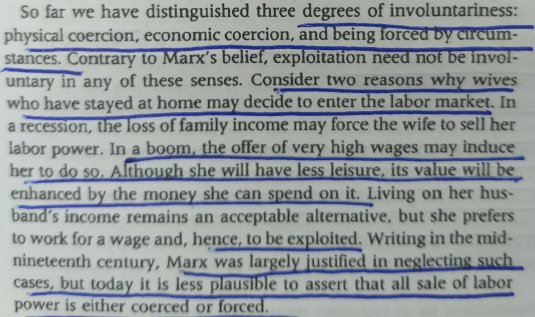
Jon Elster on the lack of gender analysis in the labour theory of value
07 Oct 2019 Leave a comment
in applied price theory, discrimination, economics of love and marriage, gender, income redistribution, labour economics, labour supply, Marxist economics, occupational choice, Public Choice Tags: female labour force participation, marital division of labour
A Lost Generation of Socialism Youth?
06 Oct 2019 Leave a comment

I’ve opined that statist policies harm young people.
I also shared this video explaining why big government is bad for millennials and the Gen-Z crowd.
This should be a slam-dunk issue. After all, don’t they know how the communist world collapsed?
Aren’t they aware of the problems in places such as Greece and Venezuela?
Or, to make it personal, don’t they have any inkling of the fact that they are going to get screwed by entitlement programs?
And what about the fact that they lose out because of Obamacare?
Sadly, it appears many of them haven’t learned the right lesson.
Support for socialism is disturbingly high among the young.
I’ve wondered, only half-jokingly, whether they’re too clueless to vote.
David Grasso opines on this topic for the New York Post.
It’s important to look at the typical millennial trajectory, and why unprecedented government intervention…
View original post 454 more words
Pascal’s Precautionary Wager: The Logic of Fear
06 Oct 2019 Leave a comment
When I wrote the Poison of Precaution earlier this year, one piece was missing from that puzzle. What was the logic behind the acceptance that being right didn’t matter? And why do some scientists, who know better about what is not right, then tolerate this scientific illogic? I had to put precaution into a belief system.
What would happen if we compared the precautionary principle from today’s environmentalist religion to Pascal’s Wager on the existence of God from pre-Enlightenment Christian religion? Both do not follow an evidence-based approach and build their logic on the conclusion that, in the face of uncertainty, being factually correct is not as important as the potential consequences from the risk of being wrong. Just as Pascal’s argument is neither genuine nor convincing, the precautionary logic does not reinforce the eco-theology and is merely a manipulative tool to emotionally manage away uncertainty.
When your belief system…
View original post 1,634 more words
APPEASEMENT: CHAMBERLAIN, HITLER, CHURCHILL, AND THE ROAD TO WAR by Tim Bouverie
06 Oct 2019 Leave a comment


(Neville Chamberlain after returning from the Munich Conference)
In 1961 the controversial British historian, A.J.P. Taylor published THE ORIGINS OF THE SECOND WORLD WAR arguing that the war was caused by the appeasement policies pursued by England and France toward Nazi Germany. He further purported that Adolf Hitler was more of a traditional European statesman who easily could have been stopped in March 1936 at the Rhineland bridges had England and France had the will to do so. This book created a firestorm in academic circles and over the years numerous historians have challenged Taylor’s conclusions. Among the first was J.W. Wheeler-Bennett’s MUNICH: PROLOGUE TO TRAGEDY followed later by Telford Taylor’s MUNICH: THE PRICE OF PEACE, Lynne Olson’s TROUBLESOME YOUNG MEN: THE REBELS WHO HELPED SAVE ENGLAND, David Faber’s MUNICH THE 1938 APPEASEMENT CRISIS, and last year a fictional account was written by Robert Harris. These books among many…
View original post 1,342 more words
WHAT DEMOCRATIC SOCIALISM DOES TO ECONOMIC PROSPERITY
06 Oct 2019 Leave a comment
in applied price theory, comparative institutional analysis, constitutional political economy, economic growth, economic history, economics of education, economics of regulation, fiscal policy, income redistribution, industrial organisation, labour economics, macroeconomics, Marxist economics, politics - USA, Public Choice Tags: Sweden
Pinker on free speech and academic freedom
05 Oct 2019 Leave a comment
Here’s a short Big Think talk by Steve Pinker, much demonized by the success-hating Pharyngula crowd as well as those who make their living by prognosticating the demise and degradation of humanity or our lack of social progress. Here Steve advances the well-known arguments for both free speech and academic freedom, which is simply free speech (as well as freedom of inquiry, the right to pursue what interests you) in a university setting. The arguments may not be new, but in this generation need to be repeated endlessly, for many young people and Leftists are beginning to mutter darkly that free speech is overrated.
And so Steve’s rationael for free speech is worth hearing again:
“We just don’t know any route to knowledge other than what Karl Popper called ‘conjecture and refutation’: throwing an idea out there and seeing if it withstands attempts to falsify it.”
This of course refers…
View original post 240 more words
It is only cheating if you get caught – Creative accounting at the Bank of England in the 1960s
05 Oct 2019 Leave a comment
Fascination of fraud by a central bank

by Alain Naef (Postdoctoral fellow at the University of California, Berkeley)
This research was presented at the EHS conference in Keele in 2018 and is available as a working paper here. It is also available as an updated 2019 version here.
 The Bank of England. Available at Wikimedia Commons.
The 1960s were a period of crisis for the pound. Britain was on a fixed exchange rate system and needed to defend its currency with intervention on the foreign exchange market. To avoid a crisis, the Bank of England resorted to ‘window dressing’ the published reserve figures.
In the 1960s, the Bank came under pressure from two sides: first, publication of the Radcliffe report (https://en.wikipedia.org/wiki/Radcliffe_report) forced publication of more transparent accounts. Second, with removal of capital controls in 1958, the Bank came under attack from international speculators (Schenk 2010). These contradictory pressures put the Bank in an awkward…
View original post 858 more words
What lies behind Corbyn’s difficulties with “left-wing antisemitism”?
05 Oct 2019 Leave a comment

 Above: ‘that’ mural
Jeremy Corbyn has apologised for “pockets of antisemitism” in the Labour party as he attempts to deal with renewed claims discrimination against Jewish people in the party. The accusations flared up again at the weekend when it emerged that he had supported the retention of an antisemitic mural in the East End of London six years ago (for which he has now apologised, saying he “should have looked more closely” at the mural). But Jewish leaders have issued an unprecedented open letter accusing Corbyn of “siding with antisemites” and being “ideologically fixed within a far-left worldview that is instinctively hostile to mainstream Jewish communities”. They also asked supporters to stage a show of solidarity outside parliament today as Labour MPs hold their weekly meeting. In his own statement on Sunday night, Corbyn said he was “sincerely sorry for the pain which has been caused” and said Labour was campaigning “to increase support and confidence among Jewish…
View original post 2,672 more words
Labour conference motion on Israel-Palestine: both unachievable and reactionary
05 Oct 2019 1 Comment

Labour Party conference passed a motion on Israel-Palestine, but shoehorned into the same session as Brexit, with no debate, and even less understanding of the issues.
The motion supports a majority-Palestinian state within the territory of Israel-Palestine, but in a fashion suffused with political dishonesty, written to hide rather than explain the issues.
The motion is premised on an “internationalist Labour Party” having particular responsibility “because of the role Britain played as a colonial power during the 1948 Nabka when Palestinians were forcibly displaced from their homes.”
That is nonsense. From the end of World War 2, Britain refused entry for Jewish refugees into Palestine, already heavily restricted during the war and the Holocaust. An increasingly violent Jewish insurgency in Palestine fought the British.
In 1947 Britain handed the problem to the UN, which proposed the partition of Palestine into…
View original post 807 more words


Recent Comments