
More Sloppy Analysis from the New York Times
10 Oct 2019 Leave a comment

The New York Times is going overboard with disingenuous columns.
A few days ago, I pointed out the many errors in David Leonhardt’s column extolling the wealth tax.
I also explained back in August how Steven Greenhouse butchered the data when he condemned the American economy.
And Paul Krugman is infamous for his creative writing.
But Mr. Leonhardt is on a roll. He has a new column promoting class warfare tax policy.
Almost a decade ago, Warren Buffett made a claim that would become famous. He said that he paid a lower tax rate than his secretary, thanks to the many loopholes and deductions that benefit the wealthy.
…“Is it the norm?” the fact-checking outfit Politifact asked. “No.” Time for an update: It’s the norm now. …the 400 wealthiest Americans last year paid a lower total tax rate — spanning federal, state and local taxes — than any other…
View original post 481 more words
Uncommon Knowledge, with Author and Columnist Douglas Murray
10 Oct 2019 Leave a comment

In this issue of Uncommon Knowledge from the Hoover Institute, Peter Robinson is joined by British author and columnist Douglas Murray to discuss “The Death of Europe.” Important and chilling. You can just shove stuff to the side and avoid taking it on for so long, but at some point you have to take a hard look at what is, and decide what, if anything, you are willing to do or even can do about it. Do watch the whole thing, it is important.
Jeff King: The Prime Minister’s Constitutional Options after the Benn Act: Part II
10 Oct 2019 Leave a comment

 This is the second of a two-part discussion of this theme. The first part addressed the obligations under the Benn Act and the legal response to attempts to frustrate it; this second part addresses non-confidence motions, resignation and change of Government. Heading numbering is continued from Part 1.
5. Non-confidence procedure under the FTPA – the PM ‘squats’
Section 2 of the FTPA provides for an early election if a motion in the words ‘That this House has no confidence in Her Majesty’s Government” is passed in the Commons and another in the form ‘That this House has confidence in Her Majesty’s Government.’ does not pass within fourteen calendar days. In its 2010 Report (HL Paper 69) on the Fixed-term Parliaments Bill, the Constitution Committee concluded at [121] that the provision ‘does make it clear that an alternative government can be formed.’ The Explanatory Note to section 2(3) simply states…
View original post 2,295 more words
My favourite economist joke as told by David Friedman
10 Oct 2019 Leave a comment
in applied price theory, David Friedman, economics of crime, economics of information, law and economics Tags: agent principal problem, asymmetric information, moral hazard

Why do we take some environmental impacts for granted?
09 Oct 2019 Leave a comment

As California tries to reduce the risk of catastrophic wildfire, the state has run into an unexpected obstacle: air pollution regulation. The New Yorker reports on how this regulation has paradoxically blocked prescribed burns and other risk-reduction methods, even though they reduce air pollution overall:
The California Air Resources Board restricts prescribed burns to days when pollution is at acceptable levels and the weather likely to disperse emissions from fire. In practice, this means that burning can occur only during a few weeks in the spring. In summer and autumn—the seasons when forests would burn naturally—the state’s air usually falls foul of the Clean Air Act. These are also the months that are most prone to uncontrollable wildfires, whose smoke is far more damaging to human health than that from prescribed fire. But, perversely, because wildfires are classified as natural catastrophes, their emissions are not counted against legal quotas.
This…
View original post 345 more words
Jeff King: The Prime Minister’s Constitutional Options after the Benn Act: Part I
09 Oct 2019 Leave a comment
 This is the first of a two-part discussion of this theme. This first part addresses the obligations under the Benn Act and the legal response to attempts to frustrate it; the second part will address non-confidence motions, resignation and change of Government.
There has been significant confusion about options open to Government and the opposition parties after the enactment of the European Union (Withdrawal) (No.2) Act 2019 (the “Benn Act”). Prime Minister Boris Johnson (the PM) has affirmed repeatedly that he would neither breach the Act nor send the request for an extension of the negotiating period that it straightforwardly requires. This raises concerns about whether the Government has a clever plan to evade or neutralize the requirements of the Benn Act. It also has invited speculation about the possible role of a vote of non-confidence, prime ministerial resignation, and an early election. All of these issues depend to a…
View original post 1,516 more words
The writing of history: RNZ sets the record straight by listening to modern-day iwi and discounting Cook’s journals
09 Oct 2019 Leave a comment
Rawls writes:
Burdened societies, while they are not expansive or aggressive, lack the political and cultural traditions, the human capital and know-how, and, often, the material and technological resources needed to be well-ordered. The long term goal of (relatively) well-ordered societies should be to bring burdened societies, like outlaw states, into the Society of well-ordered Peoples. Well-ordered peoples have a duty to assist burdened societies. (Rawls 1999a, 106)

Radio New Zealand journalist Meriana Johnsen – without any hint of a blush, we imagine – reported that “Gisborne iwi are setting the record straight on Captain James Cook…”
In other words, we have been told this is what really happened when Cook and his crew first arrived in New Zealand.
These Gisborne iwi – and Johnsen perhaps – will now be awaiting their invitations to contribute to the history books to be introduced to our schools.
Johnsen’s report is headlined “Gisborne iwi on British ‘collisions’: ‘They started swimming away but Cook started shooting’.”
Cook started shooting?
Not his crewmen?
View original post 1,212 more words
A day for celebration
09 Oct 2019 Leave a comment
Primitive societies react violently to strangers because the their experience is strangers come to conquer and kill.That’s why they are primitive. The concept of peace and trade is foreign to them.

I reckon today should have been a public holiday, to mark 250 years – quarter of a millennium – since these remote islands had opened to the world. That is something to celebrate.
Maori had, of course, been here for perhaps 500 years prior to the arrival of Lt James Cook and Endeavour. But it seems that they’d then become cut off from the rest of the world, with little or no evidence of any ongoing contact with anything or anyone beyond these shores. Material living standards were low. Abel Tasman had come by a bit of the coast 137 years earlier, and had given the name New Zealand, but after the killing of several of his crew, he didn’t land and soon went away again, initiating no ongoing contact.
But after Cook, and the other European explorers around these shores at much the same time, the…
View original post 1,713 more words
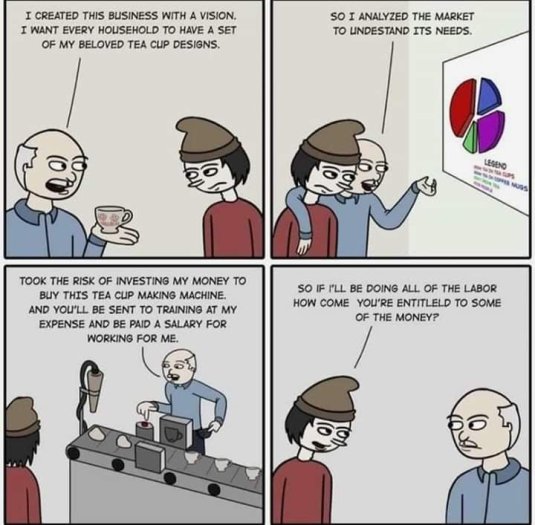
The labour theory of value @AOC @BernieSanders
09 Oct 2019 Leave a comment
in applied price theory, entrepreneurship, human capital, industrial organisation, labour economics, labour supply, Marxist economics, occupational choice, poverty and inequality, survivor principle Tags: labour theory of value
There are always plenty of jobs available?!
08 Oct 2019 Leave a comment
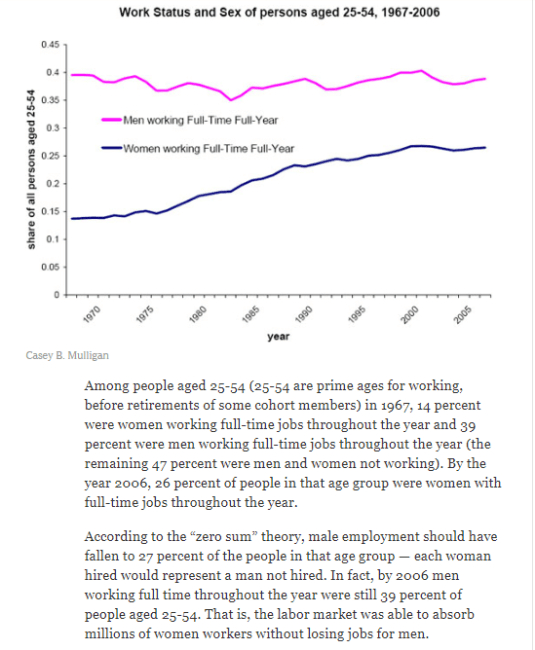
Casey Mulligan at https://economix.blogs.nytimes.com/2009/03/23/the-job-market-isnt-a-zero-sum-game/
Reboot Required: Fixing Wind & Solar Debacle Means Winding the Clock Back 30 Years
08 Oct 2019 1 Comment


Lamenting their rocketing power bills and dreading mass blackouts this coming summer, Australians can be forgiven for their sense of despair.
Australians once enjoyed the world’s cheapest power, reliably delivered, just like running water. No one talked about their power bills at backyard barbecues, or kept promising themselves that must have diesel generator to keep the lights on and freezers working.
But, like most things taken for granted, reliable and affordable electricity is only missed when it’s gone. And in Australia’s case, thanks to an obsession with chaotically intermittent and heavily subsidised wind and solar, it’s gone for good.
Wrecking an entire power generation and distribution system takes effort, but it can be done: ask a South Australian. Their self-inflicted renewable energy calamity didn’t start in earnest until 2002, when a bunch of ex-Enron crooks lobbed into town: How a Band of Criminals, Shysters & Chancers Conjured Up the Wind…
View original post 773 more words
Extinction Rebellion’s Strategic Ruse
08 Oct 2019 Leave a comment

It’s all over the news. The spontaneous protests in the streets of London to urge the government to act now to save humanity and the planet. The emotion behind the seriousness of the threat to humanity from catastrophic climate change. The celebrity pronouncements to act (lest we be judged by future generations). The chilling horror of die-ins and hunger strikes to balance the joyful carnival nature in the streets as “the people” rise up.
They are comparing themselves to Gandhi and Martin Luther King.
To a passive observer, this looks like humanity at its best and people who resist them, their message, the science and their hope for the future are merely ignorant climate deniers (old white men who are so emotionally weak that they need to “attack” a young Swedish girl). If I were a journalist, I would get my teeth into this polemic – the story writes itself.
View original post 1,489 more words


Recent Comments