
Climate change is an urgent topic of discussion among politicians, journalists and celebrities. But what do scientists say about climate change? Does the data validate those who say humans are causing the earth to catastrophically warm? In this PragerU video, MIT atmospheric physicist and one of the world’s leading climatologists, Richard Lindzen, summarizes the science behind climate change.
Introduction to Microeconomics (Lecture 9: Monopoly and Competition) Murray N. Rothbard
03 May 2019 Leave a comment
in applied price theory, Austrian economics, comparative institutional analysis, economics of regulation, law and economics, politics - USA, Public Choice, rentseeking Tags: antitrust economics, competition law
Williams College administration expresses support for segregated housing
03 May 2019 Leave a comment

Not long ago I wrote about how both a group of students and the student newspaper at Williams College in Williamstown, Massachusetts are pushing to get “affinity housing” for students (a euphemism for segregated housing). The activist students, grouped together under the rubric of CARENow, have an Instagram site with many of their thoughts and demands. On that site, as well as at this link, appears a list of demands from CARENow addressed to the Trustees of the College (there is also a letter to the President of Williams, Maud Mandel, demanding her response by tomorrow at 5 p.m.)
One of the demands is for segregated housing: housing segregated not just by race, but by sexuality and other “minority characteristics”:
3. Improve community spaces and establish affinity housing for Black, queer, and all other minoritized students.
“Minoritized” is a new word that was coined to emphasize deliberate oppression rather…
View original post 350 more words
Free to Choose by Milton Friedman: Episode “Created Equal” (Part 6 of transcript and video)
02 May 2019 Leave a comment

Liberals like President Obama want to shoot for an equality of outcome. That system does not work. In fact, our free society allows for the closest gap between the wealthy and the poor. Unlike other countries where free enterprise and other freedoms are not present. This is a seven part series.
Created Equal [6/7]. Milton Friedman’s Free to Choose (1980)
(Laughter)
PIVEN: If you look at the leadership of the black __
(Applause)
FRIEDMAN: But I want to go back to the __
MCKENZIE: Yeah.
FRIEDMAN: __ I want to carry it back to an earlier point. Number one, there’s no question but what equality of results, if it comes about through a framework of freedom, is a desirable result. Number two, I argue in the film I’ve argued here that in point of fact you get greater equality of actual results by a system under which people are free to achieve unequal…
View original post 1,655 more words
How Mrs Thatcher smashed the Keynesian consensus
02 May 2019 1 Comment

Apr 9th 2013, 14:13 by G.I. | WASHINGTON, D.C.
[Greg Ip] In March 1981, 364 eminent British economists published a letter to Margaret Thatcher in The Times condemning her plans to hike taxes even as her monetarist attack on inflation plunged the economy ever deeper into recession. The signatories wrote:
There is no basis in economic theory or supporting evidence for the Government’s belief that by deflating demand they will bring inflation permanently under control and thereby induce an automatic recovery in output and employment … [P]resent politics will deepen the depression, erode the industrial base of our economy and threaten its social and political stability.
View original post 1,352 more words
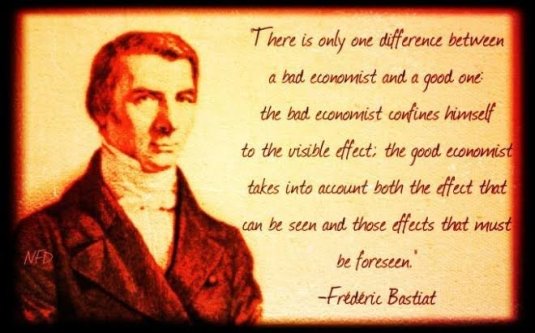
FRIEDMAN FRIDAY Listing of transcripts and videos of “Free to Choose” episode 4 – From Cradle to Grave on www.theDailyHatch.org
01 May 2019 Leave a comment
In the last few years the number of people receiving Food Stamps has skyrocketed. President Obama has not cut any federal welfare programs but has increased them, and he has used class warfare over and over the last few months and according to him equality at the finish line is the equality that we should all be talking about. However, socialism has never worked and it has always killed incentive to produce more. Milton Friedman shows in this film series below how so many people get caught in the “Welfare Trap.” Friedman also gives a great solution to this problem in the “negative income tax.” I am glad that I had the chance to be studying his work for over 30 years now.
In 1980 when I first sat down and read the book “Free to Choose” I was involved in Ronald Reagan’s campaign for president and excited about the race. Milton Friedman’s books…
View original post 2,427 more words
Life Peerages Act 1958: First Women Life Peers
30 Apr 2019 Leave a comment

Today marks the 60th anniversary of the announcement of the first life peers after the passing of the Life Peerages Act, 1958. This Act also allowed women to sit in the House of Lords for the first time so this blog is July’s installment of the Women and Parliament series. We are delighted to hear from guest blogger Dr Duncan Sutherland, a historian who has worked on women in Parliament for several years. Today he considers the experiences and contributions of the first four women life peers…
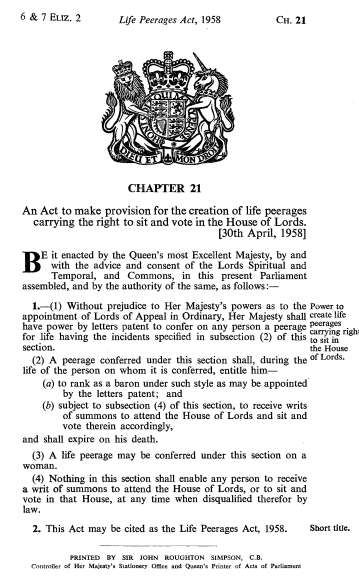
When the government announced the creation of life peers in 1958 to help revitalise the moribund Second Chamber, there was particular interest in who the first women appointed would be. Among those suggested but not chosen were Nancy Astor, former Suffragist Marjory Corbett Ashby and the elderly former Conservative Party activist Caroline Bridgeman. Three women passed over in 1958 would receive peerages…
View original post 1,178 more words
BBC senior editor defends double standards on terrorism
30 Apr 2019 Leave a comment

Those who have been following the BBC’s coverage of the recent attack at a synagogue near San Diego may have noticed that the sole use of the word terrorist appears in a quote from the wounded Rabbi in one of the BBC’s reports. A programme aired last month casts some light on related editorial policy.
The March 22nd edition of the BBC Radio 4 programme ‘Feedback’ included an item (from 1:03 here) concerning criticism of the BBC’s coverage of the terror attacks at two mosques in Christchurch, New Zealand, the previous week. Presenter Roger Bolton spoke with the BBC News editorial director Kamal Ahmed and from 5:20 the conversation turned to “the use of the word terrorism”. [emphasis in italics in the original]
Bolton: “Should the BBC have used the term ‘terrorist attack’ instead of ‘shooting’?”
Ahmed: “On the issue of terror and terrorism…
View original post 674 more words
FRIEDMAN FRIDAY Listing of transcripts and videos of “Free to Choose” episode 3 – Anatomy of a Crisis on www.theDailyHatch.org
30 Apr 2019 Leave a comment
 Listing of transcripts and videos of “Free to Choose” episode 3 – Anatomy of a Crisis on http://www.theDailyHatch.org
Milton Friedman in his series “Free to Choose” used a pencil as a simple example to should have the “invisible hand” of the freemarket works (phrase originally used by Adam Smith).
“How grateful I have been over the years for the cogency of Friedman’s ideas which have influenced me. Cherishers of freedom will be indebted to him for generations to come.”
—Alan Greenspan, former Chairman, Federal Reserve System
 “Right at this moment there are people all over the land, I could put dots on the map, who are trying to prove Milton wrong. At some point, somebody else is trying to prove he’s right That’s what I call influence.”
—Paul Samuelson, Nobel Laureate in Economic Science
In 1980 when I first sat down and read the book “Free…
View original post 1,871 more words
Jason Brennan: Why Not Capitalism? (April 9, 2019)
30 Apr 2019 Leave a comment
in applied price theory, Austrian economics, comparative institutional analysis, development economics, economic history, economics of crime, entrepreneurship, industrial organisation, labour economics, law and economics, property rights, Rawls and Nozick Tags: capitalism and freedom
FRIEDMAN FRIDAY Listing of transcripts and videos of “Free to Choose” episode 1 – Power of the Market on www.theDailyHatch.org
29 Apr 2019 Leave a comment
Milton Friedman’s books and film series really helped form my conservative views. Take a look at one of my favorite films of his:
Free to Choose ^| 1980 | Milton FriedmanPosted on Monday, July 17, 2006 4:20:46 PM by Choose Ye This Day
FREE TO CHOOSE: The Power of the Market
Friedman: Once all of this was a swamp, covered with forest. The Canarce Indians who lived here traded the 22 square miles of soggy Manhattan Island to the Dutch for $24.00 worth of cloth and trinkets. The newcomers founded a city, New Amsterdam at the edge of an empty continent. In the years that followed, it proved a magnet for millions of people from across the Atlantic; people who were driven by fear and poverty; who were attracted by the promise of freedom and plenty. They…

View original post 1,606 more words
The Green New Deal’s Bad Science
29 Apr 2019 Leave a comment
Mark Mills and James Meigs join John Stossel to discuss the Green New Deal, the limits of wind and solar power, and the magical thinking of an all-renewable energy future.


Recent Comments