
The Day of the Illiberals.
01 Feb 2019 Leave a comment

It’s been a bizarre few weeks for UK politics.
Today, the UK rolled out the red carpet for China. A country that sentenced 2,466 to death in 2014, and, according to Human Rights Watch, uses torture to extract confessions. But we wont be bringing up its human rights abuses, because we’re a Tory country now, and human rights just gets in the way of all that money. Unless Jeremy Corbyn makes excuses for human rights abusers, in which case, it’s a travesty.
Speaking of Jeremy Corbyn & hypocrisy, on the day the Tories are lavishing sycophantic praise on a country that uses forced abortions to enforce its laws on families, Jeremy Corbyn – who insists he’ll bring up human rights abuses with the Chinese this evening – hired Seumas Milne as his new head of communications. The same Seumas Milne who, two days after the September 11th attacks, wrote:
“It…
View original post 1,078 more words
Dissolution By Demise of the Crown
01 Feb 2019 Leave a comment


Introduction
Last year, the Journal of Parliamentary and Political Law published my piece “When the Bell Tolls for Parliament: Dissolution by Efflux of Time,” in which I highlighted a little-known means by which Parliament can dissolve automatically when it reaches its maximum lifespan – without any intervention whatever from the Crown. This is dissolution by efflux of time. The Fixed-Term Parliaments Act, 2011 had now made dissolution by efflux of time the norm and has put into abeyance the prerogative authority over dissolution.
In his famous treatise Commentaries on the Laws of England, Blackstone identified that dissolution can occur through one of three ways:
View original post 1,762 more words
Review of “Days of Fire: Bush and Cheney in the White House” by Peter Baker
01 Feb 2019 Leave a comment
‘The House divided’: the creation of a second division lobby for the Commons in 1836
31 Jan 2019 Leave a comment

The huge publicity given to recent parliamentary votes on Brexit has put the over-crowded division lobbies of the House of Commons in the spotlight as never before and prompted the introduction of proxy voting on a trial basis. While MPs now vote in two division lobbies, this has only been the case since 1836, as Dr. Kathryn Rix, Assistant Editor of our House of Commons, 1832-1945 project, explains.

On 22 February 1836 an historic vote took place in the House
of Commons, when the second reading of the London and Brighton Railway Bill was
defeated by 281 votes to 75. What made this division so significant was not the
legislation involved, but the manner in which the vote took place. As the Commons Journal recorded, ‘The House
divided: The Yeas to the old Lobby; The Noes to the new Lobby’. That new…
View original post 1,002 more words
from Microeconomic Insights: ‘The economics of density: evidence from the Berlin Wall’
30 Jan 2019 Leave a comment

by Gabriel Ahlfeldt (London School of Economics, LSE), Stephen Redding (Princeton University), Daniel Sturm (LSE) and Nikolaus Wolf (Humboldt University Berlin)
The full post and online access to the full article is available on the Microeconomics website
Economic activity is highly unevenly distributed across geographical space. This is reflected in the existence of cities as well as the concentration of economic functions in specific locations within cities, such as Manhattan in New York and the Square Mile in London. Understanding the strength of the forces of agglomeration that underlie these concentrations of economic activity is central to a range of policy questions.
What makes cities thrive? Is it proximity to natural resources – such as rivers, oceans, and energy sources – that make places attractive for firms to locate production? Is it shared amenities – such as leafy streets and scenic views – that make them attractive places for people…
View original post 389 more words
A response from Steve Pinker to Salon’s hit piece on “Enlightenment Now”
30 Jan 2019 Leave a comment

Phil Torres is a “riskologist” who studies existential risk, and seems to have it in for the New Atheists (Salon, of course, is always willing to provide him with a platform for that). Torres’s latest Salon piece is an attack on Steve Pinker and his last book (Enlightenment Now, or EN), a piece called “Steven Pinker’s fake Enlightenment: His book is full of misleading claims and false assertions.” Torres’s piece is pugnacious, ending with a suggestion that Pinker may actually be hiding stuff that he knows is wrong:
Let me end with a call for action: Don’t assume that Pinker’s scholarship is reliable. Comb through particular sentences and citations for other hidden — or perhaps intentionally concealed — errors in “Enlightenment Now.” Doing so could be, well, enlightening.
When I read Torres’s piece, I wasn’t impressed, as Pinker’s “errors and false assertions” seemed to…
View original post 1,241 more words
The Australian approach to “consumer protection” policy is a threat to consumer welfare and free speech
30 Jan 2019 Leave a comment
Price Theory David D Friedman
30 Jan 2019 Leave a comment
in applied price theory, comparative institutional analysis, constitutional political economy, David Friedman, economics of regulation, law and economics
Prohibition club in Chicago
30 Jan 2019 Leave a comment
This is the first time I’ve seen actual footage of a “speakeasy”—an illegal alcohol-dispensing joint that operated during Prohibition in America (between 1920 and 1933). Sent by reader Michael, the video even has sound, and shows dancing girls, a band, and an oily top-hatted master of ceremonies. And, as Michael pointed out, the booze is clearly visible on the tables.
The YouTube notes say this,
Old film of Mack’s Club (12 East Pearson Street) in Chicago, Il on February 13, 1931. The troupe leader is Harry Glen. These scenes were taken with early Movietone sound cameras.
This club was in downtown Chicago, and I can’t find any other information about it, nor any about Harry Glen. Perhaps ambitious readers may find other information. I’m just showing this because movies of speakeasies during Prohibition, which were illegal, are rare, and those with sound even rarer.
I don’t know how America survived…
View original post 13 more words
Stephen Laws: Why a Money Resolution with Queen’s Recommendation Is Required for a Bill for the Postponing or Cancelling of “Exit Day”
29 Jan 2019 Leave a comment

 In a post on this blog yesterday, Andrew Denny argued that I was wrong to suggest that a money resolution, with Crown recommendation, would be needed under the Standing Orders of the House of Commons for a provision of a Bill for the purpose of securing the postponement of the expiry of the UK’s Article 50 notification or the revocation of that notification (“a postponing or revoking provision”).
He accurately sets out the standing orders and my argument from the paper, written for Policy Exchange, in which I made the suggestion. That argument is that any postponing or cancelling provision would involve (as the published Bills for securing a postponement do) a provision for the postponement or cancellation of “exit day” (within the meaning of the European Union (Withdrawal) Act 2018). That, in turn, would mean the postponement or cancellation of the repeal of section 2(3) of the European…
View original post 1,386 more words
Can Indirect Questioning Induce Honest Responses on Bribery Experience Surveys?
29 Jan 2019 Leave a comment

As I noted in my last post, bribery experience surveys – of both firms and citizens – are increasingly popular as a tool not only for testing hypotheses about corruption’s causes and effects, but for measuring the effectiveness of anticorruption policies, for example in the context of assessing progress toward the Sustainable Development Goals’ anticorruption targets. Bribery experience surveys are thought to have a number of advantages over perception-based indicators, greater objectivity chief among them.
I certainly agree that bribery experience surveys are extremely useful and have contributed a great deal to our understanding of corruption’s causes and effects. They’re not perfect, but no indicator is; different measures have different strengths and weaknesses, and we just need to use caution when interpreting any given set of empirical results. In that spirit, though, I do think the anticorruption community should subject these experience surveys to a bit more critical…
View original post 1,447 more words
Guardian ‘photos of the week’: Gaza and Syria. A case study in ‘disproportionality’
29 Jan 2019 Leave a comment

The Guardian’s institutional hostility to Israel is in part driven by their near obsession with the plight of the Palestinians – a story almost always framed, regardless of the facts, in terms of the latter’s suffering at the hands of the former. This disproportionate focus was evident in our review of their ‘Photos of the Week‘ series, which they describe as “The best photographs in news and culture from around the world”.
Our survey of this series since March 31st – when the Hamas-led ‘Great March of Return’ began – found that 31 photos depicted scenes from the weekly Gaza border riots.
(This count doesn’t include photos related to other non-protest related Gaza violence – such as IDF responses to Hamas rocket attacks – or events in the West Bank. If we were to include such photos, the count would be significantly higher.)
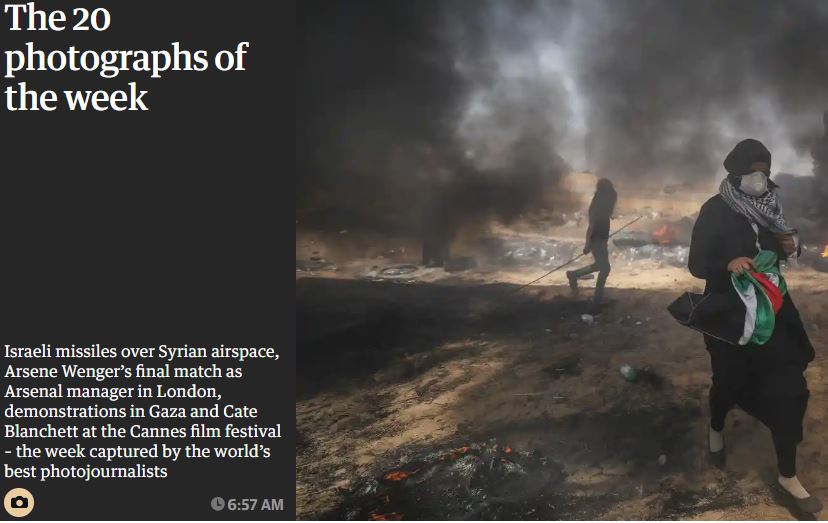
In contrast, the Guardian published a…
View original post 488 more words
WRITER, SAILOR, SOLDIER, SPY: ERNEST HEMINGWAY’S SECRET ADVENTURES, 1936-1961 by Nicholas Reynolds
29 Jan 2019 Leave a comment


(Ernest Hemingway in Spain during the Civil War)
In Nicholas Reynolds new book, WRITER, SAILOR, SOLDIER, SPY: ERNEST HEMINGWAY’S SECRET ADVENTURES, 1935-1961, the author, the CIA Museum’s historian poses the question as to why Hemingway, who tried all forms of spying, before and during World War II would sign on with Stalin’s henchmen at the NKVD. Reynolds relates that he had been working on an OSS (Office of Strategic Services) exhibit at the museum when he came across the links between Soviet intelligence and Hemingway and wondered how this could have happened, and what it means for Hemingway’s legacy. Reynolds thesis is clear; Hemingway’s relationship with the NKVD was impactful, and this chapter in his life has often been overlooked. According to the author it influenced Hemingway’s decision making the last fifteen years of his life and played a role in his eventual suicide in 1961. With the Cold…
View original post 1,507 more words


Recent Comments