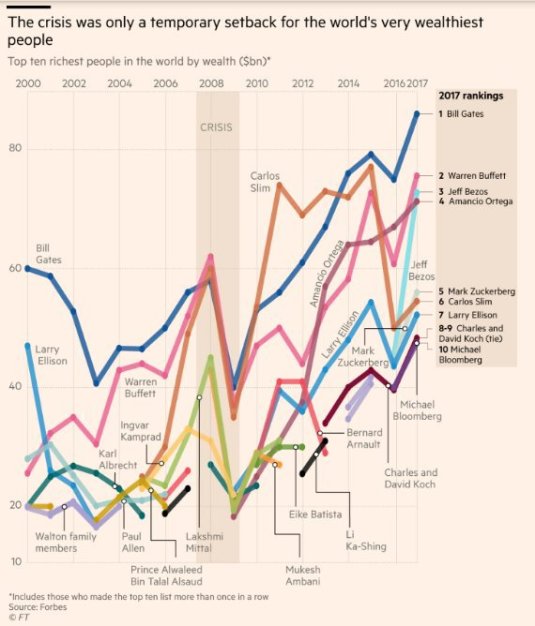
How the very richest have fared since the crisis https://t.co/HVJxvjbN3o pic.twitter.com/SwBii0SHWQ
— FT Data (@ftdata) August 30, 2017
Celebrating humanity's flourishing through the spread of capitalism and the rule of law
15 Jan 2019 Leave a comment
in applied price theory, entrepreneurship, human capital, industrial organisation, labour economics, labour supply, occupational choice, poverty and inequality, survivor principle Tags: top 1%
15 Jan 2019 Leave a comment
in applied price theory, development economics, economic history, growth miracles, health economics, politics - New Zealand Tags: China, The Great Escape
15 Jan 2019 Leave a comment
in applied price theory, entrepreneurship, human capital, industrial organisation, labour economics, public economics, survivor principle Tags: top 1%
15 Jan 2019 Leave a comment
in applied price theory, entrepreneurship, human capital, labour economics, occupational choice, politics - New Zealand, politics - USA, Public Choice, public economics, technological progress Tags: taxation and entrepreneurship, taxation and investment
15 Jan 2019 Leave a comment
15 Jan 2019 Leave a comment
in applied price theory, development economics, economic history, economics of education, economics of regulation, Milton Friedman
14 Jan 2019 Leave a comment

 Introductory
Somewhat overshadowed by the Wightman saga, and the unscheduled Conservative leadership demarche, the UKSC decision in the UK Withdrawal from the European Union (Legal Continuity)(Scotland) Bill compatibility reference was handed down in the same week in December. It will be argued this decision contains more of lasting constitutional significance which lies both in the court’s approach to Parliamentary sovereignty, and in the likely consequences for the territorial constitution/devolution settlement in the aftermath of Brexit.
In its basic intent, the UK Withdrawal from the European Union (Legal Continuity)(Scotland) Bill (“the Continuity Bill”) occupies some of the same ground as the European Union (Withdrawal) Act 2018, though both were bills at time the battle was joined. It will be recalled that at the time of publication of the European Union (Withdrawal) Bill (“the Withdrawal Bill”), the Scottish and Welsh governments took a common position against the provisions so far as relating…
View original post 2,600 more words
14 Jan 2019 Leave a comment
in applied price theory, discrimination, gender, labour economics Tags: gender wage gap

14 Jan 2019 Leave a comment
In response to my post yesterday, my friend and economist/nuclear engineer (great mix) Laurent Béland pointed out that the Father-Sons mobility figures in Chetty et al. are depressing. Yes, at first glance, they are (see below – the red line). 
But, at second glance, it is not as terrible. Think about family structures with the 1940 birth cohorts. The father works and, in most likelihood, the mother is a stay-at-home father. Most of the earnings come from the father who probably works 45 to 60 hours a week. If my father earns 40,000$ at 60 hours a week or earn 40,000$ at 40 hours a week, the line remains at the same height, but we are not talking about the same living standard in reality. Chetty et al. do not account for hours worked to achieve income. The steep decline – faster than the baseline of household-size adjusted decline…
View original post 197 more words
14 Jan 2019 Leave a comment
in applied price theory, applied welfare economics, comparative institutional analysis, economic history, economics of regulation, industrial organisation, labour economics, Milton Friedman
14 Jan 2019 Leave a comment
in applied price theory, labour economics, minimum wage, unemployment
14 Jan 2019 Leave a comment
Fascinating discussion of life in 1950s NZ
There was a news story a few years ago in which some academics were reported as suggesting that pretty much everyone of West European descent alive today was descended from Charlemagne, first Holy Roman Emperor. That he had 18 children, legitimate and otherwise, only increased those probabilities. 35 generations back we each have about 34 billion notional ancestors and yet the total population of north-western Europe back then was only about 20 million.
I didn’t give the story much thought until last week. For the last few months my 12 year old daughter has been hard at work tracing family trees, with a bit of help from Dad. I was mostly interested in the last couple of hundred years, but she has been keen to trace every line possible as far back as we could go. We’ve put in some intense effort over the holidays and last week…
View original post 1,642 more words
13 Jan 2019 Leave a comment
No one was really sane, everyone on the point of a total numb shock, of hysteria, a madness that shrinks have only now begun to diagnose. (p.98)
Page is a legendary figure about whom legends were weaved during the climactic years of a war which itself became the stuff of legends, during the legendary 1960s.
I read Michael Herr’s book of journalism from the war, Despatches, which features Page as a central character, when it came out (1977), and bought this book when it was new in 1983. I saw The Deer Hunter (1978) and Apocalypse Now (1979) in cinemas when they were released, and in 1980 went hitch-hiking across the USA, getting a long lift through the mid-West from a Vietnam vet who’d had a leg amputated and was stoned all the time. In Boston I hung out with a would-be rock band which featured ‘Weird…
View original post 2,142 more words
13 Jan 2019 Leave a comment
People were encouraged to transform themselves into what the communists called ‘New People’. Everywhere, in government offices, factories, workshops, schools and universities, they were ‘re-educated’ and made to study newspapers and textbooks, learning the right answers, the right ideas and the right slogans. While the violence abated after a few years, thought reform never ended, as people were compelled to scrutinise their every belief, suppressing the transitory impressions that might reveal hidden bourgeois thoughts behind a mask of social conformity. Again and again, in front of assembled crowds or in study sessions under strict supervision, they had to write confessions, denounce their friends, justify their past activities and answer questions about their political reliability. (p.xiii)
For three-quarters of the twentieth century China was the site of enormous turmoil, war, famine, tyranny and suffering. Frank Dikötter is a Dutch historian, professor of humanities at the University of Hong Kong, formerly of the School…
View original post 3,133 more words
Celebrating humanity's flourishing through the spread of capitalism and the rule of law
Celebrating humanity's flourishing through the spread of capitalism and the rule of law
Celebrating humanity's flourishing through the spread of capitalism and the rule of law
Celebrating humanity's flourishing through the spread of capitalism and the rule of law
Celebrating humanity's flourishing through the spread of capitalism and the rule of law
Celebrating humanity's flourishing through the spread of capitalism and the rule of law
Celebrating humanity's flourishing through the spread of capitalism and the rule of law
Celebrating humanity's flourishing through the spread of capitalism and the rule of law
A History of the Alt-Right
Econ Prof at George Mason University, Economic Historian, Québécois
Celebrating humanity's flourishing through the spread of capitalism and the rule of law
Scholarly commentary on law, economics, and more
Beatrice Cherrier's blog
Celebrating humanity's flourishing through the spread of capitalism and the rule of law
Celebrating humanity's flourishing through the spread of capitalism and the rule of law
Celebrating humanity's flourishing through the spread of capitalism and the rule of law
Why Evolution is True is a blog written by Jerry Coyne, centered on evolution and biology but also dealing with diverse topics like politics, culture, and cats.
Celebrating humanity's flourishing through the spread of capitalism and the rule of law
A rural perspective with a blue tint by Ele Ludemann
DPF's Kiwiblog - Fomenting Happy Mischief since 2003
Celebrating humanity's flourishing through the spread of capitalism and the rule of law
The world's most viewed site on global warming and climate change
Tim Harding's writings on rationality, informal logic and skepticism
A window into Doc Freiberger's library
Let's examine hard decisions!
Commentary on monetary policy in the spirit of R. G. Hawtrey
Thoughts on public policy and the media
Celebrating humanity's flourishing through the spread of capitalism and the rule of law
Politics and the economy
A blog (primarily) on Canadian and Commonwealth political history and institutions
Reading between the lines, and underneath the hype.
Economics, and such stuff as dreams are made on
"The British constitution has always been puzzling, and always will be." --Queen Elizabeth II
Celebrating humanity's flourishing through the spread of capitalism and the rule of law
Celebrating humanity's flourishing through the spread of capitalism and the rule of law
WORLD WAR II, MUSIC, HISTORY, HOLOCAUST
Undisciplined scholar, recovering academic
Celebrating humanity's flourishing through the spread of capitalism and the rule of law
Res ipsa loquitur - The thing itself speaks
In Hume’s spirit, I will attempt to serve as an ambassador from my world of economics, and help in “finding topics of conversation fit for the entertainment of rational creatures.”
Researching the House of Commons, 1832-1868
Articles and research from the History of Parliament Trust
Reflections on books and art
Posts on the History of Law, Crime, and Justice
Celebrating humanity's flourishing through the spread of capitalism and the rule of law
Exploring the Monarchs of Europe


Recent Comments