
Good question
25 Aug 2018 Leave a comment
in applied price theory, applied welfare economics Tags: pessimism bias, The Great Enrichment
The Wisdom of Mark Textor
24 Aug 2018 Leave a comment

The following stroll down memory lane just appeared on Business Insider. It is apparently something written 12 months ago by Mark Textor. This is the same Mark Textor that said/wrote:
The qualitative evidence is they don’t matter,’’ Mr Textor said. “The sum of a more centrist approach outweighs any alleged marginal loss of so-called base voters.
Consider also that Mark Textor contributed to the building of the same edifice that is complained about in the following:
You work hard and do the right thing, and get no wage growth while the big end of town and politicians get tax cuts, wage increases and bonuses.
You pay your rego and taxes to build roads but still have to pay tolls to use them to get your kids to school and yourself to work while others profit.
You save up all your life and put into your super…
View original post 302 more words
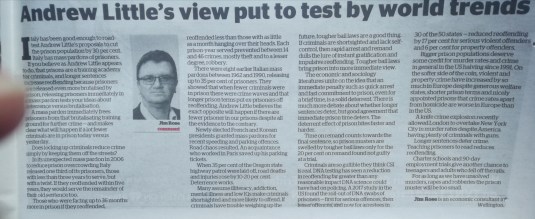
My @NZHerald op-ed on @AndrewLittleMP’s catch and release ideas @sst_nz
24 Aug 2018 Leave a comment
in applied price theory, economics of crime, law and economics, politics - New Zealand Tags: crime and punishment, criminal deterrence, law and order
Robert Lucas on the utopianism of most economic advisors
23 Aug 2018 Leave a comment
in applied price theory, applied welfare economics, comparative institutional analysis, economics of bureaucracy, history of economic thought, Public Choice, Robert E. Lucas Tags: The pretence to knowledge

Hayek v. Rawls on Social Justice: Correcting the False Narrative
23 Aug 2018 Leave a comment

Matt Yglesias, citing an article (“John Rawls, Socialist?“) by Ed Quish in the Jacobin arguing that Rawls, in his later years, drifted from his welfare-state liberalism to democratic socialism, tweeted a little while ago
https://twitter.com/mattyglesias/status/1032410530173075456
I’m an admirer of, but no expert on, Rawls, so I won’t weigh in on where to pigeon-hole Rawls on the ideological spectrum. In general, I think such pigeon-holing is as likely to mislead as to clarify because it tends to obscure the individuality of the individual or thinker being pigeon-hold. Rawls was above all a Rawlsian and to reduce his complex and nuanced philosophy to simple catch-phrase like “socialism” or even “welfare-state liberalism” cannot possibly do his rich philosophical contributions justice (no pun intended).
A good way to illustrate both the complexity of Rawls’s philosophy and that of someone like F. A. Hayek, often regarded as standing on the opposite end of…
View original post 684 more words
Bari Weiss returns with a column on Asia Argento, Avital Ronell, #MeToo, and the Shoe on the Other Foot
23 Aug 2018 Leave a comment

I don’t know how anyone can find this new New York Times column by Bari Weiss objectionable, but I know they’ll try. (Click on screenshot to read it.)
The column is about two women who have been accused of sexual abuse. The first, Asia Argento, is an actor who was revealed to have paid $380,000 to buy the silence of a 17 year old boy (below the age of consent) with whom she apparently had sex. The ironic thing is that Argento was one of the main accusers of Harvey Weinstein in the #MeToo scandal. Argento was important in helping bring down Weinstein, and in calling attention to men’s use of power to leverage sexual mistreatment of women, but it turned out she herself had apparently committed sexual malfeasance.
Weiss’s column is balanced, pointing out that women, too, can be abusive, manipulative, and cruel. Yet at the same time she’s…
View original post 871 more words
David D. Friedman | Market failure
22 Aug 2018 Leave a comment
in applied price theory, applied welfare economics, comparative institutional analysis, David Friedman, law and economics, property rights Tags: market failure
OIA: cartels, oligopoly, oligopsony & monopsony @women_nz @NZHumanRights @nztreasury @NZcomcom
22 Aug 2018 Leave a comment
in applied price theory, discrimination, gender, industrial organisation

The UK’s unpaid war debts to the United States, 1917-1980
22 Aug 2018 Leave a comment

by David James Gill (University of Nottingham)
 Trenches in World War I. From <www.express.co.uk>
We all think we know the consequences of the Great War – from the millions of dead to the rise of Nazism – but the story of the UK’s war debts to the United States remains largely untold.
In 1934, the British government defaulted on these loans, leaving unpaid debts exceeding $4 billion. The UK decided to cease repayment 18 months after France had defaulted on its war debts, making one full and two token repayments prior to Congressional approval of the Johnson Act, which prohibited further partial contributions.
Economists and political scientists typically attribute such hesitation to concerns about economic reprisals or the costs of future borrowing. Historians have instead stressed that delay reflected either a desire to protect transatlantic relations or a naive hope for outright cancellation.
Archival research reveals that the British cabinet’s…
View original post 315 more words
Matthias Doepke on Why He Studies Family Economics
22 Aug 2018 Leave a comment
in applied price theory, business cycles, economics of love and marriage, human capital, labour economics, labour supply, macroeconomics Tags: economics of families
Behind on my French socialist bashing
22 Aug 2018 Leave a comment
in applied price theory, business cycles, comparative institutional analysis, economic growth, economic history, economics of regulation, financial economics, fiscal policy, industrial organisation, macroeconomics, Public Choice, rentseeking Tags: economics of socialism, France, The fatal conceit

Seattle’s $15 Minimum Wage is Hurting the Workers It’s Intending to Help
22 Aug 2018 Leave a comment
in applied price theory, labour economics, minimum wage, politics - USA, poverty and inequality Tags: offsetting behaviour, The fatal conceit, unintended consequences


Recent Comments