10 Aug 2018
by Jim Rose
in applied price theory
 International Liberty
When I give speeches about modern welfare states, I’ll often cite grim data from the IMF, BIS, and OECD about the very depressing fiscal consequences of ever-expanding government.
 And if I really want to worry an audience, I’ll augment those numbers by talking about the erosion of societal capital and explain it’s very hard to adopt necessary reforms once the work ethic and self-reliance have been replaced by a culture of dependency and entitlement.
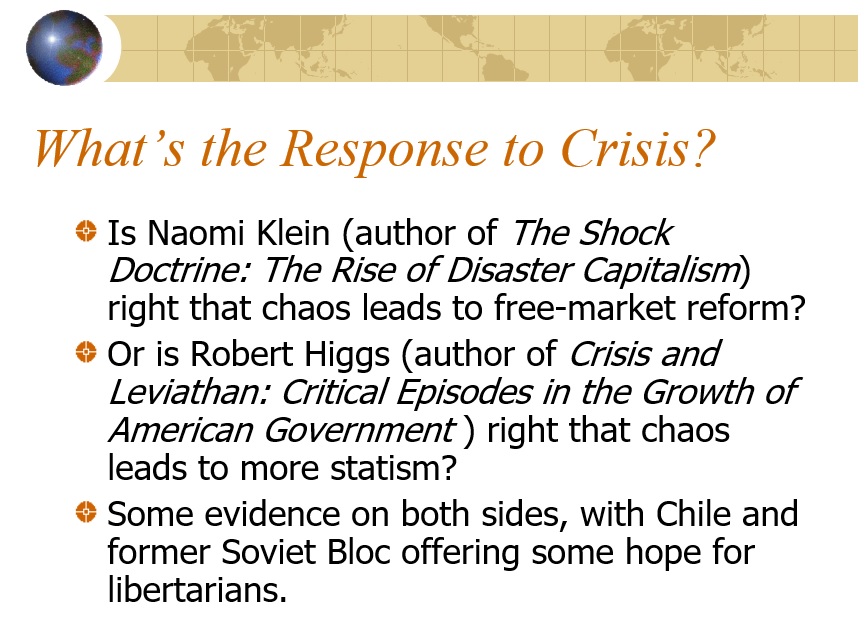
I basically warn people that many western nations (including the United States) are doomed to suffer Greek-style fiscal collapse. Depending on the type of speech, this is where I sometimes share a slide suggesting that there are two possible outcomes once an economic crisis occurs.
- Does a crisis caused by bad government lead to even more bad government, which is the pessimistic hypothesis in Robert Higgs’ classic, Crisis and…
View original post 683 more words
10 Aug 2018
by Jim Rose
in applied price theory, applied welfare economics, comparative institutional analysis, constitutional political economy, economics of education, economics of regulation, entrepreneurship, income redistribution, industrial organisation, labour economics, politics - USA, Public Choice
Tags: regressive left
10 Aug 2018
by Jim Rose
in applied price theory
 The Climate Fix

Welcome to issue #13 of my occasional newsletter on climate and energy issues. As a reminder, my day-to-day research and teaching is primarily focused on sports governance and various issues of science policy. But I’ve written a fair bit on the topics of climate and energy over the past 25 years, including two recent books and a boatload of academic papers.
Now that I’m no longer being investigated by Congress, the subject of a billionaire’s delegitimization campaign or receiving threats I’ve decided to start again writing a bit more on climate issues. So caveat lector!
A few things to say up front:
- If you appreciate the perspective, consider the tip jar to your right.
- These funds continue to help me defray the costs of several trips where I have had the chance to develop and present new talks. I am otherwise unfunded on this topic.
- As such, contributions are much…
View original post 1,096 more words
09 Aug 2018
by Jim Rose
in applied price theory
Stamp auctions anticipated Vickery as well.
 Mostly Economics
I just learnt how Fisher figured the Philips Curve before AW Philips.
Now this gem by Avinash Tripathi tells us how the famous German polymath Johann Wolfgang von Goethe figured second price auction way back in 18th century:
Johann Wolfgang von Goethe (1749-1832) was arguably the greatest German writer, poet and polymath of the Romantic era. His forays in science, diplomacy, literature etc are well-known. His dabblings in the applied economics and auction design are less known however.
One incident in particular is worth mentioning. While selling the publishing rights of his epic poem ‘Hermann and Dorothea’, Goethe had made an intriguing proposal to his publisher. According to this proposal, Goethe would submit his reserve price in a sealed envelope. The publisher was asked to quote how much he was willing to pay for the publishing rights of this poem. If the price quoted by the publisher turned…
View original post 235 more words
09 Aug 2018
by Jim Rose
in applied price theory
It is easy to rebut the Commission’s argument that ” there is no evidence which exists to justify or shape it”
Prison reformers are at one with the tough on crime crowd when it comes to the effects of 3-strikes and you are out. Tough on crime advocates emphasise the incentive not to offend in the first place. Prison reformers stress the other side of the same coin; if a crime is committed, the offender has nothing to lose on their 3rd strike from greater violence and killing witnesses and then nothing to lose once they are in prison because they cannot be sentenced to further time.
What was found in the USA was offenders serve the same 25-to-life anyway so third strikers were more violent. But if offenders had something to lose, if their punishment was more tailored to their latest crime, they chose to be less violent.
 Families Commissioner Blog
The ‘Three Strikes’ law exists because a majority of Members of Parliament want it, although there is no evidence which exists to justify or shape it. This is not an unusual situation, and there are many examples of legislation being weakly informed by evidence, or by none at all. Understanding how we got here might be helped here if we explore some of the ‘evidence’ used to introduce the law and explain its operation since then.
The overall incidence of crime is falling, and has been doing so since the 1990s, and violent crime has been falling over the past decade. There are few cases that the three strikes law affects, and these do not provide evidence to conclude whether this particular law has had any influence on offending, especially when the introduction of the law will also have had an influence on the prosecution of cases and in sentencing…
View original post 919 more words
09 Aug 2018
by Jim Rose
in applied price theory
 JONATHAN TURLEY
Below is my column in the Hill Newspaper on the latest “smoking gun” of obstruction in the form of Trump tweets. There continues to be a categorical refusal of many to acknowledge the implications of the interpretation being advanced to implicate Trump. There is also a failure to acknowledge that the Clinton campaign received more information was Russian sources, including Russian intelligence figures. The difference is the Clinton people were smart enough to use a cut out in the form of a former British spy.
While advocates continue to maintain that agreeing to go to a meeting to review promised evidence of crimes is a federal election violation, no case like this has ever resulted in a conviction that I know of. Indeed, I do not know of any case remotely similar to this case as being brought. The First Amendment implications should bar any such prosecution.
Here is the…
View original post 1,175 more words
09 Aug 2018
by Jim Rose
in applied price theory
 Family Inequality
After this post about small multiple graphs, and partly inspired by two news reports I was interviewed for — this Salt Lake Tribune story about teen marriage, and this New York Times report mapping age at first birth — I made some historical data figures.
These visualizations use decennial census data from 1900 to 1990, and then American Community Survey data for 2001, 2010, and 2016; all data from IPUMS.org. (I didn’t use the 2000 Census because marital status is messed up in that data, with a lot of people who should be never married coded as married, spouse absent; 2001 ACS gets it done.)
An important, simple way of illustrating the myth-making around the 1950s is with marriage age. Contrary to the myth that the 1950s was “traditional,” a long data series show the period to be unique. The two trends here, teen marriage and divorce, both show the…
View original post 604 more words
09 Aug 2018
by Jim Rose
in applied price theory
 BBC Watch
On August 7th the BBC News website published an article titled “Israeli tank fire kills two Hamas militants in Gaza” on its Middle East page. The report relates to an incident which took place earlier in the day when IDF soldiers on patrol in the northern sector of the Border between Israel and the Gaza Strip identified gunfire from the Beit Lahiya area. Hamas later claimed that the snipers were taking part in a drill held by the terror group near the border fence.
The BBC’s report on the incident opened as follows:
“The Israeli military has struck a Hamas border post in northern Gaza with a tank shell, killing two members of the Palestinian group’s military wing.
The military said the tank responded to shots fired at soldiers from the post.
But Hamas said its fighters were taking part in a live-fire exercise and that Israel…
View original post 531 more words
09 Aug 2018
by Jim Rose
in applied price theory

We recently tweeted the writer of an otherwise unproblematic Guardian article (The Islamic school that ensures its boys understand the Israeli point of view, Aug. 7) in response to her erroneous claim that the Balfour Declaration promised “the land of Palestine” to the “Zionist Federation” of the UK and Ireland.
We then emailed Guardian editors, who upheld our complaint and amended the passage, which now reads as follows:

Additionally, the following addendum, noting the change, appears at the bottom of the article.

Related Articles
View original post 21 more words
08 Aug 2018
by Jim Rose
in applied price theory, applied welfare economics, Austrian economics, comparative institutional analysis, F.A. Hayek, income redistribution, Ludwig von Mises, Milton Friedman, Public Choice, public economics
Tags: taxation and investment, taxation and labour supply
08 Aug 2018
by Jim Rose
in applied price theory, comparative institutional analysis, economic growth, economic history, economics of regulation, entrepreneurship, income redistribution, industrial organisation, international economics, labour economics, labour supply, macroeconomics, Public Choice, public economics, survivor principle, welfare reform
Tags: Sweden
08 Aug 2018
by Jim Rose
in applied price theory, comparative institutional analysis, development economics, economic growth, economic history, economics of regulation, growth miracles, industrial organisation, labour economics, law and economics, Milton Friedman, poverty and inequality
Tags: Hong Kong, The Great Fact
08 Aug 2018
by Jim Rose
in applied price theory
 Point of Order
Whose job is to check that university authorities comply with the Education Act 1989?
We ask because of the widely reported goings-on at Massey University, which have culminated in students being denied the chance to listen to Don Brash, former Governor of the Reserve Bank, former leader of the National Party, former leader of the ACT Party, and the best known member of Hobson’s Choice.
Section 161 of the Education Act deals with the academic freedom which has been imperilled at Massey. It says:
View original post 1,020 more words
Previous Older Entries Next Newer Entries


Recent Comments