How Canada Tracked the US during the Great Depression

Vincent Geloso's avatarNotes On Liberty

Over the last few years, while I continued my research on other fronts, I started spending small amounts of time on a daily basis to read about the Great Depression and more precisely, how Canada lived through the depression.

Since the old adage is that Canada gets pneumonia when the US gets the flu, I thought that it was a worthy endeavor (although Pedro Amaral and James McGee have been working on that front) to try to see what insights we can derive from looking at Canada’s experience during the Great Depression (especially since it had a very different banking system).

In the process, I managed to collect in a datasheet, the Industrial Production Index of Canada (consisting largely of heavy industry with some light industries and utilities, making it a relatively well-rounded index). This is what it looks like.

industrialproduction

Other than seeing Canada’s experienced mirrored in the US experience…

View original post 24 more words

Hirshleifer on the Private and Social Value of Information

David Glasner's avatarUneasy Money

I have written a number posts (hereherehere, and here) over the past few years citing an article by one of my favorite UCLA luminaries, Jack Hirshleifer, of the fabled UCLA economics department of the 1950s, 1960s, 1970s and 1980s. Like everything Hirshleifer wrote, the article, “The Private and Social Value of Information and the Reward to Inventive Activity,” published in 1971 in the American Economic Review, is deeply insightful, carefully reasoned, and lucidly explained, reflecting the author’s comprehensive mastery of the whole body of neoclassical microeconomic theory.

Hirshleifer’s article grew out of a whole literature inspired by two of Hayek’s most important articles “Economics and Knowledge” in 1937 and “The Use of Knowledge in Society” in 1945. Both articles were concerned with the fact that, contrary to the assumptions in textbook treatments, economic agents don’t have complete information about…

View original post 3,682 more words

David D. Friedman with some thoughts on his new book

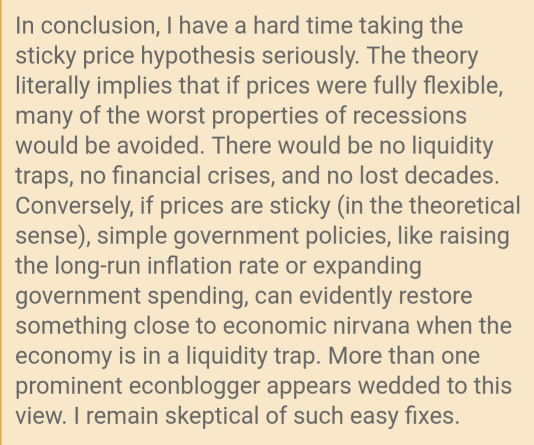
@dandolfa on how Keynesian macroeconomics is just to good to be true

http://andolfatto.blogspot.com/2010/07/sticky-price-hypothesis-critique.html?m=1

Alexandria Ocasio-Cortez: Another lionized Democrat cozying up to anti-Semites

whyevolutionistrue's avatarWhy Evolution Is True

Well, my headline may be a tad exaggerated, but I’m pretty sure that the subject of this post is not friendly to Jews (she’s made some remarkably ill informed comments about Palestine). Read on.

Many Democrats have been excited about Alexandria Ocasio-Cortez, for the young Hispanic activist (she’s 28) won the Democratic primary for a House seat in New York, gaining a big upset victory over the incumbent. She’s a Democratic Socialist, but my take on her is that she’s not particularly bright and is espousing views that, while they may win her a seat in the House, won’t advance the Democratic platform. In fact, her election may give Democrats an even worse image.

I say that because Ocasio-Cortez has cozied up to some odious characters. Here she is headlining the Universal Muslim Association of America meeting with our favorite sharia-lover and FOF (Friend of Farrakhan), Linda Sarsour (click…

View original post 515 more words

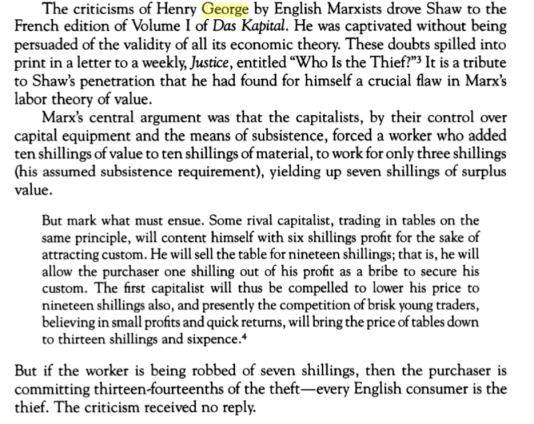
Labour Theory of Value and the Subjectivist Theory of Value (I. Kirzner)

When Trans and Gay Culture Collide, Hilarity Ensues

Transgender issues are unrelated to gay rights. Gay rights is about being left alone. Transgender women want access to common spaces and opportunities reserved for women.

Image

Alastair Smith – The Dictator’s Handbook: Why Bad Behavior is Almost Always Good Politics

George Stigler considered George Bernard Shaw to be an asute critic of the labour theory of value

Journalistic bias and distortion about latest incidents in Israel

whyevolutionistrue's avatarWhy Evolution Is True

You might have heard that about 200 (or more) rockets were fired at Israeli civilian targets by Hamas last week, and that Israel responded by the Israeli Defense Forces targeting over 100 Hamas terrorist and military sites. No Israeli civilians were killed, though at least 7 were injured and more treated for shock as 30 rockets not intercepted by Israel’s “Iron Dome” landed in fields but also destroyed Israeli houses, cars, factories, and a playground (Israel has an efficient early warning system). According to reports, three Palestinians were killed: a woman, her one-year-old chid, and a Hamas militant.

Not in dispute is that Hamas has continually been firing rockets from Gaza at Israeli citizens for months, but not on the scale that happened this week, which was a significant escalation of the violence. Also, since April Hamas has been sending incendiary devices via balloons and even birds into Israel, aimed…

View original post 666 more words

BBC Radio 4 news bulletins mislead UK audiences on Gaza rocket attacks

Hadar Sela's avatarBBC Watch

h/t CL

BBC Radio 4’s ‘Midnight News’ on August 9th included an item (from 18:09 here) concerning events in southern Israel and the Gaza Strip which had begun several hours beforehand.

The BBC’s newsreader refrained from informing listeners who carried out the missile fire mentioned in his chronologically reversed portrayal of the story. [emphasis in bold added, emphasis in italics in the original]

Newsreader: “Israel has carried out a dozen airstrikes on targets in Gaza in response to the firing of around 36 missiles into Israel. One Palestinian man was killed. The Israelis said at least three people were wounded inside Israel. Yesterday two fighters from Hamas, which controls Gaza, were killed by Israeli fire. From Jerusalem, Yolande Knell reports.”

By the time that news bulletin went on air (02:00 Israel time), over 70 projectiles had been launched from the Gaza Strip. In other words, Radio 4 news…

View original post 475 more words

Constitutional Change and Upper Houses: the Italian Case

Constitution Unit's avatarThe Constitution Unit Blog

downloadOn 11 and 12 June 2018 the Constitution Unit co-hosted a workshop at Rome LUISS university, on ‘The challenges of reforming upper houses in the UK and Italy’. This is the second in a series of posts summarising the speakers’ contributions. Professor Carlo Fusaro, a leading proponent of Matteo Renzi’s failed Senate reform of 2016, reflects on why the proposals were defeated and what wider lessons can be learned from their failure.
In a previous blog, Constitution Unit Director Meg Russell set out some more general obstacles to bicameral reform. In this post, reflecting on the recent Italian experience, I argue that the challenges of reforming second chambers have changed, and grown, significantly in recent years.

Constitutional change is difficult by design. Transformation of those constitutional bodies which have a say in the decision making process of constitutional revisions is even more difficult, the most difficult of all…

View original post 2,034 more words

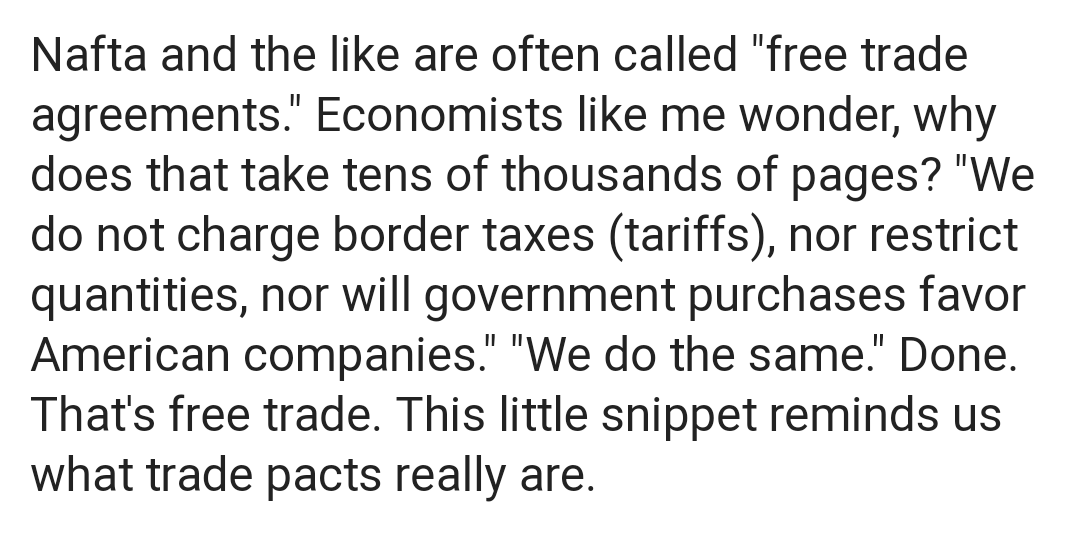
.@JohnHCochrane says free trade agreements should be 2 lines @golrizghahraman

from https://johnhcochrane.blogspot.com/2018/08/free-trade-or-managed-mercantilism.html?m=1

The Debunkers vs The Wage Gap

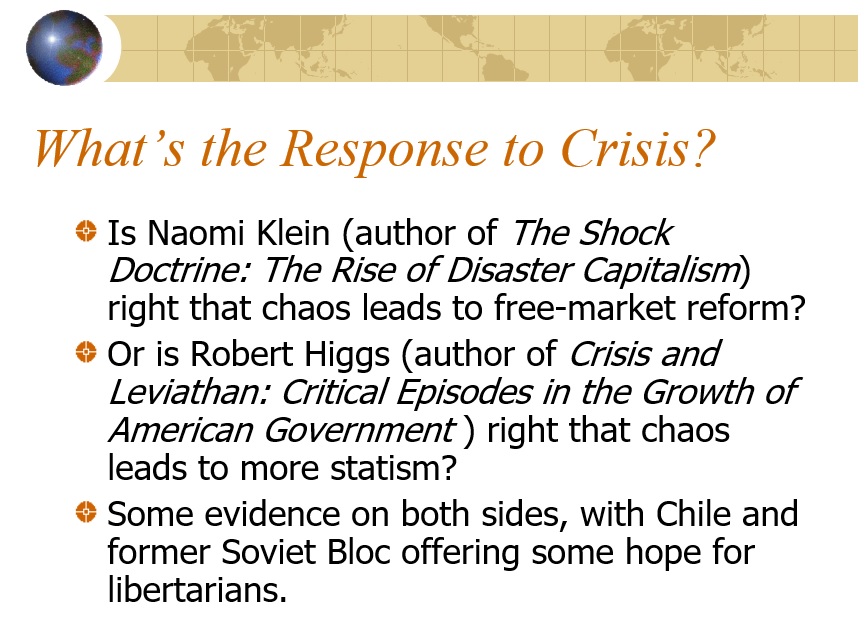
Do Economic Crises Produce Liberalization or More Statism?

Dan Mitchell's avatarInternational Liberty

When I give speeches about modern welfare states, I’ll often cite grim data from the IMF, BIS, and OECD about the very depressing fiscal consequences of ever-expanding government.

And if I really want to worry an audience, I’ll augment those numbers by talking about the erosion of societal capital and explain it’s very hard to adopt necessary reforms once the work ethic and self-reliance have been replaced by a culture of dependency and entitlement.

I basically warn people that many western nations (including the United States) are doomed to suffer Greek-style fiscal collapse. Depending on the type of speech, this is where I sometimes share a slide suggesting that there are two possible outcomes once an economic crisis occurs.

  • Does a crisis caused by bad government lead to even more bad government, which is the pessimistic hypothesis in Robert Higgs’ classic, Crisis and…

View original post 683 more words

Previous Older Entries Next Newer Entries

Coordination Problem

Celebrating humanity's flourishing through the spread of capitalism and the rule of law

Libertarian Land

Celebrating humanity's flourishing through the spread of capitalism and the rule of law

Arin’s Substack

Celebrating humanity's flourishing through the spread of capitalism and the rule of law

David Andolfatto

Celebrating humanity's flourishing through the spread of capitalism and the rule of law

Monetary Non-Neutrality

Celebrating humanity's flourishing through the spread of capitalism and the rule of law

Reason Magazine

Celebrating humanity's flourishing through the spread of capitalism and the rule of law

Coyote Blog

Celebrating humanity's flourishing through the spread of capitalism and the rule of law

Thoughts from the North

Celebrating humanity's flourishing through the spread of capitalism and the rule of law

Fardels Bear

A History of the Alt-Right

Vincent Geloso

Econ Prof at George Mason University, Economic Historian, Québécois

Bassett, Brash & Hide

Celebrating humanity's flourishing through the spread of capitalism and the rule of law

Truth on the Market

Scholarly commentary on law, economics, and more

The Undercover Historian

Beatrice Cherrier's blog

Matua Kahurangi

Celebrating humanity's flourishing through the spread of capitalism and the rule of law

Temple of Sociology

Celebrating humanity's flourishing through the spread of capitalism and the rule of law

Velvet Glove, Iron Fist

Celebrating humanity's flourishing through the spread of capitalism and the rule of law

Why Evolution Is True

Why Evolution is True is a blog written by Jerry Coyne, centered on evolution and biology but also dealing with diverse topics like politics, culture, and cats.

NoTricksZone

Celebrating humanity's flourishing through the spread of capitalism and the rule of law

Homepaddock

A rural perspective with a blue tint by Ele Ludemann

Kiwiblog

DPF's Kiwiblog - Fomenting Happy Mischief since 2003

The Dangerous Economist

Celebrating humanity's flourishing through the spread of capitalism and the rule of law

Watts Up With That?

The world's most viewed site on global warming and climate change

The Logical Place

Tim Harding's writings on rationality, informal logic and skepticism

Doc's Books

A window into Doc Freiberger's library

The Risk-Monger

Let's examine hard decisions!

Uneasy Money

Commentary on monetary policy in the spirit of R. G. Hawtrey

Barrie Saunders

Thoughts on public policy and the media

Liberty Scott

Celebrating humanity's flourishing through the spread of capitalism and the rule of law

Point of Order

Politics and the economy

James Bowden's Blog

A blog (primarily) on Canadian and Commonwealth political history and institutions

Science Matters

Reading between the lines, and underneath the hype.

Peter Winsley

Economics, and such stuff as dreams are made on

A Venerable Puzzle

"The British constitution has always been puzzling, and always will be." --Queen Elizabeth II

The Antiplanner

Celebrating humanity's flourishing through the spread of capitalism and the rule of law

Bet On It

Celebrating humanity's flourishing through the spread of capitalism and the rule of law

History of Sorts

WORLD WAR II, MUSIC, HISTORY, HOLOCAUST

Roger Pielke Jr.

Undisciplined scholar, recovering academic

Offsetting Behaviour

Celebrating humanity's flourishing through the spread of capitalism and the rule of law

JONATHAN TURLEY

Res ipsa loquitur - The thing itself speaks

Conversable Economist

In Hume’s spirit, I will attempt to serve as an ambassador from my world of economics, and help in “finding topics of conversation fit for the entertainment of rational creatures.”

The Victorian Commons

Researching the House of Commons, 1832-1868

The History of Parliament

Articles and research from the History of Parliament Trust

Books & Boots

Reflections on books and art

Legal History Miscellany

Posts on the History of Law, Crime, and Justice

Sex, Drugs and Economics

Celebrating humanity's flourishing through the spread of capitalism and the rule of law

European Royal History

Exploring the Monarchs of Europe