
The two giants of the mobile-ad economy have opposing philosophies on making money from your time. Namely, Google saves time while Facebook soaks it up.
Celebrating humanity's flourishing through the spread of capitalism and the rule of law
17 Mar 2015 Leave a comment
in applied price theory, economics of media and culture Tags: Facebook, Google
The two giants of the mobile-ad economy have opposing philosophies on making money from your time. Namely, Google saves time while Facebook soaks it up.
17 Mar 2015 Leave a comment
in applied price theory, applied welfare economics, health economics Tags: organ donation
15 Mar 2015 Leave a comment
in applied price theory, applied welfare economics, economics of bureaucracy, economics of education, occupational choice, organisational economics, politics, Public Choice
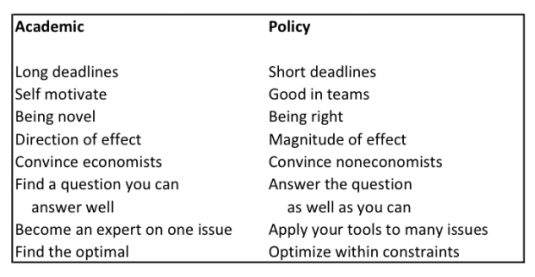
Academia rewards findings that are different and unexpected. In policy it is more important to be right than novel—after all, millions of lives may be impacted by a policy decision. In academia, people argue a lot about the direction of an effect but very little about the magnitude: in policy it’s the reverse…
14 Mar 2015 Leave a comment
in applied price theory, Austrian economics Tags: market process, The meaning of competition
13 Mar 2015 Leave a comment
in applied price theory, applied welfare economics, comparative institutional analysis, development economics, economic history, economics of crime, growth disasters, growth miracles, law and economics, Public Choice, rentseeking Tags: corruption, Deirdre McCloskey, The Industrial Revolution
13 Mar 2015 Leave a comment
in applied price theory, Austrian economics, behavioural economics, comparative institutional analysis, entrepreneurship, industrial organisation, survivor principle Tags: efficient markets hypothesis, entrepreneurial alertness, Paul Samuelson
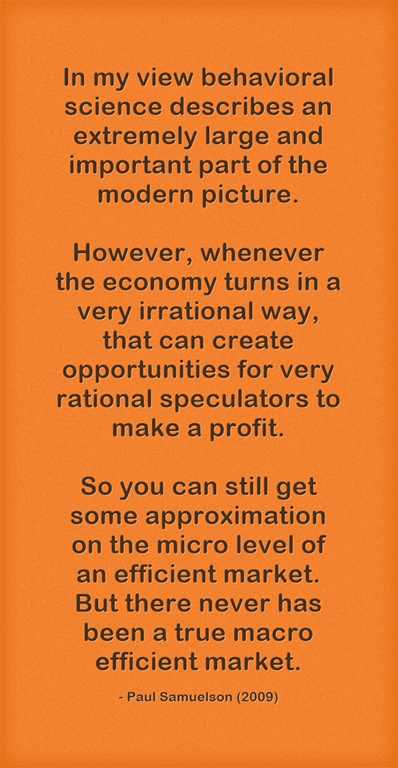
via Samuelson vs. Friedman, David Henderson | EconLog | Library of Economics and Liberty and An Interview With Paul Samuelson, Part One — The Atlantic.
09 Mar 2015 Leave a comment
09 Mar 2015 Leave a comment
09 Mar 2015 Leave a comment
in applied price theory, economic history, energy economics Tags: electric cars
09 Mar 2015 Leave a comment
in applied price theory, environmental economics, global warming, politics - USA, war and peace Tags: Syria, water markets

I am an economist so permit me to make one Econ 101 point.
As drought conditions unfolded in Syria, did water prices rise? Is water metered and paid for in Syria? How do farmers and residential water customers access water?
If there had been a market signal of increased scarcity, water prices would have gone up and rational households and firms would reduce their consumption.
In the presence of such well functioning water markets, no “excess conflict” would have resulted. Capitalist markets thus can diffuse violence as increasingly scarce resources are allocated efficiently and water consumers are incentivized to invest in strategies and actions to reduce their water demand.
So, to repeat my point; if the PNAS authors are correct then it is the synergistic effect between increased drought conditions and the absence of water markets that caused the problem. If the nation had well functioning water markets, then I would strongly predict that there would be no extra violence.
via Environmental and Urban Economics: The Drought Causes War Hypothesis: Evidence from Syria.
05 Mar 2015 Leave a comment
in applied price theory, industrial organisation, survivor principle Tags: creative destruction, food, Indian food
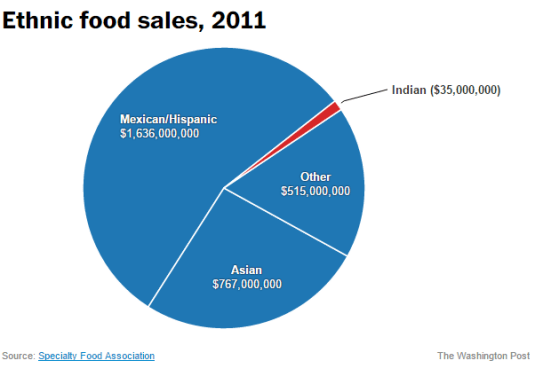
No need to rage against the gaucheness of Americans who, in fact, have embraced many foods:
The cuisine is among the most labor intensive in the world. And yet Americans are unwilling to pay beyond a certain, and decidedly low, price point.
Via Why delicious Indian food is surprisingly unpopular in the U.S. – The Washington Post.
04 Mar 2015 Leave a comment
in applied price theory, applied welfare economics, discrimination, gender, labour economics Tags: economics of beauty

via How Your Face Shapes Your Economic Chances – The Atlantic.
Celebrating humanity's flourishing through the spread of capitalism and the rule of law
Celebrating humanity's flourishing through the spread of capitalism and the rule of law
Celebrating humanity's flourishing through the spread of capitalism and the rule of law
Celebrating humanity's flourishing through the spread of capitalism and the rule of law
Celebrating humanity's flourishing through the spread of capitalism and the rule of law
Celebrating humanity's flourishing through the spread of capitalism and the rule of law
Celebrating humanity's flourishing through the spread of capitalism and the rule of law
Celebrating humanity's flourishing through the spread of capitalism and the rule of law
A History of the Alt-Right
Econ Prof at George Mason University, Economic Historian, Québécois
Celebrating humanity's flourishing through the spread of capitalism and the rule of law
Scholarly commentary on law, economics, and more
Beatrice Cherrier's blog
Celebrating humanity's flourishing through the spread of capitalism and the rule of law
Celebrating humanity's flourishing through the spread of capitalism and the rule of law
Celebrating humanity's flourishing through the spread of capitalism and the rule of law
Why Evolution is True is a blog written by Jerry Coyne, centered on evolution and biology but also dealing with diverse topics like politics, culture, and cats.
Celebrating humanity's flourishing through the spread of capitalism and the rule of law
A rural perspective with a blue tint by Ele Ludemann
DPF's Kiwiblog - Fomenting Happy Mischief since 2003
Celebrating humanity's flourishing through the spread of capitalism and the rule of law
The world's most viewed site on global warming and climate change
Tim Harding's writings on rationality, informal logic and skepticism
A window into Doc Freiberger's library
Let's examine hard decisions!
Commentary on monetary policy in the spirit of R. G. Hawtrey
Thoughts on public policy and the media
Celebrating humanity's flourishing through the spread of capitalism and the rule of law
Politics and the economy
A blog (primarily) on Canadian and Commonwealth political history and institutions
Reading between the lines, and underneath the hype.
Economics, and such stuff as dreams are made on
"The British constitution has always been puzzling, and always will be." --Queen Elizabeth II
Celebrating humanity's flourishing through the spread of capitalism and the rule of law
Celebrating humanity's flourishing through the spread of capitalism and the rule of law
WORLD WAR II, MUSIC, HISTORY, HOLOCAUST
Undisciplined scholar, recovering academic
Celebrating humanity's flourishing through the spread of capitalism and the rule of law
Res ipsa loquitur - The thing itself speaks
In Hume’s spirit, I will attempt to serve as an ambassador from my world of economics, and help in “finding topics of conversation fit for the entertainment of rational creatures.”
Researching the House of Commons, 1832-1868
Reflections on books and art
Posts on the History of Law, Crime, and Justice
Celebrating humanity's flourishing through the spread of capitalism and the rule of law
Exploring the Monarchs of Europe
Cutting edge science you can dice with



Recent Comments