
Overcoming Bias : Politics isn’t about Policy
04 Aug 2014 Leave a comment

The above summarizes much of [Robin Hanson’s] contrarian world view. (What else should go on this list?)
When he say “X is not about Y,” I mean that while Y is the function commonly said to drive most X behavior, in fact some other function Z drives X behavior more. He won’t support all these claims, for today, let him just talk politics.
The puzzlingly large cross country differences in sector labour productivity
02 Aug 2014 Leave a comment
in applied price theory, entrepreneurship, macroeconomics Tags: barriers to riches, Britain, France, Germany, Japan, relative labour productivity, USA
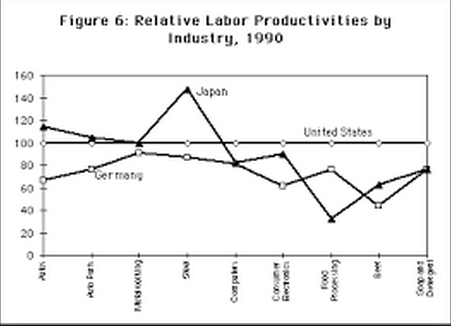
There are large productivity differences between the global industrial leaders at the industry level. In a 1993 McKinsey’s study, large differences were uncovered in value added per worker between the USA, Japan, France, the UK and Germany across individual industries, by a factor of three in some cases (Prescott and Parente 2000, 2005).
- The USA competes with Japan for productivity leadership in many manufacturing industries.
- The Japanese services sector productivity can be as little as a one-third of that of the USA. Japanese labour productivity is almost twice Germany’s in producing automobiles and is better that Germany by a large margin for many other manufactured goods.
- The USA is uniformly more productive in services sector labour productivity. For example, British, French and German telecom workers were 38 to 56 per cent as productive as their American counter-parts.
Figure 1: Relative Value Added Per Worker: Germany, Japan, and the United States Manufacturer’s Industries
| Industry | Japan | Germany |
| Automobiles | 116 | 66 |
| Automobile Parts | 124 | 76 |
| Metal Working | 119 | 100 |
| Steel | 145 | 100 |
| Computer | 95 | 89 |
| Consumer Electronics | 115 | 62 |
| Food | 33 | 76 |
| Beer | 69 | 44 |
| Soap and Detergent | 94 | 76 |
Differences in the access to the global pool of useful knowledge cannot explain such large productivity differences at the sector and the individual industry levels between the USA, Japan, France, the UK and Germany and between these three European neighbours. The stock of useful technological knowledge does not vary that much across these countries (Prescott and Parente 2000, 2005). These countries produce and are the markets for the majority of that knowledge.
Figure 2: Relative Value Added Per Worker – service industries
| Industry | Japan | Germany | U.K. | France |
| Retailing | 44 | 96 | 82 | 69 |
| Telecommunications | 66 | 50 | 38 | 56 |
| Banking | – | 68 | 64 | – |
Lags in technology diffusion cannot be important. The USA, Japan, France, the UK, and Germany define the global technological frontier.
Differences in the skills of the individual worker or in the total stock of human capital of all workers in a country cannot explain these differences in value added per worker. The USA, Japan, France, the UK and Germany all have relatively well-educated, experienced and tested labour forces. For example, the 1993 McKinsey’s study inquired into the education and skills levels of Japanese and German steel workers. Comparably skilled German steel workers were half as productive as their Japanese counterparts (Prescott and Parente 2000, 2005).
What differ between these countries at the glob technological frontier is the amount of the global pool of useful productive of knowledge that is used and as work practices. Ford Europe failed to adopt Japanese just-in-time production, but Ford U.S.A. has adopted it. In the beer industry, much of the high technology machinery in Japan and U.S. is manufactured in Germany but German breweries fail to use these more productive technologies. The less productive airline sector in Europe vis-à-vis the United States is the result of over-staffing.
Hayek on Keynes and the microeconomic foundations of macroeconomics
31 Jul 2014 9 Comments
in applied price theory, F.A. Hayek, macroeconomics Tags: FA Hayek, Keynes, the microeconomic foundations of macroeconomic

HT: Cafe Hayek
Calmfor’s Iron Law of Active Labour Market Policy.
31 Jul 2014 Leave a comment
in applied price theory, fiscal policy, job search and matching, labour economics, labour supply, macroeconomics, welfare reform Tags: Active labour market programs, Lars Calmfors, welfare reform, work for the dole, workfare

Lars Calmfors is a Swedish economist whose main interest is labour makets.
His iron law of Active Labour Market Policy (ALMP) refers to a characteristic of make work schemes, like the WPA that operated in the United States in the 1930s.
The characteristic or problem with these schemes is that if people are attracted to these schemes by generous pay or conditions, their motive to search for regular work is necessarily reduced.
Assuming unemployment is anywhere near NAIRU, the effect of this reduced aggregate labour supply will be inflationary, which means that demand will have to be reduced, which in turn means that the jobs created by the make work scheme will be, at least to some extent, at the expense of regular jobs.
Alternatively, if people are coerced into joining make work schemes because of what might be called a “workfare” sanction, their job search efforts are not reduced, thus the jobs created by the make work scheme have a better chance of not being at the expense of normal jobs.
via RALPHONOMICS: Calmfor’s Iron Law of Active Labour Market Policy..
The most forgotten diagrams in the political economy of taxation-updated
30 Jul 2014 Leave a comment
in applied price theory, public economics, taxation Tags: incidence of taxes, the burden of taxes

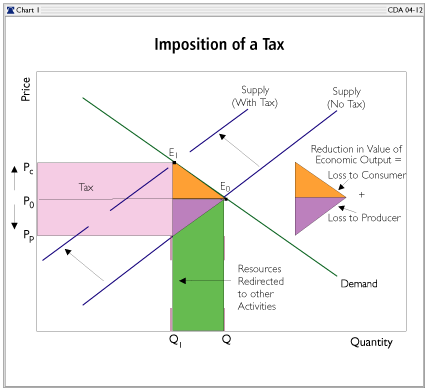
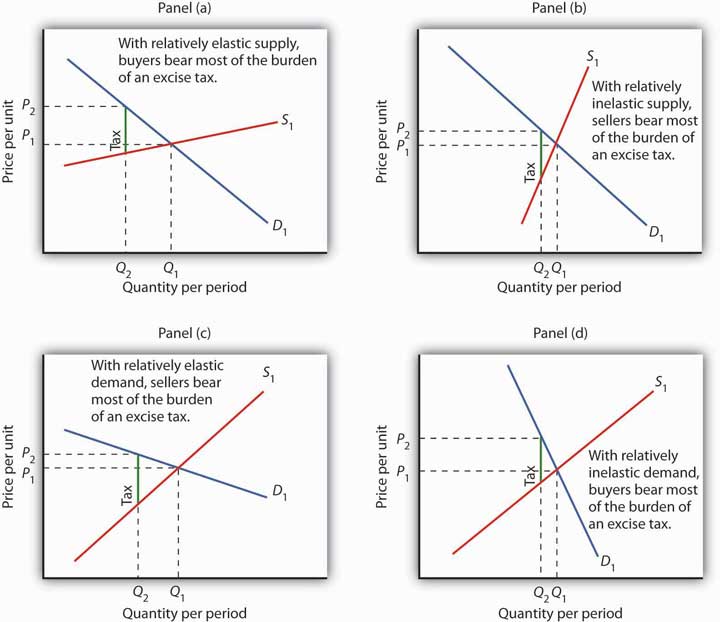
The ability to pass the burden of the tax depends on price elasticity of demand and price elasticity of supply.
The politics of ethnicity-based research in New Zealand
30 Jul 2014 Leave a comment
in applied price theory, discrimination, human capital, income redistribution, labour economics, labour supply, politics - New Zealand, population economics, Public Choice, rentseeking Tags: employment discrimination, inequality, Maori economic development, poverty, Simon Chapple, The Great Enrichment, The Great Fact
When Simon Chapple in 2000 wrote “Māori Socio-Economic Disparity”, which showed that disadvantage in New Zealand is more closely tied to age, marital status, education, skills, and geographic location than it is to ethnicity, broadly conceived, such as Māori ethnicity:
- He was summoned before the Māori Affairs Committee of parliament to defend his paper! His chief executive at the Ministry of Social Policy went along with him to defend what he wrote while employed as a senior analyst at the Department of Labour. Staff at his new ministry launched a petition to have Simon fired.
- The head of the Māori Affairs Ministry accused Simon of breaching the public service code of conduct.
Chapple also found that there are important differences in socio economic development by Māori self-identity. Those who identified only as Māori did worse than those that are identified as Māori and another ethnicity. Identifying only as Māori also correlated with living in rural New Zealand.
In terms of employment discrimination, employers would not know whether a Māori job applicant identified as only as Māori or also with another ethnicity, so discrimination is not a good explanation of Māori disadvantage because of this counterfactual. A major driver of Māori disadvantage, which is identifying on the Census form solely as Maori, is simply unknown to discriminating employers as a basis for discrimination in hiring and promotion.
There were editorials in the Dominion Post, which I cannot find online, and in the New Zealand Herald. The latter said:
The Government is being prodded to recognise that Maori deprivation has more to do with socio-economic factors than ethnicity.
This was the conclusion of a report by the Labour Department’s senior research analyst, Simon Chapple. Helen Clark might well have had that finding partly in mind when she referred to a lot of water having gone under the bridge since the Government first formulated legislation.
Mr Chapple said, in essence, that place of residence, age, education and skills had more to do with poverty than race. In areas such as South Auckland, Northland and the central North Island, there were poor Maori, but there were also poor Pākehā and poor Pasifika.
The Minister attacked him and the paper as well for contradicting the Minister’s claim during the election campaign that everything got worse for Maori in the 1990s.

Real equivalised median household income rose 47% from 1994 to 2010; for Māori, this rise was 68%; for Pasifika, 77% (Perry July 2014)
See Karen Baehler’s Ethnicity-based research and politics: snapshots from the United States and New Zealand for more information and a comparison with the similar response to Daniel Patrick Moynihan’s The Negro Family: A Case for National Action in 1965.
About a quarter of Negro families are headed by women. The divorce rate is about 2 1/2 times what it is [compared with whites],” Moynihan said. “The number of fatherless children keeps growing. And all these things keep getting worse, not better, over recent years.”
Moynihan, now retired from the United States Senate, was a senior official in LBJ’s Labor Department in 1965. He wrote his report on a typewriter over a few weeks and had the publications office in the basement of the Labor Department print 100 of them, marked “For Official Use Only.”
- He warned about the breakdown of the African-American family where deprivation and disorganisation had formed their own vicious circle.
- Many civil rights leaders had labelled Moynihan’s report a subtle form of racism because of its unflattering portrayal of the black family (Wilson 1987).
- These accusations of racism helped make the breakdown of the family a taboo subject in social policy in the USA
see The Moynihan Report Revisited: Lessons and Reflections after Four Decades for a review by the best and the brightest in American economics and sociology on Daniel Patrick Moynihan’s prophetic warnings. Holzer says, for example:
Moynihan was extremely insightful and even prescient in arguing that the employment situation of young black men was a “crisis . . . that would only grow worse.”
He understood that these trends involve both limits on labour market opportunities that these young men face as well as skill deficits of and behavioural responses by the young men themselves.
More children are growing-up without a working father living in the home and glean the awareness that work is a central expectation of adult life (Wilson 1987, 1996).
Single-parent households increased from 13 per cent of all Māori households in 1981 to 24.4 per cent in the 2006 Census. In the 2006 Census, 70 per cent of Māori single parent households were on a low income compared to 15 per cent of other Māori one family households (Kiro, Randow and Sporle 2010).
Most of the skill gaps that are present at the age of 18 – skill gaps which substantially explain gaps in adult earnings and employment in all groups – are also present at the age of five (Cunha and Heckman 2007). There is much evidence to show that disadvantaged children have lower levels of soft skills (non-cognitive skills): motivation, persistence, self-discipline, the ability to work with others, the ability to defer gratification and plan ahead, etc. (Heckman 2008). Most of the skills that are acquired at school build on these soft skills that are moulded and reinforced within whānau.
When I started working on labour economics in 2007 I found that the labour economics of Māori was very narrowly written and stayed well clear of the minefield that Simon braved about how ethnicity does not matter that much to Māori social disadvantage.
Offsetting behaviour alert: school breakfast programmes
30 Jul 2014 1 Comment
in applied price theory, economics of education, health economics Tags: offsetting behaviour, school breakfast programmes

When children arrive at school without breakfast, being the dismal economist I am, the question I ask is not why they didn’t have breakfast – I ask whether their parents had breakfast.
If these children are getting a free breakfast because their parents are too poor to buy them breakfast food, why aren’t their parents invited to school to have a free breakfast as well. How do these parents eat at all? Any good parent would give up their breakfast for their children.
Diane Whitmore Schanzenbach and Mary Zaki in their just released Expanding the School Breakfast Program: Impacts on Children’s Consumption, Nutrition and Health look at the school lunch program is nearly universally available in U.S. public schools.

They use experimental data collected by the US Department of Agriculture to measure the impact of two policy innovations aimed at increasing access to the school breakfast program.
The first, universal free school breakfast, provides a hot breakfast before school (typically served in the school’s cafeteria) to all students regardless of their income eligibility for free or reduced-price meals.
The second is the Breakfast in the Classroom program that provides free school breakfast to all children to be eaten in the classroom during the first few minutes of the school day.
The study grouped schools into treated groups (school decided between breakfast in class and cafeteria-based) and control (had normal meal tested before school breakfast which serves free or reduced-price (maximum price of 30 cents) breakfast to those that are income-eligible and can be purchased at full price for those ineligible for a meal subsidy).
The study showed that breakfast in the classroom substantially increased participation in the school breakfast program and the likelihood a child eats a high-quality breakfast. However, there was no evidence for positive impacts on other outcomes, including: overall dietary quality, health, attendance rates, and test scores.

Both policies increase the take-up rate of school breakfast, though much of this reflects shifting breakfast consumption from home to school or the consumption of multiple breakfasts and relatively little of the increase is from students gaining access to breakfast.
Eating in breakfast at home when I was kid was a good chance to talk to my mum and dad and brothers and sisters, but I wasn’t much of a morning person, so I might be understating the benefits of having breakfast at home. I was always running late, so I would always say to mum on the way out to the car to go to school
Feed the cat
.
The invisible punch: prices, profits AND losses as error correction mechanisms
29 Jul 2014 Leave a comment


George Stigler on do business owners maximise profits?
29 Jul 2014 Leave a comment
in applied price theory, Armen Alchian, entrepreneurship, George Stigler, survivor principle, theory of the firm Tags: george stigler, market selection, profit-maximisation

Entrepreneurs often do not know why they survived in competition. George Stigler in his autobiography told this wonderful story about how you could not get businessmen to admit in a survey that they maximise profits.
You go to their office and asked them: Do they maximise profits?
Their answer would be, of course, not. I am here to provide employment to my workers and put a small amount aside for the education of my children.
The surveyor would then ask them: if you do were to raise your prices, do you expect to increase your profits?
The businessman answers no.
The surveyor how would then ask them: if you were to cut your prices, do you expect to increase your profits?
The businessman answers no.
The survey would then ask: can you point to a time in the last 12-months where you substituted profit for some other objective?
At this point of time, you would be thrown out of their office as some sort of lunatic.

Reasonable and unreasonable wariness of intellectuals
29 Jul 2014 Leave a comment
in applied price theory, economics, economics of education, personnel economics Tags: intellectuals, Richard Posner, Thomas Sowell


Sweden’s March Towards Capitalism – Reason.com
28 Jul 2014 1 Comment
in applied price theory Tags: deregulation, privatisation, Sweden, tax cuts
Sweden is not a socialist success story but instead owes its economic growth to the lowered tax rates and deregulation of the early 1990s, which allowed innovation and investment to flourish.
Bergh also discusses how Sweden’s national voucher program revitalized the country’s educational system


Recent Comments