I bought a BMW in Japan. Before I could, I had to rent a car space and have a policeman come out to measure it to make sure it will big enough from my car.
Anyone who steps out of line in the Tokyo Police Department, the car space measuring squad is where you will spend the rest of your career. I’m sure they envy the guys with the window seats in the big corporations.
The massive re-deployment of police after the July 2005 London bombings is a test of whether more police reduce crime.
There was a 34% increase in hours worked by police in central-inner London in the six weeks that followed the attacks.
Draca, Machin and Witt in Panic on the Streets of London found a 11% fall in crime. A 10% increase in police leads to a 3% fall in crime. This is broadly consistent with previous casual estimates of the impact of police on crime.
Klick and Tabarrok (2005) found that increases in the Terror Alert levels in the Mall area of Washington, D.C cut crime. A 10% increase in police leads to a 3% fall in crime.
By means of glasses, hotbeds, and hotwalls, very good grapes can be raised in Scotland, and very good wine too can be made of them at about thirty times the expense for which at least equally good can be brought from foreign countries.
Would it be a reasonable law to prohibit the importation of all foreign wines, merely to encourage the making of claret and burgundy in Scotland?
…As long as the one country has those advantages, and the other wants [lacks] them, it will always be more advantageous for the latter, rather to buy of the former than to make.
A blackguard whose faulty vision sees things as they are, not as they ought to be. Hence the custom among the Scythians of plucking out a cynic’s eyes to improve his vision.
Armen Alchian successfully identifying lithium as the fissile fuel in the Bikini Atoll atomic bomb using only publicly available financial data. The early 1954 RAND corporation memo by Alchian was classified a few days later.
The Stock Market Speaks: How Dr. Alchian Learned to Build the Bomb by Joseph Michael Newhard, August 27, 2013 atfor a replication study of Alchian’s event study of share market reactions to the Bikini Atoll nuclear detonations in 1954 updated with declassified information and modern finance theory.
An extra challenge for Alchian was not only was the component of the bomb classified, whether the explosion was atomic or hydrogen was classified too.
The share price of the supplier of lithium surged within a few days.
The replication study by Newhard found a significant upward movement in the price of Lithium Corporation relative to the other corporations. Within three weeks of the explosion, its shares were up 48% before settling down to a monthly return of 28% despite secrecy, scientific uncertainty, and public confusion surrounding the test; the company saw a return of 461% for the year.
The share market is a surprising efficient tool for discerning new knowledge.
After the Challenger space shuttle disaster in 1986, the share market identified within the hour which component supplier made the faulty part and marked it down accurately as to damages and loss of business. The blue ribbon commission of inquiry took 6-months to find the culprit.
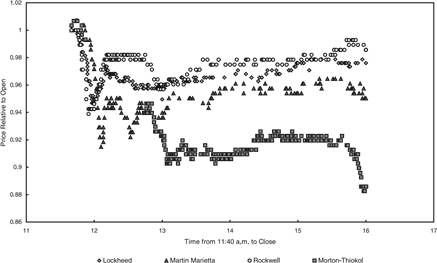
In the period immediately following the crash, securities trading in the four main shuttle contractors singled out Morton Thiokol as having manufactured the faulty component.
Intraday stock price movements following the challenger disaster
At market close, Thiokol’s shares were down nearly 12 per cent. By contrast, the share prices of the three other firms started to creep back up, and by the end of the day their value had fallen only around 3 per cent.
Morton Thiokol shed some $200 million in market value on the day. Over the next several months, the other contractors recovered and outperformed the market while Morton Thiokol lagged.
As a result of the investigation, Morton Thiokol had to pay legal settlements and perform repair work of $409 million at no profit. It also dropped out of bidding for future business.
The $200 million equity decline for Morton Thiokol in hindsight is a reasonable prediction of lost cash flows that came as a result of the judgment of culpability in the crash.
William Brown found that a group of firms that had significant ties to Lyndon Johnson increased in the market value after President Kennedy’s assassination. The share prices of General Dynamics, whose main aircraft plant was located in Fort Worth, Texas, climbed from $23.75 on November 22 to $25.13 on November 26, and by February 1964 was up over $30, a jump of around 30 per cent in three months.
Over the ten trading days following the announcement of Timothy Geithner’s nomination as U.S. Treasury Secretary, financial firms with a connection to Geithner experienced a cumulative abnormal return of about 12% relative to other financial sector firms. This reversed when his nomination ran into trouble due to unexpected tax return issues.
Pat Akey (2013) looked at the abnormal returns in share prices around close U.S. congressional elections. Firms gain on the election of a politician with whom they are connected – and they lost when he or she is defeated. The cumulative abnormal return to be between 1.7% and 6%.
Much more commonly, [economic imperialism] is used by Marxists to describe–and attack–foreign investment in “developing” (i.e., poor) nations.
The implication of the term is that such investment is only a subtler equivalent of military imperialism–a way by which capitalists in rich and powerful countries control and exploit the inhabitants of poor and weak countries.
There is one interesting feature of such “economic imperialism” that seems to have escaped the notice of most of those who use the term.
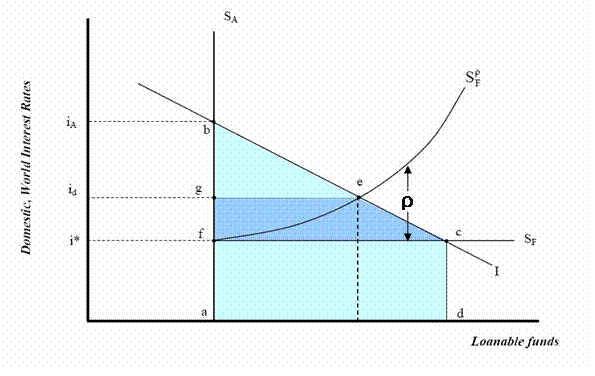
Developing countries are generally labour rich and capital poor; developed countries are, relatively, capital rich and labour poor. One result is that in developing countries, the return on labour is low and the return on capital is high–wages are low and profits high. That is why they are attractive to foreign investors.
To the extent that foreign investment occurs, it raises the amount of capital in the country, driving wages up and profits down.
The effect is exactly analogous to the effect of free migration. If people move from labour-rich countries to labour-poor ones, they drive wages down and rents and profits up in the countries they go to, while having the opposite effect in the countries they come from.
If capital moves from capital-rich countries to capital-poor ones, it drives profits down and wages up in the countries it goes to and has the opposite effect in the countries it comes from.
The people who attack “economic imperialism” generally regard themselves as champions of the poor and oppressed.
To the extent that they succeed in preventing foreign investment in poor countries, they are benefiting the capitalists of those countries by holding up profits and injuring the workers by holding down wages.
It would be interesting to know how much of the clamour against foreign investment in such countries is due to Marxist ideologues who do not understand this and how much is financed by local capitalists who do.
David D. Friedman
Opposition to immigration might protect the wages of local workers. Opposition to foreign investment might increase the profits of local capitalists.
How does more competition help the local capitalists? The foreign investment is in response to the high returns in the local market and that inflow of foreign capital will continue until local rates of return match those in other countries.
Equalisation of risk-adjusted rate of returns is central to the operation of capital markets.
Stopping this process of equalisation through regulation only benefits the capitalists inside the country. It reduces the wages of workers because they have less capital and fewer modern technologies to work with.
Surprisingly many relatives overcame their grief to be in the bank first thing the next morning at opening time to claim the bank account.
We would say thank you for the notification of a deceased depositor, the bank account would be frozen and we waited for correspondence from the executor of the will.
An eye-opener as was my first encounter with illiteracy. Customers asked for their deposit slips to be written out for them because they could not write the word twenty.
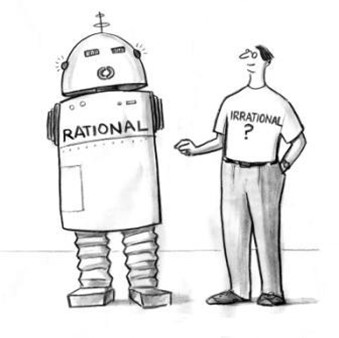
The rationality postulate is under attack from the other people are stupid fallacy: not you, not me, not present company, of course, but the nameless them over there; the perpetually baffled, every man jack of them.
These no-hopers are deemed competent to vote and DRIVE CARS, but they cannot get their head around a credit card. How the them over there find their way to work every morning must be a mystery to behavioural economists. One summary of behavioural labour economics is this:
The key empirical findings from field research in behavioural economics imply that individuals can make systematic errors or be put off by complexity, that they procrastinate, and that they hold non-standard preferences and non-standard beliefs
The tokens were for spending money at the hospital canteen and trips to town and other privileges. They were earned by keeping you and your area clean and helping out with chores.
The first token economies were for chronic, treatment-resistant psychotic inpatients.
In 1977, a major study, still considered a landmark, successfully showed the superiority of a token economy compared to the standard treatments. Despite this success, token economies disappeared from the 1980s on.
Experiments which would now be unethical showed that the occupational choices and labour supply of certified lunatics responded to incentives in the normal, predictable way.
For example, tokens were withdrawn for helping clean halls and common areas. The changes in occupational choice and reductions in labour supply was immediate and as predicted by standard economics.
Some patients would steal the tokens for other patients, so the token individually marked, and the thefts almost stopped. Crime must pay even for criminally insane inpatients.
Kagel reported that:
The results have not varied with any identifiable trait or characteristic of the subjects of the token economy – age, IQ, educational level, length of hospitalization, or type of diagnosis.
Behavioural economics is an excellent example of how engaging in John S. Mill’s truth that engaging with people who are partly or totally wrong sharpens your arguments, improves their presentation and deepens your analysis.
People have a better understanding of rationality such as through the work of Vernon Smith on ecological and constructivist rationality and of how people deal with human frailties and correct error through specialisation, exchange and learning.
George Stigler in his Existence of X-inefficiency paper opposed attributing behaviour to errors because error can explain everything so it explains nothing until we have a theory of error.
Kirzner in “X–Inefficiency, Error and the Scope for Entrepreneurship” wrote that error is pervasive in economic processes. Rational Misesian human actors are human enough to err.
What is inefficient about the world, said Kirzner, is at each instant, an opportunity for improvements, in one way or another and is yet simply not yet noticed. The lure of pure entrepreneurial profits harnesses the systematic elimination of errors and points the way to the market generated institutions necessary for steady social improvements to emerge. Brand names are an obvious example of an institution to overcome doubts about product quality. Middle-men and brokers specialise in performing much of the calculation burdens in their markets.
Many still compare real-world marketplaces to idealised regulation overseen by bureaucrats free of the very biases they are nudging us along to overcome. There are real constraints that limit the options available to fix what are seen as problems to be solved.
Vernon Smith when asked about behavioural economics, wondered how so cognitively flawed a creature made it out of the caves. Vernon Smith argued that the answer had a lot to do with the institutions that emerged to overcome human limitations:
Markets are about recognizing that information is dispersed in all social systems and that the problem of society is to find, devise, and discover institutions that incentivize and enable people to make the right decisions without anyone having to tell them what to do.
Smith and Hayek both posit that market institutions rather than individuals bear the primary cognitive burden in coordinating economic activity. To quote Vernon Smith:
What we learn from experiments is that any group of people can walk into a room, be incentivized with a well-defined private economic environment, have the rules of the oral double auction explained to them for the first time, and they can make a market that usually converges to a competitive equilibrium, and is 100 per cent efficient—they maximize the gains from exchange—within two or three repetitions of a trading period.
Yet knowledge is dispersed, with no participant informed of market supply and demand, or even understanding what that means.
This strikingly demonstrates what Adam Smith called ”a certain propensity in human nature . . . to truck, barter, and exchange one thing for another”
These double oral auctions converged to the competitive price even with as few as three or four sellers with neither the buyers nor sellers knowing anything of the values or costs of others in the market. Price-taking behaviour was not necessary to reach these competitive outcomes.
Behavioural economics is a clumsy way of discussing the pervasiveness of errors because insufficient attention is paid to decentralised, emergent market processes that correct them, often long ago.
About the only book I almost read in one sitting was Wild Swans. I stopped reading at 2 in the morning. This autobiography is 676 pages long. Wild Swans is the story of three generations of women and their families in 20th century China. It is the biggest grossing non-fiction paperback in publishing history.
Wild Swans starts with Jung Chang’s grandmother whose feet were bound at the age of two in 1909. She was later to be a concubine to the local warlord. Her mother was a communist revolutionary in the 1940s onwards and her own story as among other things a teenage Red Guard in the Cultural Revolution. The Guardian described Wild Swan as “For many in the west, Wild Swans was their first real insight into life under the Chinese Communist party.”
I will only mention the part of it that reminded me of Steven Cheung’s analysis of how class ridden communist societies were.
A party membership card puts you above others. That card described in enormous detail what privileges you received depending on your rank in the party.
This is exactly what happened in wild swans. Jung Chang’s father was of the 14th rank while her mother was of the 17th rank. This rank decided what food you got, your accommodation, whether your parents could live with you and even the type of seat you got on the railways.
Star Trek was supposed to be a society that had abolished money and as a post-scarcity economy because everything was available through a replicator. The type of economics it is based on is cooperative economics. To quote Captain Picard:
A lot has changed in three hundred years. People are no longer obsessed with the accumulation of ‘things’. We have eliminated hunger, want, the need for possessions.
The economics of the future is somewhat different. You see, money doesn’t exist in the 24th century… The acquisition of wealth is no longer the driving force in our lives. We work to better ourselves and the rest of Humanity.
The Ferengi and their 285 rules of acquisition were a satire on capitalism. The Ferengi was originally meant to replace the Klingons as the Federation’s arch-rival but they were far too comical.
Gene Roddenberry’s love story with socialism is the most class-ridden society I have ever seen. In Star Trek, higher ranked officers had larger cabins, and most of all they always beamed back from the planet.
Anyone who beamed down with Captain Kirk dressed in those red security officer tops were expendables. Death and accommodation were class based on Star Trek.
The U.S.S. Enterprise also spent a lot of time negotiating trade treaties and visiting planets where the Earth colonists lived in agrarian poverty with famines and preventable diseases.
Why Evolution is True is a blog written by Jerry Coyne, centered on evolution and biology but also dealing with diverse topics like politics, culture, and cats.
In Hume’s spirit, I will attempt to serve as an ambassador from my world of economics, and help in “finding topics of conversation fit for the entertainment of rational creatures.”


 The massive re-deployment of police after the July 2005 London bombings is a test of whether more police reduce crime.








Recent Comments