
Henry Hazlett on the fiscal stimulus and other manifestations of the broken window fallacy
19 Dec 2014 1 Comment
in applied welfare economics, fiscal policy, macroeconomics Tags: broken window fallacy, fiscal stimulus, Henry Hazlett
The rise of the working rich among the top 0.1% in the USA
19 Dec 2014 Leave a comment
in applied welfare economics, economic history, entrepreneurship, politics - USA, poverty and inequality

Source: “Income Inequality in the United States, 1913-1998” with Thomas Piketty, Quarterly Journal of Economics, 118(1), 2003, 1-39
(Tables and Figures Updated to 2012 in Excel format, September 2013) via Chad Jones
Before 1940, most of the income of the top 0.1% of income earners in the USA was income from investments.
By the end of the 20th century, the top 0.1% were earning their incomes as wages and salaries, business incomes and capital gains. Very little of that income of the top 0.1% was in the form of passive income from capital. The top 0.1% of the USA are now working rich – entrepreneurs.
The unbelievable rise of single motherhood in America over the last 50 years – The Washington Post
19 Dec 2014 Leave a comment
in applied welfare economics, labour economics, labour supply, poverty and inequality, welfare reform Tags: causes of poverty, single parenthood


via The unbelievable rise of single motherhood in America over the last 50 years – The Washington Post.
The war on drugs: Drug induced mortality rates compared
18 Dec 2014 Leave a comment
in applied welfare economics, comparative institutional analysis, economics of regulation, political change, politics - Australia, politics - New Zealand, politics - USA Tags: drug decriminalisation, marijuana decriminalisation, Portugal, war on drugs
Robert Lucas and where have all the small entrepreneurs gone?
18 Dec 2014 1 Comment
in applied welfare economics, economics of regulation, entrepreneurship, industrial organisation, Robert E. Lucas, survivor principle, theory of the firm Tags: entrepreneurship, firm entry, firm exit, occupational choice
Robert Lucas predicted the decline in the number of small business people and small firms in 1978. The number of small firms will fall and the number of large firms will rise with increases in real wages (Lucas 1978; Poschke 2013; Gollin 2008; Eeckhout and Jovanovic 2012).
Lucas closed his 1978 discussion of the size distribution of firms, and how firms are getting larger an average over the course of the 20th century, with a discussion of a lovely restaurant he visited on the Canadian border. He predicted that in couple of decades time, these type of restaurants will be fewer.
Nations that are more productive over time and have higher wages because they have accumulated more capital per worker.
One consequence of more capital per worker is real wages increase at a faster rate than profits (Gollin 2008; Eeckhout and Jovanovic 2012). For example, the rate of return on capital was stable over the 20th century while real wages increased many fold (Jones and Romer 2010). This relationship turns out to be crucial in terms of occupational choice and the decision to become an entrepreneur – a small business owner
Higher wages reduces the supply of entrepreneurs and increases the average size of firms because entrepreneurship becomes a less attractive occupational choice (Lucas 1978; Gollin 2008; Eeckhout and Jovanovic 2012).
For example, in the mid-20th century, many graduates who were not teachers were self-employed professionals. With an expanding division of labour because of economic growth, many well-paid jobs and new occupations emerged for talented people in white-collar employment.
OECD countries richer than New Zealand should have less self-employment and more firms that are large because paid employment is an increasingly better-rewarded career option for their high skilled workers.
The U.S. had the second lowest share of self-employed workers (7 per cent) in the OECD in 2010 – the latest data – which is less than half the rate of New Zealand self-employment (16.5 per cent) in 2011 (OECD 2013). The Australian self-employment rate was 11.6 per cent in 2010 (OECD 2013).
A companion reason for larger average firm sizes in countries richer than New Zealand is more capital-intensive production can prosper in larger corporate hierarchies than can labour-intensive production (Lucas 1978; Becker and Murphy 1992; Poschke 2011; Eeckhout and Jovanovic 2012).
The more able entrepreneurs can run larger firms with bigger spans of control in richer countries because their employees can profitably use more capital per worker with less supervision. The diseconomies of scale to management and entrepreneurship should rise at a faster rate in less technological advanced countries such as New Zealand because they are more labour intensive economies (Lucas 1978; Becker and Murphy 1992; Poschke 2011; Eeckhout and Jovanovic 2012).
Importantly, the more able entrepreneurs benefit most from introducing frontier technologies because they can deal more easily with their increased complexity and more uncertain prospects (Poschke 2011; Lazear 2005; Shultz 1975; 1980). Growing technological complexity reduces the supply of entrepreneurs because it takes longer to acquire the necessary balance of skills and experience needed to lead a firm (Lazear 2005; Otani 1996).
The more marginal entrepreneurs will switch to be employees as technology advances so the average size of firms will increase. The entrepreneurs that remain in business will be the most able, more skilled and more experienced entrepreneurs and will be more capable of running larger firms that pioneer complex, frontier technologies (Poschke 2011; Lazear 2005, Otani 1996; Lucas 1978).
Countries more technologically advanced than New Zealand will have both larger firms and less self-employment because of growing technological complexity.
The greater is the exposure to foreign competition, the smaller is the fraction of self-employed and small firms in a country (Melitz 2003; Díez and Ozdagli 2012). More foreign competition increases wages because of lower prices, which makes self-employment less lucrative. More exporting favours larger firms both because of the fixed costs of entering export markets and because the stiffer competition will weed-out the lower ability entrepreneurs who run the smaller firms (Melitz 2003; Díez and Ozdagli 2012).
Other factors can countermand the effects that occupational choice, frontier technologies, exporting and capital intensity have to increase the average size of firms as real wages rise.
For example, tax and regulatory policies reduce the average size of firms in many EU member states to levels that are similar to New Zealand. The EU is less likely to have large firms in its labour intensive sectors. Employment protection laws, product market and land use regulation and in particular, high taxes stifled the growth of labour intensive services sectors in the continental EU (Bertrand and Kramatz 2002; Bassanini, Nunziata and Venn 2009; Rogerson 2008).
EU firms are are more capital intensive with fewer employees than otherwise because labour is so expensive to hire in the EU. Small and medium sized firms can struggle to grow in much of the EU because of regulatory burdens that phase in with firm size (Garicano, Lelarge and Van Reenen 2012; Hobijn and Sahin 2013; Rubini, Desmet, Piguillem and Crespo 2012). Average firm sizes are 40% smaller in Spain and Italy than in Germany. Obstacles to firm growth originate in product, labour, technology and financial and the binding constraints differ from one EU member state to another (Rubini, Desmet, Piguillem and Crespo 2012).
Average firm sizes in the USA and UK may be larger because of fewer tax and regulatory policies that limit business growth. Bartelsman, Scarpetta and Schivardi (2005) found that new entrants in the U.S. started on a smaller scale than in Europe but grew at a much higher rate. This willingness to experiment on a smaller scale was worth the risk because the payoff was much larger in terms of growth in the more flexible U.S. markets.
In summary, many factors drive the size distribution of firms countries including taxation and regulation. Underlying this, nonetheless, is Lucas’s point from 1978 that rising real wages makes starting a small business a less inviting occupation choice.

/assets.sbnation.com/uploads/chorus_asset/file/2527402/Death_chart_by_industry-01__1_.0.png)

Greg Mankiw’s Blog: Spreading the Wealth Around
15 Dec 2014 Leave a comment
in applied welfare economics, liberalism Tags: poverty and inequality

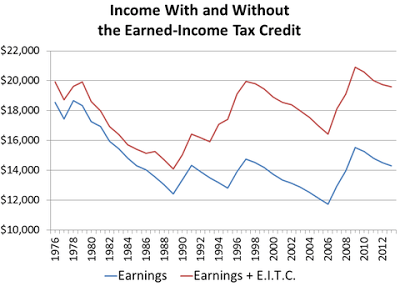
EITC is better than the Minimum Wage
15 Dec 2014 Leave a comment
in applied welfare economics, labour economics, liberalism, minimum wage, poverty and inequality Tags: earned income tax credit, family tax credits, in-work tax credits, minimum wage, negative income tax, poverty and inequality
Global warming – where there is and is not a consensus to deny | Ordinary Times
14 Dec 2014 Leave a comment
in applied welfare economics, climate change, environmental economics, environmentalism, global warming, Karl Popper, politics - Australia, politics - New Zealand, politics - USA, Public Choice Tags: climate alarmism, expressive voting, global warming

The motte for climate change activists are the following:
- Global temperatures are rising.
- Greenhouse gases lead to increased temperatures.
- Greenhouse gases emitted by humans have led to measurable increases in temperature beyond what would have occurred without any humans.
The above points are highly defensible because Science. I believe they are true (though I do so only via trust in others rather than having evaluated any of the research involved personally).
Activists, however, do not sit in this motte for long. They often go on to make a lot of other claims in the bailey:
- Long-term projections of the Earth’s climate are accurate.
- Catastrophe will result in a few decades due to human carbon emissions.
- Nuclear energy is not a viable alternative to fossil fuels.
- Carbon capture is not viable.
- Geoengineering is not viable.
- Unilateral subsidization of renewables by Western industrialized nations is an effective way to reduce global emissions of greenhouse gases.
- Subsidies of energy-efficient products are a better use of resources rather than research and development.
- Subsidizing vehicles that pollute less than other vehicles will provide a net reduction in greenhouse emissions.
- LEED-certified buildings are more energy-efficient than old buildings.
- Building new LEED-certified buildings reduces net greenhouse emissions relative to not building them.
- Sending oil by railcar will result in less net emissions than sending oil through a pipeline (e.g. the Keystone pipeline).
Not all activists make all of these claims, but I think most make at least some claims that are less defensible than those in the motte.
The end result is that anyone who opposes any of the views, even questionable ones sitting in the bailey, can be branded an anti-science denialist. Strictly speaking, this is unfair since there certainly isn’t a scientific consensus on questions like whether it makes sense to spend thousands of dollars subsidizing Chevy Volts while taxing bicycles and safety helmets at 8%.
via An Example of the Motte and Bailey Doctrine | Ordinary Times.
Is it really too hard for people to bother to feed their kids? – Whale Oil Beef Hooked
13 Dec 2014 1 Comment
in applied price theory, applied welfare economics, labour economics, liberalism, poverty and inequality Tags: causes of poverty, inequality and poverty, school breakfast programmes, The Great Fact

An Economic Explanation for Putin’s Recklessness
12 Dec 2014 Leave a comment


What is the main driver of a gender wage gap?
12 Dec 2014 Leave a comment
in applied welfare economics, discrimination, gender, labour economics, liberalism, organisational economics, personnel economics

Politics and disaster aid in the Philippines – The Washington Post
11 Dec 2014 Leave a comment
in applied welfare economics, development economics, economics of natural disasters, growth disasters, growth miracles Tags: corruption, natural disaster relief, Philippines, rent seeking, Tacloban

The good news is that we find that fund allocations do indeed respond to the location and intensity of typhoons and tropical storms.
However, political ties between members of Congress and local mayors, specifically party and clan ties, are also associated with greater funding for a given municipality.
One of the most devastated cities in the aftermath of Typhoon Haiyan is Tacloban City, with a population of 221,174 people.
Our research suggests that for a municipality of this size, a match in party affiliation between the member of Congress and the mayor increases the distribution of funds by PHP 1.74 million ($40,000), while a match in clan affiliation increases this distribution by PHP 6.23 million ($142,000).
The result that clan ties have a much larger effect than party ties on the distribution of per capita reconstruction funds underscores the relative importance of clan loyalty in decision-making by Philippine congressional representatives.
via Politics and disaster aid in the Philippines – The Washington Post.


Recent Comments