Celebrating humanity's flourishing through the spread of capitalism and the rule of law
30 Oct 2014 Leave a comment
in applied welfare economics, industrial organisation Tags: innovation, R&D, The fatal conceit, The pretence to knowledge

30 Oct 2014 Leave a comment
in applied price theory, applied welfare economics, comparative institutional analysis, development economics, entrepreneurship, liberalism Tags: Deirdre McCloskey, The fatal conceit, The pretence to knowledge
29 Oct 2014 Leave a comment
in applied price theory, applied welfare economics, economic growth, industrial organisation Tags: economic growth, innovation, R&D, The fatal conceit, The pretence to knowledge

29 Oct 2014 Leave a comment
in applied price theory, applied welfare economics, economics of regulation, gender, income redistribution, minimum wage, politics - New Zealand, rentseeking Tags: gender wage gap, living wage, minimum wage, pay equity
I wonder who will pay for this? Caregiver wages are funded out of a fixed budget allocated by the government.
A higher wage will change the type of worker that the caregiving sector will seek to recruit, as happened after increases in the teenage went minimum wage.
When the teenage minimum wage went up in New Zealand, employment of 17 and 18-year-olds fell, while the employment of 18 to 19-year-olds increased because the latter were more mature and reliable than the younger contemporaries.
Pay Equity Challenge Coalition
Media release: Pay Equity Challenge Coalition
28 October 2014
Coalition Celebrating Equal Pay Case Outcome
“The Court of Appeal’s decision declining the employers’ appeal in the Kristine Bartlett case is a huge victory for women workers” said Pay Equity Coalition Challenge spokesperson Angela McLeod.
“The Courts’ decision that equal pay may be determined across industries in female-dominated occupations revitalises the Equal Pay Act 1972 and will be a major factor in closing New Zealand’s stubborn 14 percent gender pay gap”.
The judgement by the Court of Appeal upholding the Employment Court decision again validates the work of caregivers and that they are underpaid, she said.
“We commend the Service and Food Workers Union Nga Ringa Tota in taking this case and exposing the underpayment and undervaluation of aged care workers. And the decision is a victory for all the women’s organisations who have never given up fighting for equal pay,”…
View original post 92 more words
29 Oct 2014 Leave a comment
in applied price theory, applied welfare economics, economics of regulation, labour economics, Marxist economics, minimum wage Tags: minimum wage
28 Oct 2014 Leave a comment

26 Oct 2014 Leave a comment
in applied welfare economics, economics of crime, labour economics, occupational choice Tags: economics of crime, three strikes laws
The idea of selective incapacitation is to make a distinction between offenders with a high and a low propensity to commit crime.
Figure 1. Average rate of theft from car and domestic burglary – pre and post-introduction of the Dutch habitual offender law

Note: Plotted coefficients show the average crime rate relative to the month preceding introduction of the habitual offender law. The bars show the 95% confidence intervals. Based on monthly data for 31 cities during 1998-2007.
A habitual offender law adopted in the Netherlands in 2001 (Vollaard 2012). Only offenders with ten or more offenses on their criminal record faced enhanced prison-terms.
Between 2001 and 2007, 1,400 mostly non-violent, relatively old and invariably drug-addicted offenders were sentenced under the law. They accounted for 5% of the prison population. The law implied sentence enhancements of some 1,000%, typically a two-year rather than a two-month sentence for the affected offender population.
These sentence enhancements resulted in a 25% drop in acquisitive crime – the crimes that the affected offenders committed. The law did not have an impact on violent and sexual crimes, offenses that were rarely committed by the affected offenders.
Making the length of prison sentences more dependent on prior criminal records is a cost-effective crime policy. The Dutch policy affected only 5% of the prison population, but reduced property crime rates by 25% to 40%.
25 Oct 2014 Leave a comment
in applied welfare economics, income redistribution, Marxist economics, politics - New Zealand, rentseeking Tags: lost decades, occupy movement, poverty and inequality, prosperity and depression, top 1%
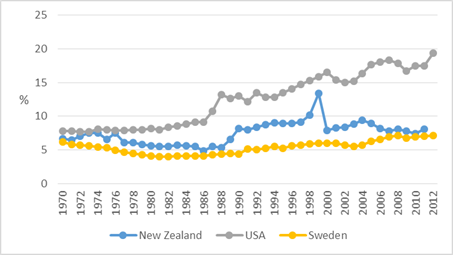
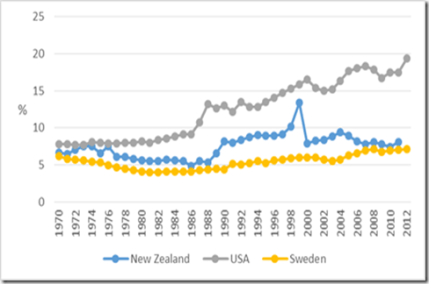
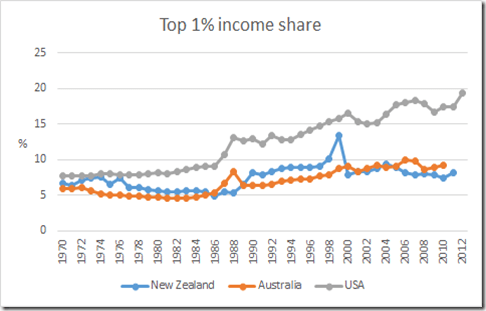
The NZ top 1% share has been steady at 8-9% since the mid-1990s. The top 1%’s share rose strongly in the USA in recent decades, from 13% in the mid-1980s to 19% in 2012.
Figure 1: Top 1% income shares, USA, New Zealand and Sweden, 1970-2012
Source: The World Top Income Database at http://topincomes.g-mond.parisschoolofeconomics.eu/#Database
The top 1% in New Zealand is so lazy that Sweden is overtaking it – See figure 1.
The Occupy crowd blame everything from the global financial crisis to a bad environment on growing inequality and the top 1%. Such an argument has no foundation in fact in New Zealand.
Income inequality as measured by the Gini coefficient has not risen much in New Zealand for 20 years – See figure 2. How can the poor be getting getting poorer, ground under by the yoke of capitalism, if the rich are not getting richer. The occupy movement should apply for unemployment benefits and seek career guidance.
Figure 2: Gini coefficient New Zealand 1980-2015
Source: Bryan Perry, Household incomes in New Zealand: Trends in indicators of inequality and hardship 1982 to 2013. Ministry of Social Development (July 2014).
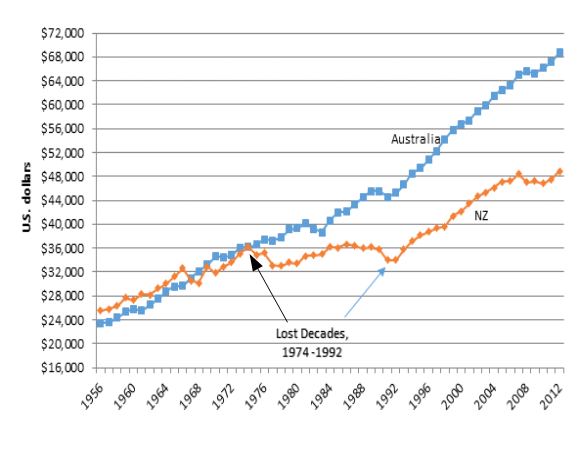
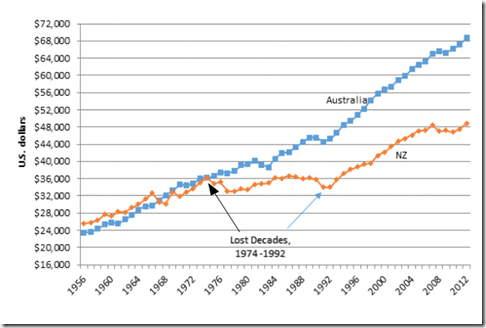
The last major increase in income inequality in New Zealand was in the late 1980s and early 1990s and that was followed by a long economic boom – See figure 3 .
Figure 3: Real GDP per New Zealander and Australian aged 15-64, converted to 2013 price level with updated 2005 EKS purchasing power parities, 1956-2012
Source: Computed from OECD Stat Extract and The Conference Board, Total Database, January 2014, http://www.conference-board.org/economics .
This long boom was after two decades of next to no economic growth in the 1970s and 1980s in New Zealand – see figure 3 . This depression between 1974 and 1992 was New Zealand’s lost decades.
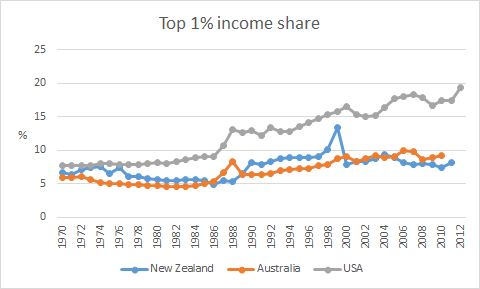
Figure 4 shows that both the lost decades of economic growth in New Zealand and the emergence of the trans-Tasman income gap the seemed to somewhat coincide with the top 1% of earners in Australia increasing their share of income from 6% to 10% of total incomes while the New Zealand top 1% sat on their hands. They are such lazy devils.
Figure 4: Top 1% income shares, USA, New Zealand and Australia, 1970-2012
Source: The World Top Income Database at http://topincomes.g-mond.parisschoolofeconomics.eu/#Database
Celebrating humanity's flourishing through the spread of capitalism and the rule of law
Scholarly commentary on law, economics, and more
Beatrice Cherrier's blog
Celebrating humanity's flourishing through the spread of capitalism and the rule of law
Why Evolution is True is a blog written by Jerry Coyne, centered on evolution and biology but also dealing with diverse topics like politics, culture, and cats.
Celebrating humanity's flourishing through the spread of capitalism and the rule of law
A rural perspective with a blue tint by Ele Ludemann
DPF's Kiwiblog - Fomenting Happy Mischief since 2003
Celebrating humanity's flourishing through the spread of capitalism and the rule of law
The world's most viewed site on global warming and climate change
Tim Harding's writings on rationality, informal logic and skepticism
A window into Doc Freiberger's library
Let's examine hard decisions!
Commentary on monetary policy in the spirit of R. G. Hawtrey
Thoughts on public policy and the media
Celebrating humanity's flourishing through the spread of capitalism and the rule of law
Politics and the economy
A blog (primarily) on Canadian and Commonwealth political history and institutions
Reading between the lines, and underneath the hype.
Economics, and such stuff as dreams are made on
"The British constitution has always been puzzling, and always will be." --Queen Elizabeth II
Celebrating humanity's flourishing through the spread of capitalism and the rule of law
WORLD WAR II, MUSIC, HISTORY, HOLOCAUST
Undisciplined scholar, recovering academic
Celebrating humanity's flourishing through the spread of capitalism and the rule of law
Res ipsa loquitur - The thing itself speaks
In Hume’s spirit, I will attempt to serve as an ambassador from my world of economics, and help in “finding topics of conversation fit for the entertainment of rational creatures.”
Researching the House of Commons, 1832-1868
Articles and research from the History of Parliament Trust
Reflections on books and art
Posts on the History of Law, Crime, and Justice
Celebrating humanity's flourishing through the spread of capitalism and the rule of law
Exploring the Monarchs of Europe
Cutting edge science you can dice with
Small Steps Toward A Much Better World
“We do not believe any group of men adequate enough or wise enough to operate without scrutiny or without criticism. We know that the only way to avoid error is to detect it, that the only way to detect it is to be free to inquire. We know that in secrecy error undetected will flourish and subvert”. - J Robert Oppenheimer.
The truth about the great wind power fraud - we're not here to debate the wind industry, we're here to destroy it.
Celebrating humanity's flourishing through the spread of capitalism and the rule of law
Economics, public policy, monetary policy, financial regulation, with a New Zealand perspective
Celebrating humanity's flourishing through the spread of capitalism and the rule of law
Restraining Government in America and Around the World
Recent Comments