Learn Liberty | The most dangerous monopoly: When caution kills
22 Jun 2014 Leave a comment
in applied price theory, applied welfare economics, economics, economics of regulation, technological progress Tags: drug lags, health and safety
Addressing Global Environmental Externalities: Transaction Costs Considerations
20 Jun 2014 Leave a comment
in applied welfare economics, economics of climate change, Public Choice Tags: Gary Libecap, global commons, global environmental externalities, global warming, property rights, transaction costs
Gary D. Libecap, “Addressing Global Environmental Externalities: Transaction Costs Considerations.” Journal of Economic Literature (2014).

Abstract
Is there a way to understand why some global environmental externalities are addressed effectively, whereas others are not?
The transaction costs of defining the property rights to mitigation benefits and costs is a useful framework for such analysis. This approach views international cooperation as a contractual process among country leaders to assign those property rights.
Leaders cooperate when it serves domestic interests to do so. The demand for property rights comes from those who value and stand to gain from multilateral action.
Property rights are supplied by international agreements that specify resource access and use, assign costs and benefits including outlining the size and duration of compensating transfer payments, and determining who will pay and who will receive them.
Four factors raise the transaction costs of assigning property rights:
(i) scientific uncertainty regarding mitigation benefits and costs;
(ii) varying preferences and perceptions across heterogeneous populations;
(iii) asymmetric information; and
(iv) the extent of compliance and new entry.
These factors are used to examine the role of transaction costs in the establishment and allocation of property rights to provide globally valued national parks, implement the Convention on the International Trade in Endangered Species of Wild Fauna and Flora, execute the Montreal Protocol to manage emissions that damage the stratospheric ozone layer, set limits on harvest of highly-migratory ocean fish stocks, and control greenhouse gas emissions.
Did the 1996 U.S. Welfare Reforms Work?
19 Jun 2014 Leave a comment
in applied welfare economics, labour economics, welfare reform Tags: U.S. 1996 welfare reforms
At the same time as major changes in program structure occurred during the 1990s, there were also stunning changes in behaviour. Strong adjectives are appropriate to describe these behavioural changes.
Nobody – of any political persuasion – predicted or would have believed possible the magnitude of change that occurred in the behaviour of low-income single-parent families over this decade.
The subsequent declines in welfare participation rates and gains in employment were largest among the single mothers previously thought to be most disadvantaged: young (ages 18-29), mothers with children aged under seven, high school drop-outs, and black and Hispanic mothers. These low-skilled single mothers who were thought to face the greatest barriers to employment.

Richard Epstein on the true nature of labour markets
17 Jun 2014 Leave a comment
in applied welfare economics, labour economics, Richard Epstein Tags: labour markets, Richard Epstein
Jacob Viner and the ambiguous welfare effects of preferential trade agreements
17 Jun 2014 1 Comment
in applied price theory, applied welfare economics, international economic law, international economics Tags: Jacob Viner, Paul Krugman, preferential trade agreements, trade creation, trade diversion
The world trade system is a growing assortment of discriminatory trade agreements known as the ‘spaghetti bowl’ for reasons that the diagram of regional trade agreements (RTAs) in the Western Hemisphere makes clear.
Preferential trade agreements are the correct name for the political spin masters call free trade agreements or regional trade agreements.
- A preferential trade agreement is a trading bloc that gives preferential access to certain products from the participating countries. This is done by reducing or abolishing tariffs and other trade restrictions for the members of the trade bloc.
- A customs union is a type of trade bloc which is composed of a free trade area with a common external tariff.
Everything you need to know about trade blocs, preferential trading agreements, and customs union is in a book written by Jacob Viner in 1951. His book The Customs Union Issue introduced the distinction between the trade-creating and the trade-diverting effects of customs unions:
Trade diversion occurs if the common tariff around a customs union and the absence of tariffs within the union lead one of the members to purchase products from another member rather than from a “cheaper” producer in the outside world.
The classic example of this is the entry of Britain into the European Common market in 1973. It started sourcing dairy and wool imports from within the common market rather than from New Zealand as was the case for the past hundred years.
Assume the most efficient producer of lamb in the world is New Zealand. Before joining a customs union the UK will place an identical tariff on lamb imported from any country, this is shown on the diagram below. Before the customs union, French lamb is more expensive than New Zealand lamb once the tariff was paid. There are no imports from France. After joining the EU the tariff on French lamb will be removed.

The formation of the customs union between Britain and France reduces the price of lamb imports from PNZ+t to PFrance. Trade diversion now takes place as consumption switches from the low cost New Zealand farmers to the higher cost French lamb. Lower cost imports from outside the customs union have been replaced by high cost imports from within the customs union.
The welfare analysis analysis is tricky because consumer prices fall, but some of the tariff revenue is now converted into higher import prices because the lamb is sourced with the inefficient French farmers. This is shown in the multiple graphs below where some government tariff revenue is lost and is instead converted into payments to the higher-cost French farmers.

On the diagram below it is possible to highlight the gains and losses in welfare:
- There has been an increase in consumer surplus of areas 1 + 2 + 3 + 4.
- There has been a reduction in the producer surplus of UK lamb producers of area 1.
- There will be a loss of government tariff revenue of 3 + 5.

The will be a net loss in UK welfare if 2 + 4 < 5. It is possible that trade diversion will lead to an increase in UK welfare if 2 + 4 > 5. All in all this situation is full of ambiguity rather than the glories of straight out free trade were a country simply abolish the tariffs and buy from the cheapest supplier. As Paul Krugman explains:
If economists ruled the world, there would be no need for a World Trade Organization. The economist’s case for free trade is essentially a unilateral case – that is, it says that a country serves its own interests by pursuing free trade regardless of what other countries may do.
Or as Frederic Bastiat put it, it makes no more sense to be protectionist because other countries have tariffs than it would to block up our harbours because other countries have rocky coasts. So if our theories really held sway, there would be no need for trade treaties: global free trade would emerge spontaneously from the unrestricted pursuit of national interest.
Trade creation occurs if the abolition of tariffs between members of the customs union leads a member country to purchase products from another member country rather than producing it at higher cost itself.

Whether the trade creation of seats that trade to version requires very careful calculations such as those above . Whether there is a net loss or net gain will depend upon how the elasticity of domestic demand and the size of the initial tariff.
It doesn’t take much trade diversion to offset any trade creation. The trade diversion must be to a supplier within the trade bloc that is not much more expensive than the global cheapest price.

Source: http://www.mhhe.com/economics/pugel12e/keygraph/graphkey10h.html
Viner noted that the greater the similarity of the production mixes of the member countries, the greater the scope for trade creation relative to trade diversion; the more different the production mixes, the greater the scope for trade diversion!
Viner recognized that countries forming a customs union would in fact not be likely to permit the extensive relocation and reorganization of industry required to realize the potential benefits from the finer division of labour. This led him to regard customs unions as:
“unlikely to prove a practicable and suitable remedy for today’s economic ills” but rather “a psychological barrier to the realization of the more desirable but less desired objectives of … the balanced multilateral reduction of trade barriers on a non-discriminatory basis”
The expansion of trade after the signing of preferential trading agreements such as the common market and the many that followed including those signed by New Zealand, Australia and NAFTA are consistent with both trade creation and trade diversion.
The quality of arguments mounted against preferential trade agreements are surprisingly poor.There are good economic arguments against them based on the trade diversion cancelling out the trade creation.
By introducing discriminatory treatment into the trading system, the proliferation of preferential trade agreements promote costly trade diversion, interfere with the efficient operation of global business and allow great powers to extract unjustified concessions from weaker countries. These concessions can be in areas such as intellectual property rights, the purchasing pharmaceuticals by government agencies and social clauses on issues such as environmental and labour standards. Krugman again:
Fortunately or unfortunately, however, the world is not ruled by economists. The compelling economic case for unilateral free trade carries hardly any weight among people who really matter.
If we nonetheless have a fairly liberal world trading system, it is only because countries have been persuaded to open their markets in return for comparable market-opening on the part of their trading partners.
Never mind that the “concessions” trade negotiators are so proud of wresting from other nations are almost always actions these nations should have taken in their own interest anyway; in practice countries seem willing to do themselves good only if others promise to do the same.
The last time a world trade agreement was negotiated Clinton was President, cell phones were as heavy as a brick and no one had heard of email.
Attacking people personally is so much easier than doing the hard analysis
17 Jun 2014 Leave a comment
in applied price theory, applied welfare economics Tags: Milton Friedman, value judgements


On net, are the results good or bad?
13 Jun 2014 Leave a comment
in applied price theory, applied welfare economics, comparative institutional analysis, David Friedman, law and economics Tags: David Friedman

Wise Words on Minimum Wage, Jim Buchanan edition
13 Jun 2014 1 Comment
in applied welfare economics, labour economics
I found the best writer on global warming to be Thomas Schelling
09 Jun 2014 2 Comments
in applied welfare economics, environmental economics, global warming, international economics, Thomas Schelling Tags: game theory, global warming
Tom Schelling has been involved with the global warming debate since chairing a commission on the subject for President Carter in 1980.

Schelling is an economist who specialises in strategy so he focuses on climate change as a bargaining problem. Schelling drew in his experiences with the negotiation of the Marshall Plan and NATO.
International agreements rarely work if they talk in terms of results. They work better if signatories promise to supply specific inputs – to perform specific actions now.
Individual NATO members did not, for example, promise to slow the Soviet invasion by 90 minutes if it happened after 1962.
NATO members promised to raise and train troops, procure equipment and supplies, and deploy these assets geographically.
All of these actions can be observed, estimated and compared quickly. The NATO treaty was a few pages long.
The Kyoto Protocol commitments were made not about actions but to results that were to be measured after more than a decade and several elections.
Climate treaties should promise to do certain actions now such as invest in R&D and develop carbon taxes that return the revenue as tax cuts. If the carbon tax revenue is fully refunded as tax cuts, less reliable countries, in particular, have an additional incentive to collect the carbon tax properly to keep their budget deficits under control.
Schelling is a genius at problem definition when he asked this
Suppose the kind of climate change expected between now and, say, 2080 had already taken place, since 1900.
Ask a seventy-five-year-old farm couple living on the same farm where they were born: would the change in the climate be among the most dramatic changes in either their farming or their lifestyle?
The answer most likely would be no. Changes from horses to tractors and from kerosene to electricity would be much more important.
Climate change would have made a vastly greater difference to the way people lived and earned their living in 1900 than today.
Today, little of our gross domestic product is produced outdoors, and therefore, little is susceptible to climate. Agriculture and forestry are less than 3 per cent of total output, and little else is much affected.
Even if agricultural productivity declined by a third over the next half-century, the per capita GNP we might have achieved by 2050 we would still achieve in 2051.
Considering that agricultural productivity in most parts of the world continues to improve (and that many crops may benefit directly from enhanced photosynthesis due to increased carbon dioxide), it is not at all certain that the net impact on agriculture will be negative or much noticed in the developed world.
As for the chances of a global treaty, Schelling has said:
The Chinese, Indonesians, or Bangladeshis are not going to divert resources from their own development to reduce the greenhouse effect, which is caused by the presence of carbon-based gases in the earth’s atmosphere.
This is a prediction, but it is also sound advice.
Their best defence against climate change and vulnerability to weather in general is their own development, reducing their reliance on agriculture and other such outdoor livelihoods.
Furthermore, they have immediate environmental problems — air and water pollution, poor sanitation, disease — that demand earlier attention.
The mismeasurement of prosperity
07 Jun 2014 Leave a comment
in applied welfare economics, development economics, entrepreneurship, growth miracles Tags: longevity, mismeasurement, prosperity
The average quality of goods: new goods and improved versions of older goods can provide variety and entirely new products and services previously unavailable at any price.
Measurement of the impact of new goods is ‘pretty much guesswork at present’ and ‘some very large gains in consumer welfare’ may be missed (Moulton 1996, p. 173).

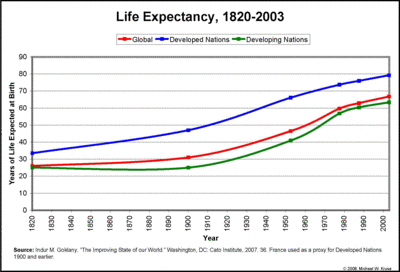
An important bias affecting the measurement of prosperity is greater longevity.

The life expectancy of males at birth improved by 5.9 years between 1970-72 and 1995-97, and by another 3.6 years by 2005-2007 (Statistics New Zealand 2009a). Life expectancy of males at birth increased by a mere 1.3 years from 1950-52 to 1970-72!
Becker et al. (2005) estimated that the six year increase in New Zealand life expectancy between 1965 and 1995 amplified the 34.3 per cent increase in New Zealand GDP per capita to the income equivalent of a 47.3 per cent rise. Becker et al. (2005) estimated that the 73.5 per cent rise in Australian GDP per capita between 1965 and 1995 was enhanced to 95.5 per cent after adjustment for the seven year increase in life expectancy.
Reality television programmes are common-place using the large differences in even 20th century living standards as their theme. The latest niche targeting younger audiences is programmes about the technological backwardness of the 1970s and even the 1980s.
The Spirit Level
07 Jun 2014 Leave a comment
in applied welfare economics Tags: data mining, income inequality, Spirit Level
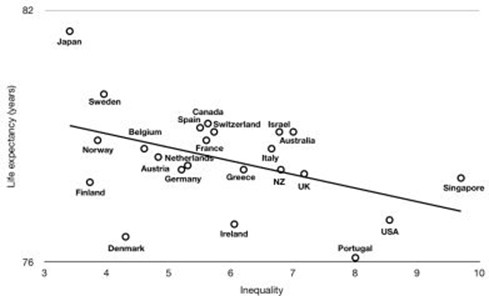
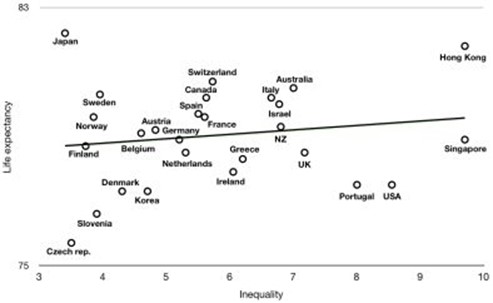
Below are the inequality and life expectancy graphs with and without the strategic deletion of important countries:
Inequality and life expectancy graph, The Spirit Level
Inequality and life expectancy graph, UN (2006)
One of the interesting aspects of The Spirit Level is the claims that the authors make about their originality:
- In the first edition, their preface claimed that they had found something really new about the link between inequality and life expectancy and other quality-of-life variables.
- In the next edition of their book, their preface claimed that they were summarising the consensus of the scientific literature.
John Kay reviewed The Spirit Level in the Financial Times where he wrote:
The evidence presented in the book is mostly a series of scatter diagrams with a regression line drawn through them. No data is provided on the estimated equations, or on relevant statistical tests.
If you remove the bold lines from the diagram, the pattern of points mostly looks random, and the data dominated by a few outliers.
David Friedman – Market Failure: An Argument Both For and Against Government
04 Jun 2014 Leave a comment
in applied welfare economics, constitutional political economy, David Friedman Tags: comparative institutional analysis, David Friedman, government failiure, market failure
Poverty isn’t what it used to be
02 Jun 2014 1 Comment
in applied welfare economics, politics - USA, technological progress Tags: poverty, The Great Fact
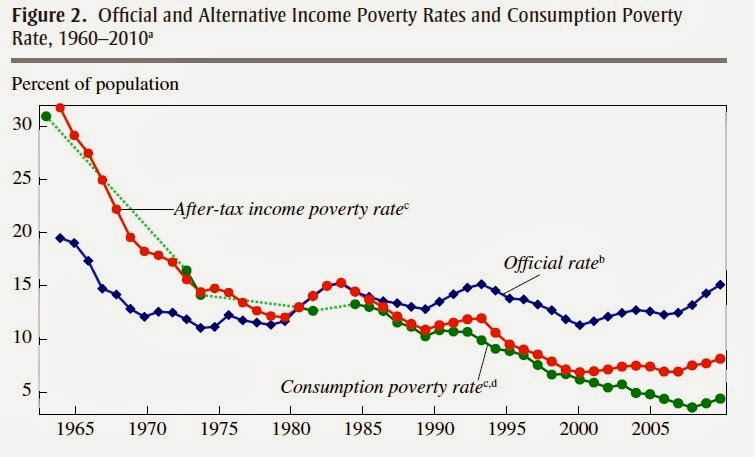
In 1960-61, according to the BLS Consumer Expenditure Survey, the bottom one-fourth of American homes spent about 12 per cent more than their pre-tax reported incomes each year.
By 2011, according to that same survey, those in the lowest quintile were spending nearly 125 per cent more than their reported pre-tax incomes and nearly 120 per cent more than their reported post-tax, post-transfer incomes.
By 2011, average per capita housing space for people in poverty was higher than the U.S. average for 1980, and crowding (more than one person per room) was less common for the 2011 poor than for the non-poor in 1970.
More than three-quarters of the 2011 poor had access to one or more motor vehicles, whereas nearly three-fifths were without an auto in 1972-73.
Refrigerators, dishwashers, washers and dryers, and many other appliances were more common in officially impoverished homes in 2011 than in the typical American home of 1980 or earlier.
Microwaves were virtually universal in poor homes in 2011, and DVD players, personal computers, and home Internet access are now typical in their amenities of the poor that not even the richest U.S. households could avail themselves of at the start of the War on Poverty in 1964.
The charts the third of the charts below shows below show that below American households that are poor and that are not poor do not differ greatly in the consumer amenities that they.
Americans counted as poor today are manifestly living longer, are healthier, better nourished (or over-nourished), and more schooled than their predecessors half a century ago.


Recent Comments