David Friedman – Market Failure: An Argument Both For and Against Government
04 Jun 2014 Leave a comment
in applied welfare economics, constitutional political economy, David Friedman Tags: comparative institutional analysis, David Friedman, government failiure, market failure
Poverty isn’t what it used to be
02 Jun 2014 1 Comment
in applied welfare economics, politics - USA, technological progress Tags: poverty, The Great Fact
In 1960-61, according to the BLS Consumer Expenditure Survey, the bottom one-fourth of American homes spent about 12 per cent more than their pre-tax reported incomes each year.
By 2011, according to that same survey, those in the lowest quintile were spending nearly 125 per cent more than their reported pre-tax incomes and nearly 120 per cent more than their reported post-tax, post-transfer incomes.
By 2011, average per capita housing space for people in poverty was higher than the U.S. average for 1980, and crowding (more than one person per room) was less common for the 2011 poor than for the non-poor in 1970.
More than three-quarters of the 2011 poor had access to one or more motor vehicles, whereas nearly three-fifths were without an auto in 1972-73.
Refrigerators, dishwashers, washers and dryers, and many other appliances were more common in officially impoverished homes in 2011 than in the typical American home of 1980 or earlier.
Microwaves were virtually universal in poor homes in 2011, and DVD players, personal computers, and home Internet access are now typical in their amenities of the poor that not even the richest U.S. households could avail themselves of at the start of the War on Poverty in 1964.
The charts the third of the charts below shows below show that below American households that are poor and that are not poor do not differ greatly in the consumer amenities that they.


Americans counted as poor today are manifestly living longer, are healthier, better nourished (or over-nourished), and more schooled than their predecessors half a century ago.
David Friedman “Global Warming, Population, and the Problem with Externality Arguments”
01 Jun 2014 Leave a comment
Gordon Tullock on the motives for income distribution
01 Jun 2014 Leave a comment
in applied welfare economics, constitutional political economy, Gordon Tullock, income redistribution, Public Choice Tags: Gordon Tullock, income redistribution

Piketty: A Wealth of Misconceptions by Don Boudreaux
01 Jun 2014 2 Comments
in applied price theory, applied welfare economics, economic growth, entrepreneurship, human capital, labour economics, labour supply Tags: inequality and poverty, Piketty, seen and unseen, The Great Enrichment, The Great Fact

Piketty’s method of doing economics involves frequent grand proclamations about "social justice" and economic "evolutions," but he offers no analyses of the dynamics of individual decision-making, often referred to as "microeconomics," that should be central to the issues he raises…
Revealingly, Piketty writes of income and wealth as being claimed or "distributed," never as being earned or produced. The resulting statistics are too aggregated—too big-picture—to reveal what is happening to individuals on the ground…
He imagines that such aggregates interact in robotic fashion through a logic of their own, unmoved by individual human initiative, creativity, or choice…
If we follow the advice of Adam Smith and examine people’s ability to consume, we discover that nearly everyone in market economies is growing richer…
THE U.S. IS THE bête noir of Piketty and other progressives obsessed with monetary inequality.
But middle-class Americans take for granted their air-conditioned homes, cars, and workplaces—along with their smartphones, safe air travel, and pills for ailments ranging from hypertension to erectile dysfunction…
At the end of World War II, when monetary income and wealth inequalities were narrower than they’ve been at any time in the past century, these goods and services were either available to no one or affordable only by the very rich.
So regardless of how many more dollars today’s plutocrats have accumulated and stashed into their portfolios, the elite’s accumulation of riches has not prevented the living standards of ordinary people from rising spectacularly…
Piketty’s disregard for basic economic reasoning blinds him to the all-important market forces at work on the ground—market forces that, if left unencumbered by government, produce growing prosperity for all. Yet, he would happily encumber these forces with confiscatory taxes.
Deirdre McCloskey on why poverty matters more than inequality (BBC Radio interview)
30 May 2014 2 Comments
in applied price theory, applied welfare economics, development economics, growth miracles Tags: Deirdre McCloskey, Piketty, The Great Enrichment, The Great Escape, The Great Fact
In place of capitalism, she talks of a system of ‘market-tested innovation and supply’:
You have to ask what the source of the inequality is.
If the source is stealing from poor people, I’m against it.
But if the source is, you got there first with an innovation that everyone wants to buy, so you get paid some crazy sum, you ought to be paid so much, don’t you think?
There is noting to be gained by focusing on inequality.

McCloskey’s characteristically extravagant self-description:
She asks that compared to all the envy driven policies, what has helped the poor more than increasing the size of pie?
McCloskey argued that:
- Equality is not an ethically sensible purpose.
- Changes in inequality was made an issue by the intellectuals, not by the working class.
- Absolute poverty is what matters and can be solved.
- Inequality is a fool’s errand.
- Who are you going to trust to fix a problem is the key?
- You must look at the actual ability of government to do various things.
- predicting the future of human affairs is a deeply foolish project.
Peter Saunders on The Spirit Level Delusion
30 May 2014 Leave a comment
in applied welfare economics, taxation, technological progress Tags: inequality, Peter Saunders, Sprite Level Delusion
The United States’ Big Welfare State
28 May 2014 Leave a comment
in applied welfare economics, politics - USA Tags: growth of government, welfare state

The United States has long had a larger welfare state than most other Western democracies. Surprised? You may not be aware of the new research on “net social spending.”
Net social spending includes not just government expenditures on social programs, but also tax credits for social purposes and, as a debit, government taxation of social benefits. It turns out that many of the so-called “generous” European welfare states tax social benefits at a high rate. Meanwhile, the United States uses the tax code to help the poor, through the Earned Income Tax Credit. We should also include mandatory private social payments, which are not directly paid by the government.
Using the OECD data, I have plotted total net social expenditure over time for 26 rich countries (click the image to zoom in).
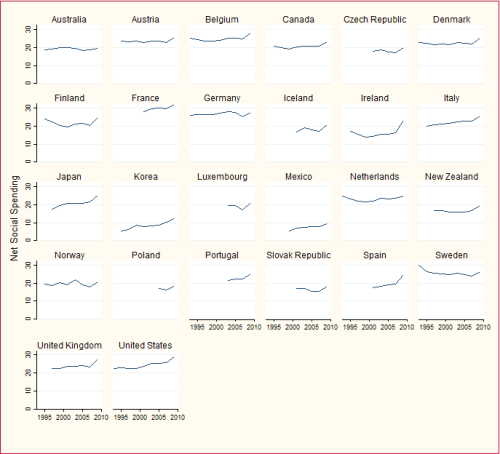
As of 2009, the United States had the second largest welfare state in the world, at 28.8%…
View original post 90 more words
Foreigners Are Our Friends | Bryan Caplan | Learn Liberty – YouTube
23 May 2014 Leave a comment
in applied price theory, applied welfare economics, economic growth, economics, international economics, Public Choice, rentseeking Tags: anti-foreign bias, Bryan Caplan, free trade, protectionism
Everything’s Amazing and Nobody’s Happy | Bryan Caplan
22 May 2014 Leave a comment
in applied welfare economics, economic growth, technological progress Tags: Bryan Caplan, pessimism
Ronald Coase on applied welfare economics versus comparative institutional analysis
21 May 2014 Leave a comment
in applied welfare economics, constitutional political economy, law and economics, Ronald Coase Tags: Coase, comparative institutional analaysis

All solutions have costs, and there is no reason to suppose that governmental regulation is called for simply because the problem is not well handled by the market or the firm.
Satisfactory views on policy can only come from a patient study of how, in practice, the market, firms and governments handle the problem of harmful effects….
It is my belief that economists, and policy-makers generally, have tended to over-estimate the advantages which come from governmental regulation.
But this belief, even if justified, does not do more than suggest that government regulation should be curtailed. It does not tell us where the boundary line should be drawn.
This, it seems to me, has to come from a detailed investigation of the actual results of handling the problem in different ways.
IEA Graphic Shows How to Radically Reduce CO2
21 May 2014 1 Comment
in applied welfare economics, economics of climate change Tags: global warming

Corporate welfare and middle-class welfare defined
20 May 2014 Leave a comment
in applied welfare economics, industrial organisation, Public Choice, rentseeking, survivor principle Tags: corporate welfare, farm welfare, middle-class welfare
The term corporate welfare was coined by Ralph Nader in 1956. Corporate welfare is subsidies, tax breaks, or other favourable treatment for business and implies that business are much less needy of such treatment than the poor.
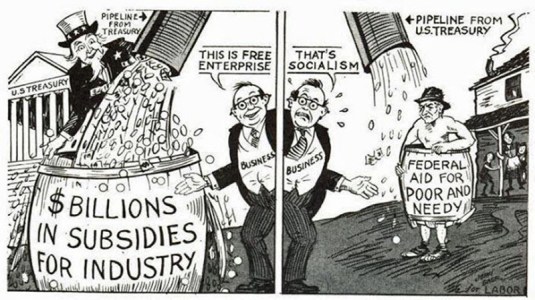 The Right talks of the deserving and undeserving poor. The Left countered with payments to business.
Supporters of corporate welfare often justify them as remedying some sort of purported market failure.
Businesses, big and small, see market failure everywhere under balance sheets that are in the red.
The notion behind corporate welfare is profits should be private while losses should be a reason for a taxpayer bailout.
 Both direct and indirect subsidies to businesses are classified as corporate welfare. The reason is businesses as supposed to make a profit or go out of business.
If a business is losing money, they should try better or do something different or just go out of business.
Losses are not a reason for a taxpayer bailout. No business project should be premised on government subsidies.
The purpose of the capital market is to direct investment to projects that have a future and take support away from failing projects.
The capital market is picking winners and losers every day because that’s its job. That’s what it’s good at.
The participants in the capital market who are not good at picking winners and avoiding losers will themselves will go soon out of business.
Corporate welfare is increasingly used interchangeably with crony capitalism.
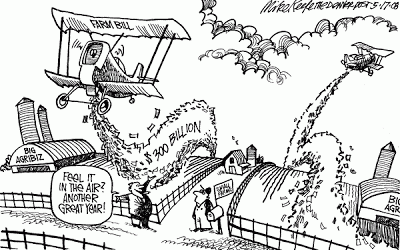 A kissing cousin of corporate welfare is farm welfare. These are the countless subsidies that farmers get in Europe and America, and in the past, in New Zealand.
Middle-class welfare is cash payments by the government to the non-poor. These payments to the middle-class can be for having children such as in Working for Families, for early-childhood education or for childcare. Middle-class welfare also can be tax breaks and subsidies for retirement savings of the nonpoor.
 It is pointless to tax the middle-class and then give them their money pretty much straight back as a cash payment for a particular purpose be it child care or for their retirement. Middle-class welfare covers at least in part expenses the middle-class could have covered themselves but for the taxes.
The Right Minimum Wage: $0.00 – New York Times 1987–Updated Again
19 May 2014 1 Comment
in Alfred Marshall, applied welfare economics, David Friedman, labour economics, minimum wage Tags: David Card, interpersonal comparision of utility, Milton Friedman, minimum wage, offsetting behaviour, The fatal conceit, The pretense to knowledge
Raising the minimum wage by a substantial amount would price working poor people out of the job market.
A far better way to help them would be to subsidize their wages or – better yet – help them acquire the skills needed to earn more on their own…
Raise the legal minimum price of labour above the productivity of the least skilled workers and fewer will be hired.
If a higher minimum means fewer jobs, why does it remain on the agenda of some liberals?
A higher minimum would undoubtedly raise the living standard of the majority of low-wage workers who could keep their jobs. That gain, it is argued, would justify the sacrifice of the minority who became unemployable.
The argument isn’t convincing. Those at greatest risk from a higher minimum would be young, poor workers, who already face formidable barriers to getting and keeping jobs. Indeed, President Reagan has proposed a lower minimum wage just to improve their chances of finding work.
What does the New York Times say in 2014?
The minimum wage is specifically intended to take aim at the inherent imbalance in power between employers and low-wage workers that can push wages down to poverty levels.…
The weight of the evidence shows that increases in the minimum wage have lifted pay without hurting employment
Both the White House and the New York Times are not the best of Bayesian updaters because the author of the one study on which they are very much hang their hats for their policy conclusions about no job losses from a minimum wage increase interprets his results with very much less zeal than they do:
I think careful research on the topic has found that for this range of minimum wage increase, the almost unmistakable conclusion is that there will be little in the way of job losses, while the wages of low-end workers will get a boost (his underlining).
The claims of the White House and the New York Times that the minimum wage can be lifted without hurting employment are a long bow from what Andrajit Dube said about small changes in the minimum wage having small adverse effects on unemployment:
What Andrajit Dube said s not much different from everyone else on the minimum wage – Nuemark is an example:
a 10 per cent increase in the minimum wage could reduce young adult employment by up to 2 per cent
David Card was always very careful amount about how his pioneering research was about how small increases in the minimum wage not reducing employment in the presence of search and matching costs:
From the perspective of a search paradigm, these policies make sense, but they also mean that each employer has a tiny bit of monopoly power over his or her workforce.
As a result, if you raise the minimum wage a little—not a huge amount, but a little—you won’t necessarily cause a big employment reduction. In some cases you could get an employment increase.
There is always offsetting behaviour: Barry Hirsch found that when the federal minimum wage went up in 2007, businesses just made their employees work harder to justify the expense.
I am always surprised that people might think that the minimum wage will have anywhere near its intended effects after market participants have had time to act to counter its effects as Peltzman explains:
Regulation creates incentives for behaviour to offset some or even all of the intended effect of the regulation…
Regulation seldom changes the forces that produces the particular results the regulators seek to change. So we need to ask whether the regulation really changes result or only the form in which the market forces assert themselves.
Is a minimum wage increase a Pareto improvement – a policy action done in an economy that harms no one and helps at least one person?

Obviously there are winners and losers from a minimum wage increase and these wins and loses must be summed up in some way as they are for all public policy changes.

When there are winners and losers from deregulation, the only thing seems to matter to many of those who support a minimum wage increase are the losses to the incumbent industry and its often well-paid workers rather than the gains to consumers, rich or poor.
For there to be a Marshall improvement, the sum of all of the gains and losses must sum to a positive.
A Marshall improvement from a minimum wage or any other change is measured by adding utilities as if everyone receives the same utility from a dollar. A dollar is a dollar to everyone as David Friedman explains:
A net improvement in the sense used by Marshall–what I have elsewhere called a Marshall improvement–is a change whose net value is positive, meaning that the total value to those who benefit, measured as the sum of the number of dollars they would each, if necessary, pay to get the change, is larger than the total cost to those who lose, measured similarly.
The advantage of the Marshall improvement criterion is we commonly observe people’s values of different things by seeing how much they are willing to pay for it.
Alfred Marshall was aware that treating people as if they all had the same utility for a dollar was a stretch but this was considered less relevant for policy changes that affect large and diverse groups of people. Individual differences could be expected to cancel out over a broad suite of policies in a well-functioning democracy so that most people gain in net terms through time. David Friedman explains:
I prefer to use the Marshallian approach, which makes the interpersonal comparison explicit, instead of hiding it in the ‘could be made but isn’t’ compensating payment…
a change that benefits a millionaire by $10 and costs a pauper $9 is a potential Pareto improvement, since if combined with a payment of $9.50 from the millionaire to the pauper it would benefit both. If the payment is not made, however, the change is not an actual Pareto improvement.
The ‘potential Paretian’ approach reaches the same conclusion as the Marshallian approach and has the same faults; it simply hides them better. That is why I prefer Marshall…
It is worth noting that although a Marshall improvement is usually not a Pareto improvement, the adoption of a general policy of ‘Wherever possible, make Marshall improvements’ may come very close to being a Pareto improvement…
Add up all the effects and, unless one individual or group is consistently on the losing side, everyone, or almost everyone, is likely to benefit.
This is the latest review of the minimum wage research from David Neumark:
The potential benefits of higher minimum wages come from the higher wages for affected workers, some of whom are in poor or low-income families.
The potential downside is that a higher minimum wage may discourage employers from using the low-wage, low-skill workers that minimum wages are intended to help.
If minimum wages reduce employment of low-skill workers, then minimum wages are not a “free lunch” with which to help poor and low-income families, but instead pose a trade-off of benefits for some versus costs for others.
Research findings are not unanimous, but evidence from many countries suggests that minimum wages reduce the jobs available to low-skill workers.
George Stigler set-out the conditions for a minimum wage to achieve its purported objectives in 1946, which have not been bettered:
If an employer has a significant degree of control over the wage rate he pays for a given quality of labour, a skilfully-set minimum wage may increase his employment and wage rate and, because the wage is brought closer to the value of the marginal product, at the same time increase aggregate output…
This arithmetic is quite valid but it is not very relevant to the question of a national minimum wage. The minimum wage which achieves these desirable ends has several requisites:
1. It must be chosen correctly… the optimum minimum wage can be set only if the demand and supply schedules are known over a considerable range…
2. The optimum wage varies with occupation (and, within an occupation, with the quality of worker).
3. The optimum wage varies among firms (and plants).
4. The optimum wage varies, often rapidly, through time.
A uniform national minimum wage, infrequently changed, is wholly unsuited to these diversities of conditions.
The case for a minimum wage was therefore hung, drawn and quartered in 1946 by Stigler. Not every cause and effect is open to policy manipulation because of the lack of the necessary knowledge about the relationship and insufficiently deft policy tools to exploit that knowledge in a timely fashion and as circumstances change. This information and organisational burden is such that the process of setting minimum wage increases is an example of public policy making that is groping about in the dark. Success can be neither appraised in advance nor later retrospectively determined.


Recent Comments