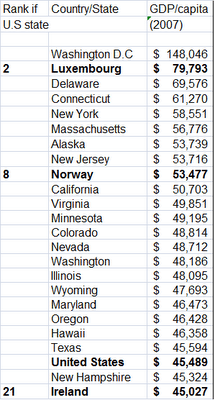
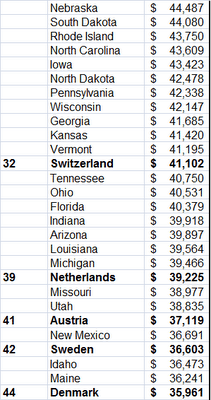
The path to higher U.S. prosperity

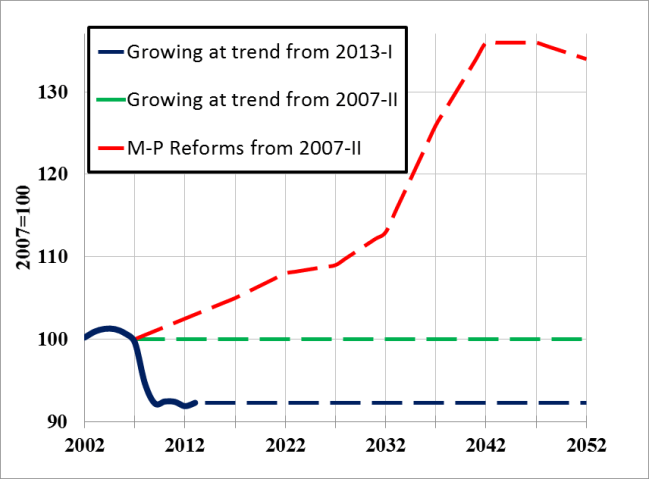
Suppose the USA:

  1. Had mandatory savings for retirement
  2. Eliminated capital income taxes
  3. Broadened tax base and lowered the marginal tax rate
  4. Phased in reforms so all birth-year cohorts are made better off
  5. Left welfare programs and local public good shares the same
  6. Savings not part of taxable income, saving withdrawals part of taxable income – with these changes U.S. income tax would be a consumption tax

US Detrended GDP per Capita

Source: Edward Prescott and Ellen McGrattan 2013.

Beyond Efficiency Dr. Israel Kirzner

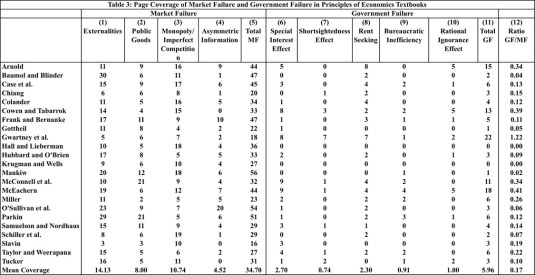
The huge differences in the coverage of government failure versus market failure in 23 leading Principles of Economics – James Gwartney and Rosemarie Fike

23 leading Principles of Economics texts reveals huge differences in the coverage of government failure versus market failure

On average, the coverage of market failure in the 23 texts is nearly six times that of government failure.

As a result of the omission of public choice, many current students of economics are presented a naïve and largely fallacious view of government and the power of economics to explain the presence of debt financing, unfunded promises, special interest spending, and the institutional environment underlying economic growth and development.

Krugman’s textbook does not mention government failure at all!

Via Economicsone

In praise of traffic cops

Due to budget cuts, 35% of Oregon State Highway Police were laid off. These mass layoffs dramatically reduced citations and resulted in a 10-20% increase in injuries and fatalities.

The strongest effects were under fair weather conditions outside of city-limits where state police employment levels were most relevant.

These results in DeAngelo and Hansen’s “Life and Death in the Fast Lane: Police Enforcement and Traffic FatalitiesAmerican Economic Journal: Economic Policy 2014 suggest that a highway fatality can be prevented with $309,000 of additional expenditures on traffic police.

A standard measure of the “value of a statistical life” is it is worth taking regulatory or law enforcement actions that reduce the risks of death when the costs of these actions are less than about $9 million per life saved.

Road safety is an area where James Buchanan’s punishment dilemma is strong:

For some laws or behavioural rules, the individual’s self-interest may override adherence [to the law], at least in certain circumstances.

Traffic violations offer a good example here.

Recognizing that he may himself violate traffic regulations on occasion, the individual may be reluctant to accept institutions that impose severe penalties, despite his preferences that all “others” than himself should be led to obey the general rules by sufficiently severe sanctions.

Just as the individual prefers that all others abide voluntarily by law while he remains free to violate it, so, too, he prefers that differentially severe punishment for law violation be meted out to others than himself.

Voters are less than keen to support strong penalties and convict when sitting on juries because of the fear that there but for the grace of god go I: that they would be in the dock at the receiving end of the heavy punishments.

If we commit to punish offenders and those who might commit offenses are deterred by this commitment to punish them, there would be fewer offenses. This also means doing the unpleasant things of meeting out these punishment when there are offenses by the undeterred:

  • It is painful to subject others to punishment (“son, this is going to hurt me as much as it hurts you”); and
  • It is even more painful to vote for penalties that may be imposed on yourself in person.

The initially low penalties for causing death by dangerous driving is an example of the punishment dilemma. These penalties only slowly increased over several decades as societal attitudes hardened.

Economic Progress since Howard Hughes in the 1960s

Back in the day, with two flatmates, we bought a VCR for about $1000.

videocassette recorder (VCR)

It was a remote control albeit this was connected by a cord to the machine – luxury

These days, DVD players go for $50.

Cafe Hayek makes these wonderful elaborations about how ordinary people live their lives as well as the billionaire Howard Hughes did in 1965:

  • Hughes could afford to talk on the phone for hours to someone hundreds or thousands of miles away.  Even the poorest pays no long-distance charges even when making an overseas telephone call. There is Viber and Skype.

  • Hughes could afford to equip his house with a large screen, a state-of-the-art projector, an impressive sound system, and a film library filled with thousands of movies, documentaries, and television shows, so that he had a virtual movie theatre in his home.  Today, nearly everyone can buy a large-screen hi-definition television, a surround-sound speaker system, and download movies.

  • Hughes could afford to staff his kitchen with chefs from Thailand, Korea, Japan, Vietnam, Ethiopia, Afghanistan, Morocco, Lebanon, and India. Today, such restaurants are common-place.

  • Hughes could easily afford to equip each member of his family with an automobile of his or her own.  Today it’s not unusual for a middle-class household to have one car each for every person in that household who is at least 17 years old.

  • Hughes could easily afford to holiday in a foreign country.  In New Zealand, overseas travel is included in living wage calculations.

  • Hughes could afford to fly to whatever distant locations he visited.  Air travel is now emphatically routine even for high school students.

  • Hughes hired servants to wash his dishes.  Today, automatic dishwashers are the norm.

  • Hughes could afford to equip his residence with an always-at-the-ready dark room so that he could take high-quality photographs and view them minutes later. People upload their photos and videos to Facebook and Instagram moments after they take them.

The Rawlsian social justice case for super-entrepreneurs and many more billionaires

The report SuperEntrepreneurs shows that:

  • SuperEntrepreneurs founded half the largest new firms created since the end of the Second World War
  • There is a strong correlation between high rates of SuperEntrepreneurship in a country and low tax rates
  • a low regulatory burden and high rates of philanthropy both correlate strongly with high rates of SuperEntrepreneurship
  • Active government and supranational programmes to encourage entrepreneurship – such as the EU’s Lisbon Strategy – have largely failed.
  • Yet governments can encourage entrepreneurialism by lowering taxes (particularly capital gains taxes which have a particularly high impact on entrepreneurialism while raising relatively insignificant revenues); by reducing regulations; and by vigorously enforcing property rights.
  • High rates of self-employment and innovative entrepreneurship are both important for the economy.
  • Yet policy makers should recognise that they are not synonymous and should not assume policies which encourage self-employment necessarily promote entrepreneurship.
  • Policy makers should use a definition of entrepreneurship which is based on innovation.

SuperEntrepreneurs examined about 1,000 self-made men and women who have earned at least $1 billion dollars and who appeared in Forbes magazine list of the world’s richest people between 1996 and 2010.

Hong Kong has the most, with around three SuperEntrepreneurs per million inhabitants, followed by Israel, the US, Switzerland and Singapore.

The US is roughly four times more super-entrepreneurial than Western Europe and three times more super-entrepreneurial than Japan.

Super-entrepreneurs tend to be well-educated – 84% have a university degree.

Many started their own company but there is no clear relationship between self-employment and successful entrepreneurship

Steven Kaplan and Joshua Rauh’s “It’s the Market: The Broad-Based Rise in the Return to Top TalentJournal of Economic Perspectives 2013 found that those in the Forbes 400 richest are less likely to have inherited their wealth or grown-up wealthy.

Today’s super-rich are self-made rich because they produce new and better products and services that people wanted and are willing to pay for.

John Rawls was alive to the importance of incentives in a just and prosperous society.

With his emphasis on fair distributions of income, Rawls’ initial appeal was to the Left. Left-wing thinkers then started to dislike his acceptance of capitalism and his tolerance of large discrepancies in income and wealth.

Rawls excluded envy when we are behind his veil of ignorance designed the social contract about how the society will be organised. He believed that principles of justice should not be affected by individual inclinations, which are mere accidents.

Rawls also argued that the liberties and political status of equal citizens encourage self-respect even when one is less well off than others; and background institutions (including a competitive economy) make it likely that excessive inequalities will not be the rule. He supposes that

the main psychological root of our liability to envy is a lack of self-confidence in our own worth combined with a sense of impotence

Then there is the old Russian joke that tells the story of a peasant with one cow who hates his neighbour because he has two. A sorcerer offers to grant the envious farmer a single wish any thing he wants: “Shoot my neighbour’s cow!” he demands.

via http://www.kiwiblog.co.nz/2014/04/entrepreneurship.html

Richard Epstein: Income, Wealth and Inequality. Leveling Up or Leveling Down?


Many people are far too smart to save for their retirements

Which is better? Save for your retirement through the share market or save to own your own home and then present yourself at the local social security office to collect your taxpayer funded old-age pension?

Under this fine game of bluff, you bleed the taxpayer in your old age and pass on your debt-free home to your children.

This strategy is rational for the less well-paid. The family home is exempt from Income and asset testing for social security. If you lose you bet, sell your house and live off the capital.

For ordinary workers, this is a good bet. The middle class might prefer to live in a more luxurious retirement.

For ordinary workers, whose wages are not a lot more than their old age pension from the government, a government funded pension is a good political gamble. The old-age pension for a couple in New Zealand is set at no less that 60% of average earnings.

Compulsory savings for retirement requires the middle class to do what they can afford to do and would have done anyway.

Compulsory savings for retirement requires the working class to do what they can less afford to do.

Instead compulsory retirement savings deprives them of an old-age pension paid for by the taxes of the middle class.

In Australia, ordinary workers are required by law to save 9% of their wages for their retirements at 65 before they have had a chance to save for a car or a house or the rest of the condiments of life the middle class take for granted.

Edward Prescott argues for compulsory retirement savings account albeit with important twists because it is otherwise irrational for many to save for their retirement:

The reason we need to have mandatory retirement accounts is not because people are irrational, but precisely because they are perfectly rational — they know exactly what they are doing.

If, for example, somebody knows that they will be cared for in old age — even if they don’t save a nickel — then what is their incentive to save that nickel? Wouldn’t it be rational to spend that nickel instead?

…Without mandatory savings accounts we will not solve the time-inconsistency problem of people under-saving and becoming a welfare burden on their families and on the taxpayers. That’s exactly where we are now.

Prescott’s proposals are age specific. Those younger than 25 are not required to save anything because they are more pressing priorities such as buying cars and other consumer durables:

  • Before age 25, workers would have no mandatory government retirement savings.
  • Beginning at age 25, workers would contribute 3% vis-à-vis the current 10.6%.
  • At age 30, that rate would increase to 5.3 percent.
  • At 35, the rate would equal the full 10.6 percent.
  • Upon retirement, there would be an annuity over the remaining lives of the individual and spouse

clip_image001

Most of all, the retirement savings must go into private savings accounts. These savings remain assets of the individual and therefore the compulsory savings requirements is not a tax and does not discourage labour supply, as Prescott explains:

Any system that taxes people when they are young and gives it back when they are old will have a negative impact on labour supply. People will simply work less.

Put another way: If people are in control of their own savings, and if their retirement is funded by savings rather than transfers, they will work more.

Prescott’s Nobel Prize jointly with Finn Kydland was for showing that policies are often plagued by problems of time inconsistency. They demonstrated that society could gain from prior commitment to economic policies.

Of course, as Tyler Cowen observed, forced savings schemes are easily offset by people rearranging their affairs, and they have their entire adult life to do so:

How much can our government force people to save in the first place?

You can make them lock up funds in an account, but they can respond by borrowing more on their credit cards, taking out a bigger mortgage, and in general investing less in their future.

People do not save for their retirements not because they are short-sighted, but because they are far-sighted. They know that governments will not carry out their threats and other big talk about not providing an adequate old-age pension.

The only way that governments can commit to not bailing people out who retire with no savings is to make them save for their own retirements over their working lives.

Some will be against this compulsion. Their opposition to compulsion cannot be based on opposition to the nanny state because that is faulty reasoning.

These opponents of compulsion and everyone else in the retirement income policy debate are playing in a far more complicated, decades long dynamic political game where ordinary people time and again out-smart conceited governments who pretend they know better:

The government has strategies.

The people have counter-strategies.

Ancient Chinese proverb

You’re an ideologue; no, you’re the ideologue!

I find that people who call out other people and opposing analysis as ideological are themselves ideologues. They cannot see political differences as other than ideological cat fights.

This is rather than an honest difference of opinion over the effectiveness of different options to achieve a common end as Milton Friedman explained:

I venture the judgment, however, that currently in the Western world, and especially in the United States, differences about economic policy among disinterested citizens derive predominantly from different predictions about the economic consequences of taking action – differences that in principle can be eliminated by the progress of positive economics – rather than from fundamental differences in basic values, differences about which men can ultimately only fight.

Hayek attributed to his opponents nothing more than intellectual error. Hayek (1948) believed that:

we must recognize that it may be genuine error which leads the well-meaning and intelligent people who occupy those key positions in our society to spread views which to us appear a threat to our civilization. Nothing could be more important than to try to understand the sources of this error in order that we should be able to counter it.

Hayek (1968) continues:

The worst mistake a fighter for our ideals can make is to ascribe to our opponents dishonest or immoral aims. I know it is sometimes difficult not to be irritated into a feeling that most of them are a bunch of irresponsible demagogues who ought to know better…

we ought to realize that their conceptions derive from serious thinkers whose ultimate ideals are not so very different from our own and with whom we differ not so much on ultimate values, but on the effective means of achieving them.

William Baumol and Alan Blinder described the role of economics in policy debates as follows:

While economic science can contribute the best theoretical and factual knowledge there is on a particular issue, the final decision on policy questions often rests either on information that is not currently available or on tastes and ethical opinions about which people differ (the things we call ‘value judgments’), or on both.

Lester Thurow said that differences in the valuation of outcomes is at the basis of most disagreements:

Liberal and conservative economists most frequently disagree on who ought to be hurt and who ought to be helped. Their technical disagreements on who will be hurt and who will be helped are much less frequent.

Karl Popper argued that who made an argument is of little value. He said that the growth of knowledge depended not on the ethics of the individual scientists but on the critical spirit to scientific community as a whole. The critical scrutiny of others polices the truth:

The genuine rationalist does not think that he or anyone else is in possession of the truth; nor does he think that mere criticism as such helps us achieve new ideas.

But he does think that, in the sphere of ideas, only critical discussion can help us sort the wheat from the chaff.

He is well aware that acceptance or rejection of an idea is never a purely rational matter; but he thinks that only critical discussion can give us the maturity to see an idea from more and more sides and to make a correct judgement of it.

Peter Drucker championed a business rule of never making a decision until there is disagreement; only then do you know what you are planning to do:

Unless one has considered alternatives, one has a closed mind.

This above all, explains why effective decision-makers deliberately disregard the second major command of the textbooks on decision-making and create dissension and disagreement, rather than consensus.

Decisions of the kind the executive has to make are not made well by acclamation.

They are made well only if based on the clash of conflicting views, the dialogue between different points of view, the choice between different judgments.

The first rule in decision-making is that one does not make a decision unless there is disagreement

Alfred P. Sloan said at a meeting of one of his top management committees:

“Gentlemen, I take it we are all in complete agreement on the decision here.”  Everyone around the table nodded assent.

“Then,”continued Sloan, “I propose we postpone further discussion of this matter until our next meeting to give ourselves time to develop disagreement and perhaps gain some understanding of what the decision is all about”.

Why I am not reviewing Thomas Piketty’s Capital in the Twenty-First Century – updated again

It’s 700 pages long and goes on about Marx. Some people were watching the other channel when the Berlin Wall fell.

thomas-piketty-economist-will-hutton

My 1 o’clock lecture at ANU in 1990 was next to a room rented out ironically from 12 to 1 to the Campus Trots and then to the Campus Christians for an hour of prayer to another saviour.

The Twitter summary of Piketty is this:

Karl Marx wasn’t wrong, just early. Pretty much. Sorry, capitalism. #inequalityforevah

The only Marxist I bother with is Jon Elster. He is a leading proponent of Analytical Marxism and one of the last polymaths. Brian Barry once wrote that to review one of Elster’s books one:

would either have to have taken off several years to master the many fields which fall within Elster’s purview or would be a consortium of at least twenty carefully-chosen experts.

All of Elster’s books and writings are worth reading, including

  • Ulysses and the Sirens (1979);
  • Sour Grapes: Studies in the Subversion of Rationality (1983);
  • Making Sense of Marx (1985); and
  • An Introduction to Karl Marx (1986).

As Jon Elster noted:

Marxian economics is, with a few exceptions, intellectually dead

and Marx’s labour theory of value is:

useless at best, harmful and misleading at its not infrequent worst.

To go on with my non-review, I will quote Tyler Cowen:

The crude seven-word version of Piketty’s argument is “rates of return on capital won’t diminish.”

Piketty’s reasons why rates of return on capital won’t diminish are fairly specific and restricted to only a small share of capital.

.. In any case this is pure speculation and Piketty’s entire argument depends upon it.

… Piketty converts the entrepreneur into the rentier.

To the extent capital reaps high returns, it is by assuming risk…

Yet the concept of risk hardly plays a role in the major arguments of this book.

Once you introduce risk, the long-run fate of capital returns again becomes far from certain.

In fact the entire book ought to be about risk but instead we get the rentier…

Overall, the main argument is based on two (false) claims.

First, that capital returns will be high and non-diminishing, relative to other factors.

Second, that this can happen without significant increases in real wages.

Piketty’s advocacy of a top marginal income tax rate of 80% and a an international treaty for a wealth tax are wildly impractical and destructive of economic growth and entrepreneurship. His advocacy of 60% marginal tax rates on incomes above $200,000 strike at the heart of the professional and managerial occupations that are the backbone of day-to-day capitalism. Piketty’s wealth tax would tax the homes and the retirement savings of the ordinary middle class:

  • wealth below 200,000 euros be taxed at a rate of 0.1 percent,
  • wealth between 200,000 and one million euros at 0.5 percent,
  • wealth between one million and five million euros at 1.0 percent, and
  • wealth above five million euros at 2.0 percent.

Piketty’s reason for these high top tax rates is not to bring in more revenue or to redistribute wealth to poor and the downtrodden but simply “to put an end to such incomes.” Harsanyi argues that:

Like many progressives, Piketty doesn’t really believe that most people deserve their wealth anyway, so confiscating it presents no real moral dilemma.

He also argues that we can measure a person’s productivity and the value of a worker (namely, low-skilled labourers) while arguing that other groups of workers (namely, the kind of people he doesn’t admire) are bequeathed undeserved, “arbitrary” salaries. What tangible benefit does a stockbroker or a kulak or an explanatory journalist offer society, after all?

This takes me back to Jon Elster who had this to say on socialism:

Optimism and wishful thinking have been features of socialist thought from its inception.

In Marx, for instance, two main premises appear to be that whatever is desirable is possible, and that whatever is desirable and possible is inevitable.

…It has become clear that classical socialism massively underestimated the importance of economic incentives.

Greg Mankiw is less harsh, but still to the point:

Like President Obama and others on the left, Piketty wants to spread the wealth around.

Another philosophical viewpoint is that it is the government’s job to enforce rules such as contracts and property rights and promote opportunity rather than to achieve a particular distribution of economic outcomes.

No amount of economic history will tell you that John Rawls (and Thomas Piketty) offers a better political philosophy than Robert Nozick (and Milton Friedman).

John Rawls was actually very much alive to the importance of incentives in a just and prosperous society.

Unequal incomes might turn out to be to the advantage of everyone. Work effort and entrepreneurial alertness respond to incentives; incentives channel people into the occupations and jobs where they produce more.

Rawls lent qualified support to the idea of a flat-rate consumption tax because these taxes:

impose a levy according to how much a person takes out of the common store of goods and not according to how much he contributes.

A simple way to have a progressive consumption tax is to exempt all savings from taxation.

With his emphasis on fair distributions of income, Rawls’ initial appeal was to the Left. Left-wing thinkers then started to dislike his acceptance of capitalism and his tolerance of large discrepancies in income and wealth.

It’s impossible to make the workers better off by taxing capital. The optimal rate of tax on income from capital is zero. This is why the Mirrlees Review of the UK taxation system argued for zero taxation of the returns to capital.

Robert Lucas estimated in 1990 that eliminating all taxes on income from capital would increase the U.S. capital stock by about 35% and consumption by 7%.

Hans Fehr, Sabine Jokisch, Ashwin Kambhampati, and Laurence J. Kotlikoff (2014) found that eliminating the corporate income tax completely would raise the U.S. capital stock (machines and buildings) by 23%, output by 8% and the real wages of unskilled and skilled workers each by 12%.

Book reviews serve the same purpose as film reviews. They are filters for our time. Do you agree?

I made a time management decision to not read a long book plenty of others reviewed and some even understood.

As for the growing income inequality, there is a long literature dating back 25-years arguing that skill-biased technological change is increasing the returns to investing in education as Gary Becker blogged in 2011:

Earnings inequality in the United States and many other countries has increased greatly since the late 1970s, due in large measure to globalization and technological progress that raised the productivity of more educated and more skilled individuals.

While the average American college graduate earned about a 40% premium over the average high school graduate in 1980, this premium increased to over 70% in 2000.

The good side of this higher education-based earnings inequality is that it induced more young men, and especially more young women, to go to and finish college.

The bad side is that many sufficiently able children could not take advantage of the greater returns from a college education because their parents did not prepare them to perform well in school, or they went to bad schools, or they lacked the financing to attend college.

As a result, the incomes of high school dropouts and of many high school graduates stagnated while incomes boomed for many persons who graduated college, and even more so for those with post graduate education.

There is nothing new under the sun.

The living wage

Why not just increase the family tax credit? That would increase the incomes of poor families without putting their jobs at particular greater risk.

The local calculation of the living wage includes cable TV and an overseas holiday.

Milton Friedman provides some critical truths on the living wage:

Do-Gooders believe passing a law saying nobody shall get less than [a minimum wage] is helping poor people (who need the money).

You’re doing nothing of the kind.

What you’re doing is to ensure that people whose skills do not justify that wage will be unemployed.

Climate policy targets revisited | Richard Tol

The IPCC’s Fifth Assessment Report estimates lower costs of climate change and higher costs of abatement than the Stern Review. However, current UN negotiations focus on stabilising atmospheric concentrations of greenhouse gases at even lower levels than recommended by Stern.

This column argues that, given realistic estimates of the rate at which people discount the future, the UN’s target is probably too stringent.

Moreover, since real-world climate policy is far from the ideal of a uniform carbon price, the costs of emission reduction are likely to be much higher than the IPCC’s estimates.

PRTP is the preferred rate of time preference used in net present value calculations.

via Climate policy targets revisited | vox.

Robert Doar on 10 welfare reform lessons

In the National Review, Robert Doar set-out these from his time as commissioner of the New York City social service agency between 2007 and 2013:

  1. Always promote personal responsibility.
  2. Employment is far better than training and education.
  3. Making work pay is welfare reform too.
  4. Be honest about the importance of married two-parent families.
  5. Caseworkers don’t cost much; benefits do.
  6. Medicaid is where the money is.
  7. Immigrants get welfare too.
  8. Welfare recipients (and workers too) will try to "get over."  "To get over" is a very New York expression meaning to steal 
  9. When it comes to the disabled, trust but verify.
  10. Always cheer for the economy.

Figure 1: WELFARE CASELOADS AND RECIPIENTS (AFDC AND TANF PROGRAMS), IN THOUSANDS

Welfare caseloads have declined since the 1996 welfare reform

Source: Administration for Children and Families, TANF caseload data, 2011.

I should add that after the 1996 federal welfare reforms in the USA that time limited life-time federal welfare receipt to 5-years, the 2/3rd decline in welfare participation and the gains in employment were largest among the single mothers previously thought to be most disadvantaged: young (ages 18-29), mothers with children aged under seven, high school drop-outs, and black and Hispanic mothers. These low-skilled single mothers were thought to face the greatest barriers to employment. Blank (2002) found that:

nobody of any political persuasion predicted or would have believed possible the magnitude of change that occurred in the behaviour of low-income single-parent families.

EARTH DAY: SPIRITUALLY UPLIFTING, INTELLECTUALLY DEBASED by Julian L. Simon

During the first great Earth Week in 1970 there was panic.

The public’s outlook for the planet was unrelievedly gloomy.

The doom saying environmentalists – of whom the dominant figure was Paul Ehrlich – raised the alarm: The oceans and the Great Lakes were dying; impending great famines would be seen on television starting in 1975; the death rate would  quickly increase due to pollution; and rising prices of increasingly-scarce raw materials would lead to a reversal in the past centuries’ progress in the standard of living.

… On average, people throughout the world  have been living longer and eating better than ever before.

Fewer people die of famine nowadays than in earlier centuries.

The real prices of food and of every other raw material are lower now than in earlier decades and centuries, indicating a trend of increased natural-resource availability rather than increased scarcity.

The major air and water pollutions in the advanced countries have been lessening rather than worsening.

Julian L. Simon

Via Julian Simon memorial site

HT: The Climate Counsel

PEETA (People Enjoy Eating Tasty Animals)-updated

The web site formally known as People Enjoy Eating Tasty Animals (PEETA) is one of my favourite web sites.

When called PEETA in 1996 or so, this web site was the subject of a pioneering intellectual property court case by PETA.

Grilled Steak Recipe with Garlic-Herb Butter

The web site is a resource for those who enjoy eating meat, wearing fur and leather, hunting, and the fruits of scientific research. More on animal testing later with the help of Penn and Teller.

via People Eating Tasty Animals.

BTW, why are people not allowed to eat tasty animals, but other animals are allowed to eat each other if they can catch them. Should carnivores be required to become vegans? That would be a death sentence for them.

Previous Older Entries Next Newer Entries

Bassett, Brash & Hide

Celebrating humanity's flourishing through the spread of capitalism and the rule of law

Truth on the Market

Scholarly commentary on law, economics, and more

The Undercover Historian

Beatrice Cherrier's blog

Matua Kahurangi

Celebrating humanity's flourishing through the spread of capitalism and the rule of law

Temple of Sociology

Celebrating humanity's flourishing through the spread of capitalism and the rule of law

Velvet Glove, Iron Fist

Celebrating humanity's flourishing through the spread of capitalism and the rule of law

Why Evolution Is True

Why Evolution is True is a blog written by Jerry Coyne, centered on evolution and biology but also dealing with diverse topics like politics, culture, and cats.

Down to Earth Kiwi

Celebrating humanity's flourishing through the spread of capitalism and the rule of law

NoTricksZone

Celebrating humanity's flourishing through the spread of capitalism and the rule of law

Homepaddock

A rural perspective with a blue tint by Ele Ludemann

Kiwiblog

DPF's Kiwiblog - Fomenting Happy Mischief since 2003

The Dangerous Economist

Celebrating humanity's flourishing through the spread of capitalism and the rule of law

Watts Up With That?

The world's most viewed site on global warming and climate change

The Logical Place

Tim Harding's writings on rationality, informal logic and skepticism

Doc's Books

A window into Doc Freiberger's library

The Risk-Monger

Let's examine hard decisions!

Uneasy Money

Commentary on monetary policy in the spirit of R. G. Hawtrey

Barrie Saunders

Thoughts on public policy and the media

Liberty Scott

Celebrating humanity's flourishing through the spread of capitalism and the rule of law

Point of Order

Politics and the economy

James Bowden's Blog

A blog (primarily) on Canadian and Commonwealth political history and institutions

Science Matters

Reading between the lines, and underneath the hype.

Peter Winsley

Economics, and such stuff as dreams are made on

A Venerable Puzzle

"The British constitution has always been puzzling, and always will be." --Queen Elizabeth II

The Antiplanner

Celebrating humanity's flourishing through the spread of capitalism and the rule of law

Bet On It

Celebrating humanity's flourishing through the spread of capitalism and the rule of law

History of Sorts

WORLD WAR II, MUSIC, HISTORY, HOLOCAUST

Roger Pielke Jr.

Undisciplined scholar, recovering academic

Offsetting Behaviour

Celebrating humanity's flourishing through the spread of capitalism and the rule of law

JONATHAN TURLEY

Res ipsa loquitur - The thing itself speaks

Conversable Economist

In Hume’s spirit, I will attempt to serve as an ambassador from my world of economics, and help in “finding topics of conversation fit for the entertainment of rational creatures.”

The Victorian Commons

Researching the House of Commons, 1832-1868

The History of Parliament

Articles and research from the History of Parliament Trust

Books & Boots

Reflections on books and art

Legal History Miscellany

Posts on the History of Law, Crime, and Justice

Sex, Drugs and Economics

Celebrating humanity's flourishing through the spread of capitalism and the rule of law

European Royal History

Exploring the Monarchs of Europe

Tallbloke's Talkshop

Cutting edge science you can dice with

Marginal REVOLUTION

Small Steps Toward A Much Better World

NOT A LOT OF PEOPLE KNOW THAT

“We do not believe any group of men adequate enough or wise enough to operate without scrutiny or without criticism. We know that the only way to avoid error is to detect it, that the only way to detect it is to be free to inquire. We know that in secrecy error undetected will flourish and subvert”. - J Robert Oppenheimer.

STOP THESE THINGS

The truth about the great wind power fraud - we're not here to debate the wind industry, we're here to destroy it.

Lindsay Mitchell

Celebrating humanity's flourishing through the spread of capitalism and the rule of law

Alt-M

Celebrating humanity's flourishing through the spread of capitalism and the rule of law

croaking cassandra

Economics, public policy, monetary policy, financial regulation, with a New Zealand perspective

The Grumpy Economist

Celebrating humanity's flourishing through the spread of capitalism and the rule of law

International Liberty

Restraining Government in America and Around the World