What Is The Best Way To Measure Poverty in Britain?
14 Dec 2017 Leave a comment
in applied price theory, applied welfare economics, labour economics, poverty and inequality Tags: child poverty, family poverty
The Truth About Climate Change
08 Dec 2017 Leave a comment
in applied price theory, applied welfare economics, environmental economics, global warming Tags: climate alarmism
The Economic Cost of EU Membership
30 Nov 2017 Leave a comment
in applied price theory, applied welfare economics, industrial organisation, international economics Tags: Brexit
David Friedman “Global Warming, Population, and the Problem with Externality Arguments”
28 Nov 2017 Leave a comment
in applied price theory, applied welfare economics, environmental economics, global warming Tags: David Friedman, externalities
9 charts to be thankful for: humanity is getting better
24 Nov 2017 Leave a comment
in applied welfare economics, development economics, economic history, growth miracles Tags: pessimism bias, The Great Enrichment, The Great Escape, The Great Fact
Brexit: even a worst-case scenario is not so bad
16 Nov 2017 Leave a comment
in applied price theory, applied welfare economics, international economics Tags: Brexit, British economy, British politics, EU
Deirdre McCloskey on the grumblings of the Twitter Left
30 Oct 2017 Leave a comment
in applied welfare economics, economic history, growth miracles, poverty and inequality
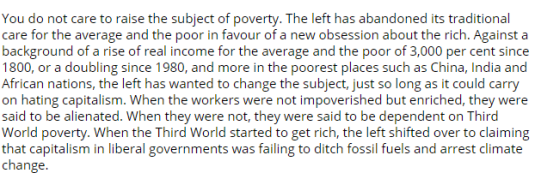
Source: The Duel: Is inequality the root of all social ills? | Prospect Magazine.
Growth paths of #LatAm & the Caribbean the South East Tigers: wrld.bg/NCtLt #RiseoftheSouth http://t.co/IFuUOWldox—
World Bank Pubs (@WBPubs) May 31, 2015
But is a living wage policy still worth a try?
24 Oct 2017 Leave a comment
in applied price theory, applied welfare economics, minimum wage, politics - New Zealand, politics - USA
https://twitter.com/EconBizFin/status/626687442834300928
Demands for massive pay rises for the low-paid are not just confined to New Zealand. The US debate is worth reviewing because their living wage advocates are so upfront about the job losses.
US living wage activists such as Fight for $15 want to double their federal minimum wage from $7.25 per hour to $15 per hour. California, New York, San Francisco and Seattle are among the states and cities increasing their local minimum wages, currently of up to $12, to $15 by 2021 or 2022.
Some such as Arindrajit Dube say that these very large wage increases by cities and states in their federal system are experiments “worth running and monitoring” (Lane 2016). As Dube said recently:
“… 30 to 40 percent of the California workforce will get a raise … This will be a big experiment. It’s far outside of our evidence base…
If you’re risk-averse, this would not be the scale at which to try things. On the other hand, if you think that wages are really low and they’ve been low for a really long time and we can afford to take some risks, doing things at this scale will get us more evidence” (Lee 2016).
Noah Smith (2016) concluded that the empirical literature on minimum wages suggests that a 10% minimum wage increase would reduce employment by about 2% so doubling the federal minimum wage would see the employment of young people go down by one-fifth. Smith (2016) said this is a “small but real effect — a $15 federal minimum wage might throw a million kids out of work”.
Should activists use minimum wage breadwinners for policy experiments? Noah Smith (2016) considers balancing the one million unemployed teenagers against the wage gains for adults as “necessary for a decision”.
Smith suggests that the large minimum wage increases in some US states and cities will tell us how big this welfare trade-off between jobs and wage rises is:
We don’t really know what happens when you raise the minimum wage to $15 — but soon, we will know. We will be able to see whether employment rates fall in L.A., Seattle, and San Francisco. We will be able to see whether people who can’t get work migrate from these cities to cities with lower minimum wages.
We will be able to see if employment growth suddenly slows after the enactment of the policy. In other words, federalism will do its job, by allowing cities to act as policy laboratories for the rest of the country (Smith 2015).
“Big experiments” involving large minimum wage increases to “provide clear evidence” to quote Dube’s words (Scheiber and Lovett 2016) are wrongheaded as Robert Lucas has explained:
I want to understand the connection between in the money supply and economic depressions. One way to demonstrate that I understand this connection–I think the only really convincing way–would be for me to engineer a depression in the United States by manipulating the U.S. money supply.
I think I know how to do this, though I’m not absolutely sure, but a real virtue of the democratic system is that we do not look kindly on people who want to use our lives as a laboratory. So I will try to make my depression somewhere else (Lucas 1988).
Leading reasons for economic theory, empirical research and the study of economic history are to warn the present against repeating past errors and not try experiments that are folly (Rosen 1993). There is too much group think and not enough courage of your vocation (see Dylan Matthew’s tweet below).
https://twitter.com/dylanmatt/status/720786520509165568
Australian-born economist Justin Wolfers is frank about the wishful thinking in the US debate:
But if you are interested in what level to set the minimum wage, the existing literature is nearly hopeless. Plausible reforms lie far outside the bounds of historical experience.
We don’t have useful estimates of the extent to which employment effects vary with the minimum wage. Since policymakers tend to implement short-run fixes, we know a lot about the effects of temporary reforms, but very little about the consequences of lasting reform (Wolfers 2016).
Most of the empirical studies are of the jobs lost over the next few years. When estimates have a 10 to 15-year horizon with time enough for entry, exit and technological adaptation and automation, a “long-run disemployment effect that is five times larger than the short-run effect” is in evidence (Aaronson, French, Sorkin 2016; Aaronson, French, Sorkin and To forthcoming; Sorkin 2015).
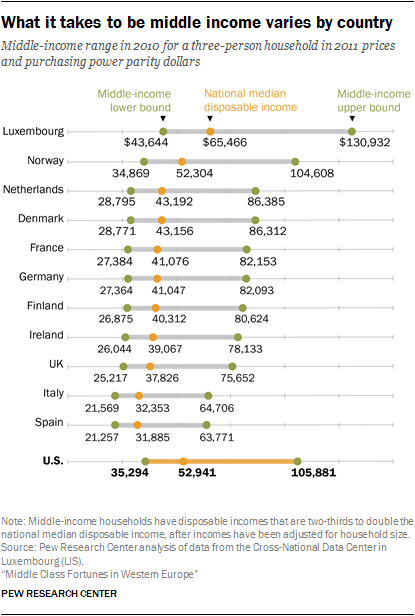
A lot of Europe’s middle class would be poor in the USA
23 Oct 2017 Leave a comment
in applied welfare economics, poverty and inequality Tags: family poverty
Was 75% of Piketty’s class war a measurement error?
18 Sep 2017 Leave a comment
in applied welfare economics, politics - USA, poverty and inequality

Source: “Using Tax Data to Measure Long-Term Trends in U.S. Income Inequality.”
David Splinter and
Gerald Auten. Working paper for the 2017 Annual Meeting of the American Economics Association, 2016.
What Does Research Tell Us About Minimum Wage?
16 Sep 2017 Leave a comment
in applied price theory, applied welfare economics, economics of regulation, labour economics, minimum wage Tags: unintended consequences
Climate economics (UG): Costs of emission reduction
15 Sep 2017 Leave a comment
in applied price theory, applied welfare economics, environmental economics, global warming
 Utopia, you are standing in it!
Recent Comments