Could Civilization Survive a World Without Growth? The answer, simply, is no — NY Times — https://t.co/GiDZkBVyMt pic.twitter.com/XBAVlF3fUl
— Robert Went (@went1955) December 2, 2015
More on The Great Enrichment
09 Dec 2015 Leave a comment
in applied welfare economics, development economics, economic history, growth disasters, growth miracles Tags: The Great Enrichment, The Great Escape, The Great Fact
Global deaths from indoor and outdoor pollution
03 Dec 2015 1 Comment
in applied welfare economics, energy economics, environmental economics, health economics, transport economics, urban economics Tags: air pollution, indoor pollution, The Great Escape
Is promoting R&D New Zealand’s path to prosperity?
02 Dec 2015 Leave a comment
in applied price theory, applied welfare economics, comparative institutional analysis, economic growth, economic history, entrepreneurship, industrial organisation, macroeconomics Tags: creative destruction, endogenous growth theory, entrepreneurial alertness, innovation, international technology diffusion
Michael Reddell was right to run his sceptical eye over the enthusiasm of the New Zealand government for promoting local R&D. Politicians are obsessed with boffins in lab coats who invent thing rather than the entrepreneurs who risk import technologies and adapt them to local markets.
New Zealand is a technology follow-up. 99% of global R&D is undertaken abroad. The key innovation policy question for New Zealand is how to adopt those technologies rather than how to invent them.
https://img.quozio.com/img/a6dd47b6/1025/The-fraction-of-US.jpg
Appropriate institutions and distance for the global technological frontier
As technology followers such as New Zealand approach the global technological frontier, the institutions appropriate for continued productivity growth change.
As a country moves closer to the global technological frontier, the impact of each successive technology import will decline. The latest imported technology is usually a smaller and smaller upgrade on before. A more skilled workforce and greater entrepreneurship is needed to squeeze out all of the available productivity and product quality gains from the latest imported technologies.
The institutions appropriate to further growth are context-dependent
The political, tax and regulatory institutions that favour the more ready-made implementation of more standardised imported technologies do not necessarily favour the growing demand for the domestic innovations in New Zealand as the global technological frontier nears. There is a growing demand for more highly skilled workers to master and adapt the leading-edge technologies to the distinctive circumstances of each New Zealand workplace to stay ahead in rapidly changing competitive environments and meet the changing needs of customers.
Productivity growth is not manna from heaven. Every increase in productivity and in product quality and variety are the sum of many inventions that must be first discovered by prospective innovators building on past ideas and developed, tested, adopted and adapted by profit-minded entrepreneurs and workers. Investments in R&D, in human capital and in on-the job learning and in the entrepreneurial judgments about risking investments in the new technologies that all underpin further growth in productivity are all influenced by public policies.
Moving from implementation-based to innovation-based policy regimes
As a country approaches the global technology frontier, continued technological imitation is no longer enough to keep productivity growing at the trend rate of two per cent per year. There must be an institutional switch from a technology implementation-based policy regime to an innovation-based policy regime.
The end by 1990 of the EU’s productivity convergence on the USA has been partly attributed to not making the policy shift from technology implementation enhancing institutions to innovation enhancing institutions. EU members invested far less than the USA in R&D and tertiary education had more rigid labour and product markets, had less entry and exit of firms, and much higher taxes.
Institutions must adapt to distance from the technological frontier
As a country approaches the global technology frontier, there must be younger firms, fewer incumbents, better educated workers, more R&D, more entry and exit, more flexible product and labour markets and lower taxes. These dynamic entrepreneurial features were not common-place in pre-1984 New Zealand.
New Zealand too had to switch to institutions that enhanced innovation and entrepreneurial entry just to return to growing at the global trend rate of 2 per cent per year. The political, tax and regulatory institutions appropriate prior to 1973 when New Zealand was a colonial farm for the UK are different to the institutions that are growth-enhancing in a less sheltered economic environment. There is no reason to suppose that the rising burden of knowledge and product proliferation has in any way ebbed to lighten the pressure for continued reform.
The institutional foundations of prosperity and stagnation
Questions about greater prosperity of New Zealand must be correctly posed and should focus on the fundamental causes of productivity growth rather than the proximate causes. The proximate causes of productivity and prosperity are the accumulation of more human and physical capital and technological progress.
Institutions are the fundamental cause of prosperity and cross-country differences in per capita incomes. Institutions determine the incentives and constraints on working, learning and investing, and influence, in a profound way, investments in physical and human capital and R&D and the importing of new technologies. It is premature to conclude that the national institutions and policies of OECD member countries are fairly similar and that the institutional differences that they do have are minor in their impact on respective national productivity and income levels.
There have been periods of prosperity, divergence, depression, recovery, catch-up and no catch-up at difference times in OECD member countries and usually for country-specific reasons. These large changes in fortune are not by chance. The differences in policy that gave rise to these divergences in income levels and extended periods of prosperity and stagnation should be open to analysis so that policy improvements can be discovered for possible application in New Zealand.

The Productivity Hub is a partnership of agencies which aims to improve how policy can contribute to the productivity performance of the New Zealand economy and the wellbeing of New Zealanders. The Hub Board is made up of representatives from the Productivity Commission, the Ministry of Business, Innovation and Employment, Statistics New Zealand and the Treasury
The Productivity Hub yesterday hosted a symposium in Wellington with the title “Growing more innovative and productive Kiwi firms”. “Growing” things is usually something gardeners do – people doing stuff to things. So the title perhaps carried somewhat unfortunate connotations of successful firms being the products of government action. That probably wasn’t their intention, at least not wholly, but then again it wasn’t entirely out of line with the list of attendees – 161 names, of whom at least 150 would have been bureaucrats, academics, and the like. There appeared to be only a very…
View original post 2,243 more words
Is global warming our biggest problem?
02 Dec 2015 Leave a comment
in applied price theory, applied welfare economics, energy economics, environmental economics, global warming Tags: climate alarmism, Little ice age, younger dryas

Climate sceptics are so low that they must be smeared as libertarians
01 Dec 2015 3 Comments
in applied welfare economics, economics of regulation, environmental economics, global warming, politics - USA, Public Choice
When the Twitter Left brands an opponent as a libertarian, I assume it’s a secret handshake among true believers trying to identify each other. You need time management counselling in your calling as a political junkie if you knew what a libertarian was until a few years ago. The only reason to change was the election of Senator Ron Paul.
The Twitter Left likes to smear opponents as libertarians despite the fact that certainly outside the USA and even within the USA few know what the libertarian means even with the help of scare quotes.
Only political junkies have an inkling of what a neoliberal is so why smear someone such an even more obscure label such as libertarian? Libertarian must be lower than a neo-liberal and should be hated even more by the Twitter Left must be the implication despite its poor marketing outreach value. I’m still puzzled as to why use such an obscure political label.
Today in the New York Times, a guide was published giving its readers the short answers to the key questions global warming. The author argued that most attacks on the science of global warming come from libertarians and other political conservatives who don’t like the implications of fighting global warming for growth in the size of government.

Source: Short Answers to Hard Questions About Climate Change – The New York Times via Environmental Economics: Short Answers to Hard Questions About Climate Change – The New York Times.
It is true that people attempt to discredit the arguments behind positions. Let he who is without sin cast the first stone.
“How to discredit an unwelcome report:
… Stage Four: Discredit the person who produced the report. Explain (off the record) that
1. He is harbouring a grudge against the Department.
2. He is a publicity seeker.
3. He is trying to get a Knighthood/Chair/Vice Chancellorship.
4. He used to be a consultant to a multinational.
5. He wants to be a consultant to a multinational.”
Sir Humphrey, The Greasy Pole.
As a professional economist, I am used to special interests as well as the Twitter Left arguing that economics is “just a theory” and its methodology is unrealistic along with various other attempts to avoid engaging with the actual advice put forward.
It is also true that scepticism about climate science has a partisan divide. In the USA, for example, Democrats are far more worried about global warming then independents or Republicans. (Independents is their name for swinging voters. They are called independents because if they register as one, they can vote in the Republican or Democratic primaries in many states).

I have argued in the blogosphere since 2011 that let the science be settled, only the economics matters because the economic cost of global warming is small.
Global warming, although real, is not apt to be severe. It will lower the level of GDP by maybe 2%. The loss of one year’s income growth! Courtesy of David Friedman’s reading of the report, this is what the most recent report of the IPCC said:
With these recognized limitations, the incomplete estimates of global annual economic losses for additional temperature increases of ~2°C are between 0.2 and 2.0% of income (±1 standard deviation around the mean)
I have also argued that the climate alarmists scored a great tactical victory in keeping the debate about the reliability of the science. By successfully baiting that trap for opponents, the climate alarmists have avoided having to discuss the costs and benefits of global warming.
Richard Tol on the scientific consensus about human-caused global warming skepticalscience.com/graphics.php?g… http://t.co/OpdRtsY1tx—
John Cook (@skepticscience) March 24, 2015
So it is rather curious that climate sceptics are playing to the strength of the climate alarmists rather than their weaknesses. Those weaknesses are the economics of global warming and the public choice economics of international climate agreements.
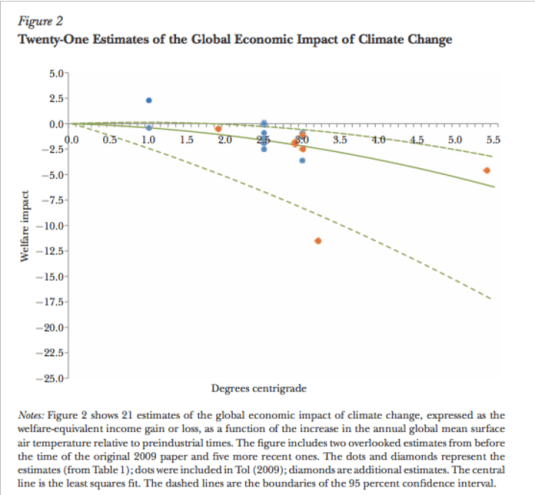
Source: Richard Tol.
Not only is the economic cost of global warming small, the chances of supplying an international public good such as a treaty to reduce carbon emissions is minimal.
The New York Times today in its Q&A guide did not quantify the costs and benefits of global warming. That makes their guide deeply misleading. This is because such estimates of the cost of global warming as a percentage of GDP are available from the IPCC. Which is worse? Being a libertarian or a misleading, low rent journalist?

Source: Short Answers to Hard Questions About Climate Change – The New York Times via Environmental Economics: Short Answers to Hard Questions About Climate Change – The New York Times.
What is even more bizarre in the guide today in the New York Times is the claim that politicians are finally taking climate change seriously. Anyone who claims that a climate change treaty will come out of Paris that is in any way binding is simply not paying attention to the last 5 years of politics and who controls the U.S. Congress. They cannot be taken seriously as a political commentator.
Obama gave up on a climate bill passed by the House of Representatives in 2010 despite the fact that he had the numbers in the Senate to break a filibuster. There were 5 Republican senators who would have voted for cap and trade in April 2010: Lindsey Graham, Susan Collins, Olympia Snowe, Scott Brown, and George LeMieux. There were 57 Democrat Senators. It takes 60 votes to break a filibuster.
Obama gave up because he didn’t want the additional political flak of passing a climate change bill in the aftermath of the political costs of passing Obamacare. President Obama could have fought harder to get the Bill the House passed through the Senate but he did not.
Concern about global warming fads away when it becomes a hip pocket issue. Rather than blaming vast right-wing conspiracies, using Google searches for “unemployment” and “global warming”, Kahn and Kotchen found that:
- Recessions increase concerns about unemployment at the expense of public interest in climate change;
- The decline in global-warming searches is larger in more Democratic leaning states; and
- An increase in a state’s unemployment rate decreases in the probability that Americans think global warming is happening, and reduces the certainty of those who think it is.
As Geoff Brennan has argued, CO2 reduction actions will be limited to modest unilateral reductions of a largely token character. There are many expressive voting concerns that politicians must balance to stay in office and the environment is but one of these. Once climate change policies start to actually become costly, expressive voting support for these policies will fall away, and it has.

Political outlooks and risk perception
29 Nov 2015 1 Comment
in applied welfare economics, economics of regulation, health economics Tags: anti-vaccination movement, expressive voting, GMOs, gun control, political psychology, risk risk trade-offs
A hidden cost of terrorism
28 Nov 2015 1 Comment
in applied price theory, applied welfare economics, economics of crime, law and economics, transport economics, war and peace Tags: offsetting the, risk risk trade-offs, unintended consequences, war against terror
Fact checking @Bernie Sanders latest presidential debate
27 Nov 2015 Leave a comment
in applied price theory, applied welfare economics, economic growth, labour economics, politics - USA, poverty and inequality, welfare reform Tags: 2016 presidential election, Leftover Left, Twitter left
There are now more mobile phones than people
26 Nov 2015 1 Comment
in applied welfare economics, development economics, economics of media and culture, entrepreneurship, growth miracles, industrial organisation Tags: cell phones, creative destruction, international technology diffusion, living standards, mobile phones, technology diffusion
The Heckman equation explained
26 Nov 2015 Leave a comment
in applied welfare economics, economics of education, human capital Tags: early childhood education, economics of families, James Heckman
@stevenljoyce has his bridge too far on corporate welfare
25 Nov 2015 Leave a comment
in applied welfare economics, politics - New Zealand, rentseeking, transport economics
Productivity and the National Living Wage
21 Nov 2015 1 Comment
in applied price theory, applied welfare economics, entrepreneurship, industrial organisation, labour economics, minimum wage, politics - New Zealand, poverty and inequality, survivor principle Tags: British economy, living wage
A brilliant point by @FlipChartRick in the reblog. What sort of single year labour productivity increase is required to cover a UK living wage increase. Basic arithmetic kills.
A 6.6% annual productivity growth would be required to fund a living wage. This will be far above trend and would be required in sectors such as services that are not at all known for rapid productivity growth because of Baumol’s disease.
A subsequent Twitter exchange updated a key chart to include Australia and New Zealand.

The CIPD and the Resolution Foundation are collaborating on a piece of research into the impact of the National Living Wage (NLW). According to their first study over half of the country’s employers expect to be affected by it. Around a third said they would meet the increased cost by improving productivity and 22 percent said they would take lower profits. Only 15 percent said they would lay off workers or slow down recruitment.
That all sounds promising but, as Matt Whittaker points out, the productivity increase needed to cover the cost of the NLW could be pretty steep. As you might expect, there is a strong relationship between rising minimum wages and rising productivity. Most countries in the OECD have not strayed very far from this line of best fit.
 In the absence of any productivity growth, the proposed NLW would move some way from the line (the green circle) by 2016 and…
View original post 565 more words

 Utopia, you are standing in it!


Recent Comments