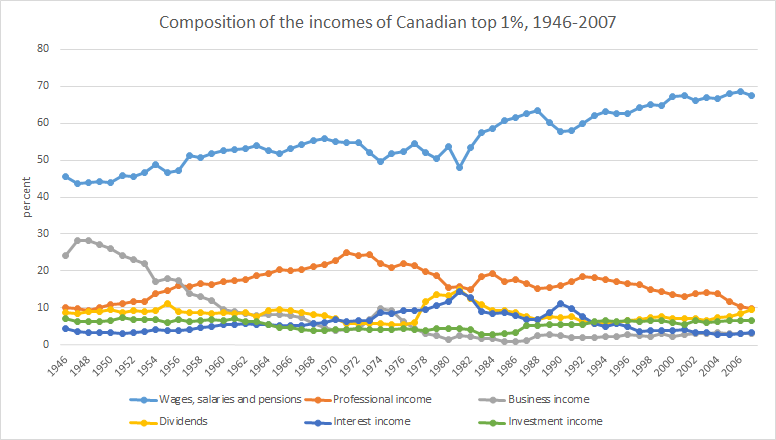
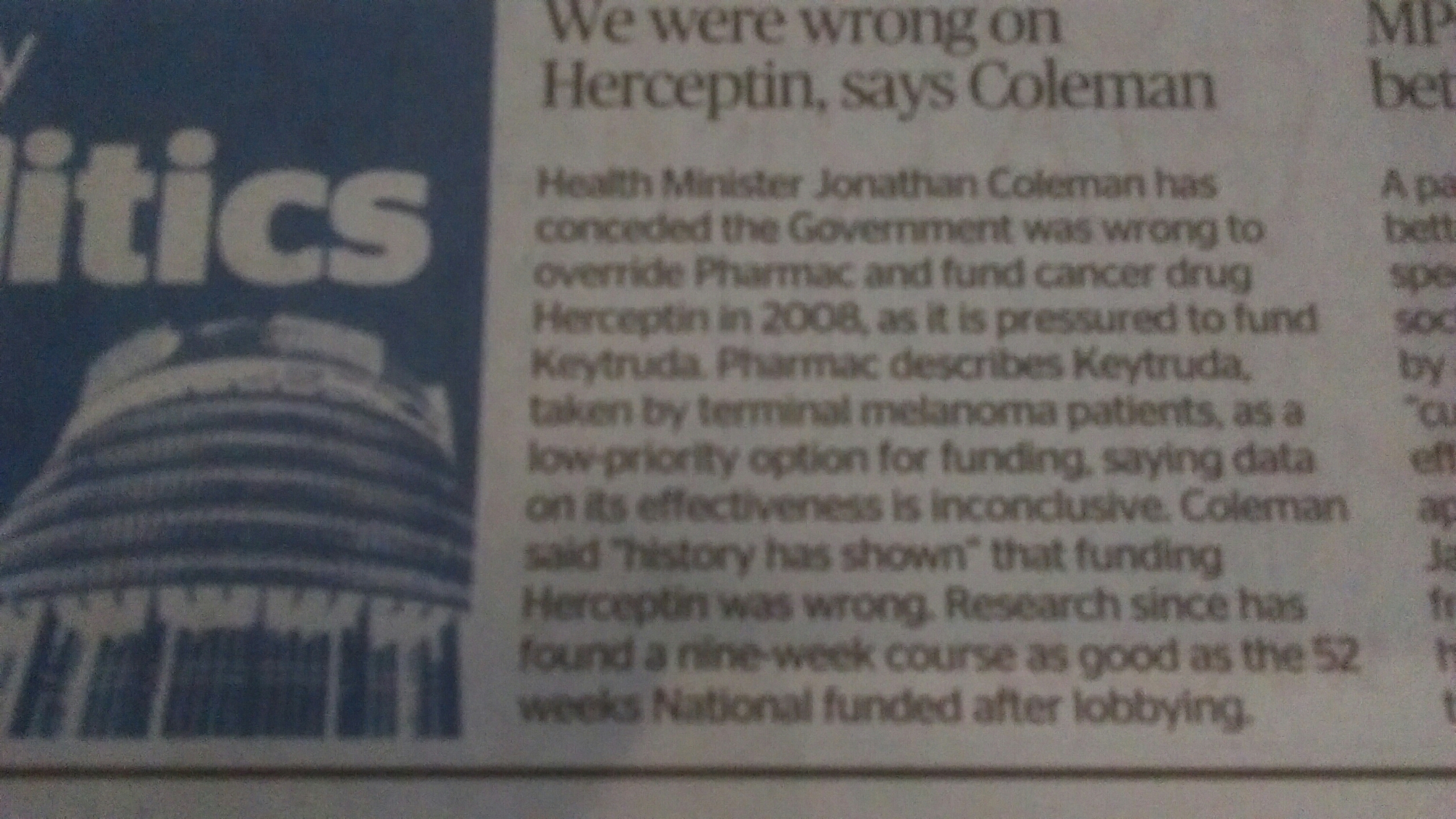
Source: The World Wealth and Income Database.
The rise of the Canadian working rich – composition of top 1% incomes since 1946
08 Jan 2016 Leave a comment
in applied welfare economics, economic history, human capital, labour economics, poverty and inequality Tags: Canada, superstar wages, superstars, top 1%, working rich
Adam Smith versus Jamie Whyte or is there poverty on the Starship Enterprise?
07 Jan 2016 2 Comments
in Adam Smith, applied welfare economics, politics - New Zealand, poverty and inequality, Rawls and Nozick Tags: child poverty, family poverty, star trek
Jamie Whyte today wrote an excellent op-ed on the meaninglessness of current measures of poverty. His point was that defining poverty as 60% of the median income means the poor will always be with us. This relative definition of poverty misleads us as to the level of hardship and deprivation in society as Jamie Whyte says today:
There is no poverty in New Zealand. Misery, depravity, hopelessness, yes; but no poverty.
The poorest in New Zealand are the unemployed. They receive free medical care, free education for their children and enough cash to pay for basic food, clothing and (subsidised) housing. Most have televisions, refrigerators and ovens. Many even own cars. That isn’t poverty.
I agree that this definition of poverty in relative income terms is misleading and reflects a political agenda. When I was young, the poor were thin, now they are fat.
Poverty rates have not changed despite a greater abundance of food. Indeed, child poverty rates have increased since I was young despite this relative opulence of food.
Over the Christmas break I read Simon Chapple and Jonathan Boston’s Child Poverty in New Zealand. They included a discussion of what was poverty drawing on the relative concept of poverty of Adam Smith. Smith spoke about wrote about the differences in poverty between countries and across time:
A linen shirt … is, strictly speaking, not a necessary of life. The Greeks and Romans lived, I suppose, very comfortably though they had no linen.
But in the present times, through the greater part of Europe, a creditable day-labourer would be ashamed to appear in public without a linen shirt, the want of which would be supposed to denote that disgraceful degree of poverty which, it is presumed, nobody can well fall into without extreme bad conduct.
In any society, a certain level of material well-being is necessary to not be in poverty. Smith also talked about how poverty lines differ between countries starting with the discussion about shoes:
The poorest creditable person of either sex would be ashamed to appear in publick without them. In Scotland, custom has rendered them a necessary of life to the lowest order of men; but not to the same order of women, who may, without any discredit, walk about bare-footed. In France, they are necessaries neither necessaries neither to men nor to women; the lowest rank of both sexes appear there publickly, without any discredit, sometimes in wooden shoes, and sometimes bare-footed.
Under necessaries, I comprehend, not only those things which nature, but those things which the established rules of decency have rendered necessary to the lowest rank of people.
All other things I shall call luxuries; without meaning by this appellation, to throw the smallest degree of reproach upon the temperate use of them. Beer and ale, for example, in Great Britain, and wine, even in the wine countries, I call luxuries. A man of any rank may, without any reproach, abstain totally from tasting such liquors. Nature does not render them necessary for the support of life; and custom nowhere renders it indecent to live without them.
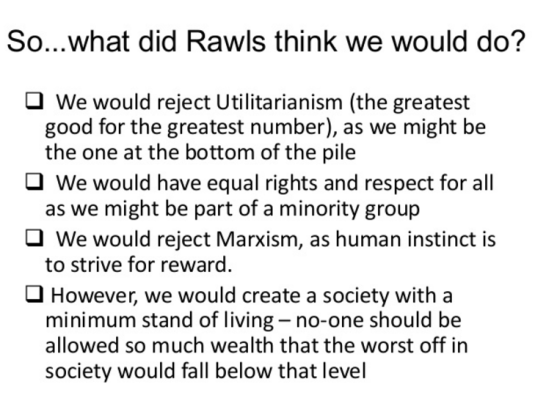
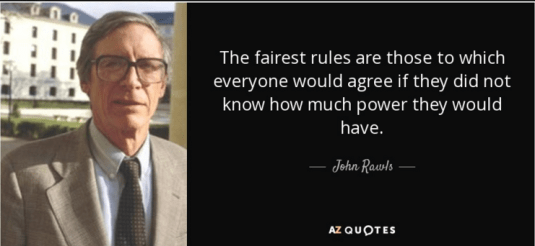
Much of the Wealth of Nations was about the natural progress of opulence under a capitalist system. There is nothing wrong with inequality as John Rawls has explained.

The fact that citizens have different talents can be used to make everyone better off. In a society governed by the difference principle, those better endowed with talents are welcome to use their gifts to make themselves better off, so long as they also contribute to the good of those less well endowed.

With his emphasis on fair distribution of income, Rawls’ initial appeal was to the Left, but left-wing thinkers started to dislike his acceptance of capitalism and tolerance of large discrepancies in income.
Will the poor always be with us? I once had an argument with a colleague at work about whether there was poverty on the Starship Enterprise.
Star Trek was supposed to be a society that had abolished money and a post-scarcity economy because everything was available through a replicator. To quote Captain Picard:
A lot has changed in three hundred years. People are no longer obsessed with the accumulation of ‘things’. We have eliminated hunger, want, the need for possessions.
The economics of the future is somewhat different. You see, money doesn’t exist in the 24th century… The acquisition of wealth is no longer the driving force in our lives. We work to better ourselves and the rest of Humanity.
The Ferengi and their 285 rules of acquisition were a satire on capitalism. The Ferengi was originally meant to replace the Klingons as the Federation’s arch-rival but they were too comical.
Gene Roddenberry’s love story with socialism was a class-ridden society. In Star Trek, higher ranked officers had larger cabins, and most of all they always beamed back from the planet.

An old mate reminded me years ago that anyone who beamed down with Captain Kirk dressed in those red security officer tops were expendables. They were lucky to last 60 seconds in most episodes I watched.
Death and accommodation were class based on Star Trek but it was a supremely opulent society for everyone. That is the point to remember.
Standards are living are much better today than before for everyone despite inequalities that are quite acceptable under the difference principle of John Rawls.
Current definitions of poverty do not take into account the natural progress of opulence. In the 1970s, US Department of Energy started collecting its Household Energy Consumption Survey. This survey is one of the few accurate measures of growing affluence among the poor in America.
Not only does this survey ask about household appliances, it asked about on income. The survey is conducted every 4 years or so since the 1970s. Because of that, it is able to track the diffusion of appliances to households of varying incomes across America.
Yesterday’s luxuries at today’s necessities in poor households with a rapid diffusion of everything from air-conditioners to digital appliances. Many poor households in the USA have more space than middle-class households in Western Europe. Food is also much cheaper in the USA than in Europe.
https://twitter.com/VisualEcon/status/644080191841640448
This growing affluence of poorer Americans is despite higher measured family poverty in America according to the relative poverty measure based on the median income. That makes no sense.
@GarethMorgannz is repeating Bob Hawke’s mistake that child poverty can be solved by more money
06 Jan 2016 Leave a comment
in applied welfare economics, labour economics, labour supply, politics - New Zealand, welfare reform Tags: 1996 US welfare reforms, child poverty, family poverty, universal basic income
Jess Berentson-Shaw’s series on child poverty in the Dominion Post on child poverty had two major flaws. She argues that the solution to child poverty is to give more families more money.
The first flaw is she does not discuss previous failed attempts to solve poverty with more money. For example, Bob Hawke promised in the 1987 election that no child need live in poverty by 1990. Raising the family allowance to $1 above the family poverty line did not fix child poverty. That promise was the one Hawke later said he regretted most in his public life.
During the 1987 Australian Federal election campaign, Labour Party Prime Minister Bob Hawke announced a Family Allowance Supplement that would ensure no Australian child need live in poverty by 1990. These changes in social welfare benefits and family allowance supplements would ensure that every family would be paid one per week dollar more than the poverty threshold applicable to their family situation. I know child poverty was to be done in this way because I worked in the Prime Minister’s Department at this time.
About 580,000 Australian children lived in poverty in 1987. In 2007, at least 13 per cent of children, or 730,000 people, were poor. This was after social welfare benefits and family allowance supplements were increased to $1 above the child poverty threshold.
There is an infallible test of the practicality of Left over Left dreams such as the abolition of child poverty by writing bigger and bigger cheques to those currently poor.
If you could abolish child poverty simply by increasing welfare benefits and family allowances, the centre-right parties would be all over it like flies to the proverbial as a way of camping over the middle ground and winning the votes of socially conscious swinging voters for decades to come. Many people who would naturally vote for the centre-right parties on all other issues vote for centre-left parties out of a concern for poverty and a belief that centre-left parties will give a better deal to the poor.
The notion that poverty is simply the result of a lack of money and giving people more money will abolish child poverty has never worked. As the OECD (2009, p. 171) observed:
It would be naïve to promote increasing the family income for children through the tax-transfer system as a cure-all to problems of child well-being.
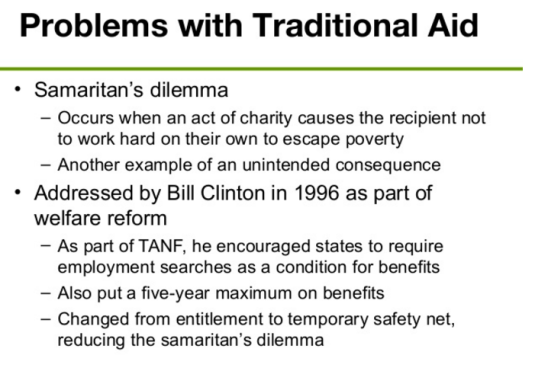
Berentson-Shaw’s second major flaw is she does not discuss the success of the 1996 US federal welfare reforms. Any serious participant in discussions of child poverty must address those 1996 US reforms.
These reforms cut Hispanic and black child poverty rates by 1/3rd in a few years by moving single mothers into employment. Time limits on welfare for single parents reduced caseloads by two thirds, 90% in some states.
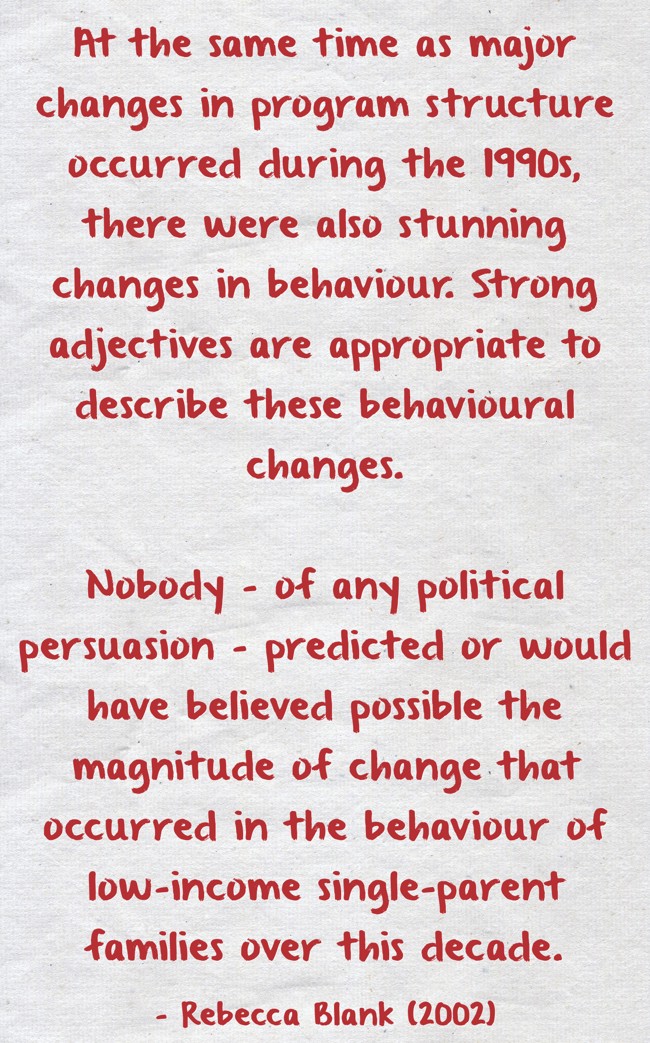
After the 1996 US Federal welfare reforms, the subsequent declines in welfare participation rates and gains in employment were largest among the single mothers previously thought to be most disadvantaged: young (ages 18-29), mothers with children aged under seven, high school drop-outs, and black and Hispanic mothers. These low-skilled single mothers were thought to face the greatest barriers to employment. Blank (2002) found that:
…nobody of any political persuasion predicted or would have believed possible the magnitude of change that occurred in the behaviour of low-income single-parent families.
Employment are never married mothers increased by 50% after the US well for a reforms: employment of single mothers with less than a high school education increased by two-thirds; and employment of single mothers aged 18 to 24 approximately doubled.
Working population poverty is unchanged despite declines in elderly and child poverty #PovertyIs http://t.co/i7O7dTEUg2—
Political Line (@PoliticalLine) June 19, 2015
With the enactment of welfare reform in 1996, black child poverty fell by more than a quarter to 30% in 2001. Over a six-year period after welfare reform, 1.2 million black children were lifted out of poverty. In 2001, despite a recession, the poverty rate for black children was at the lowest point in national history.
Proposal to make child-care tax credit refundable would boost employment of working mothers bit.ly/1i1Xzcq https://t.co/2xlQQtPRJs—
The Hamilton Project (@hamiltonproj) October 29, 2015
The only modern welfare reforms to significantly cut child poverty were the US federal welfare reforms. They emphasised helping those who helped themselves, which is the classic Samaritans’ dilemma.

Countless studies show that when comparing the carrot and the stick in welfare reform, the stick is always more effective in reducing poverty and increasing employment.
The typical white family still makes $25,000 more than the typical black one: washingtonpost.com/news/wonkblog/… http://t.co/CEOADLSJdx—
Demos Action (@DemosAction) September 16, 2015
The best solution to child poverty is to move their parents into a job. Simon Chapple is clear in his book last year with Jonathan Boston:
Sustained full-time employment of sole parents and the fulltime and part-time employment of two parents, even at low wages, are sufficient to pull the majority of children above most poverty lines, given the various existing tax credits and family supports.
The best available analysis, the most credible analysis, the most independent analysis in New Zealand or anywhere else in the world that having a job and marrying the father of your child is the secret to the leaving poverty is recently by the Living Wage movement in New Zealand.
According to the calculations of the Living Wage movement, earning only $19.25 per hour with a second earner working only 20 hours affords their two children, including a teenager, Sky TV, pets, annual international travel, video games and 10-hours childcare.
This analysis of the Living Wage movement shows that finishing school so your job pays something reasonable and marrying the father of your child affords a comfortable family life. In the USA this is called the success sequence.
@TransportBlog should bikes be banned as unsafe?
05 Jan 2016 2 Comments
in applied welfare economics, health and safety, transport economics
Adam Smith on entrepreneurial drive
02 Jan 2016 Leave a comment
in Adam Smith, applied price theory, applied welfare economics, entrepreneurship, history of economic thought, industrial organisation, survivor principle Tags: competition as a discovery procedure, creative destruction, entrepreneurial alertness, market selection, The meaning of competition
Diogenes on what should governments do
26 Dec 2015 Leave a comment
in applied price theory, applied welfare economics, comparative institutional analysis, constitutional political economy, liberalism Tags: ancient Greeks, Diogenes, growth of government, philosophy of economics, size of government, The fatal conceit, The pretence to knowledge
Why John Rawls rejected utilitarianism behind the veil of ignorance
19 Dec 2015 Leave a comment
in applied welfare economics, constitutional political economy, Rawls and Nozick
The Great Fact in Latin America
19 Dec 2015 1 Comment
in applied welfare economics, development economics, economic history, growth disasters, growth miracles Tags: Latin America, The Great Enrichment, The Great Fact
In early 2000s more than 40% of Latin Americans lived on less than $4 a day. What about now? wrld.bg/OK6J6 http://t.co/iEZm030rj6—
World Bank Poverty (@WBG_Poverty) June 25, 2015
Choices that lead to poverty @GarethMorgannz @povertymonitor
15 Dec 2015 2 Comments
in applied welfare economics, labour economics, labour supply, politics - New Zealand, politics - USA, poverty and inequality, welfare reforms
The best evidence that poverty can be a choice is the success of the 1996 US welfare reforms and other carrot and stick approaches to poverty reduction. Poverty in the USA dropped dramatically in the mid-1990s after being stable for decades.
The stick is the most important part of poverty reduction programs that have succeeded. The poverty is not a choice movement deny to themselves the most successful child poverty reduction tool of modern times.
The success of the 1996 US federal welfare reforms were not discussed in an experts report on solutions to child poverty published a few years ago by the Children’s Commissioner. It should have been.
After decades of no progress against child poverty, five-year time limits on federal welfare assistance along with mandatory work requirements encouraged a large number of single mothers to find work. Many of these single mothers who joined the workforce in the USA were high school dropouts with small children.
Proposal to make child-care tax credit refundable would boost employment of working mothers bit.ly/1i1Xzcq https://t.co/2xlQQtPRJs—
The Hamilton Project (@hamiltonproj) October 29, 2015
Child poverty fell dramatically among minorities after the 1996 US federal welfare reforms. Everybody was surprised by the massive increases in the employment of single mothers and the reductions in child poverty. Nobody expected young mothers with small children to have so much control over their destiny.
That ability of single mothers to find a job as a condition of welfare benefits after the 1996 US federal welfare reform contradicts the belief that poverty is not a choice.
Child poverty is concentrated among single mothers and in particular single mothers on a welfare benefit. The subsequent declines in welfare participation rates and gains in employment were largest among the single mothers previously thought to be most disadvantaged: young (ages 18-29), mothers with children aged under seven, high school drop-outs, and black and Hispanic mothers.
When welfare benefits are linked to work requirements, the 1996 US federal welfare reforms showed that a surprisingly large number of single mothers can find and keep a job. Employment are never married mothers increased by 50% after these US reforms; employment of single mothers with less than a high school education increased by two-thirds; employment of single mothers aged of 18 to 24 approximately doubled.
Brian Caplan has been among those to link self-destructive behaviours to many of those in poverty. He argues there are a number of reasonable steps that healthy adults can take to avoid poverty for them and their children:
- Work full-time, even if the best job you can get isn’t fun.
- Spend your money on food and shelter before getting cigarettes and cable TV.
- Use contraception if you can’t afford a child.
Caplan specifically includes among the undeserving poor the children of poor or irresponsible parents.
Caplan along with Charles Murray point out that a number of pathologies are particularly prevalent among poor:
- alcoholism: Alcohol costs money, interferes with your ability to work, and leads to expensive reckless behaviour.
- drug addiction: Like alcohol, but more expensive, and likely to eventually lead to legal troubles you’re too poor to buy your way out of.
- single parenthood: Raising a child takes a lot of effort and a lot of money. One poor person rarely has enough resources to comfortably provide this combination of effort and money.
- unprotected sex: Unprotected sex quickly leads to single parenthood. See above.
- dropping out of high school: High school drop-outs earn much lower wages than graduates. Kids from rich families may be able to afford this sacrifice, but kids from poor families can’t.
- being single: Getting married lets couples avoid a lot of wasteful duplication of household expenses. These savings may not mean much to the rich, but they make a huge difference for the poor.
- non-remunerative crime: Drunk driving and bar fights don’t pay. In fact, they have high expected medical and legal expenses. The rich might be able to afford these costs. The poor can’t.
Caplan is disputing that healthy adults who are poor are victims. That is central to the poverty is not a choice movement: the poor are victims. Many are not, especially the healthy adults.
Policy debates about how to reduce poverty must break out of poverty is not a choice mentality because as Caplan says:
Being poor is a reason to save money, work hard, and control your impulses.
The choices people can make to avoid poverty are finish high school, seek a full-time job, delay children until you marry, and avoid crime. Working against this is as women’s labour market opportunities improved, their interest in low-status men has declined. As Charles Murray explains, working class males have become less industrious:
In 2003-5, men who were not employed spent less time on job search, education, and training, and doing useful things around the house than they had in 1985. They spent less time on civic and religious activities. They didn’t even spend their leisure time on active pastimes such as exercise, sports, hobbies, or reading…
How did they spend that extra leisure time? Sleeping and watching television. The increase in television viewing was especially large – from 27.7 hours per week in 1985 to 36.7 hours in 2003-5…
The demand to date and marry such men has declined because raising children as a solo mission has become more viable for mothers.
Saying poverty is not a choice undermines important messages about help but hassle that must be woven into the heart of the incentive structures of social insurance and the welfare state.
Statistical illusions about U.S. poverty @JulieAnneGenter @povertymonitor
15 Dec 2015 Leave a comment
in applied welfare economics, politics - USA, poverty and inequality
The social, economic and environmental benefit per dollar spent on pursuing different targets for global development 2016-2030
13 Dec 2015 Leave a comment
in applied welfare economics, development economics, energy economics, environmental economics, health economics Tags: MDG
Just how expensive is Keytruda @annetterongotai @JordNZ @VernonSmall @AndrewLittleMP – updated
11 Dec 2015 Leave a comment
in applied welfare economics, health economics, politics - New Zealand
At $30 million per year just to treat stage IV melanoma cancer, Keytruda is number two with a bullet. The second most expensive drug on the Pharmac budget of $800 million would be based on a political decision by an opposition party keen to win office if the Labour Party had its way.

Source: Pharmac Annual Review 2014, p. 11.
Funding Keytruda at $200,000 per treatment for all 2,000 melanoma patients would consume about 60% of the Pharmac budget.
There are plenty more similar wonder drugs coming down the pipe. This really is a floodgates issue, not just a slippery slope to politicisation.


Recent Comments