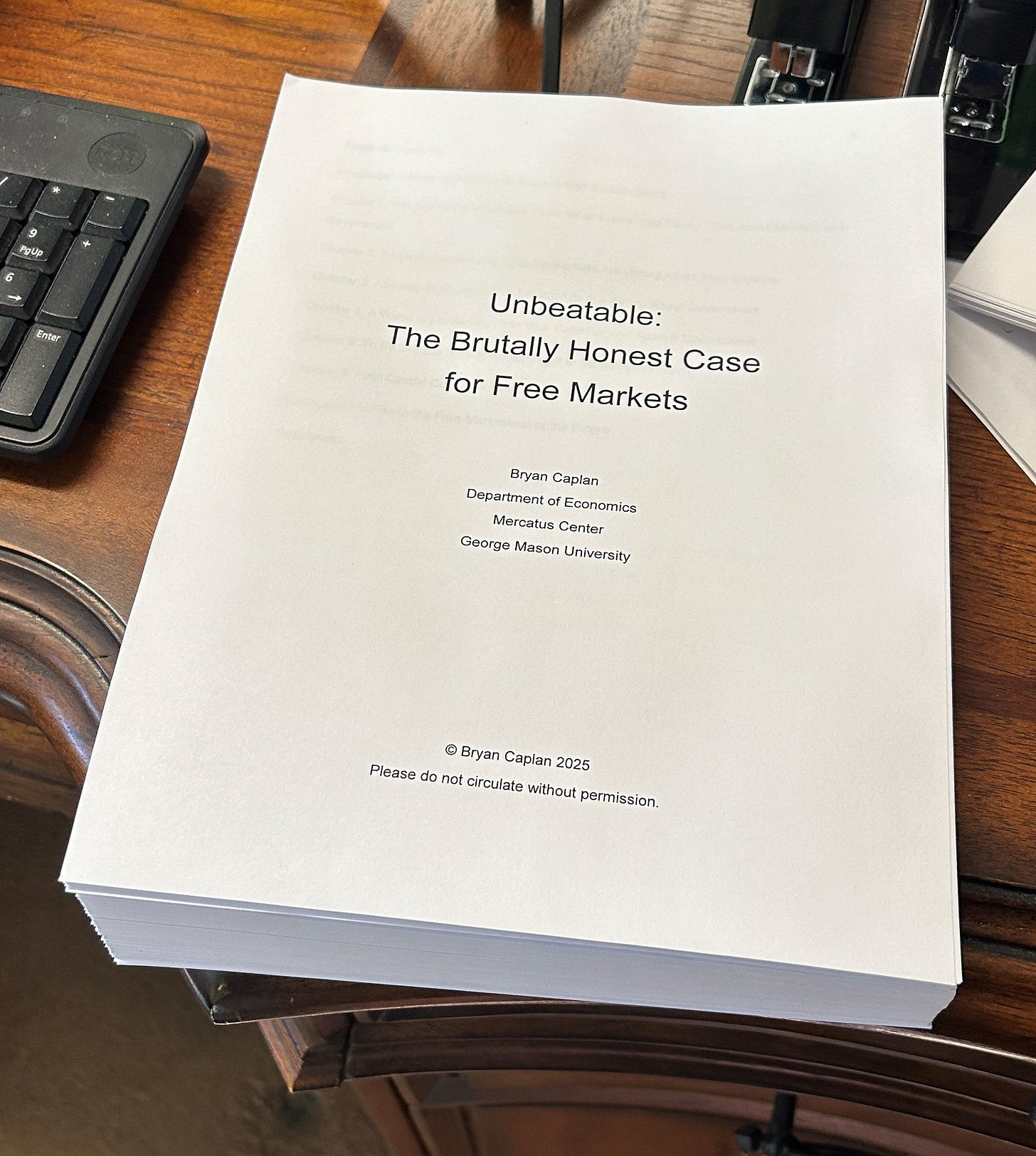
An excerpt from the conclusion of *Unbeatable*
A Friendly Appeal to the Unconvinced
Celebrating humanity's flourishing through the spread of capitalism and the rule of law
14 May 2026 Leave a comment
in applied price theory, comparative institutional analysis, constitutional political economy, development economics, economic history, liberalism Tags: The Great Enrichment
An excerpt from the conclusion of *Unbeatable*
A Friendly Appeal to the Unconvinced
10 May 2026 Leave a comment
in applied price theory, comparative institutional analysis, defence economics, economic history
When I’m in Britain or Ireland, one of my favourite sightseeing trips is to visit medieval castles. Even the ruined ones are fun to visit. Actually, maybe the ruined ones are more fun to visit, because you get to imagine what they would have looked like in their heyday. Britain and Ireland are full of castles,…
The economics of castles
08 May 2026 Leave a comment
in Adam Smith, applied price theory, comparative institutional analysis, economic history, health economics, history of economic thought, liberalism, Marxist economics

In a recent Substack essay, “The progress movement needs a better theory of progress,” Brink Lindsey argues that the progress movement has settled for too thin a vision. It focuses on wealth creation and technological advance, he says, when it should adopt a “fuller conception of progress”—one that promotes “spiritual welfare” and thicker accounts of…
Grow the Pie, Skip the Sermon
30 Apr 2026 Leave a comment
in applied price theory, comparative institutional analysis, constitutional political economy, economics of education, economics of information, history of economic thought, Public Choice
A few months ago, a high school econ student asked me to zoom with his class. I’m working against a tight deadline for Blockade, so I was inclined to decline. But the student’s list of questions was so ambitious that I decided to make the time. See for yourself:Here is the plan:- 5 minutes -WELCOME…
Economics is Counter-Emotional, Not Counter-Intuitive
30 Apr 2026 Leave a comment
in applied price theory, comparative institutional analysis, constitutional political economy, development economics, econometerics, economic history, economics of bureaucracy, growth disasters, growth miracles, history of economic thought, Public Choice
What determines whether and how regulations are reformed? We use a newly constructed data set of 3,590 successful and failed regulatory reforms in 189 countries, between 2005 and 2022, to address this question. We document that regulations have become more business friendly in some regulatory domains but not others. We also show that regulations are…
How Reform Happens
15 Apr 2026 Leave a comment
in applied price theory, comparative institutional analysis, economics of regulation, health economics, liberalism, Marxist economics Tags: nanny state, regressive left
I spoke to my friends at the Sloavkian think tank INESS (the Institute of Economic and Social Studies) recently. We talked about my 2025 paper Anti-Capitalism and Public Health and you can watch the video below.
A discussion about Anti-Capitalism and “Public Health”
27 Mar 2026 1 Comment
in applied price theory, behavioural economics, comparative institutional analysis, constitutional political economy, development economics, growth disasters, growth miracles

One of the most destructive myths in economics is the zero-sum fallacy. Back in 2018, I shared a cartoon that sought to debunk the notion that one person getting richer meant another person had to be poorer. But I wasn’t satisfied with the cartoon, so I offered a modified version. But I still didn’t think […]
Wealth Is Not a Fixed Pie
26 Mar 2026 1 Comment
in applied price theory, comparative institutional analysis, development economics, economic history, economics of regulation, history of economic thought, liberalism, Marxist economics
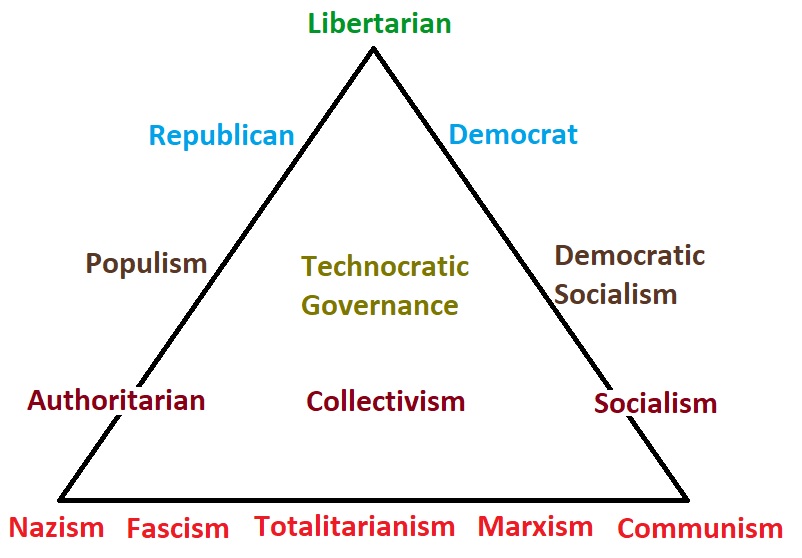
I’ve written a four-part series (here, here, here, and here) explaining why socialism is a bad idea, but let’s use today’s column to define this evil ideology. As I mentioned in the video, genuine socialism is based on three very specific concepts. Government ownership of the means of production Central planning to determine the allocation […]
Defining Socialism
23 Mar 2026 Leave a comment
in comparative institutional analysis, constitutional political economy, politics
In mixed-member proportional (MMP) electoral systems, an “overhang” seat can result if a party wins more seats via the nominal tier (of, typically, single-seat districts) than it would be entitled to if a regular proportional-representation (PR) systems were used.
Strategic overhangs and ways to prevent them in MMP systems
14 Mar 2026 Leave a comment
in applied price theory, comparative institutional analysis, economics of bureaucracy, entrepreneurship, industrial organisation, managerial economics, market efficiency, organisational economics, Public Choice

My First Theorem of Government is the simple observation that insiders are the biggest beneficiaries of government. I was motivated to release that theorem because bad news for taxpayers is good news for bureaucrats, consultants, contractors, lobbyists, and politicians. A classic example is the Department of Education in Washington, which has squandered more than $2.6 […]
Cost Overruns Are Bad for Taxpayers, Good for Insiders
10 Mar 2026 Leave a comment
in Alfred Marshall, comparative institutional analysis, economics of bureaucracy, economics of natural disasters, economics of regulation, health economics, politics - New Zealand, Public Choice Tags: economics of pandemics
The Royal Commission has released their second and final report. Some key aspects: Simeon Brown points out: The post Covid-19 Royal Commission report released first appeared on Kiwiblog.
Covid-19 Royal Commission report released
09 Mar 2026 Leave a comment
in Adam Smith, applied price theory, comparative institutional analysis, development economics, economic history
TweetIn today’s National Post I celebrate the 250th anniversary – which is this coming Monday, March 9th – of the publication of Adam Smith’s An Inquiry Into the Nature and Causes of the Wealth of Nations. A slice: Smith then inquired into wealth’s causes. He didn’t inquire into the causes of poverty. Smith understood that…
The Wealth of Nations: Happy 250th Birthday!
06 Mar 2026 Leave a comment
in Austrian economics, comparative institutional analysis, economic history, economics of regulation, entrepreneurship, history of economic thought, industrial organisation, law and economics, organisational economics, politics - Australia, technological progress, theory of the firm Tags: competition law, creative destruction
Ask anyone in Australia’s competition law community what transformed the economy, and you will hear a familiar story. Australia was once a cartelised, complacent place where businesses divided up markets and consumers paid the price. Then came the Trade Practices Act in 1974, and competition law forced firms to compete. This is not a fringe […]
Dismantling the competition myth
04 Mar 2026 Leave a comment
in applied price theory, applied welfare economics, comparative institutional analysis, history of economic thought, law and economics, Public Choice

Law & economics traces its intellectual roots to the University of Chicago. That lineage still shapes how the field is understood. Chicago price theory—especially Gary Becker’s (1976) systematic application of maximization, equilibrium, and stable preferences across social life, and George Stigler’s (1992, p. 459) suggestion that “every durable social institution or practice is efficient, or…
The Evaluative Emptiness of the Economic Approach to Law
02 Mar 2026 Leave a comment
in applied price theory, Austrian economics, comparative institutional analysis, economics of bureaucracy, industrial organisation, law and economics, liberalism, Murray Rothbard, privatisation, Public Choice
Update: I’m doing a Substack Live today on You Have No Right to Your Culture with the Boyd Institute’s Peter Banks. 4 PM ET.SummaryThis is the shortest chapter of the book, just six pages long. Rothbard makes a laundry list of what he calls “the major problem areas of our society” and argues that government…
Bet On It Book Club: For a New Liberty, Chapter 4
Celebrating humanity's flourishing through the spread of capitalism and the rule of law
Celebrating humanity's flourishing through the spread of capitalism and the rule of law
Celebrating humanity's flourishing through the spread of capitalism and the rule of law
Celebrating humanity's flourishing through the spread of capitalism and the rule of law
Celebrating humanity's flourishing through the spread of capitalism and the rule of law
Celebrating humanity's flourishing through the spread of capitalism and the rule of law
Celebrating humanity's flourishing through the spread of capitalism and the rule of law
A History of the Alt-Right
Econ Prof at George Mason University, Economic Historian, Québécois
Celebrating humanity's flourishing through the spread of capitalism and the rule of law
Scholarly commentary on law, economics, and more
Beatrice Cherrier's blog
Celebrating humanity's flourishing through the spread of capitalism and the rule of law
Celebrating humanity's flourishing through the spread of capitalism and the rule of law
Celebrating humanity's flourishing through the spread of capitalism and the rule of law
Why Evolution is True is a blog written by Jerry Coyne, centered on evolution and biology but also dealing with diverse topics like politics, culture, and cats.
Celebrating humanity's flourishing through the spread of capitalism and the rule of law
A rural perspective with a blue tint by Ele Ludemann
DPF's Kiwiblog - Fomenting Happy Mischief since 2003
Celebrating humanity's flourishing through the spread of capitalism and the rule of law
The world's most viewed site on global warming and climate change
Tim Harding's writings on rationality, informal logic and skepticism
A window into Doc Freiberger's library
Let's examine hard decisions!
Commentary on monetary policy in the spirit of R. G. Hawtrey
Thoughts on public policy and the media
Celebrating humanity's flourishing through the spread of capitalism and the rule of law
Politics and the economy
A blog (primarily) on Canadian and Commonwealth political history and institutions
Reading between the lines, and underneath the hype.
Economics, and such stuff as dreams are made on
"The British constitution has always been puzzling, and always will be." --Queen Elizabeth II
Celebrating humanity's flourishing through the spread of capitalism and the rule of law
Celebrating humanity's flourishing through the spread of capitalism and the rule of law
WORLD WAR II, MUSIC, HISTORY, HOLOCAUST
Undisciplined scholar, recovering academic
Celebrating humanity's flourishing through the spread of capitalism and the rule of law
Res ipsa loquitur - The thing itself speaks
In Hume’s spirit, I will attempt to serve as an ambassador from my world of economics, and help in “finding topics of conversation fit for the entertainment of rational creatures.”
Researching the House of Commons, 1832-1868
Articles and research from the History of Parliament Trust
Reflections on books and art
Posts on the History of Law, Crime, and Justice
Celebrating humanity's flourishing through the spread of capitalism and the rule of law
Exploring the Monarchs of Europe
Cutting edge science you can dice with


Recent Comments