It’s hard to get too much enthusiasm for the Tamaki Makaurau by-election. The Maori roll and seats have become more politicised than ever before, as they are no longer an exercise in ensuring a core level of Maori representation in Parliament, but rather an expression of Maori nationalism. It used to be that the Maori…
The by-election without much choice
The by-election without much choice
03 Sep 2025 1 Comment
in comparative institutional analysis, constitutional political economy, discrimination, economics of bureaucracy, income redistribution, labour economics, law and economics, liberalism, Marxist economics, politics - New Zealand, property rights, Public Choice, rentseeking
Inside India’s endless trials
03 Sep 2025 1 Comment
in comparative institutional analysis, development economics, economic history, economics of crime, growth disasters, growth miracles, law and economics, property rights Tags: India
The FT’s Krishn Kaushik covers the courts in India: …in one recent example a Delhi court concluded a property dispute after 66 years. Both the original litigants were dead. Still, the lawyer for one of the warring parties cautioned that the conclusion was in fact not the end, as the ruling would be appealed. Three […]
Inside India’s endless trials
Kiwis don’t need a Constitutional Court to crimp our elected law-makers – we already have judges who do that
02 Sep 2025 Leave a comment
in comparative institutional analysis, constitutional political economy, law and economics, politics - New Zealand, property rights Tags: constitutional law, Thailand
Bob Edlin writes – Thailand’s Constitutional Court reminds us of how judges can be politically powerful. It has removed Prime Minister Paetongtarn Shinawatra from office, ruling that she “lacks the qualifications and possesses prohibited characteristics” under the Thai constitution. As the ABC reported, her dismissal flings the country into political instability. It also highlights the […]
Kiwis don’t need a Constitutional Court to crimp our elected law-makers – we already have judges who do that
FERC Must Seize the Supreme Court’s Energy Opportunity
15 Aug 2025 1 Comment
in applied price theory, comparative institutional analysis, economics of bureaucracy, economics of regulation, energy economics, environmental economics, environmentalism, law and economics, politics - USA, property rights, Public Choice, rentseeking Tags: nuisance suits
The Court has provided the legal framework. FERC must provide the will to use it.
FERC Must Seize the Supreme Court’s Energy Opportunity
Mamdani’s unworkable proposal for NYC-owned grocery stores
31 Jul 2025 1 Comment
in applied price theory, comparative institutional analysis, constitutional political economy, economics of regulation, income redistribution, law and economics, Marxist economics, politics - USA, property rights, Public Choice, rentseeking, transport economics, urban economics Tags: economics of socialism, regressive left, rent control, useful idiots

Democrat Zohran Mamdani is likely to be the next mayor of NYC, as he proffered a number of campaign promises that delighted progressives young and old. (This is besides his pro-Palestinian stand on the Gaza war, which is irrelevant to his actions as NYC mayor but still delighted the benighted.) Here are a few of […]
Mamdani’s unworkable proposal for NYC-owned grocery stores
Revolution by Judicial Decree: A Review of Professor Peter Watts KC’s “Ellis v R, A Revolution in Aotearoa New Zealand, Welcome or Not”
24 Jul 2025 Leave a comment
in comparative institutional analysis, constitutional political economy, economic history, economics of bureaucracy, law and economics, politics - New Zealand, property rights, Public Choice Tags: constitutional law
Roger Partridge writes – Revolutions conjure images of violent uprisings, the storming of institutions, and the forcible overthrow of existing orders. But constitutional foundations can be destroyed through more subtle means. When judges discard long-established constitutional principles and remake the law according to their preferences, they engage in a revolution that may be no less […]
Revolution by Judicial Decree: A Review of Professor Peter Watts KC’s “Ellis v R, A Revolution in Aotearoa New Zealand, Welcome or Not”
The Milei Miracle, Part II
23 Jul 2025 Leave a comment
in applied price theory, budget deficits, comparative institutional analysis, constitutional political economy, development economics, economic growth, fiscal policy, growth disasters, growth miracles, law and economics, liberalism, libertarianism, macroeconomics, property rights Tags: Argentina

I almost feel sorry for the 108 leftist economists who predicted back in 2023 that Argentina would suffer if Javier Milei won the presidential election. Not only were they disappointed when he enjoyed a landslide victory, but the subsequent events in Argentina have shown that they were wildly wrong (all of which is discussed in […]
The Milei Miracle, Part II
Stop the corporate welfare
22 Jul 2025 Leave a comment
in applied price theory, comparative institutional analysis, economics of bureaucracy, income redistribution, industrial organisation, politics - New Zealand, Public Choice, rentseeking
The Herald reports: More than half of the $257 million loan book held by the Government entity formerly known as the Provincial Growth Fund is considered to be at risk of impairment or default. The surge in at-risk loan advances made by Crown Regional Holdings (CRH) – a vehicle used by the Government to warehouse […]
Stop the corporate welfare
The Cross of Gold: Brazilian Treasure and the Decline of Portugal (due to the resource curse)
18 Jul 2025 Leave a comment
in applied price theory, comparative institutional analysis, constitutional political economy, development economics, economic growth, economic history, growth disasters, international economics, law and economics, macroeconomics, property rights, Public Choice, rentseeking, resource economics Tags: Portugal, resources curse
By Davis Kedrosky and Nuno Palma. Published in The Journal of Economic History.In the book The Economics of Macro Issues which I used as a supplemental text, they mention that Russia has many resources but its per capita income is less than that of Luxembourg which has few resources. The book suggests that the economic…
The Cross of Gold: Brazilian Treasure and the Decline of Portugal (due to the resource curse)
Echoes of Citizens for Rowling
07 Jul 2025 Leave a comment
in comparative institutional analysis, constitutional political economy, economics of regulation, law and economics, politics - New Zealand, property rights, Public Choice, transport economics, urban economics Tags: constitutional law
Karl du Fresne writes – Who remembers the Citizens for Rowling campaign? It was a concerted attempt by the Great and the Good to derail National Party leader Robert Muldoon’s election campaign in 1975. The campaign’s backers didn’t like Muldoon’s combative, divisive brand of politics and argued that Labour’s gentlemanly Bill Rowling, who had assumed […]
Echoes of Citizens for Rowling
“The End Goal of Seizing the Means of Production”: Yup, Mamdani is a Hardcore Marxist
03 Jul 2025 Leave a comment
in applied price theory, comparative institutional analysis, constitutional political economy, economics of bureaucracy, economics of education, economics of regulation, liberalism, Marxist economics, politics - USA, Public Choice

Below is my column on Fox.com on the debate that Democratic New York mayoral candidate Zohran Mamdani is a socialist, a Democratic Socialist, or a communist. What is clear is that Mamdani is a Marxist and that is a serious problem for New York. Here is the column:
“The End Goal of Seizing the Means of Production”: Yup, Mamdani is a Hardcore Marxist
Bad Economic History Fuels Bad Present-Day Economic Policies
28 Jun 2025 1 Comment
in applied price theory, Austrian economics, comparative institutional analysis, development economics, economic history, history of economic thought, income redistribution, industrial organisation, international economics, liberalism, politics - USA, Public Choice
TweetAt CapX, I explain what motivated Phil Gramm and me to write our book, The Triumph of Economic Freedom: Debunking the Seven Great Myths of American Capitalism. A slice: Likewise with America’s own industrial revolution, the ‘Gilded Age’. American schoolchildren are taught that the final third of the 19th century witnessed John D. Rockefeller and…
Bad Economic History Fuels Bad Present-Day Economic Policies
An American Enterprise Institute Discussion of “The Triumph of Economic Freedom”
05 Jun 2025 Leave a comment
in applied price theory, comparative institutional analysis, constitutional political economy, development economics, economic growth, economic history, growth disasters, growth miracles, history of economic thought, macroeconomics Tags: anticapitalist mentality, capitalism and freedom
Tweet The post An American Enterprise Institute Discussion of “The Triumph of Economic Freedom” appeared first on Cafe Hayek.
An American Enterprise Institute Discussion of “The Triumph of Economic Freedom”
Why the U.S. Produces More Unicorns Than China and the EU
01 Jun 2025 1 Comment
in applied price theory, comparative institutional analysis, development economics, economic history, economics of regulation, entrepreneurship, human capital, industrial organisation, labour economics, occupational choice, poverty and inequality, survivor principle Tags: creative destruction
The United States has produced about twice as many unicorns (private startups valued at $1B+) as China and more than four times as many as the European Union. These numbers reflect deep institutional and cultural advantages in the U.S. startup ecosystem. Table: Number of Unicorns Created Since ~1990 Region Cumulative Unicorns United States ~1,950 China…
Why the U.S. Produces More Unicorns Than China and the EU
Irrationality As the Fountainhead of Market Failure
28 May 2025 Leave a comment
in applied price theory, applied welfare economics, comparative institutional analysis, economics of information, history of economic thought
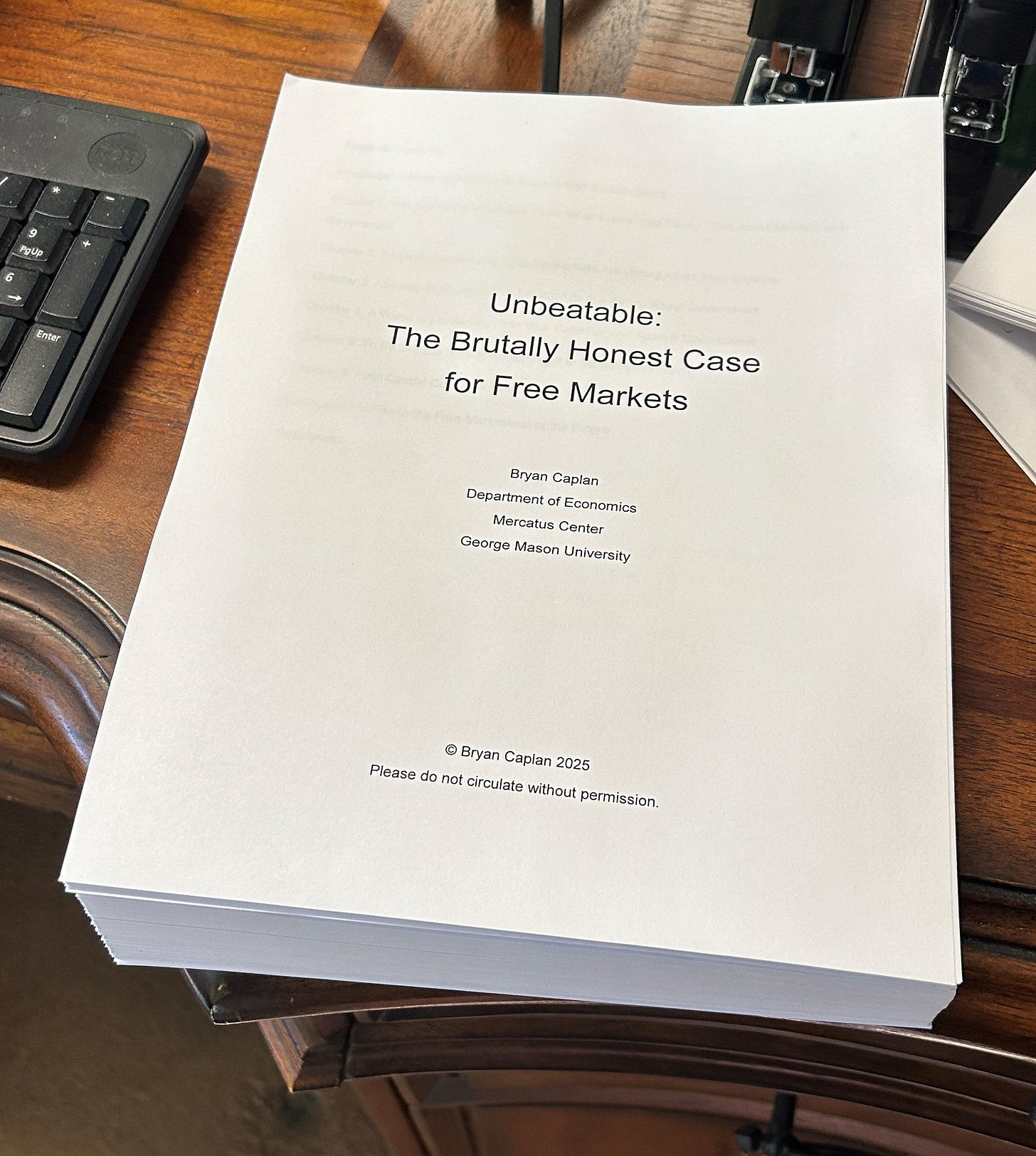
An excerpt from Chapter 4 of *Unbeatable*
Irrationality As the Fountainhead of Market Failure
 Utopia, you are standing in it!
Recent Comments