
Deirdre McCloskey on Equality and Greed and How To Be a Very Good Economist
02 Dec 2016 Leave a comment
in applied price theory, comparative institutional analysis, constitutional political economy, development economics, economic history, Marxist economics Tags: Deirdre McCloskey, The Great Enrichment, The Great Fact
Eugene Fama’s advice for the next president
01 Dec 2016 Leave a comment
in applied price theory, constitutional political economy, economics of regulation, entrepreneurship, financial economics Tags: 2016 presidential election, Eugene Fama
How Don Lavoie Changed the Debate about Socialism and Central Planning
30 Nov 2016 Leave a comment
in applied price theory, comparative institutional analysis, constitutional political economy, development economics, economic history, entrepreneurship, history of economic thought, Marxist economics, Public Choice
Adam Smith: How His Great Idea Made Us Rich – Deirdre McCloskey
26 Nov 2016 Leave a comment
in applied price theory, comparative institutional analysis, constitutional political economy, growth miracles, history of economic thought Tags: Deirdre McCloskey, The Great Enrichment, The Great Fact
Justice Antonin Scalia | The Cambridge Union
26 Nov 2016 Leave a comment
in constitutional political economy, law and economics
Why so many private members’ bills in the NZ Parliament?
13 Nov 2016 Leave a comment
in constitutional political economy, Public Choice
New Zealand has a private members’ day every week in Parliament. I cannot remember when in the last century the Australian Parliament last passed a private members bill, much less gave any time to hear private members’ bills.
Only 15 private members’ bills or private senators’ bills introduced into the Australian Parliament since 1901 have been passed into law. Several private members’ bills are passed every year in New Zealand.

Source: Proposed members’ bills – New Zealand Parliament.
One of the reasons that New Zealand has so many private members’ bills and allocate so much time for them is it is not a federal state. There are about 80 in the private members’ bills ballot; two are drawn per week.
Hot button social issues which are usually solved by letting one state take the initiative within a federation must instead in NZ must be dealt within one Parliament. The vent for this tension is a greater role for private members’ bills.
Federalism, for example, gave Congress the opportunity to deflect Marijuana decriminalisation to the states by defunding federal drug law enforcement in 2014 in states that have legalised marijuana. This allowed Congress to have it both ways by neither decriminalise marijuana at the federal level nor frustrate the movement in the states to decriminalise marijuana.
I believe there is litigation before the federal courts as to whether that defunding extends to existing marijuana prosecutions.
I am sure that will delight the legal pedants. They can work out how a US attorney can even stand up in court and discuss the prosecution when Congress has defunded marijuana drug law enforcement in that state. Presumably they pay their own taxi fare to court?
What If the Electoral College is Tied?
08 Nov 2016 Leave a comment
in constitutional political economy
Gareth Morgan has fallen for the oldest populist delusion
05 Nov 2016 Leave a comment
in constitutional political economy, politics - New Zealand, Public Choice Tags: 2017 New Zealand election, Gareth Morgan
In founding his own political party, Gareth Morgan has fallen to the populist delusion that all that is needed is for a great leader to get in who is one of us rather than one of them and she will be alright.
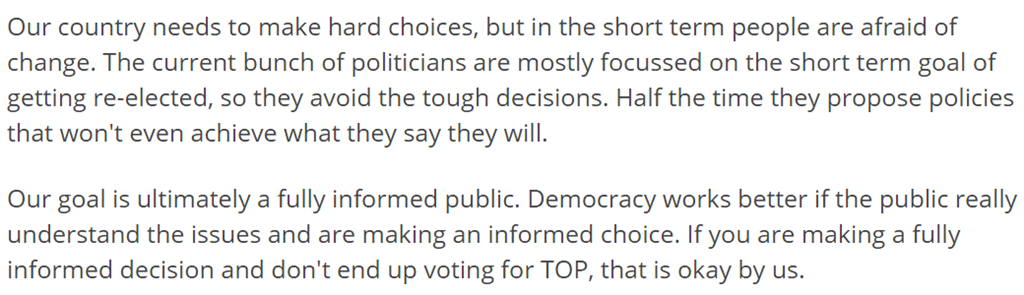
Source: About – The Opportunities Party.
In common with all populists, Morgan believes there is one will of the people frustrated by a conniving elite rather than many clashing visions of the good life that politicians must balance. Judis explains
Leftwing populists champion the people against an elite or an establishment. Theirs is a vertical politics of the bottom and middle, arrayed against the top.
Rightwing populists champion the people against an elite that they accuse of favouring a third group, which can consist, for instance, of immigrants, Islamists, or African American militants. Rightwing populism is triadic: it looks upward, but also down upon an out group.
Leftwing populism is historically different to socialist or social democratic movements. It is not a politics of class conflict, and it does not necessarily seek the abolition of capitalism. It is also different to a progressive or liberal politics that seeks to reconcile the interests of opposing classes and groups. It assumes a basic antagonism between the people and an elite at the heart of its politics.
John Rawls talked about the need for reasonable pluralism because so many people have different ideas of the way to go forward. Political institutions must be designed with that diversity in mind as David Gordon explained in a book review
The situation that drives Rawls to his theory is that of people in a large society like the United States who are divided by conflicting conceptions of the good. Some of these conceptions may be better than others, and one may in fact be the correct one: Rawls does not commit himself on this question. But none of these conceptions can be shown to be true in the strong sense that it would be unreasonable for anyone to reject it. This state of affairs Rawls terms “the fact of reasonable pluralism.”
Given reasonable pluralism, it would be wrong for the holders of one conception to impose their views on others; respect for others requires that we defend our political views with reasons others could acknowledge.
Our aim, Rawls holds, should not be a mere modus vivendi with those who profess other conceptions of the good. Rather, we should seek a stable society in which people decide disputed questions by democratic discussion.
The idea is to have a political system with sufficient checks and balances that whoever is in power does not do too much harm nor gets seriously out of alignment with the wishes of the electorate. That was the idea behind MMP: divide power between more parties and make all elections close.
It goes back to James Madison’s idea that governments are not populated by angels and so the powers of government and how they are distributed should take account of that. The idea is politicians behave in line with public interest because of the institutions that constrain and shape their choices.
It is wise to design constitutional safeguards to minimise the damage done when those crazies to the right or left of you get their chance in office, as they will sooner or later rather than focus on the powers you and those that currently agree with you should have in your few days in which you fleetingly have a majority.
Too many policies and ideas of the one political party or another assume that they are the face of the future, rather than just another political party that will hold power as often as not and always for an uncertain time. Too many policies and ideas of the Left assume that they are the face of the future, rather than just another political party that will hold power as often as not.
Who is the real stupid party? #Corbyn @jeremycorbyn #toriesforcorbyn
03 Nov 2016 Leave a comment
in applied price theory, constitutional political economy, development economics, economics of bureaucracy, growth disasters, Marxist economics, Public Choice Tags: British politics, economics of socialism, Leftover Left, Old Left, The Great Escape, Venezuela

Lawrence of Arabia on the economics of Albanian blood feuds
26 Oct 2016 Leave a comment
in constitutional political economy, David Friedman, economics of crime, law and economics Tags: economics of feuds
About 3000 Albanian families are caught up in blood feuds; the adult males hunt each other down; the reasons are long forgotten.
These blood feuds are common in rural Albania, which is rather lawless. Efforts to resolve them are largely futile because each family wants to be the last to get revenge.
Observers, of course, look upon these feuds with horror. For those involved, they are the down side of a Doomsday machine that keeps order in rural lawless areas.
Proper film buffs will remember the great scene in Lawrence of Arabia where Anthony Quinn and his son rode into the camp of a rival tribe on their own to demand payment for the water they were using.
Lawrence asked why did they go in because they could be so easily killed. Anthony Quinn said he was in no danger because if he was killed there would be a blood feud between his clan and the offending clan. This kept order. The linked clip is just fascinating rather than the actual clip.
Of course, film buffs also remember that a blood feud almost destroyed the entire Arab revolt. Lawrence resolved it by executing the murder so that he neither died at the hand of the rival clan but the rival clan felt vengeance had been satisfied.
David Friedman wrote on how feuds are common in many legal systems in their early days:
Feud is one of the mechanisms by which legal rules are enforced. Its essential logic is simple: If you wrong me, I threaten to harm you unless you compensate me for the wrong. The critical requirement for it to work is some mechanism that makes my threat more believable when you actually have wronged me than when you have not, some way of converting right into might, in order to prevent the enforcement mechanism from being used instead for extortion.
For a simple example, consider the feud system of the Rominchal gypsies, the largest gypsy population in England. If you wrong me, I threaten to beat you up. Both of us know that if you have wronged me, as judged by the norms of our community, my friends will back me and your friends won’t back you, making it in your interest to either compensate me or leave town.
Feud system have existed in many human societies. In addition to the Rominchal, well recorded examples include saga period Iceland and traditional Somali. In the Icelandic case, the mechanism for converting right into might was an explicit law code and a court system. You sued the person who wronged you. If you won, the verdict was a damage payment he owed you. If he failed to pay, he was outlawed and had two weeks to leave Iceland, after which it was legal to kill him and tortious for anyone to defend him. That system functioned for about a third of a millennium, producing substantial amounts of violence only in the final fifty year period of breakdown.
The Somali version was somewhere between the Icelandic and the Rominchal, with customary law and customary mechanisms for setting up courts to arbitrate disputes, along with a fascinating system of prefabricated coalitions to deal with both paying damages and enforcing their members’ claims.
Feuds work well as a deterrent mechanism, but if someone triggers a feud, there is a lot of mayhem. That is why third-party arbitration comes into play to prevent abuse and escalation.
I am not too sure how feuds work well if someone is murdered without a witness or is poisoned or in some other way surreptitiously done away with.
How the World Grew Rich
22 Oct 2016 Leave a comment
in comparative institutional analysis, constitutional political economy, development economics, economic history, growth disasters, growth miracles, industrial organisation, law and economics Tags: Deirdre McCloskey, The Great Enrichment, The Great Fact


Recent Comments