#TPPA CTU @FairnessNZ appeals to secretive @ILO committee to challenge NZ sovereignty over employment law
09 Mar 2016 Leave a comment
in constitutional political economy, international economic law, International law, law and economics, unions Tags: Left-wing hypocrisy, union power
The unions are very much against investor state dispute settlement provisions of trade agreements, but are happy to be serial complainants to secretive International Labour Organisation (ILO) committees about employment law amendments they do not like. A fair defeat in the floor of parliament was not good enough for them.
As far back as 1993 the Council of Trade Unions has complained to secretive ILO committees about labour market deregulation in New Zealand. These secretive committees are formed under ILO conventions in New Zealand signed decades go.

The competence of these ILO committees are clearly in question if they hear an appeal under a convention New Zealand has not ratified. Imagine the outrage if an investor state dispute settlement panel heard on appeal despite New Zealand having a carve-out for the topic concerned. An example would be tobacco regulation.
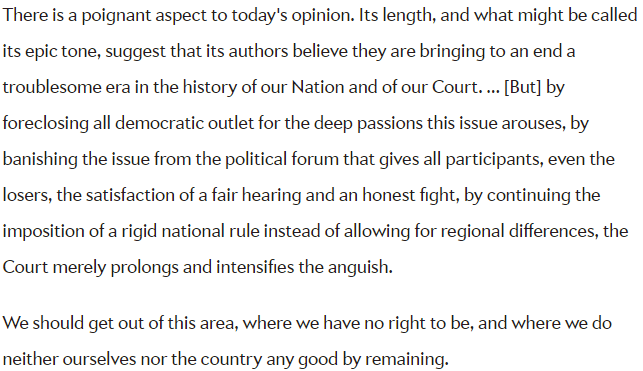
Justice Scalia has a fine critique of those who believe in activist judges and living constitutions that applies just as well as to activist international adjudicators and living international treaties:
You think there ought to be a right to abortion? No problem. The Constitution says nothing about it. Create it the way most rights are created in a democratic society. Pass a law. And that law, unlike a Constitutional right to abortion created by a court can compromise. It can…I was going to say it can split the baby! …A Constitution is not meant to facilitate change. It is meant to impede change, to make it difficult to change.
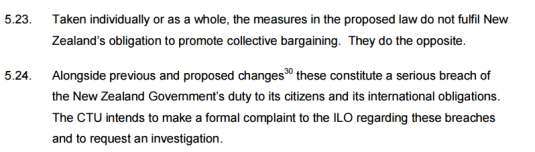
Rather than use normal democratic means – trying to persuade each other and elections – the union movement threatened to go to a secretive ILO committee made up of members of uncertain competence and impartiality over the recent laws on collective bargaining.

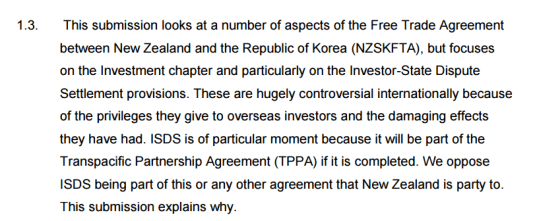
The union movement was outraged at the fact that New Zealand laws it likes could be questioned at international forums. It said this in a recent submission to the Health Select Committee of Parliament.

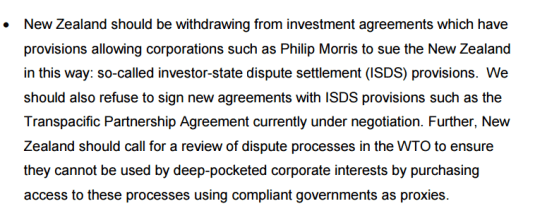
The unions were equally outraged about dispute settlement procedures in the recent free trade agreement with Korea. The unions were absolutely affronted at the idea that the sovereignty of the New Zealand Parliament could be challenged at a foreign forum.

Source: Submission of the New Zealand Council of Trade Unions Te Kauae Kaimahi to the Foreign Affairs, Defence and Trade Select Committee on the Free Trade Agreement between New Zealand and the Republic of Korea, Wellington 24 April 2015.
These protestations of the union movement would have much more credibility if union did not run off to a UN or ILO committee every time they were on the losing side of a vote in parliament. The unions are happy with those parts of international economic law that serve its interests but behave hypocritical about the other parts that do not. As United States Supreme Court Justice Antonin Scalia said
The virtue of a democratic system [with a constitutionally guaranteed right to free speech] is that it readily enables the people, over time, to be persuaded that what they took for granted is not so and to change their laws accordingly.
Nothing stirs up the impassioned (and most other people as well) more than depriving them of their right to support or oppose what is important to them through political campaigns and at an election.
The losing side, and we all end up on the losing side at one time or another, are much more likely to accept an outcome if they had their say and simply lost the vote at the election or in Parliament. Power to the people as long as I am on the winning side instead is the motto of the union movement.
The unions losing on labour market deregulation is no different from any other political difference within New Zealand. Both sides passionately but respectfully attempt to persuade their fellow citizens to accept their views.
Win or lose, advocates for today’s losing causes can continued pressing their cases, secure in the knowledge that an electoral loss today can be negated by a later electoral win, which is democracy in action as Justice Kennedy explained recently in the US context:
…a democracy has the capacity—and the duty—to learn from its past mistakes; to discover and confront persisting biases; and by respectful, rationale deliberation to rise above those flaws and injustices…
It is demeaning to the democratic process to presume that the voters are not capable of deciding an issue of this sensitivity on decent and rational grounds.
The process of public discourse and political debate should not be foreclosed even if there is a risk that during a public campaign there will be those, on both sides, who seek to use racial division and discord to their own political advantage.
An informed public can, and must, rise above this. The idea of democracy is that it can, and must, mature. Freedom embraces the right, indeed the duty, to engage in a rational, civic discourse in order to determine how best to form a consensus to shape the destiny of the Nation and its people. These First Amendment dynamics would be disserved if this Court were to say that the question here at issue is beyond the capacity of the voters to debate and then to determine.
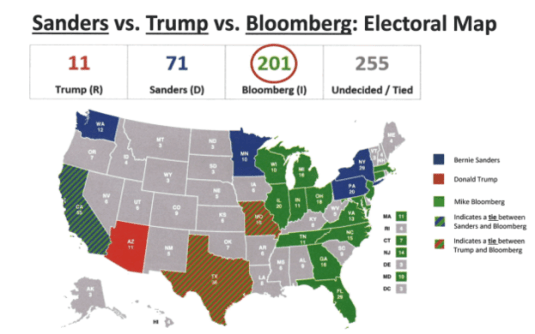
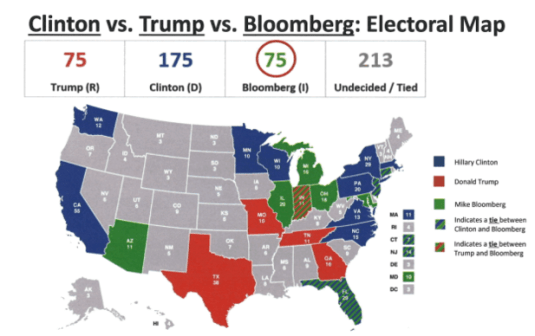
How Michael Bloomberg thought he would go against Sanders, Trump and Clinton
08 Mar 2016 Leave a comment
in constitutional political economy, politics - USA
Directors’ Law vindicated again – the American middle class think there are undervalued
06 Mar 2016 Leave a comment
Why did communism fall in the USSR?
05 Mar 2016 Leave a comment
in constitutional political economy, economic history, economics of bureaucracy, Public Choice, rentseeking
I find many explanations of the fall of the USSR disappointing because many want to believe in people power and popular rebellions.
The rise and fall of mercantilism view of the USSR put forward by Pete Boettke will be the foundation of better explanations. By analysing communism as a rent-seeking society, the process of social and political evolution can be embedded into the history of the rise and fall of mercantilism.
More freedom in Russia and China came as an unintended by-product of a constitutional struggle over who would control the rules under which the economy prospered (or failed to prosper) and the sharing within the elite.
After the death of Stalin, the Soviet Nomenklatura used both co-option and political repression to encourage loyalty to the communist regime. As Grossman noted:
Under Stalin’s leadership the nomenklatura, after initially emphasizing a strategy of co-option, then experimented with political repression as a substitute for co-option, and finally, in response to the threats posed by German militarism and the onset of the Cold War, employed a combination of intense political repression and co-option. As a result, membership in the CPSU increased rapidly, then decreased sharply, before increasing rapidly again. After Stalin was gone the nomenklatura, having learned the cost of Stalin’s repressive excesses, adopted a policy that combined more co-option with less intense political repression. As a result, membership in the CPSU increased steadily, then levelled off, until the rapprochement between the United States and China, the emergence of Islamic fundamentalism, and the escalation of the cold war arms race resulted in yet more co-option and in the final episode of growth in party membership.
More and more of the general public in Russia and China were co-opted into the winning circle through peacefully adaptations when threats of revolution were minimal.
The cost of co-opting people into the Communist Party was a decrease in the standard of living of members of the Nomenklatura, whereas the cost of political repression was the danger that members of the Nomenklatura would themselves be victimized.
These successive minor reforms were mutual beneficial constitutional exchanges as suggested by Roger Congleton’s brilliant recent book on his king-and-council template and in Herschel Grossman’s earlier paper on co-option in the communist party from 1953 to 1989.
The USSR broke apart as the result of an internal power struggle within a new generation of leaders who grew up in a climate of corruption and high living.
Perestroika and glasnost should be viewed as nothing much more than the usual system reforms and rotations of patronage that were launched after the appointment of all previous Soviet leaders. As Anderson and Boettke explain
…upon closer examination, the succession of Gorbachev in general and the perestroika/glasnost “reform” program in particular bear a close resemblance to other, earlier Soviet government policy adjustments which followed shifts in the top leadership. Gorbachev’s behaviour as a “reformer” over the period 1985 to 1989 can be explained by reference to the incentives facing the dictator of a socialist state based on the distribution of economic privilege and political patronage… Gorbachev’s period of “reform” was not an extraordinary example of the role of ideology or vision in human affairs, but a more routine episode of rent-seeking in action.
Political and economic power was devolved to the 15 republics in the old USSR because this is the only way to operate a mercantilist state.
These local leaders formed their own alliances and declared succession from the USSR when the centre was too weak to fight. Local military units defected with them to a new rent-seeking coalition.
The fall of soviet communism led to a drawn out struggle for access to patronage and state monopolies and a new and better paid manifestation of the old mercantilism but ex-KGB owned and run under Putin.
How the Curly effect explains @realdonaldtrump @berniesanders
04 Mar 2016 Leave a comment
in constitutional political economy, politics - USA, Public Choice
Why are conspiracy theorists so trusting of citizen initiated binding referendums?
04 Mar 2016 Leave a comment
in comparative institutional analysis, constitutional political economy, politics - New Zealand, Public Choice
After reflecting far more than I should on some conspiracy laden testimony at Parliament yesterday, one of the things I recall was a demand that the approval of the TPPA be put to binding referendum. The conspiracy theorist at hand was deeply concerned about how that treaty was encroaching on New Zealand’s sovereignty.
Why did this conspiracy theorist assume that a binding referendum will go his way and that opposing conspiracy theorists will not put up their own binding referendums in which he will lose?
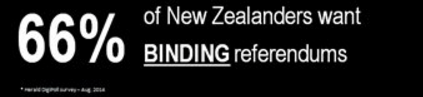
The major drawback of citizen initiated referendums is any bunch of people can put them up much to the annoyance of those who will be a victim of the law to be passed.

Just as rotation of power is inherent to Parliamentary democracy, the ability of the crazies to the either the left or the right of you to initiate their own binding citizen initiated referendums. The first referendum is likely to be on one of the following:
- decriminalising marijuana,
- banning smoking,
- voluntary euthanasia,
- a living wage,
- life means life in prison,
- same-sex marriages,
- marriage is between a man and a woman,
- entrenching the Treaty of Waitangi,
- abolishing the Maori seats,
- entrenching the Maori seats,
- stop school closures,
- capital punishment; and
- future referendums not be binding.
Binding referenda are unworkable. Parliament can’t amend them later as we learn from the implementation of the law and unintended consequences arise. Every new law is riddled with unintended consequences and blow-backs.
Do you really want to have to have another referendum to undo a binding referendum that turned out to be a bit of a mistake? One of the few redeeming features of the Parliament that is sovereign – a parliament for can make or unmake any law whatsoever – is it can repeal its mistakes quickly.
The first citizens initiated referendum was held on 2 December 1995. The question was
Should the number of professional fire-fighters employed full-time in the New Zealand Fire Service be reduced below the number employed in 1 January 1995?
Turnout was low as the referendum was not held in conjunction with a general election, and the measure was voted down easily, with just over 12% voting “Yes” and almost 88% voting “No”.
The key to constitutional design is not empowering you and yours – it is how to restrain those crazies to the Left or the Right of you, as the case may be, when they get their hands on the levers of power, as they surely will in three, six or nine years’ time.
The one inevitability of democracy is power rotates – unbridled power and binding referenda lose their shine when you must share that power with the opposing side of politics who put up their own referendum question.
Constitutions are brakes, not accelerators. Much of constitutional design is about checks and balances and the division of power to slow the impassioned majority down.
Conspiracy theorists that pretty much sore losers. The last thing they want is a binding referendum on a topic on which they are going to vote no.

The problem of constitutional design was ensuring that government powers would be effectively limited. The constitutions were designed and put in place by the classical liberals to check or constrain the power of the state over individuals.
The motivating force of the classical liberals was never one of making government work better or even of insuring that all interests were more fully represented. Built in conflict and institutional tensions were to act as constraints on the power and the size of government.
Modern democracy is government subject to electoral checks. Citizens do have sufficient knowledge and sophistication to vote out leaders who are performing poorly or contrary to their wishes. Modern democracy is the power to replace governments at periodic elections.
The power of the electorate to turn elected officials out of office at the next election gives elected officials an incentive to adopt policies that do not outrage public opinion and administer the policies with some minimum honesty and competence.
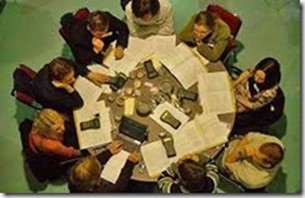
Too many want to remake democracy with the faculty workshop as their model. Such deliberation has demanding requirements for popular participation in the democratic process, including a high level of knowledge and analytical sophistication and an absence, or at least severe curtailment, of self-interested motive. The same goes for citizen initiated binding referendums.
The rotation of power is common in democracies, and the worst rise to the top, so it is wise to design constitutional safeguards to minimise the damage done when those crazies to the right or left of you get their chance in office, as they will.
State power was something that classical liberals feared, and the problem of constitutional design is insuring that such power would be effectively limited. Conspiracy theorists lose all their fear of power by drinking on the heady wine of citizens initiated referendum. Be careful for what you wish for.
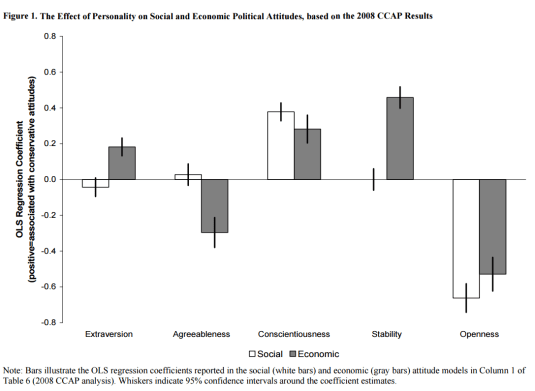
The Effect of Personality on Social and Economic Political Attitudes
04 Mar 2016 Leave a comment
in constitutional political economy, Public Choice
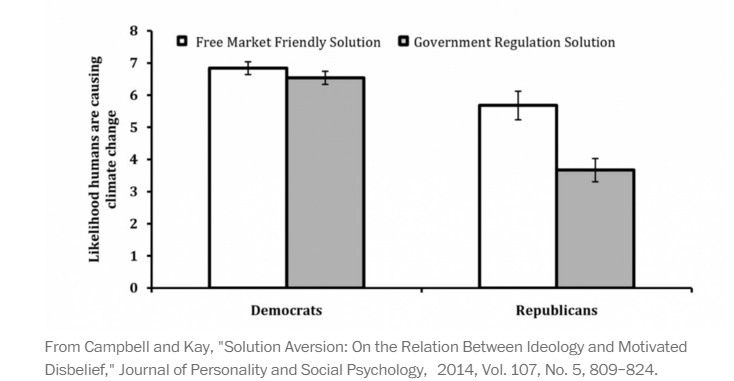
Conscientiousness is associated with conservatism and Openness is associated with liberalism. Emotional Stability is associated with conservative economic attitudes and Agreeableness is associated with liberal economic attitudes.

A fragile state lists from DFID
29 Feb 2016 Leave a comment
in constitutional political economy, development economics, growth disasters, Public Choice, rentseeking Tags: failed states
Note from @paulkrugman to @BernieSanders @JeremyCorbyn and their supporters
23 Feb 2016 Leave a comment
in applied price theory, comparative institutional analysis, constitutional political economy, economic history, economics of media and culture, economics of regulation, labour economics, macroeconomics, Marxist economics, politics - USA Tags: 2016 presidential election, antiforeign bias, antimarket bias, British politics, Leftover Left, make-work bias, rational ignorance, rational irrationality, renegade Left, Twitter left
Scalia on who should decide vexing social issues @PeterDunneMP
15 Feb 2016 Leave a comment
in comparative institutional analysis, constitutional political economy, law and economics, politics - New Zealand, politics - USA Tags: abortion rights, marijuana decriminalisation
Disputed Indian borders
15 Feb 2016 Leave a comment
in constitutional political economy Tags: economics of borders, India


Recent Comments