Gordon Tullock and Collective Preferences and Democracy
08 Nov 2015 Leave a comment
in constitutional political economy, Gordon Tullock, Public Choice Tags: preference aggregation

The demise of the Green Book and the decline of racism in America
04 Nov 2015 1 Comment
in applied price theory, constitutional political economy, discrimination, entrepreneurship, industrial organisation, liberalism, politics - USA, Public Choice, rentseeking
The Green Book was an indispensable survival guide to black Americans traveling in America in the Jim Crow Era if they wish to “sidestep humiliation (or worse) on the journeys”. As Richard Epstein noted when reflecting on the 50th anniversary of the 1964 Civil Rights Bill:
Title II was passed when memories were still fresh of the many indignities that had been inflicted on African American citizens on a routine basis. It took little imagination to understand that something was deeply wrong with a nation in which it was difficult, if not impossible, for African American citizens to secure food, transportation, and lodging when traveling from place to place in large sections of the country. In some instances, no such facilities were available, and in other cases they were only available on limited and unequal terms.
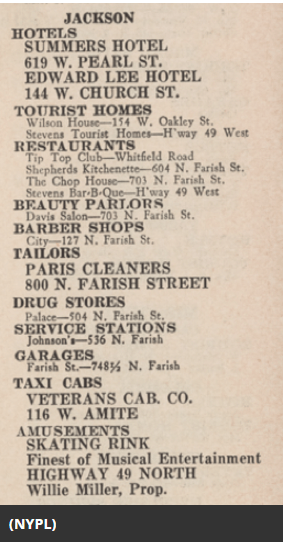
The Green Guide lists the types of businesses by name and address in the southern states that were known to welcome black patrons.
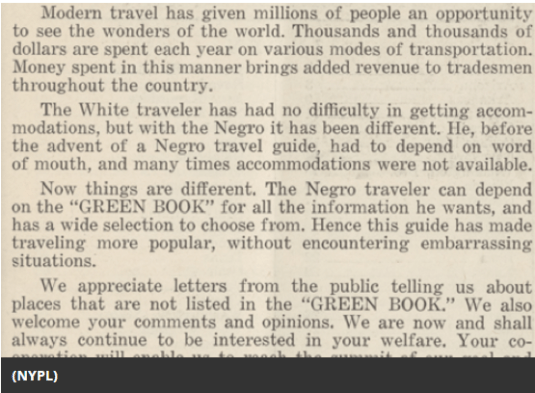
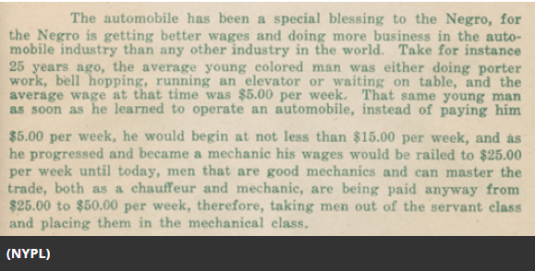
The Green Book spoke in code about how to avoid “embarrassing situations”. This was code for “the violence and discrimination inflicted by bigots”. The diffusion of the car into the black middle class was a godsend to escape racism.
The founding publisher was a US postal worker who with typical entrepreneurial flair initially published the Green Book from his apartment in Virginia starting in the late 1930s. To find businesses that welcomed black patrons, Victor Green tapped into his network of fellow mailmen. His book covered the entire 50 states, parts of Canada and even extended to Europe in later editions.
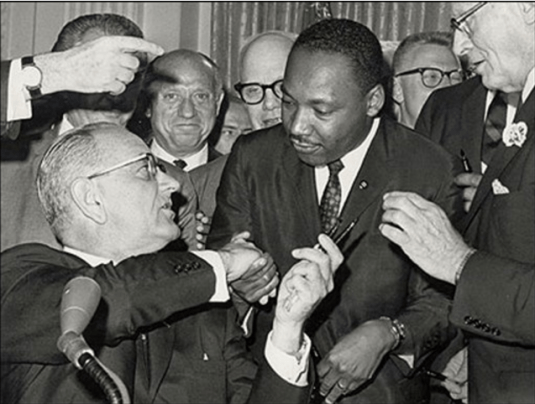
The Green Book stopped publishing a mere two years after the passage of a major civil rights bill in 1964 and the voting rights bill of 1965. These two bills strengthened voter rights and outlawed discrimination by businesses and employers.
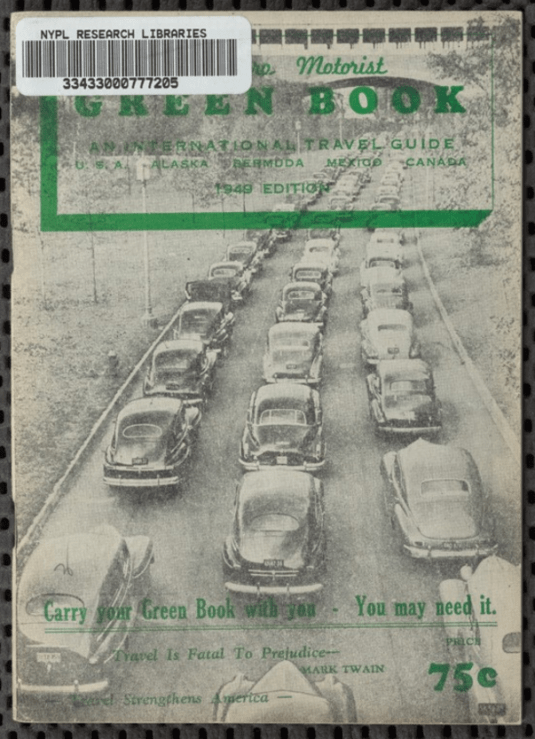
By 1966, just two years after the passage of the civil rights bill, the market collapsed for information on businesses that welcomed black patrons in America. This was because so many businesses now welcome black patronage in every part of the southern states and elsewhere in America that a special booklet no longer had buyers. At the height of its popularity, the Green Book sold 15,000 copies per year.
Yes, there were law reforms but the closing of the Green Book is a sign of surprisingly rapid social change given the dogged resistance of the Democratic Party led southern states to all previous attempts at racial integration.
As an example of this tenacious resistance to civil rights legislation, Texas divided itself into 252 counties and delegated considerable responsibility to them. Local sheriffs in southern states would campaign on slogans such as “the man who can take care of situations that may arise”.
Control of the police and local courts was central to the enforcement of racial segregation in the southern states of America. This was backed up by the monopoly that the Democratic Party had over local and state offices.
To register to vote in Texas, for example, a black voter had to register with the local voter registration board in one of the 252 counties. Assuming you could find a member – they came in late, took long lunches and went home early – they would fail the applicant on the literacy test or some other criteria.
Can you pass a literacy test given to Black voters in the 1960's http://t.co/mtOIr7XE50—
History In Pictures (@historyepics) August 28, 2015
The aggrieved black would be voter would then have to take is local voter registration board all the way to the Supreme Court to overturn that decision. The members of the local voter registration board would refuse to follow the orders of the US District Court orders. The criminal contempt citation would be appealed all the way to the Supreme Court.
Once the criminal contempt citation is upheld by the Supreme Court, the voter registration board resigned so the litigation would have to start all over again against the new board members. This was because the state of Texas could not be named as a co-defendant under the 1957 civil rights law – the first past 100 years by Congress.
Such was the hostile legal environment, the lawlessness, the FBI had an eight part go to strategy in case a local sheriff arrested FBI agents in southern states when they are enforcing civil rights law. Black civil rights leaders in the USA were keen gun owners and owned a lot of them for home defence and they used them.
Plenty of school busing orders by courts were appealed for years and years and were resisted at every turn in both northern and southern states. One or two states closed their entire school systems and threatened to transfer the assets to private hands to prevent racial integration.
James Heckman was one of the first economist to note the rapid social change in the southern states of America over the course of the 60s. Heckman spent two years as a teenager in the late 1950s in racist Southern States of America and returned in 1963 and in 1970. His parents were received a delegation of neighbours upon their arrival to explain Southern ways.
Civil disobedience at its best, 1950s http://t.co/WzszCj1zBf—
Historical Pics (@VeryOldPics) September 20, 2015
There was organised segregation in 1963 when Heckman visited again as a college student. His 1963 visit with a college roommate from Nigeria was monitored by the local sheriff. In Birmingham, they stayed at the black YMCA. The people at the YMCA were frightened to death because Heckman and his Nigerian friend were breaking the local Jim Crow laws. Shops closed in New Orleans to avoid serving them.
In 1970, Heckman re-visited New Orleans as an academic, going back to the same places as in 1963. They were completely integrated, totally changed. This rapid social change fascinated him.
The Civil Rights Act of 1964 broke the control of segregationists over their political and legal institutions. The racial segregation collapsed because it could no longer rely on Jim Crow laws and the private violence and boycotts through the White Citizens Councils which police turned a blind eye too when they were not actively involved.
Unlike the Ku Klux Klan, the White Citizens’ Councils met openly and was seen as “pursuing the agenda of the Klan with the demeanour of the Rotary Club” by “unleashing a wave of economic reprisals against anyone, Black or white, seen as a threat to the status quo”. In Mississippi, the State Sovereignty Commission funded the Citizens’ Councils.
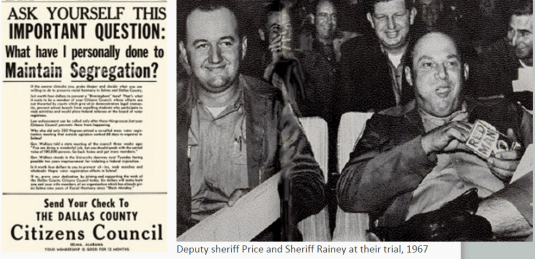
The 1957 and, particular, the 1964 civil rights laws overthrew racial segregation because more Black Americans could vote in the Southern States in state and local elections. Politicians soon courted those votes and there was a political realignment and a social revolution. The lawlessness that back-up most of segregation quickly came to an end because its victims could now vote. Richard Epstein explains:
With Jim Crow in the South this set of insidious practices was not accomplished by explicit laws mandating racial segregation. Rather, those inflexible social and economic patterns were supported by four interlocking strategies. First, illicit control of the electoral franchise, which in turn translated into control of the police and the courts. Second, corrupt use over the infrastructure translated into an ability to deny water and electrical hook-ups to firms that did not toe the segregationist line. Third, private violence to which southern police forces turned a blind eye when they did not actively support it. Fourth, social ostracism to those who spoke up against the system. Sensible people either left, stayed away or remained silent.
LBJ was behind the first civil rights bill of the 20th century. This was the 1957 civil rights bill. LBJ’s astute understanding of public choice processes was central to how he crafted the 1957 bill.
Then Senator Johnson could see that his fellow Southern Democrats would not live with racial integration at the social level. But he knew from his dealings with the Southern Democrats that in their heart of hearts that they could not ultimately deny that people have a right to vote. LBJ knew that if Black Americans in the Southern States could secure the right to vote, all the other rights they sought would soon follow and would be protected by law. He was right.
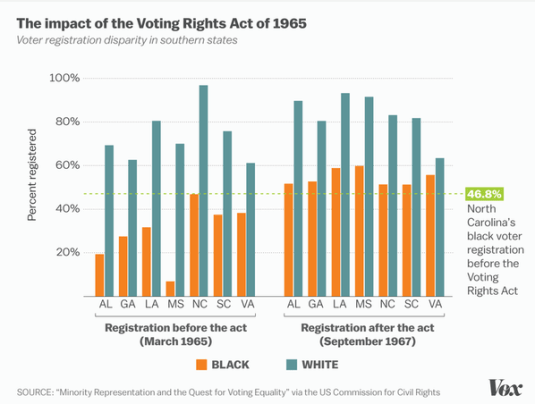
The Voting Right Act had a huge impact on many southern states. For example, black voter registration rates in Mississippi increased from a mere 6.7 percent in 1965 to 59.8 percent in 1967, according to the US Commission for Civil Rights. For a state that’s historically around 40 percent black, this represented a massive shift in politics — a change that much of the predominantly white leadership at the time feared but would have to accept due to the Voting Rights Act.
Timur Kuran in “Sparks and Prairie Fires: A Theory of Unanticipated Political Revolutions,” suggested that political revolutions and large shifts in political and social opinion will catch us by surprise again and again because of people’s readiness to conceal their true political preferences proclivities under perceived social pressure.
Kuran begins with a simple, even mundane point: social pressures can make people say that they want and believe something that they really don’t want or believe… The result of social pressures is to produce what Kuran calls “preference falsification,” a phenomenon that occurs when you make an inaccurate public statement about your actual preferences (or beliefs). Falsified preferences might be described more simply, of course, as lies; but they are a distinctive, and distinctly interesting, kind of lies, with particular social implications… People joined organizations they abhorred, followed orders they considered nonsensical, cheered speakers they despised and ostracized dissidents they greatly admired.
Those ready to oppose racism or who were lukewarm about it, kept their opposition private until a coincidence of factors gave them the courage to bring their views into the open. In switching sides, they encouraged other hidden opponents to switch. Fear changes sides. Genuine supporters of the old older falsify their publically professed preferences, pretending that they support the new order. These are late-switchers. Do not trust them. These opportunists will just as easily switch back.
Plenty of people have had personal experiences of this in the 1980s and the 1990s when there was rapid change in social and political attitudes about racism, sexism and gay rights. A few people had to stand up for what was right and a surprisingly large number quickly joined their side.
Once Blacks in the southern states started voting for the local sheriff and judges and for state-wide officials, the local legal infrastructure helped the market work rather than frustrated it. As Richard Epstein noted when writing a freedom of association but his remarks equally apply to the market process:
The practice of freedom of association cannot survive in a society that has corrupt electoral institutions, corrupt provision of public services, corrupt use of public force, and unrestrained use of private violence. The hard question in these settings is to ask exactly what legal changes should be made. In one sense, the thought that some non-discrimination principle could gain hold through legislation seems laughable. Indeed, it was only because federal legislation could work, with much huffing and puffing, to override state legislation that the local monopoly was broken… The competitive market works well when supported by well-ordered public institutions.
The rapid demise of the Green Book is a testament to the shallowness of racism in America apart from a hard-core full of hatred of whatever comes along. Certainly, the collapse in the market for a specialised information on businesses willing to accept black patch and suggests that many southern businesses opened their doors to black customers once it was physically safe to do so. The Civil Rights Bill of 1964 bought an end to lawlessness in the South principally because black people could now vote. Epstein again:
At its best, and in its original form, the Civil Rights Act of 1964 sought to break the control of the local segregationist forces over their political institutions. First on the list was Title I, which attacked exclusion from voting.
#Africa is turning democratic
01 Nov 2015 Leave a comment
in constitutional political economy, development economics, economic history, growth disasters, growth miracles, liberalism, Public Choice Tags: Africa, capitalism and freedom
Mises on Nazi socialism
31 Oct 2015 Leave a comment
in applied price theory, Austrian economics, comparative institutional analysis, constitutional political economy, defence economics, economics of bureaucracy, economics of regulation, industrial organisation, labour economics, Ludwig von Mises, Public Choice, survivor principle Tags: Nazi Germany
#TBT Ludwig von Mises' 1942 Letter to the Editor in the @nytimes on Nazi socialism. http://t.co/kv7TFekY8J—
Mises Institute (@mises) October 15, 2015
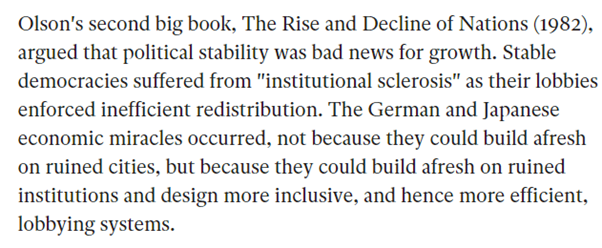
@NaomiAKlein agrees with #MiltonFriedman on Mancur Olson’s theory of how nations escape institutional sclerosis
25 Oct 2015 Leave a comment
in comparative institutional analysis, constitutional political economy, development economics, economic history, economics of bureaucracy, income redistribution, Marxist economics, Milton Friedman, Public Choice, rentseeking, technological progress Tags: expressive voting, interest groups, Leftover Left, logic of collective action, Mancur Olson, Naomi Klein, pressure groups, rational ignorance, rational irrationality, rise and decline of nations, Twitter left

Source: quoted by Naomi Klein in “The Shock Doctrine”.
LA premiere tonight @NaomiAKlein @avilewis @mrdannyglover in person Q&A 7.30pm sundancecinemas.com http://t.co/wRkPFbnUHu—
Changes Everything (@thischanges) October 16, 2015
1. There will be no countries that attain symmetrical organization of all groups with a common interest and thereby attain optimal outcomes through comprehensive bargaining.
2. Stable societies with unchanged boundaries tend to accumulate more collusions and organizations for collective action over time.
3. Members of “small” groups have disproportionate organizational power for collective action, and this disproportion diminishes but does not disappear over time in stable societies.
4. On balance, special-interest organizations and collusions reduce efficiency and aggregate income in the societies in which they operate and make political life more divisive.
5. Encompassing organizations have some incentive to make the society in which they operate more prosperous, and an incentive to redistribute income to their members with as little excess burden as possible, and to cease such redistribution unless the amount redistributed is substantial in relation to the social cost of the redistribution.
6. Distributional coalitions make decisions more slowly than the individuals and firms of which they are comprised, tend to have crowded agendas and bargaining tables, and more often fix prices than quantities.
7. Distributional coalitions slow down a society’s capacity to adopt new technologies and to reallocate resources in response to changing conditions, and thereby to reduce the rate of economic growth.
8. Distributional coalitions, once big enough to succeed, are exclusive, and seek to limit the diversity of incomes and values of their membership.
9. The accumulation of distributional coalitions increases the complexity of regulation, the role of government, and the complexity of understandings, and changes the direction of social evolution.
Source: Obituary: Professor Mancur Olson | Obituaries | News | The Independent
The Economics of Red State vs. Blue State Carbon Politics
25 Oct 2015 Leave a comment
in applied price theory, climate change, constitutional political economy, economics of climate change, economics of media and culture, economics of regulation, energy economics, environmental economics, environmentalism, politics - Australia, politics - New Zealand, politics - USA, Public Choice, transport economics, urban economics
1. My JPAM 2000 paper documents that suburbanites drive more and consume more electricity than urban residents.
2. My 2011 JUE paper documents that center city liberal resident NIMBY zoning regulation has deflected more development to the suburbs where people live a high carbon life (see paper #1 above) and then oppose carbon pricing.
3. My co-authored 2013 JPUBE paper documents that energy intensive manufacturing industries seek out cheap electricity price areas. Whether U.S carbon pricing and the resulting higher electricity prices would nudge them to move oversees remains an open question.
4. My co-authored 2012 EER paper documents that more educated people are more likely to have installed solar panels and to go off the grid and thus not pay higher electricity prices.
5. My 2013 EI paper documents that Congress Representatives oppose carbon mitigation regulation when they are conservative, their district is poorer and their district is high carbon. Nancy Pelosi and Tom Steyer are in liberal, rich, low carbon San Francisco. There, it is easy to comply with carbon regulation. They will pay few new costs for such low carbon regulation.
6. My co-authored 2015 JAERE paper documents that even in California and within counties that suburbanites vote against low carbon regulation relative to center city residents. Since we control for the fact that liberals live in center cities, this 3rd variable does not explain the urban form/voting correlation.
7. In my co-authored 2015 JUE paper we document that U.S protectionism through the Buy America Act has hindered the improvement of our bus fleet as a green technology.
Source: Environmental and Urban Economics: The Economics of Red State vs. Blue State Carbon Politics
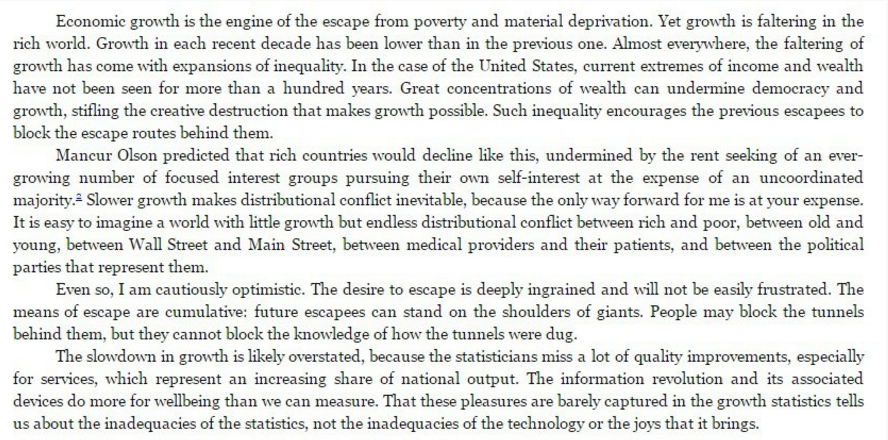
Angus Deaton on slow growth as a force for distributional conflict
25 Oct 2015 Leave a comment
in applied welfare economics, comparative institutional analysis, constitutional political economy, development economics, growth disasters, growth miracles, income redistribution, liberalism, Public Choice, rentseeking Tags: Angus Deaton, The Great Enrichment, The Great Escape, The Great Fact
@SeumasMilne could @jeremycorbyn win?
23 Oct 2015 Leave a comment
in constitutional political economy, Joseph Schumpeter, Public Choice Tags: British Labour Party, British politics, expressive voting, Leftover Left, rational ignorance, rational irrationality, Twitter left, voter demographics
Catch-Up Service: the popularity and unpopularity of Jeremy Corbyn's policies @IndyVoices independent.co.uk/voices/comment… http://t.co/9c9gmHzKFg—
John Rentoul (@JohnRentoul) October 16, 2015
While standard British Labour Party populist policies resonate with the electorate, all the policies that Jeremy Corbyn brings as a socialist, peacenik and renegade Liberal are deeply unpopular and will be used against him as wedge issues by the Tories.
The popularity of individual policies in the Labour Party manifesto didn’t do them any good at the 2015 general election.
Public don't think Corbyn will succeed – y-g.co/1MspFMb http://t.co/4jjHbfsktC—
(@YouGov) September 17, 2015
What matters to the voters at the last British general election was that brand Labour was down on the nose. It was not a credible alternative government.
Peter Kellner: Measuring the gap between Corbyn’s supporters and Labour’s target voters – y-g.co/1izSpph http://t.co/f1NaNL4xgt—
(@YouGov) September 25, 2015
Jeremy Corbyn makes that gap into a chasm because of the vast difference between what his supporters on the left of the Labour Party want and what the voters who must be persuaded to switch their vote for Labour to win in 2020 want as government policies.
Jeremy Corbyn 'twice as left-wing' as Ed Miliband – y-g.co/1LLWUsG http://t.co/no9euWcM2X—
(@YouGov) September 29, 2015
Jeremy Corbyn is much further to the left than Ed Miliband, who lost the election in 2015 rather badly because he was too far to the left for the taste of the British electorate.
Fascinating. Yawning chasm between why Labour members think they lost and why voters think they did. From @thetimes http://t.co/MvhZYI2CTr—
Joe Watts (@JoeWatts_) July 23, 2015
Ed Miliband was rejected in the 2015 British election because he was not a fiscal conservative nor a credible economic manager. The anti-austerity message loses votes.
The heaviest suicide note in history http://t.co/1xDQlnnWU7—
Phil Rodgers (@PhilRodgers) May 03, 2015
There is a yawning chasm between the reasons why the left of the Labour Party thinks their party lost the 2015 British general election and why Labour voters thought they lost the election.
Peter Mandelson in the New York Times on why Labour lost: nytimes.com/2015/05/20/opi… http://t.co/pzbIXOmwpX—
Alex Wickham (@WikiGuido) May 19, 2015
The anti-austerity message was one of the reasons why Labour lost in the eyes of its own voters and would-be voters in the centre of politics
Peter Kellner on Jeremy Corbyn as Britain’s least popular new opposition leader – y-g.co/1LdnNoP http://t.co/Ygyo8gV1uZ—
(@YouGov) October 05, 2015
The deep unpopularity of Jeremy Corbyn cannot be understated as a barrier to British Labour winning the next election.
That deep unpopularity of Jeremy Corbyn sacrifices the one winning advantage that British Labour has under Jeremy Corbyn. That advantage is governments tend to lose elections rather than oppositions win them.
Schumpeter disputed the widely held view that democracy was a process by which the electorate identified the common good, and a particular party was then elected by the voters because it was the most suited to carrying out this agreed common good:
- The people’s ignorance and superficiality meant that they were manipulated by politicians who set the agenda.
- Although periodic votes legitimise governments and keep them accountable, their policy programmes are very much seen as their own and not that of the people, and the participatory role for individuals is limited.
Schumpeter’s theory of democratic participation is voters have the ability to replace political leaders through periodic elections.
Citizens do have sufficient knowledge and sophistication to vote out leaders who are performing poorly or contrary to their wishes. The power of the electorate to turn elected officials out of office at the next election gives elected officials an incentive to adopt policies that do not outrage public opinion and administer the policies with some minimum honesty and competence.
Denis Healey's speech to Labour conference after 1959 defeat. http://t.co/BTdbfJj147—
Stephen Bush (@stephenkb) October 03, 2015
Power rotates in the Schumpeterian sense. Governments were voted out when they disappointed voters with the replacement not necessarily having very different policies.
Here is the Commons motion slamming Corbyn as a threat when the IRA bomber row broke in 1987: sunnation.co.uk/jeremy-corbyn-… http://t.co/KiOEUkqi9a—
Harry Cole (@MrHarryCole) September 19, 2015
The challenge for British Labour is Corbyn cannot win unless he projects minimal competence and stops having policies on defence, foreign affairs and terrorism that outrage public opinion.
Jeremy Corbyn has plenty of outrageous opinions and is yet to show even the most basic competence in running the office of opposition leader, working 24/7 as opposition leader, and showing some ability to win support from members of the Parliamentary Labour Party. If Jeremy Corbyn cannot win votes of his own MPs, what chance do he have with the British people whose interests he claims to champion.

@EricCrampton @KhyaatiA should New Zealand divide into Cantons?
22 Oct 2015 Leave a comment
in comparative institutional analysis, constitutional political economy, economics of bureaucracy, politics - New Zealand, Public Choice Tags: economics of federalism, Switzerland
Suggestions by the New Zealand Initiative for regions to be able to ask to be exempt from some national policies was against a background that New Zealand is too small to be a federal state. The New Zealand provinces were abolished in 1876. Switzerland seems to still put bread in the shops despite having many tiny Cantons and half-Cantons.
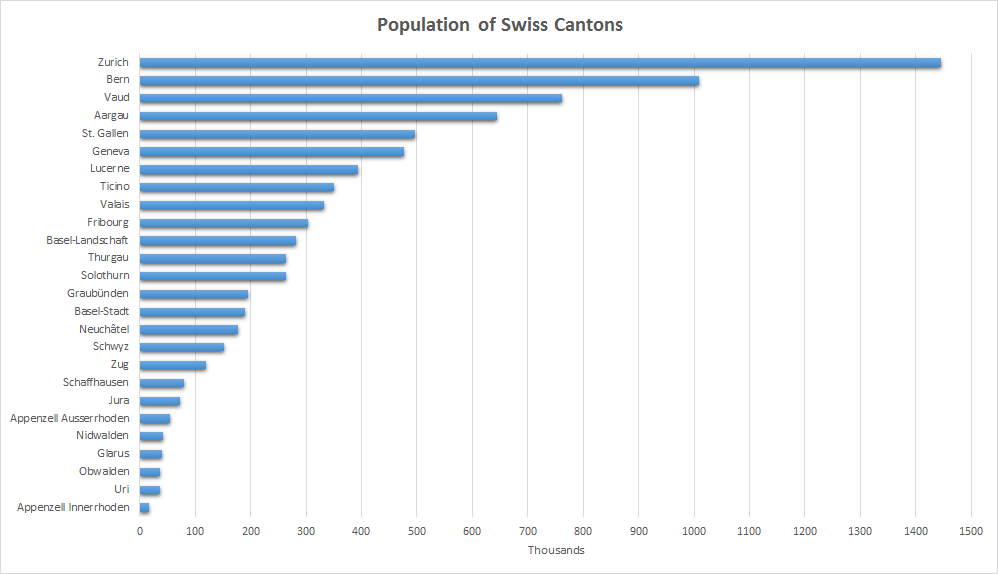
Source: Swiss Statistics – Cantons, communes.
So many American states have smaller populations are New Zealand, half in all, that is difficult to present them on a chart. All managed to be richer the New Zealand despite the horrors of federalism or because of it. These small state populations are before considering how much local government legislative power there is, including taxing and spending powers, city income taxes and city sales taxes, and county and local police forces.
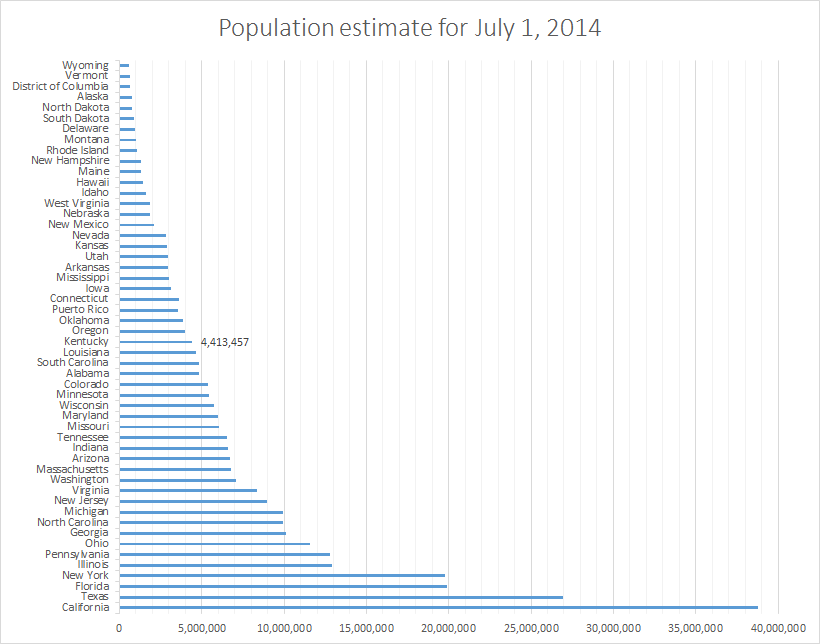
Source: List of U.S. states and territories by population – Wikipedia, the free encyclopedia.
The median national population size of countries is not much more than New Zealand’s current population.
- Controlling for location, Easterly and Kraay (2002) found that smaller states were richer than other states in per capita real GDP.
- Rose (2006) reviewed the impact of size on the level of income, inflation, material well-being, health, education, and the quality of a country’s institutions and found that small countries are more open to trade than large countries, but are not systematically different otherwise.
As I argued in my previous post on distance, New Zealand were prosperous from the time of European settlement despite a small population and their great distance from the main markets of the world on each side of the Atlantic.
Half the world's population lives inside this circle. http://t.co/XlTeEsTZkn—
Weird Science (@weird_sci) October 17, 2015
Of the ten richest countries in terms of GDP per capita, only four have populations above one million people (Alesina 2003). These countries are the USA (290 million people), Switzerland (7 million people), Norway (4 million people) and Singapore (3 million people). Of these four nations, two are below the global national population median of six million (Alesina 2003).
@Maori_Party The greatest advantage of being colonised by the British
20 Oct 2015 Leave a comment
in constitutional political economy, Public Choice Tags: age of empires, British empire, British justice

HT: David Friedman.
@GreenpeaceNZ @jamespeshaw The Futility and Farce of Global Climate Negotiations @RichardTol
18 Oct 2015 Leave a comment
in constitutional political economy, development economics, economics of bureaucracy, environmental economics, environmentalism, global warming, growth disasters, growth miracles, international economics, politics - Australia, politics - New Zealand, politics - USA, Public Choice, rentseeking Tags: bootleggers and baptists, climate alarmism, expressive voting, free-riders, global warming, green tariffs, international public goods, Leftover Left, New Zealand Greens, Twitter left
It is time for the environmental movement to face up to the fact that there never will be an international treaty to restrain carbon emissions. The practical way to respond to global warming is healthier is wealthier, richer is safer. Faster economic growth creates more resources for resilience and adaptation to a changing environment.
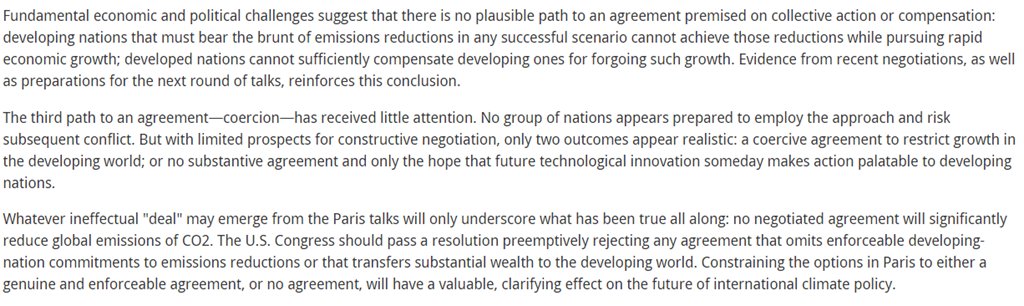
NEW REPORT: The Futility and Farce of Global Climate Negotiations bit.ly/1LvFFv3 http://t.co/TwbFUwaPlm—
Manhattan Institute (@ManhattanInst) October 17, 2015
India's target compared to its recent history http://t.co/pIvwhoSTpL—
Richard Tol (@RichardTol) October 02, 2015

@NiceMangos How renegade liberals promote intolerance against Islam
16 Oct 2015 1 Comment
in constitutional political economy, liberalism
How ‘Regressive Progressives’ and ‘Illiberal liberals’ promote intolerance Towards Muslims http://t.co/2EblbHyumR—
Eiynah — (@NiceMangos) October 09, 2015
Is Liberal (Canadian) Media Silencing non-orthodox/ex-Muslim voices? nicemangos.blogspot.ca/2015/10/is-lib… #cdnpoli #elxn42 #niqab http://t.co/G5cUjIu2Sb—
Eiynah — (@NiceMangos) October 15, 2015
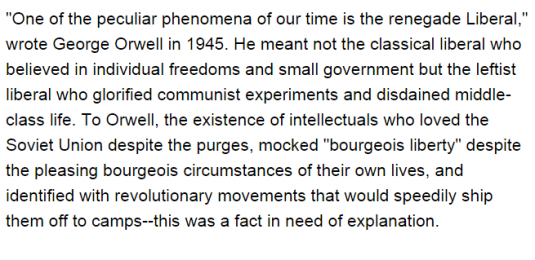
Source: Deconstructing Chomsky – Reason.com.
HT: Lorenzo Michael Warby.
 Utopia, you are standing in it!
Recent Comments