
The economics of federalism: states as decentralized competitors and political markets
08 Dec 2014 Leave a comment

Modern democracy: the power to replace governments at periodic elections
07 Dec 2014 Leave a comment
in constitutional political economy, Public Choice Tags: checks and balances, constitutional political economy, public choice, retrospective voting
Citizens do have sufficient knowledge and sophistication to vote out leaders who are performing poorly or contrary to their wishes. Modern democracy is government subject to electoral checks.
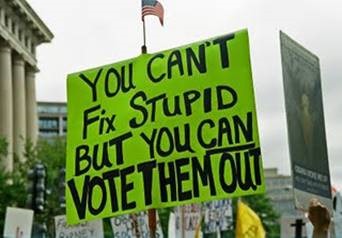
The power of the electorate to turn elected officials out of office at the next election gives elected officials an incentive to adopt policies that do not outrage public opinion and administer the policies with some minimum honesty and competence.
A representative democracy enables the adult population, at very little cost in time, money or distraction from private pursuits commercial or otherwise:
- to punish at least the flagrant mistakes and misfeasance of officialdom,
-
to assure an orderly succession of at least minimally competent officials,
-
to generate feedback to the officials concerning the consequences of their policies,
-
to prevent officials from (or punish them for) entirely ignoring the interests of the governed, and
-
to prevent serious misalignments between government action and public opinion.
Enough of politics and elections, I have a life to lead, don’t you? Too many want to remake democracy with the faculty workshop as their model.

Such deliberation has demanding requirements for popular participation in the democratic process, including a high level of knowledge and analytical sophistication and an absence, or at least severe curtailment, of self-interested motives.


More on More Efficient Tax Systems Leading to Bigger Government
02 Dec 2014 Leave a comment
in comparative institutional analysis, constitutional political economy, liberalism, Public Choice Tags: Casey Mulligan, Gary Becker, growth in government, public choice
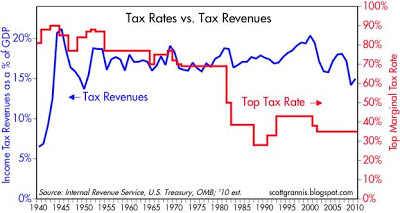
…in Deadweight Costs and the Size of Government (NBER Working Paper Number No. 6789) , [Gary Becker and Casey Mulligan] conclude that flatter and broader taxes also tend to encourage bigger government because taxpayers offer less resistance to increases in flat tax rates than in rates of more onerous and less efficient forms of taxation.
Any decline in the resistance of taxpayers leads to larger government budgets since an endless number of groups agitate for greater government support.
Flat tax rates, such as the VAT and Social Security taxes on earnings, usually start at very low levels but invariably increase over time.
The VAT is now 20 percent and higher in some countries. And payroll taxes began at a modest 2 percent in the 1930s in the United States, but have been increased 21 times to the present 15 percent combined rate on employees and employers.
Constitutions are brakes, not accelerators
30 Nov 2014 Leave a comment
in constitutional political economy, Gordon Tullock, James Buchanan, liberalism, Public Choice Tags: checks and balances, constitutional political economy, economics of constitutions, public choice
Much of constitutional design is about checks and balances. This division of power slows the impassioned majority down.
Constitutional constraints are basically messages from the past to the present that you must think really hard, and go through extra hurdles before you do certain things.
The 18th and 19th century classical liberals were highly sceptical about the capability and willingness of politics and politicians to further the interests of the ordinary citizen, and were of the view that the political direction of resource allocation retards rather than facilitates economic progress.
Governments were considered to be institutions to be protected from but made necessary by the elementary fact that all persons are not angels. Constitutions were to constrain collective authority.
The problem of constitutional design was ensuring that government powers would be effectively limited. The constitutions were designed and put in place by the classical liberals to check or constrain the power of the state over individuals.
The motivating force of the classical liberals was never one of making government work better or even of insuring that all interests were more fully represented. Built in conflict and institutional tensions were to act as constraints on the power and the size of government.

Representative democracy is a division of labour in the face of information overload
27 Nov 2014 Leave a comment
in constitutional political economy, Public Choice Tags: constitutional law, constitutional political economy, public choice
John Stuart Mill had sympathy for the that parliaments are best suited to be places of public debate on the various opinions held by the population and to act as watchdogs of the professionals who create and administer laws and policy:
Their part is to indicate wants, to be an organ for popular demands, and a place of adverse discussion for all opinions relating to public matters, both great and small; and, along with this, to check by criticism, and eventually by withdrawing their support, those high public officers who really conduct the public business, or who appoint those by whom it is conducted
Representative democracy has the advantage of allowing the community to rely in its decision-making on the contributions of individuals with special qualifications of intelligence or character. Representative democracy makes a more effective use of resources within the citizenry to advance the common good.
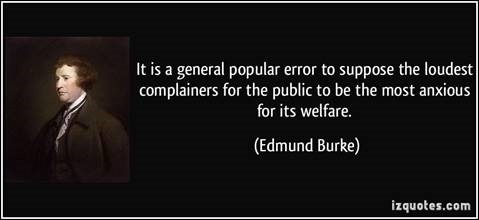
Members of parliament are trustees who follow their own understanding of the best action to pursue in another view. As Edmund Burke wrote:
Parliament is not a congress of ambassadors from different and hostile interests; which interests each must maintain, as an agent and advocate, against other agents and advocates; but parliament is a deliberative assembly of one nation, with one interest, that of the whole; where, not local purposes, not local prejudices ought to guide, but the general good, resulting from the general reason of the whole.
You choose a member indeed; but when you have chosen him, he is not a member of Bristol, but he is a member of parliament. … Our representative owes you, not his industry only, but his judgment; and he betrays instead of serving you if he sacrifices it to your opinion.

More Efficient Tax Systems Lead to Bigger Government
26 Nov 2014 Leave a comment
in comparative institutional analysis, constitutional political economy, politics - USA, Public Choice Tags: Casey Mulligan, Gary Becker, growth in government, public choice

G. Warren Nutter on the continually agitated nature of political discourse | Cafe Hayek
24 Nov 2014 Leave a comment
in constitutional political economy, economics of bureaucracy, liberalism, Public Choice Tags: G. Warren Nutter

It’s not just Ed Miliband. Labour’s on the wrong side of history » The Spectator
21 Nov 2014 Leave a comment
in applied price theory, applied welfare economics, comparative institutional analysis, constitutional political economy, election campaigns, liberalism, macroeconomics, Marxist economics, political change, politics - Australia, politics - New Zealand, politics - USA, public economics, technological progress Tags: free trade, globalisation, market augmenting governments

Politicians can’t be heroes any more. Instead, they have to operate within the tightly drawn tramlines of the global economy.
This is true for those on the left and the right, but the pressure that this places on countries to adopt a low-tax, light-regulation regime is something with which the right is far more comfortable.
via It’s not just Ed Miliband. Labour’s on the wrong side of history » The Spectator.


 Utopia, you are standing in it!
Recent Comments