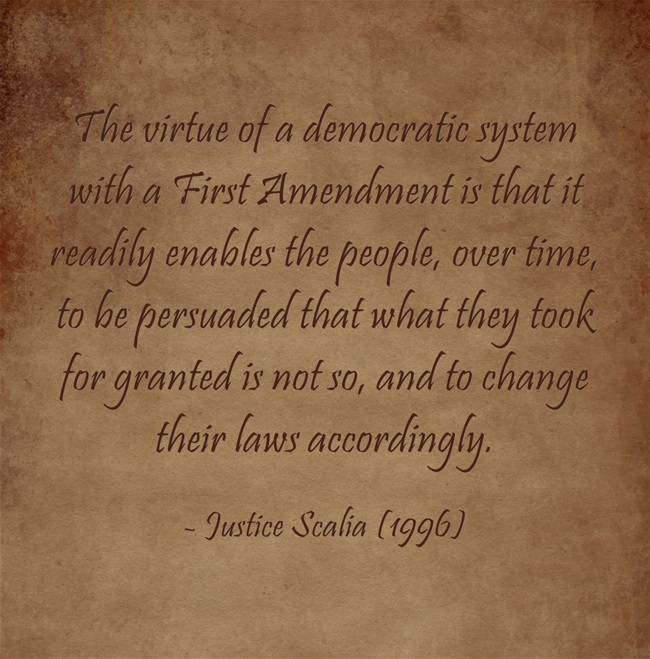
In a democracy we resolve our differences by trying to persuade each other and elections
17 Jul 2014 Leave a comment


Justice Antonin Scalia on the popular will and the role of the courts
29 Jun 2014 Leave a comment
in constitutional political economy, law and economics Tags: Antonin Scalia, constitutional law

Who do members of parliament represent?
28 Jun 2014 Leave a comment
in constitutional political economy, Federalism, James Buchanan, Joseph Schumpeter, Public Choice Tags: consititutional design, Edmund Burke, federalism, James Madison, Jospeh Schumpeter, JS Mill, theories of representation

The theoretical literature on political representation focused on whether representatives should act as delegates or as trustees. James Madison articulated a delegate conception of representation. Representatives who are delegates simply follow the expressed preferences of their constituents.
The classical liberals of the 18th century were highly sceptical about the capability and willingness of politics and politicians to further the interests of the ordinary citizen, and thought the political direction of resource allocation retards rather than facilitates economic progress.
Governments were considered to be institutions to be protected from but made necessary by the elementary fact that all persons are not angels. Constitutions were a means to constrain collective authority. The problem of constitutional design was ensuring that government powers would be effectively limited.
- Sovereignty was split among several levels of collective authority; federalism was designed to allow for a deconcentration or decentralization of coercive state power.
- At each level of authority, separate branches of government were deliberately placed in continued tension, one with another.
- The dominant legislative branch was further restricted by the constitutional establishment of two houses bodies, each of which was elected on a separate principle of representation.
These constitutions were designed and put in place by the classical liberals to check or constrain the power of the state over individuals. The motivating force was never one of making government work better or even of insuring that all interests were more fully represented.
Members of parliament as trustees are representatives who follow their own understanding of the best action to pursue in another view. As Edmund Burke wrote:
Parliament is not a congress of ambassadors from different and hostile interests; which interests each must maintain, as an agent and advocate, against other agents and advocates; but parliament is a deliberative assembly of one nation, with one interest, that of the whole; where, not local purposes, not local prejudices ought to guide, but the general good, resulting from the general reason of the whole.
You choose a member indeed; but when you have chosen him, he is not a member of Bristol, but he is a member of parliament. …
Our representative owes you, not his industry only, but his judgment; and he betrays instead of serving you if he sacrifices it to your opinion.
Burke does not seem to be a fan of federalism and vote trading to protect minorities. Madison liked conflict and tension as a constraint of power and the size of government.
Schumpeter disputed that democracy was a process by which the electorate identified the common good, and that politicians carried this out:
• The people’s ignorance and superficiality meant that they were manipulated by politicians who set the agenda.
• Democracy is the mechanism for competition between leaders.
• Although periodic votes legitimise governments and keep them accountable, the policy program is very much seen as their own and not that of the people, and the participatory role for individuals is usually severely limited.
Modern democracy is government subject to electoral checks. John Stuart Mill had sympathy for this view that parliaments are best suited to be places of public debate on the various opinions held by the population and to act as watchdogs of the professionals who create and administer laws and policy:
Their part is to indicate wants, to be an organ for popular demands, and a place of adverse discussion for all opinions relating to public matters, both great and small; and, along with this, to check by criticism, and eventually by withdrawing their support, those high public officers who really conduct the public business, or who appoint those by whom it is conducted
Representative democracy has the advantage of allowing the community to rely in its decision-making on the contributions of individuals with special qualifications of intelligence or character. Representative democracy makes a more effective use of resources within the citizenry to advance the common good.
Jon Elster on the dangers of majority rule
28 Jun 2014 Leave a comment
in constitutional political economy Tags: democracy, majoritarianism

Firstly, majority government will always be tempted to manipulate political rights to increase its chances of re-election. If it is free to change the timing of the election, for instance, it may choose a moment when economic conjunctures are favourable.
Secondly, a majority may set aside the rule of law under the sway of a standing interest or a momentary passion. This was Madison’s main worry:
In all cases where a majority are united by a common interest or passion, the rights of the minority are in danger.
Thirdly, here is the case of a popular majority acting (through its representatives) to further its economic interests.
Fourthly, there is the case of a popular majority acting (through its representatives) under a sudden impulse, a momentary passion. There are references by American founders such as Randolph to "the turbulence and follies of " and "the fury of democracy," by Hamilton to "the popular passions [which] spread like wild fire, and become irresistable," and by Madison to "fickleness and passion," and "the turbulency and violence of unruly passion."
Fifthly, there is the case of a popular majority acting (through its representatives) from a standing, permanent passion. This is different from a majority passion that is "sudden," "fickle," "unruly," and the like. The more permanent passions and prejudices that might fashion the will of the majority is in the late twentieth century the outstanding danger of majority rule. But this can be majoritarianism based on religious, ethnic and racial divides that lead to a permanent majority and a permanent minority.
There are four counter-majoritarian, rights-protecting devices: constitutional entrenchment of rights, judicial review, separation of powers and checks and balances.

Same players, different game: how better rules make better politics
25 Jun 2014 Leave a comment
in comparative institutional analysis, constitutional political economy Tags: James Buchanan

Coase and Demsetz on comparative institutional analysis and the fallacy of comparing actual institutions with unrealistic, idealised alternatives
23 Jun 2014 Leave a comment
in comparative institutional analysis, constitutional political economy, Ronald Coase, Ronald Coase Tags: Harold Demsetz, Roanald Coase
 |
 |
It is my belief that the failure of economists to reach correct conclusions about the treatment of harmful effects cannot be ascribed simply to a few slips in analysis. It stems from basic defects in the current approach to problems of welfare economics
Ronal Coase (1960)
The view that now pervades much public policy economics implicitly presents the relevant choice as between an ideal norm and an existing ‘imperfect’ institutional arrangement.
This nirvana approach differs considerably from a comparative institution approach in which the relevant choice is between alternative real institutional arrangements…
the design of institutional arrangements that provide incentives to encourage experimentation (including the development of new products, new knowledge, new reputations, and new ways of organizing activities) without overly insulating these experiments from the ultimate test
of survivalHarold Demsetz (1969)
Neoclassical economists think the economy is freestanding and ignore institutions!
22 Jun 2014 Leave a comment
in Adam Smith, comparative institutional analysis, constitutional political economy, James Buchanan, Ronald Coase Tags: Adam Smith, Douglass North, Elinor Ostrom, James Buchanan, Robert Fogel, The institutional structure of production
The Sveriges Riksbank Prize in Economic Sciences in Memory of Alfred Nobel 1991 was awarded to Ronald H. Coase:
for his discovery and clarification of the significance of transaction costs and property rights for the institutional structure and functioning of the economy
The Royal Swedish Academy of Sciences has decided to award The Sveriges Riksbank Prize in Economic Sciences in Memory of Alfred Nobel for 2009 to
Elinor Ostrom “for her analysis of economic governance, especially the commons” and Oliver E. Williamson “for his analysis of economic governance, especially the boundaries of the firm”
The Royal Swedish Academy of Sciences has decided to award the Bank of Sweden Prize in Economic Sciences in Memory of Alfred Nobel for 1993 jointly to Robert W. Fogel and Douglass C. North
for having renewed research in economic history by applying economic theory and quantitative methods in order to explain economic and institutional change.
The Royal Swedish Academy of Sciences has decided to award the1986 Alfred Nobel Memorial Prize in Economic Sciences to Professor James McGill Buchanan for
his development of the contractual and constitutional bases for the theory of economic and political decision-making.

Machiavelli, Mises, Milton Friedman, W.H. Hutt and Walsingham’s Manual on practical public policy advising
21 Jun 2014 1 Comment
in constitutional political economy, James Buchanan, Ludwig von Mises, Milton Friedman, Murray Rothbard, Public Choice Tags: Machiavelli, W.H. Hutt, Walsingham's Manual

Ludwig Von Mises worked as an economic-policy advisor to the Vienna Chamber of Commerce from 1909 to 1934. As Richard Ebeling notes:
What comes out from reading Mises’s policy writings from this period of his European career is that if you had asked him a fiscal, or monetary, or regulatory-policy question in the context of his role as analyst at the Chamber of Commerce, he would not have said, and did not simply say, "laissez-faire" — abolish the central bank, deregulate the economy, and eliminate taxes.
Mises accepted the context of which his policy options must be worked out. Ebeling went on to note that Mises seemed to think in three policy horizons:
- The most optimal institutional and policy arrangements in society for the fostering of the classical-liberal ideal of freedom and prosperity, based on the knowledge that he thought sound economic theory could provide;
- the actual circumstances of the present, but focused on the intermediary goals that would be leading in the direction of that more distant, "optimal" horizon; and
- current situation and the immediate future
In the 1970s, Rothbard criticised Milton Friedman for advocating indexation of prices and wages as a method to reduce some of the negative effects from an on-going inflation. Rothbard regarded this as a sell-out.
Richard Nixon’s responses to Milton Friedman were rather more flattering in terms of his policy purity:
I don’t care what Milton Friedman says, he’s not running for re-election.
In 1922, during the worsening Great Austrian Inflation, Mises proposed indexation of wages and prices. Ebeling explained Mises as follows:
- what was inefficient and unnecessary in the three-tiered Austrian bureaucratic system of federal, provincial, and municipal regulators and taxing authorities;
- what specific reforms should be introduced, how they could be experimented with in smaller regions of Austria; and
- how best to overcome the resistance of those in the bureaucracy fearful of losing their jobs
Milton Friedman was purer than this – always the first best advice:
The role of the economist in discussions of public policy seems to me to be to prescribe what should be done in the light of what can be done, politics aside, and not to predict what is ‘politically feasible’ and then recommend it.
Little wonder that Friedman had little time for those economists who promised more than they could deliver and warned less than they should of the hazards and difficulties that may lie ahead the particular policies that were being considered:
A major problem of our time is that people have come to expect policies to produce results that they are incapable of producing. …
we economists in recent years have done vast harm—to society at large and to our profession in particular—by claiming more than we can deliver.
We have thereby encouraged politicians to make extravagant promises, inculcate unrealistic expectations in the public at large, and promote discontent with reasonably satisfactory results because they fall short of the economists’ promised land.
W.H. Hutt steered the middle course that I favour:
In our judgment, the best you will be able to get away with is programme A along the following lines; but if you could find a convincing way of really explaining the issue to the electorate, our advice would have to be quite different.
We should have to recommend programme B, along the following lines.
James Buchanan emphases political realities in a similar way:
We start from here, from where we are, and not from some idealized world peopled by beings with a different history and with utopian institutions. Some appreciation of the status quo is essential before discussion can begin about prospects for improvement.
Ebeling ends by saying:
Even as that uncompromising and principled proponent of individual liberty and the free market, Mises was called upon in his role as policy analyst and advocate to sometimes devise "second-" and "third-best" policy proposals in an imperfect world dominated by collectivist and interventionist ideas and practices.
for those who have sometimes asked, "Well, but how do you apply Austrian Economics to the ‘real world’ of public policy?" here is the answer by the economist who has been considered the most original, thoroughgoing, and uncompromising member of the Austrian School over the last one hundred years! His policy analyses provide us with warning signs and guideposts to assist us in thinking about and designing better policies for our own time.
In The Prince, Machiavelli said in a chapter on how to choose wise advisors and avoid flatterers.
Therefore a wise prince ought to hold a third course by choosing the wise men in his state, and giving to them only the liberty of speaking the truth to him, and then only of those things of which he inquires, and of none others; but he ought to question them upon everything, and listen to their opinions, and afterwards form his own conclusions.
With these councillors, separately and collectively, he ought to carry himself in such a way that each of them should know that, the more freely he shall speak, the more he shall be preferred; outside of these, he should listen to no one, pursue the thing resolved on, and be steadfast in his resolutions. He who does otherwise is either overthrown by flatterers, or is so often changed by varying opinions that he falls into contempt…
A prince, therefore, ought always to take counsel, but only when he wishes and not when others wish; he ought rather to discourage every one from offering advice unless he asks it; but, however, he ought to be a constant inquirer, and afterwards a patient listener concerning the things of which he inquired; also, on learning that any one, on any consideration, has not told him the truth, he should let his anger be felt.
I think Mises read less of Machiavelli and more of the now 400 year old book written by an French courter called not to A Practical Guide for Ambitious Politicians, or Walsingham’s Manual which Gordon Tullock republished in 1961.
I have a copy of this rare book republished in 1961 which was translated again in 2007 under the title Treatise on the Court. The Early Modern Management Classic on Organizational Behaviour.
For Mises to survive and prosper as a policy advisor as he struggled for position within a small elite group amidst fierce competition, he had to know how organisations worked, how to find the levers of power and press them. That is why is pitched his advice in light of the immediate,medium term or long term policy horizon horizon as set out in the dot points above.
Walsingham’s Manual has a whole chapter on when the courtier should warn of the hazards and difficulties that may lay ahead and when he should humour the prince in his inclinations that mesh well with what Mises did. There is another chapter on how to deal with rival courtiers that made Sir Humphrey proud:
Those who feel compelled to compete with you will not be won over by shows of respect or veneration. You can, however, coax them onto a different path by
- encouraging them to aim for a goal more ambitious than yours,
- helping them achieve this goal,
- offering to help advance their ambitions, and
- playing down your own goal as being too insignificant for them to aspire to.
Imply that you have no choice but to pursue your goal because you aren’t capable of competing (as they are) for anything better. By way of contrast, praise your competitors’ reputation, power, abilities and merit: suggest that they can do far better than you and should set their sights higher.
If ever you come to fear that a competitor may get ahead of you, raise doubts and insecurities in his mind about what he wants to do. Discuss the pros and cons of the matter, but always in a way that reinforces why he should give up and look elsewhere.
Your best and quickest course, though, is to disguise or hide your objective until it’s too late for anyone to compete with you or block you.
Pushing an ambitious plan too openly may repel the very people who would have helped you if you’d been more discreet, making your task more difficult and damaging your chances of success.
Then, if you do prevail, you’ll attract more envy than you would have otherwise, and if you fail, you’ll look that much more foolish. Your safest course is to do as rowers do, turning your back on your objective and showing every sign of having some other destination.
James Buchanan and a non-discriminatory democracy?
17 Jun 2014 Leave a comment
in constitutional political economy, F.A. Hayek, James Buchanan, liberalism Tags: non-discriminatory democracy, rule of law, veil of ignorance
Under Buchanan’s generality norm, governments impose uniform regulation and use flat rate taxes on uniform tax bases to fund an equal-per-head demogrant (or a guaranteed minimum income) to replace all existing government cash transfers. Such a government would account for a large share of GDP. That did not bother him:
It seems to me that far too much of our politics is favourable treatment or unfavourable treatment for particularised groups. If we could somehow introduce into politics the requirement that would be analogous to the rule of law, that is, don’t treat one group differently from another group.
That has a lot of implications. That would not necessarily mean we’d have much smaller politics or government. It would mean there’d be a quite different characteristic of government…
The normative thrust of my current work is to try to push the generalization principle to the maximum extent possible, that is, so you don’t have particularised exemptions. One person gets it, everybody gets it. It cuts in favour of something like a flat tax. It cuts against means testing.
Buchanan has said that all successful welfare states (such as Sweden) apply a generality norm in some form or another.
For Buchanan, the very logic of majority rule implies unequal treatment or discrimination. If left unconstrained, majority coalitions will promote the interests of their own members at the expense of others.
Buchanan proposed a non-discriminatory democracy through the principle of generality:
- If extended to any single industry, tariff or quota protection also be extended and on equal terms to all industries.
- Tax structures would necessarily become simple, since the same tax rate would have to apply across-the-board on all sources or uses of tax base. Flat rate or proportional taxes on all incomes would broadly meet the generality norm.
- On the transfer side of the budget account, payments would have to be made in demogrants, equally available to all persons.
This is equivalent to Rawls’ veil of ignorance: choices must be without knowing where you lie in society so you make choices that are to the benefit of all.
Buchanan argued that if politics generates undesirable results, it is better to examine the rules than to argue about different policies or to elect different representatives. He build on Hayek who called a constitutional amendment that should read:
Congress shall make no law authorizing government to take any discriminatory measures of coercion.
Hayek went on say that, with such an amendment, all of the other rights would be unnecessary. In a non-discriminatory democracy, government choices are limited to those that benefit all.
 Utopia, you are standing in it!
Recent Comments