
Many people readily concede many of our regulations are insane, badly designed, and harmful.
25 Jul 2014 Leave a comment

What do political parties do?
24 Jul 2014 Leave a comment
in constitutional political economy, Public Choice Tags: political parties

The purpose of political parties is to popularise ideas and then present a slate of pre-screened candidates committed to delivering on these ideas, to controlling each other to ensure they stay staunch, and have a defined and published world-view or ideology on what they will do when various contingencies arise. A market for assurances arises through political brand-name capital.
A conviction politician is one who has invested is so much brand-name capital that they know they are finished if they change their views. People vote for them because they know what they will get. When the brand is betrayed, voters punish this unfaithfulness severely – execute one, educate a thousand.
Schumpeter disputed that democracy was a process by which the electorate identified the common good, and that politicians carried this out:
• The people’s ignorance and superficiality meant that they were manipulated by politicians who set the agenda.
• Democracy is the mechanism for competition between leaders.
• Although periodic votes legitimise governments and keep them accountable, the policy program is very much seen as their own and not that of the people, and the participatory role for individuals is usually severely limited.
Modern democracy is government subject to electoral checks. Citizens do have sufficient knowledge and sophistication to vote out leaders who are performing poorly or contrary to their wishes.
The power of the electorate to turn elected officials out of office at the next election gives elected officials an incentive to adopt policies that do not outrage public opinion and administer the policies with some minimum honesty and competence.
Political parties, by investing in brand names and ideologies governments have betrayed their promises make it easier to vote out governments have betrayed their promises
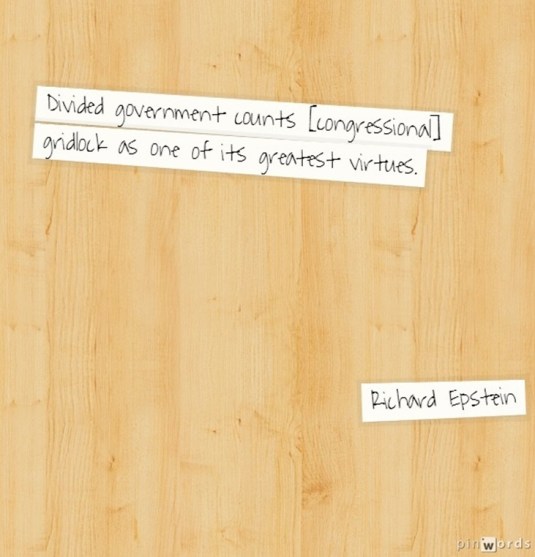
Market Failure, Considered as an Argument both for and Against Government| David Friedman
24 Jul 2014 Leave a comment
in applied price theory, applied welfare economics, comparative institutional analysis, constitutional political economy, David Friedman, liberalism, libertarianism Tags: David Friedman, externality, government failure, market failure


The Hockey Stick of Human Prosperity
22 Jul 2014 Leave a comment
On a timeline of human history, the standard of living resembles a hockey stick – flatlining and then skyrocketing in just the last few centuries.
Specialization and trade explains the astonishing growth of productivity and output in such a short amount of time—after millennia of famine, low life expectancy, and incurable disease




Recent Comments